“Hello” is one of the most common words in the English language, but it isn’t always the best choice. Whether you’re writing a business email, a text to a friend, or the opening line of a novel, the right greeting can set the whole tone. The best synonyms for hello include hi, hey, greetings, howdy, and salutations but which one to use depends on context, tone, and how formal you want to sound.
This article walks through every major alternative, explains the differences, and helps you pick the word that actually fits.
Best Synonyms for Hello
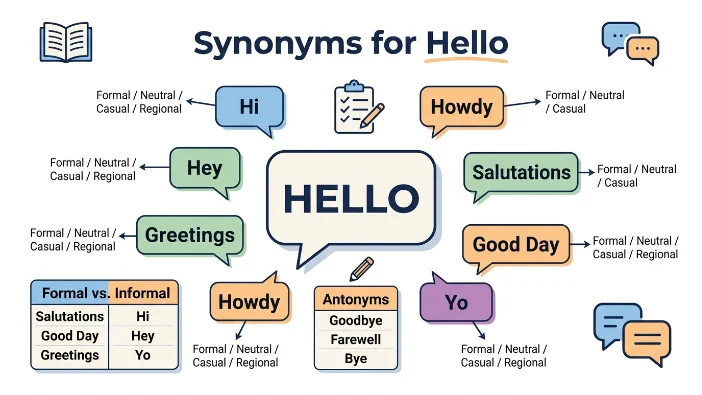
The best synonyms for hello are hi, hey, greetings, howdy, and good day. The right choice depends on tone, context, and intensity. “Hi” works almost everywhere. “Greetings” suits formal writing. “Hey” is casual and friendly. “Howdy” is regional and playful. “Good day” leans traditional and polite.
What Does Hello Mean?
“Hello” is an interjection used to greet someone, start a conversation, or get someone’s attention. It can be spoken face-to-face, written in a message, or used to answer the phone.
- Part of speech: Interjection (sometimes used as a noun or verb informally)
- Common use: Opening a conversation, greeting someone you meet, or signaling that you’re on a call
Example sentences:
- She smiled and said hello to everyone in the room.
- He picked up the phone and said hello before anyone spoke.
“Hello” sits comfortably in the middle of the formality scale more polished than “hey,” less stiff than “good evening.” That neutral quality is exactly why it’s used so widely.
Core Meaning of Hello
At its core, “hello” signals acknowledgment. It tells the other person: I see you, I’m here, and I’m ready to connect. It’s a social bridge word one that opens a door without making any promise about what comes next.
Unlike a word such as “welcome,” which implies you’re the host, or “greetings,” which sounds ceremonial, “hello” is simply neutral contact. That’s its strength and also why writers sometimes look for something with more personality, warmth, or weight.
Grammar and Usage Notes
Part of speech: Interjection primarily. When used as a noun (“a friendly hello”) or a verb (“she helloed him across the parking lot”), it’s informal.
Common patterns:
- Hello, [name]. Standard and natural
- Hello there. Slightly warmer, mildly old-fashioned
- Say hello to [someone]. Meaning: pass on my greeting
- Give them a hello from me. Informal noun use
Collocations: say hello, wave hello, call to say hello, a quick hello, a warm hello
When “hello” sounds natural: in direct conversation, email openings, phone calls, and neutral written greetings
When a synonym works better: When you want a warmer, more casual tone (use hi or hey), a more formal register (use good morning or greetings), or regional color (use howdy or g’day).
Best Synonyms for Hello
| Synonym | Meaning | Tone | Best Use Case | Example Sentence |
|---|---|---|---|---|
| Hi | Friendly, short greeting | Casual to neutral | Everyday speech, emails, texts | Hi, glad you could make it! |
| Hey | Attention-getting greeting | Very casual | Friends, social media, texts | Hey, are you coming tonight? |
| Greetings | Formal acknowledgment | Formal | Business letters, ceremonies | Greetings, and welcome to the conference. |
| Good day | Polite time-based salutation | Formal to neutral | Professional settings, older usage | Good day, Mr. Collins. |
| Howdy | Friendly regional greeting | Informal, regional | Southern US, casual humor | Howdy, stranger long time no see! |
| Salutations | Ceremonial opening greeting | Very formal | Formal letters, dramatic effect | Salutations to all our honored guests. |
| Yo | Attention-grabbing slang | Very casual / slang | Among close friends, youth speech | Yo, did you see that game last night? |
| What’s up | Casual check-in greeting | Very casual | Friends, informal texting | What’s up? Haven’t heard from you in ages. |
| Good morning / evening | Time-specific greeting | Neutral to formal | Professional and personal | Good morning, everyone let’s get started. |
| Hiya | Playful, warm greeting | Casual, friendly | Friends, children, social posts | Hiya! How’ve you been? |
Common Synonyms for Hello
These are the words most people actually use day to day. They’re comfortable, widely understood, and rarely out of place in casual settings.
Hi
Hi is probably the most flexible synonym for hello. It’s shorter, slightly warmer, and fits emails, phone calls, and face-to-face greetings equally well. Unlike “hello,” it almost never sounds stiff.
- Best context: Nearly any informal or semi-formal situation
- Hi, thanks for getting back to me so quickly.
Hey
Hey is casual and direct. It signals familiarity you’d use it with friends, colleagues you know well, or on social media. In written professional communication, it can come across as too relaxed.
- Best context: Friends, texts, internal team messages
- Hey, are you free for a call this afternoon?
Hiya
Hiya is a cheerful blend of “hi” and “ya.” It feels warm and playful without being slangy. Common in British and Irish English, but understood throughout the English-speaking world.
- Best context: Friendly personal messages, light social posts
- Hiya! It’s been forever how are you?
What’s up
Used as a greeting more than an actual question. The expected reply is usually “not much” or “nothing, you?” rather than a real update.
- Best context: Very casual, friends only
- What’s up? You look like you’ve got something to say.
Formal Synonyms for Hello
When the setting calls for polish a business letter, a public speech, or a professional email these alternatives carry the right weight.
Greetings
Works well at the start of a formal email or announcement. It sounds composed and a bit elevated, which fits professional contexts well. Avoid it in casual conversation, where it can sound theatrical.
- Greetings, and thank you for joining us this evening.
Good Morning / Good Afternoon / Good Evening
These time-specific greetings feel both courteous and professional. They work perfectly in business settings, client emails, and formal speeches. The key is accuracy saying “good morning” at 3 p.m. breaks the effect.
- Good afternoon, Dr. Rivera. Your 2 o’clock appointment is ready.
Good Day
Slightly old-fashioned in American English, but still used in formal British English and some professional contexts. It carries a polished, composed tone.
- Good day, and thank you for your patience.
Salutations
This one lands on the formal end. It suits ceremonial announcements, speeches, or formal letters. In everyday writing, it can sound overwrought.
- Salutations to our esteemed colleagues and partners.
Dear [Name]
In written correspondence, “Dear” followed by a name is the standard formal opener. It’s not a spoken greeting, but it functions as the written equivalent of “hello” in professional emails and letters.
- Dear Ms. Thompson, I’m writing to follow up on our discussion.
Informal Synonyms for Hello
Casual greetings do a lot of social work. They signal that you’re relaxed, approachable, and not standing on ceremony.
Yo
Short, punchy, and street-casual. Common in youth culture and among friends. Avoid it in any professional setting.
- Yo, we’re heading to the park you coming?
Howdy
A regional US greeting, especially associated with the South and Southwest. Used humorously or affectionately even outside those regions.
- Howdy, partner ready for the road trip?
Hey there
Slightly warmer than “hey” alone. Feels friendly and a touch more intentional, like you’re genuinely glad to see the person.
- Hey there I was just thinking about you!
What’s good
Slang greeting popular in urban American English. Similar to “what’s up” but slightly more contemporary.
- What’s good? You look well.
G’day
A short form of “good day” that’s closely associated with Australian English. Friendly and easygoing.
- G’day! You here for the market?
Strong Synonyms for Hello
Some greetings carry more energy, enthusiasm, or ceremony than a plain “hello.”
Ahoy
Originally a nautical term used to hail a ship. Used today for humor, pirate references, or playful emphasis.
- Ahoy there! Welcome aboard.
Hail
Carries a dramatic, almost heroic quality. Common in historical fiction and ceremonial contexts. Saying “hail” as a casual greeting would feel very out of place today.
- Hail, travelers you’ve arrived just in time.
Salutations
Already listed under formal, but it also carries weight and ceremony that makes it feel “strong” in its own right.
- Salutations, champions today is your day.
These strong alternatives are best used for effect in writing, humor, or speech not as genuine everyday greetings.
Mild Synonyms for Hello
Mild greetings feel gentle, unobtrusive, and warm without demanding much from the other person.
Hi there
A soft, friendly version of “hi.” It’s welcoming without being pushy, which makes it great for customer service, new acquaintances, or when you want to seem approachable.
- Hi there can I help you find something?
Hello there
Slightly warmer than a plain “hello.” Carries a gentle, curious tone as if you’re pleasantly surprised to see someone.
- Hello there I didn’t expect to run into you today.
Good to see you
Not technically a synonym, but it functions as a mild greeting substitute when you want to add warmth right away.
- Good to see you come on in.
Synonyms for Hello by Context
Everyday Conversation
In daily life, hi, hey, and hey there do the most work. They’re easy, natural, and no one overthinks them.
Professional Writing
Stick to good morning/afternoon, greetings, or dear [name] in business emails. These signal respect and professionalism without being cold.
Academic Writing
Greetings rarely appear in academic prose itself, but in cover letters or academic emails, dear [name] or good morning are appropriate.
Creative Writing
Fiction gives you the most freedom. A character can say howdy, ahoy, yo, hail, or any regional variant depending on their personality, era, and setting. Matching the greeting to the character adds authenticity.
Marketing Copy
Email subject lines and ad copy sometimes open with hi or hey to feel direct and personal. These low-formality openers can increase engagement when the brand voice is friendly.
Personal Communication
Texts and personal messages can go as casual as you like yo, hiya, what’s up, or even just the person’s name followed by an exclamation mark all work fine.
Another Word for Hello in a Sentence
Here are 13 natural example sentences using different synonyms for hello:
- Hi, I just wanted to check in and see how you’re settling in.
- Hey long time! We should catch up properly.
- Greetings, and welcome to the annual industry summit.
- Good morning, Claire your first meeting is at nine.
- Howdy, folks! Great to see so many familiar faces.
- Hiya! You look absolutely brilliant today.
- Yo, did you hear back about the interview?
- Hey there I wasn’t sure you’d make it.
- Good day, and thank you for your continued patience.
- Salutations, distinguished guests the ceremony will begin shortly.
- What’s up? You seem like you have a lot on your mind.
- G’day! You here for the opening session?
- Hello there I believe we met at last year’s event.
Hello Synonyms Compared
Some of these words are easy to confuse or misuse. Here’s a direct comparison of the closest alternatives:
| Word | Formality | Warmth | Best Setting | Key Difference |
|---|---|---|---|---|
| Hello | Neutral | Moderate | Universal | Safe default; neither warm nor cold |
| Hi | Neutral-casual | High | Most settings | Shorter, warmer, more relaxed than hello |
| Hey | Casual | High | Friends, informal | Signals familiarity; can feel too casual at work |
| Greetings | Formal | Low | Ceremonies, letters | Ceremonial; avoid in casual speech |
| Good day | Formal | Moderate | British/formal use | Old-fashioned in American English |
| Howdy | Casual | Very high | Regional, humor | Regional flavor; can feel ironic outside the South |
| Hiya | Casual | Very high | Friends, personal | Playful, British-influenced; very warm |
| Salutations | Very formal | Low | Speeches, letters | Too stiff for everyday use |
The biggest distinction to remember: hi can replace hello in almost any situation. Hey, yo, and what’s up cannot they require a casual context. Greetings and salutations require a formal one.
Words Similar to Hello
These words belong to the world of greetings but don’t always work as direct replacements for “hello.”
Welcome Implies you’re hosting or receiving someone. You wouldn’t say “welcome” when calling someone on the phone, but you would when they walk through your door.
Good to meet you A greeting specific to first-time introductions. Too narrow to replace “hello” in ongoing relationships.
How are you / How do you do These function as greeting phrases but are actually questions. In American English, “how are you” is often a greeting ritual rather than a genuine inquiry.
Namaste A greeting from South Asian cultures, widely adopted in yoga and wellness contexts in English. It carries cultural and spiritual meaning, so using it outside that context can feel out of place.
Shalom / Aloha Words from Hebrew and Hawaiian, respectively, that function as greetings (and farewells) but carry cultural specificity that limits their everyday use in general English writing.
These words are related and interesting, but they don’t slot in as simple swaps for “hello.”
Antonyms of Hello
“Hello” is a greeting so its antonyms are farewells or words that signal departure or dismissal.
| Antonym | Meaning | Example Sentence |
|---|---|---|
| Goodbye | Standard farewell | Goodbye it was great to see you. |
| Farewell | Formal or emotional departure | She waved farewell from the train window. |
| Bye | Casual goodbye | Bye! Text me when you get home. |
| See you | Informal farewell implying you’ll meet again | See you on Thursday! |
| So long | Old-fashioned, slightly wistful goodbye | So long, partner it’s been a ride. |
| Later | Very casual dismissal or farewell | Later! I’ve got to run. |
| Good night | Farewell specific to evening or bedtime | Good night, everyone thanks for coming. |
| Adieu | Formal, French-origin farewell | She bid him adieu at the station. |
How to Choose the Right Synonym for Hello
Match the context. A text to your best friend and an email to a new client are completely different situations. “Hey” works for the first; “good morning” or “dear [name]” works for the second.
Match the tone. Read the room (or the message thread). If the other person uses “hi,” you can mirror that. If they use “greetings,” respond in kind.
Think about your reader. Regional greetings like “howdy” or “g’day” can feel fun or forced depending on who’s reading. If you’re not sure, use a neutral option.
Check whether it’s exact. “Welcome” and “salutations” feel greeting-adjacent but don’t work as direct substitutes in every sentence. Test it: if it sounds odd, go back to “hello” or “hi.”
Keep it natural. The best synonym is the one that doesn’t make the reader pause and think about the word itself. If your greeting draws attention, simplify it.
Common Mistakes When Using Synonyms for Hello
Using “greetings” in casual conversation. It sounds theatrical and odd. Save it for formal emails or announcements.
Using “yo” or “what’s up” in professional emails. These are too informal for any workplace setting unless your company culture is unusually relaxed.
Treating “welcome” as a direct synonym. It only works when you’re the host. “Welcome to my office” is correct; “I welcomed her on the phone” means something different from saying hello.
Using “howdy” without awareness of tone. Outside of the American South or a clearly humorous context, it can read as patronizing or mocking.
Picking a greeting that doesn’t match the relationship. Saying “good day, sir” to a close friend feels cold. Saying “yo” to a new business contact feels unprofessional. The relationship should guide the register.
Using “salutations” to sound smart. It usually backfires and sounds pompous. Use it only when the setting genuinely calls for ceremony.
Forgetting about time-based greetings. “Good morning” at 8 p.m. is just wrong. If you use a time-specific greeting, match it to reality.
Quick Synonym List for Hello
Common synonyms Hi · Hey · Hello there · Hi there · Hiya
Formal synonyms Greetings · Good morning / afternoon / evening · Good day · Dear [Name] · Salutations
Informal synonyms Hey there · Howdy · Yo · What’s up · What’s good · G’day · Hiya
Strong synonyms Ahoy · Hail · Salutations
Mild synonyms Hi there · Hello there · Good to see you
Related words Welcome · How are you · How do you do · Namaste · Aloha
FAQs
What is the best synonym for hello?
Hi is the best all-purpose synonym for hello. It works in nearly any setting casual, professional, written, or spoken and carries a slightly warmer tone than “hello” without being too informal.
What is another word for hello?
Other words for hello include hi, hey, greetings, howdy, hiya, and good day. Each one fits a slightly different context and level of formality.
What is a formal synonym for hello?
The most natural formal synonyms for hello are greetings, good morning, good afternoon, and good evening. In written communication, dear [name] also functions as the formal equivalent of hello.
What is an informal synonym for hello?
Hey, yo, hiya, what’s up, and howdy are all informal alternatives. They work well with friends, in text messages, and in casual written communication but should be avoided in professional or formal settings.
What is a stronger word for hello?
Hail and ahoy carry more dramatic weight than hello. Salutations is also stronger in a formal, ceremonial sense. These are best used in creative writing, humor, or speeches rather than everyday conversation.
What is a milder word for hello?
Hi there and hello there are softer, more gentle versions of a standard greeting. They feel welcoming and unimposing, making them a good choice for customer service or meeting someone new.
What words are similar to hello?
Words similar to hello include welcome, how are you, how do you do, g’day, and aloha. These belong to the same family of greetings but don’t always work as direct substitutes because they carry specific meanings or cultural contexts.
What is the opposite of hello?
The opposite of hello is a farewell. Common antonyms include goodbye, bye, farewell, see you, so long, and later. These words signal the end of a conversation rather than the beginning.
How do I choose the right synonym for hello?
Think about three things: who you’re talking to, the setting, and the tone you want.
- For professional settings, use good morning or greetings.
- For friends, use hi or hey.
- For creative writing, match the greeting to the character’s voice and era.
Conclusion
Hello” is a perfectly good word but it isn’t the only one. Depending on who you’re talking to, what you’re writing, and the tone you want to set, a different greeting might land better.
Hi is warmer and nearly as universal. Greetings gives you formality. Hey gives you ease. Howdy gives you personality. The best synonym for hello is simply the one that fits your moment. Whenever you’re unsure, start with hi it almost never goes wrong.
Read More Related Articles:
- Synonyms for Evolve | Improve Your Writing Skills Fast In 2026
- Synonyms for Fix | Precise Words for Every Situation In 2026
- Synonyms for Decide | Speak with Confidence and Clarity In 2026

Ethan Caldwell is a writer who enjoys exploring the nuances of language and how words shape everyday communication. His work focuses on making complex ideas easier to understand through clear, engaging and accessible writing.