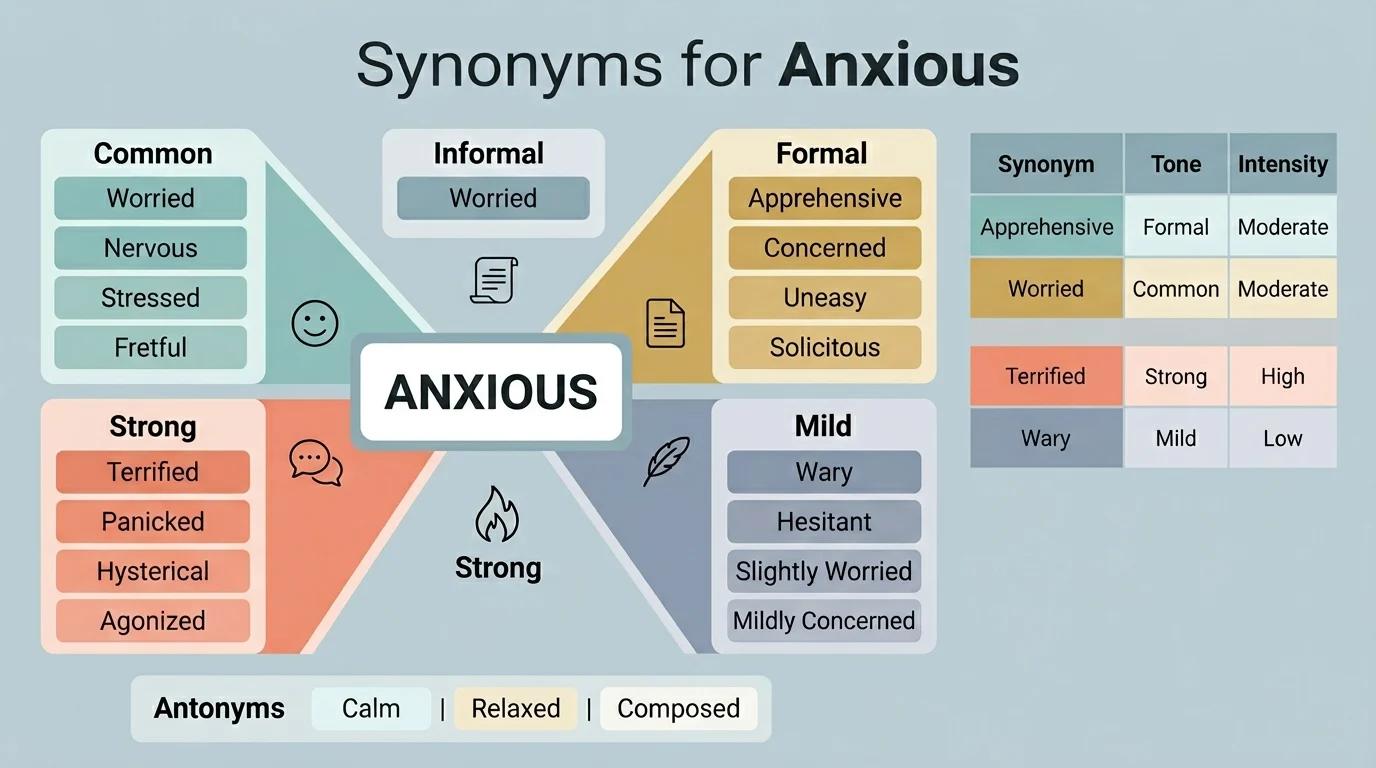
If you’re looking for synonyms for anxious, the most common choices are nervous, worried, apprehensive, uneasy, and on edge. Each of these words shares the core idea of mental tension or fear about something uncertain but they differ in tone, strength, and the situations where they fit best.
The right word depends on what you’re trying to say, how strong the feeling is, and whether you’re writing formally or casually.
Best Synonyms for Anxious
The best synonyms for anxious are worried, nervous, apprehensive, uneasy, and tense. For stronger feelings, try distressed, agitated, or fearful. For milder expressions, concerned or unsettled work well. The right choice depends on tone, context, and intensity.
What Does Anxious Mean?
Anxious is an adjective that describes a state of worry, nervousness, or unease about something uncertain or potentially threatening. It points to mental and emotional discomfort the kind that comes before a job interview, a difficult conversation, or an unknown outcome.
Part of speech:
Adjective Common forms: anxiously (adverb), anxiety (noun)
Anxious is used both for everyday low-level worry and for more intense, persistent fear. It also has a secondary meaning: eagerly wanting something to happen (as in “She was anxious to hear the results”). This eager-anticipation sense is less common but worth knowing.
Example sentences:
- He felt anxious all morning before the presentation.
- The children were anxious to open their gifts.
Core Meaning of Anxious
At its heart, anxious captures a mental state where the mind is focused on a threat, problem, or uncertain outcome. It’s not just mild concern there’s usually an element of physical tension or mental restlessness tied to it. The word sits between low-level worry and full-blown fear, which is exactly why it has so many synonyms across a wide range of intensities.
It’s most often used to describe how a person feels before an event or outcome is known. Once the outcome is clear, the anxiety tends to shift into relief, disappointment, or something else entirely.
Grammar and Usage Notes
Anxious follows standard adjective patterns in English.
Common sentence patterns:
- Subject + be + anxious “She is anxious.”
- Subject + feel + anxious “He felt anxious about the meeting.”
- Anxious + about/over + noun phrase “They were anxious about the results.”
- Anxious + to + verb “He was anxious to leave.”
Common collocations:
- anxious about (something)
- anxious over (a situation)
- feel anxious
- grow anxious
- look anxious
- anxious wait
- anxious moment
- anxious expression
When anxious sounds natural:
When describing someone’s emotional state before an uncertain event, anxious fits cleanly in both formal and everyday writing. It works well in narration, emotional description, and personal communication.
When a synonym may work better:
In highly formal academic writing, apprehensive or distressed may carry more weight. In casual speech, nervous or on edge often sounds more natural. If the worry is mild, concerned avoids overstating the emotion.
Best Synonyms for Anxious
| Synonym | Meaning | Tone | Best Use Case | Example Sentence |
|---|---|---|---|---|
| Worried | Mentally troubled by concern | Neutral | Everyday speech and writing | She looked worried when she saw the message. |
| Nervous | Tense, often with physical symptoms | Casual/neutral | Conversation, personal writing | He was nervous before the interview. |
| Apprehensive | Fearful of what might happen | Slightly formal | Essays, professional writing | The team felt apprehensive about the deadline. |
| Uneasy | Uncomfortable and unsettled | Neutral | Storytelling, emotional description | Something about the silence made her uneasy. |
| Tense | Physically and mentally strained | Neutral | Descriptions of body and mood | The whole room felt tense during the argument. |
| On edge | Irritably alert or nervous | Informal | Casual speech | He’s been on edge all week. |
| Distressed | Deeply troubled or upset | Strong | Serious emotional situations | She was visibly distressed by the news. |
| Agitated | Restless and upset | Strong | Emotional confrontations | The patient grew agitated waiting for answers. |
| Concerned | Mildly worried or troubled | Mild/formal | Professional and polite contexts | The manager was concerned about the delay. |
| Unsettled | Disturbed, lacking calm | Mild/neutral | Personal reflection, narrative | He left the meeting feeling unsettled. |
Common Synonyms for Anxious
These are the words most people reach for in everyday writing and conversation.
Worried
The most common substitute for anxious. It means mentally troubled by something that might go wrong. Use it when you want a natural, relatable word that anyone will understand. Example: She was worried about her son driving in the storm.
Nervous
Suggests tension, often with physical signs like a racing heart or shaky hands. It fits both low-level and moderate anxiety. Example: Liam felt nervous standing in front of the crowd.
Uneasy
Points to a feeling of discomfort without a clear cause. It works well when someone can’t quite name what’s bothering them. Example: There was something about his tone that left her uneasy.
Tense
Describes a state of tight, strained readiness physically and emotionally. Often used when a situation is charged with potential conflict or pressure. Example: The atmosphere in the room was tense.
On edge
A casual phrase meaning keyed up or irritably nervous. It implies that the person might react strongly to even small triggers. Example: She’s been on edge ever since she sent the application.
Formal Synonyms for Anxious
Use these in academic writing, essays, reports, and professional communication where a polished, precise word is needed.
Apprehensive
Suggests anticipatory fear worry about what might happen. It’s measured and specific, making it a strong choice for formal contexts. Best for: Academic essays, professional emails, clinical or psychological writing. Example: Residents were apprehensive about the proposed construction project.
Perturbed
Means mentally disturbed or thrown off balance. It implies that something has disrupted a person’s usual calm. Best for: Formal correspondence, analytical writing. Example: The director seemed perturbed by the unexpected findings.
Disquieted
Means unsettled or made uneasy by something. It’s a formal, somewhat literary word that conveys internal disturbance. Best for: Essays, literary analysis, formal reporting. Example: The unusual silence left the officers disquieted.
Distressed
Carries more weight than most synonyms it suggests real suffering, not just mild worry. Use it when the emotional impact is significant. Best for: Medical, psychological, or emotional reporting. Example: The patient was visibly distressed throughout the consultation.
Informal Synonyms for Anxious
These fit casual conversation, social media, text messages, and friendly writing.
On edge
Already mentioned above it’s very common in spoken English and informal writing. Example: I’ve been on edge since I heard the news.
Freaked out
Means highly anxious or upset, often suddenly. It’s strongly informal. Example: She was totally freaked out about the surprise exam.
Worked up
Means emotionally excited or agitated, often over something that may not warrant it. Slightly dismissive in tone. Example: Don’t get so worked up it’s just a test.
Jittery
Describes nervous, jumpy energy often tied to caffeine or anticipation. Playful and conversational. Example: He’s been jittery all morning thinking about the call.
Keyed up Means tense and ready, often with an undercurrent of excitement or nervousness mixed together. Example: She was totally keyed up before the competition.
Strong Synonyms for Anxious
These synonyms carry more emotional weight. Use them when the feeling is intense, persistent, or disabling.
Agitated
Points to visible restlessness pacing, talking fast, being unable to stay calm. Use when anxiety has become outwardly noticeable. Example: He grew agitated as the wait stretched past an hour.
Distressed
Suggests genuine suffering. Not just nervousness this implies the anxiety has caused real emotional pain. Example: She was deeply distressed after hearing the diagnosis.
Fraught
Means filled with or causing anxiety. Often describes a situation rather than a person (“a fraught silence”). Example: The negotiation was fraught with tension.
Alarmed
Points to sudden, heightened fear a more reactive kind of anxiety triggered by a specific threat or surprise. Example: He was alarmed when no one answered the phone.
Tormented
The strongest on this list suggests ongoing mental suffering, not just a passing worry. Use with care to avoid overstating. Example: She was tormented by thoughts of what might go wrong.
Mild Synonyms for Anxious
Sometimes the feeling is minor just a slight unease or background worry. These words reflect that without overdramatizing.
Concerned
The most neutral and widely acceptable mild substitute. It’s formal enough for professional settings and soft enough for everyday use. Example: The principal was concerned about the drop in attendance.
Unsettled
Suggests something has disrupted a person’s sense of calm without causing full anxiety. Example: The change in schedule left him feeling unsettled.
Bothered
Informal and mild conveys that something is annoying or worrying, but not severely. Example: She seemed a little bothered by the comment.
Uncertain
Focuses more on the cognitive side not knowing what to expect. It captures one reason for anxiety without labeling the feeling itself. Example: He felt uncertain about the direction of the project.
Synonyms for Anxious by Context
Everyday Conversation
In casual speech, reach for nervous, worried, on edge, or jittery. These feel natural and unforced. Avoid heavy formal words like apprehensive in everyday chat they can sound stiff.
Professional Writing
Concerned, apprehensive, and uneasy are all safe choices. They convey worry without sounding dramatic or unprofessional. Distressed works if the situation genuinely warrants it.
Academic Writing
Apprehensive, perturbed, and disquieted fit well here. They’re precise, tone-appropriate, and recognized in formal discourse. Avoid slang like worked up or freaked out.
Creative Writing
This is where you have the most freedom. Fraught, tormented, agitated, on edge, unsettled, and alarmed all create vivid emotional texture. Choose based on the character, the scene, and how much tension you want to build.
Emotional Expression
When describing real personal feelings, worried, nervous, or distressed communicate authenticity. Apprehensive works if you want to be precise about anticipatory fear rather than present-moment panic.
Personal Communication
In texts, personal emails, or journal writing, casual words like nervous, worried, jittery, or even on edge feel honest and human. Match the word to the intensity of what you’re actually feeling.
Another Word for Anxious in a Sentence
Here are example sentences showing different synonyms in real use:
- She felt nervous as the results were announced one by one.
- He was worried that he hadn’t prepared enough for the interview.
- The community remained apprehensive about the new policy changes.
- Something about the empty house made her feel uneasy.
- The players looked tense in the final minutes of the game.
- He’s been completely on edge since the deal fell through.
- She was clearly distressed when she arrived at the hospital.
- The crowd grew agitated as the delays stretched on.
- Management was concerned about the quarterly performance numbers.
- After the argument, he spent the night feeling unsettled.
- The students were jittery waiting outside the exam room.
- She found herself alarmed by how quickly the situation changed.
- He was perturbed by the sudden shift in tone.
- The whole situation left her feeling keyed up and unable to sleep.
- They felt fraught with worry as the hours passed without news.
Anxious Synonyms Compared
Some of these words are close enough that it helps to look at them side by side.
| Word | Intensity | Formality | Key Difference |
|---|---|---|---|
| Anxious | Moderate | Neutral | General emotional tension, broad use |
| Nervous | Moderate | Informal/neutral | Physical tension, often pre-event |
| Worried | Moderate | Neutral | Cognitive focus on a specific problem |
| Apprehensive | Moderate | Formal | Anticipatory fear, measured tone |
| Uneasy | Mild–moderate | Neutral | Vague discomfort, undefined source |
| Concerned | Mild | Formal/neutral | Polite, professional worry |
| Distressed | Strong | Formal | Real suffering, not just nerves |
| Agitated | Strong | Neutral | Visible restlessness, hard to conceal |
| On edge | Moderate | Informal | Ready to react, tightly wound |
| Alarmed | Strong | Neutral | Sudden fear triggered by something specific |
Worried vs. Anxious:
Worried points to specific thoughts circling a problem. Anxious is broader and includes physical tension. You can be worried about one thing; you can feel anxious without knowing exactly why.
Nervous vs. Apprehensive:
Nervous is common and informal, often linked to visible signs like shaking or stumbling. Apprehensive is more thoughtful and formal it’s about dreading a future outcome, not about how your body feels right now.
Concerned vs. Distressed:
Concerned is the mild, polished version. Distressed signals that the worry has crossed into genuine pain or upset. Using distressed for minor worry will sound exaggerated.
Words Similar to Anxious
These words belong to the same emotional neighborhood as anxious but aren’t always exact synonyms. Use them carefully.
Fearful
Related to anxiety but involves more direct fear of a specific threat. It’s not quite the same as general anxious tension. Can replace anxious when: The worry is tied to a clear, specific danger.
Stressed
Often used interchangeably with anxious in everyday speech, but technically stressed refers more to pressure from demands or workload, while anxious is about uncertainty and anticipatory worry. Can replace anxious when: The context is about workload, deadlines, or external pressure.
Paranoid
Related but carries a distinct meaning irrational or exaggerated fear of others’ intentions. It’s stronger and more specific than anxious. Use carefully: Don’t use paranoid casually unless the irrationality is clearly part of what you mean.
Overwhelmed
Describes being overcome by too much to handle. Anxiety is often a part of feeling overwhelmed, but the two aren’t the same. Can work near anxious when: The context is about too much happening at once.
Restless
Shares the inability-to-settle quality of anxiety but focuses more on physical movement and inability to relax, not necessarily on worry. Can work near anxious when: Describing the physical restlessness that comes with nervous energy.
Antonyms of Anxious
| Antonym | Meaning | Example Sentence |
|---|---|---|
| Calm | Peaceful, free of worry | She remained calm throughout the crisis. |
| Relaxed | At ease, without tension | He felt relaxed after the hiking trip. |
| Composed | In control, unruffled | The speaker stayed composed under pressure. |
| Serene | Deeply peaceful and untroubled | The morning was serene and quiet. |
| Confident | Self-assured, free of fear | She walked in confident and ready. |
| Unbothered | Unaffected, not concerned | He seemed unbothered by the criticism. |
| Content | Satisfied and at peace | She was content to let things unfold. |
How to Choose the Right Synonym for Anxious
Match the context.
A boardroom memo and a personal text message call for different words. Concerned fits the memo; nervous fits the text.
Match the tone.
If your writing is warm and casual, on edge or jittery works. If it’s measured and serious, apprehensive or distressed is more fitting.
Check the intensity.
Don’t describe a mild pre-presentation jitter as tormented. Don’t describe genuine emotional suffering as just a bit concerned. Let the word match the actual feeling.
Think about your reader.
If your audience is general or younger, simpler words like worried or nervous land better. Academic readers may expect more precise vocabulary.
Confirm the synonym is exact, not just related.
Stressed and anxious are cousins, not twins. If you’re describing anticipatory worry, stressed may not fully capture it.
Read the sentence aloud.
If the word sounds forced or out of place, it probably is. Natural language flows it doesn’t feel planted.
Prefer clarity over impressiveness.
A well-placed worried beats an unnecessary perturbed every time.
Common Mistakes When Using Synonyms for Anxious
Using distressed for minor worry.
This word signals real emotional pain. Saying “I was distressed about parking” overstates the situation and loses the word’s impact.
Using paranoid as a casual synonym.
It implies irrational thinking, which can unintentionally characterize someone’s reaction as unreasonable.
Treating stressed and anxious as identical.
They overlap but don’t always mean the same thing. Stressed points to external pressure; anxious points to internal fear or uncertainty.
Using formal words in personal writing.
Saying “I felt apprehensive about our dinner plans” to a friend sounds oddly stiff. Save apprehensive for formal writing.
Using casual words in professional writing.
“The team was totally freaked out by the audit results” won’t land well in a business report. Use concerned or unsettled instead.
Picking a related word instead of a true synonym.
Overwhelmed and restless are related to anxiety but don’t always replace it directly. Make sure the replacement carries the same core meaning.
Ignoring sentence flow.
Some synonyms need different prepositions or constructions. “Anxious about” doesn’t automatically become “alarmed about” alarmed by is more natural.
Quick Synonym List for Anxious
Common synonyms: Worried, nervous, uneasy, tense, on edge, unsettled
Formal synonyms: Apprehensive, perturbed, disquieted, distressed, ill at ease
Informal synonyms: Jittery, on edge, worked up, freaked out, keyed up
Strong synonyms: Agitated, distressed, alarmed, fraught, tormented
Mild synonyms: Concerned, bothered, uncertain, unsettled
Related words (not always exact synonyms): Stressed, fearful, overwhelmed, restless, paranoid
FAQs
What is the best synonym for anxious?
The best all-around synonym is worried for everyday use, apprehensive for formal writing, and nervous for casual speech. The right choice depends on how strong the feeling is and what tone you need.
What is another word for anxious?
Common alternatives include nervous, worried, uneasy, apprehensive, and on edge. Each one carries slightly different nuance uneasy is vaguer, apprehensive is more anticipatory, and nervous is often more physical.
What is a formal synonym for anxious?
Apprehensive, perturbed, and disquieted are all strong formal choices. Apprehensive is the most commonly used in academic and professional writing.
What is an informal synonym for anxious?
On edge, jittery, worked up, and keyed up are all informal options that fit casual conversation and personal writing well.
What is a stronger word for anxious?
Distressed, agitated, alarmed, and tormented are all stronger than anxious. Use them when the emotional intensity is genuinely high, not as a dramatic substitute for everyday worry.
What is a milder word for anxious?
Concerned is the most natural mild alternative. Unsettled and bothered also work when the feeling is minor and you don’t want to overstate it.
What is the opposite of anxious?
The clearest antonyms are calm, relaxed, and composed. Serene and unbothered work for stronger levels of peace or indifference.
How do I choose the right synonym for anxious?
Match the word to the intensity of the feeling, the formality of the writing, and the context. Read the sentence aloud to check if it sounds natural. Use a stronger word like distressed only when the situation genuinely calls for it, and avoid casual words like jittery in professional writing.
Conclusion
Anxious is a versatile word, but it rarely needs to be repeated when so many strong alternatives exist. Whether you need the polished weight of apprehensive, the emotional honesty of distressed, or the casual ease of on edge, there’s a word that fits what you’re trying to say more precisely.
The goal is always the same: choose the word that best reflects the real intensity of the feeling, fits the tone of the writing, and sounds natural to the reader. When in doubt, keep it simple worried and nervous carry more than enough meaning for most situations.

Ethan Caldwell is a writer who enjoys exploring the nuances of language and how words shape everyday communication. His work focuses on making complex ideas easier to understand through clear, engaging and accessible writing.



1 thought on “Synonyms for Anxious | Meaning, Examples and Better Word Choices In 2026”