Feeling worried is something everyone knows. But sometimes the word “worried” feels too plain, too weak, or just overused. If you are searching for synonyms for worried, you have plenty of good options. The best synonym depends on how strong the feeling is, who you are talking to, and what situation you are in. A mild concern feels different from deep anxiety. A casual conversation with a friend calls for different words than a professional email. This guide gives you clear, accurate alternatives for every situation, with real examples you can use right away.
Best Synonyms for Worried
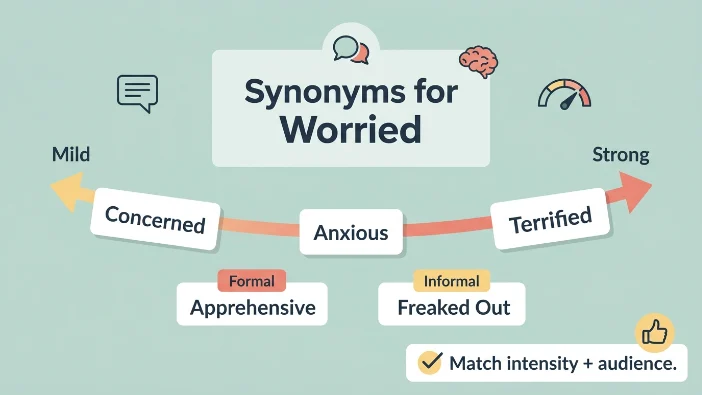
The best synonyms for worried are concerned, anxious, uneasy, and troubled.
- Use concerned for mild, practical worry.
- Use anxious for nervous, restless feelings.
- Use uneasy for vague discomfort.
- Use troubled for deeper, heavier worry.
What Does Worried Mean?
Worried is an adjective that describes a feeling of unease or concern about a potential problem or future event. A worried person thinks about something bad that might happen and feels mentally unsettled because of it.
Simple definition: Worried means feeling nervous or upset because you keep thinking about a problem or something that could go wrong.
Example sentences:
- She was worried about her son driving home in the storm.
- I felt worried when the interview went past the scheduled time.
Core Meaning of Worried
The core idea behind “worried” is anticipatory distress. You are not reacting to something bad that has already happened. Instead, your mind is running ahead to a possible negative outcome. Worry involves repetitive thoughts—going over the same concern again and again. It sits somewhere between mild concern and full fear. Unlike panic, worry often allows you to function, but it drains your mental energy. Unlike simple interest in a problem, worry carries a negative emotional charge.
Grammar and Usage Notes
Part of speech: Adjective (most common). Also used as a verb in past tense: “She worried about the test.”
Common sentence patterns:
- Worried + about + [noun/gerund]: “He was worried about losing his job.”
- Worried + that + [clause]: “They were worried that the flight would be canceled.”
- Worried + over + [noun]: “She worried over every detail.”
Common phrases:
- “worried sick” (very worried)
- “worried look” or “worried expression”
- “right to be worried”
When “worried” sounds natural: Use it for everyday concerns—health, money, relationships, work, weather, timing.
When a synonym works better: Use a stronger word like terrified for life-threatening fear. Use a more formal word like apprehensive in academic or professional writing. Use a milder word like concerned when you want to sound calm and in control.
Best Synonyms for Worried
The table below organizes the most useful synonyms by their tone and best use case.
| Synonym | Meaning | Tone | Best Use Case | Example Sentence |
|---|---|---|---|---|
| Concerned | Caring about a possible problem | Neutral, mild | Everyday conversation, workplace updates | “I’m concerned about the project deadline.” |
| Anxious | Nervous, restless, uneasy | Moderate to strong | Emotional honesty, health discussions | “She felt anxious before the presentation.” |
| Uneasy | Slightly worried without clear reason | Mild, vague | Describing gut feelings, social discomfort | “His silence made me uneasy.” |
| Troubled | Deeply worried over time | Moderate to strong | Serious personal issues, moral concerns | “He was troubled by the decision he had to make.” |
| Apprehensive | Worried about something specific in the future | Formal, controlled | Professional writing, planning contexts | “Investors were apprehensive about the merger.” |
| Distressed | Extremely upset and worried | Strong, emotional | Crisis situations, mental health contexts | “The family was distressed by the news.” |
| Bothered | Annoyed and slightly worried | Casual, mild | Conversations with friends | “It bothered me that she didn’t call back.” |
| Stressed | Worried due to pressure or overload | Neutral to moderate | Work, school, daily life | “He’s stressed about finishing the report on time.” |
Common Synonyms for Worried
These everyday words work well in normal writing and conversation. They are easy to understand and fit most situations.
Concerned
Short meaning: Feeling care or interest about a possible problem.
Best context: Professional emails, talking to family, news reports.
Example: “Doctors are concerned about the rise in flu cases.”
Nervous
Short meaning: Worried in a way that affects your body or actions—shaky hands, fast heartbeat.
Best context: Before a test, a date, a performance, or any uncertain event.
Example: “She was nervous before her driving test.”
Uneasy
Short meaning: A vague sense that something is wrong, even if you cannot name it.
Best context: Describing a strange feeling about a person, place, or situation.
Example: “I felt uneasy walking home alone that night.”
Bothered
Short meaning: Mildly worried or annoyed by something small.
Best context: Casual complaints or minor concerns.
Example: “It bothers me that he never replies to texts.”
Stressed
Short meaning: Worried because you feel too much pressure or too many demands.
Best context: Work deadlines, school workload, financial pressure.
Example: “She’s stressed about paying her bills this month.”
Formal Synonyms for Worried
Use these alternatives in academic essays, business reports, professional emails, and official documents. They sound more polished and controlled.
Apprehensive
This word describes worry about a specific future event. It sounds thoughtful, not panicked. Use it in business planning or risk assessment.
Example: “The committee is apprehensive about launching the product without more testing.”
Disquieted
A literary, formal word for feeling mentally unsettled. It implies a quiet, deep worry rather than loud fear.
Example: “The board was disquieted by the sudden resignation of the CEO.”
Disturbed
Stronger than uneasy. It means something has interrupted your mental peace. Use it when worry comes from disturbing information or events.
Example: “Researchers were disturbed by the pattern of data inconsistencies.”
Troubled (formal context)
While “troubled” works in casual speech, in formal writing it carries weight. It suggests ongoing, serious worry.
Example: “The report left us troubled about the long-term environmental impact.”
Ill at ease
A phrase meaning uncomfortable and slightly worried. Works well in descriptive business or academic writing.
Example: “New employees often feel ill at ease during their first week.”
Informal Synonyms for Worried
For conversations, text messages, social media, and casual writing, these words sound natural and friendly.
Freaked out
Strong, dramatic, and very casual. Use it for moments of high worry or panic among friends.
Example: “I freaked out when I realized I lost my wallet.”
Spooked
Means worried or scared, usually because something strange or unexpected happened.
Example: “The loud noise spooked me. I thought someone broke in.”
In a sweat
Means actively worrying, often about something urgent.
Example: “He was in a sweat over the test results all weekend.”
Stewing
Means worrying quietly and repeatedly over something, often without talking about it.
Example: “She’s been stewing about what he said for two days.”
Tense
Means worried and unable to relax, often showing in your body language.
Example: “Everyone was tense waiting for the job offers.”
Strong Synonyms for Worried
These words carry more emotional weight. Use them when the worry is intense, persistent, or deeply upsetting. Be careful: using a strong word for a small problem sounds dramatic or dishonest.
Terrified
Worry mixed with intense fear. Use only for serious threats or extreme anxiety.
Example: “She was terrified of the biopsy results.”
Panicked
Sudden, overwhelming worry that makes clear thinking hard.
Example: “He panicked when he couldn’t find his daughter in the crowd.”
Desperate
Worry combined with a feeling that you must solve the problem immediately or something terrible will happen.
Example: “The mother was desperate for news after the earthquake.”
Haunted
A literary strong word. It means worry that follows you over time, like a ghost.
Example: “Years later, he was still haunted by his financial mistakes.”
Devastated
Extreme worry and sadness mixed together, usually after something bad has already happened.
Example: “She was devastated by the diagnosis.”
Mild Synonyms for Worried
Sometimes the situation calls for a lighter touch. These words express small concerns without sounding dramatic.
A little concerned
Add “a little” or “slightly” to soften “concerned” even further.
Example: “I’m a little concerned about the weather for the picnic.”
Uncomfortable
Suggests a mild social or situational worry, not deep fear.
Example: “She felt uncomfortable asking for a raise.”
Hesitant
Means slightly worried about moving forward, so you pause.
Example: “I’m hesitant to book the flight with this strike going on.”
Cautious
Means worried enough to be careful, but not upset.
Example: “Investors are cautious after last quarter’s losses.”
Thoughtful
In some contexts, “thoughtful” replaces “worried” when the person is quietly considering a problem without distress.
Example: “He was thoughtful about the risks before signing.”
Synonyms for Worried by Context
Different situations call for different words. Here is how to choose based on where you are writing or speaking.
Everyday Conversation
Use concerned, bothered, nervous, or stressed. Keep it simple and honest.
- “I’m concerned about your sleep schedule.”
- “She’s nervous about meeting my parents.”
Professional Writing
Use concerned, apprehensive, or cautious. Avoid emotional or casual words.
- “Management is concerned about quarterly projections.”
- “We are apprehensive about the supply chain delays.”
Academic Writing
Use apprehensive, disquieted, troubled, or ill at ease. Maintain a formal, measured tone.
- “Participants reported feeling apprehensive before the procedure.”
- “The findings left researchers troubled by the ethical implications.”
Creative Writing
Use vivid words that match your character’s personality and the scene’s mood. Uneasy, haunted, distressed, panicked, or stewing all work well.
- “He uneasily checked the locked door again.”
- “She stewed over the letter all afternoon.”
Emotional Expression
Match the intensity to the real feeling. Anxious, distressed, terrified, or simply worried.
- “I’ve been anxious for days without an answer.”
- “She was distressed by the argument with her mother.”
Another Word for Worried in a Sentence
Here are 15 natural sentences using different synonyms. Read them aloud to hear how each word changes the tone.
- I’m concerned that we haven’t heard from Grandma in two days.
- She felt anxious every time her phone buzzed with a work email.
- The dark, empty hallway made him uneasy.
- He was troubled by the secret he had kept for years.
- The students were apprehensive about the final exam.
- She stressed over every detail of the wedding planning.
- It bothered me that he didn’t say goodbye.
- He panicked when the wifi went out during his online interview.
- The hiker was spooked by the rustling in the bushes.
- She’s been stewing about that comment all week.
- The family was distressed by the sudden hospitalization.
- I’m hesitant to try the new restaurant after those bad reviews.
- He grew cautious as the stock price dropped for the third day.
- The old photographs left her feeling haunted.
- She was freaked out about flying for the first time.
Worried Synonyms Compared
Some synonyms are so close that people mix them up. Here is the difference between the most easily confused pairs.
| Pair | Difference | Example |
|---|---|---|
| Concerned vs. Anxious | Concerned is calm and practical. Anxious includes nervous energy and physical restlessness. | “I’m concerned about the budget” vs. “I’m anxious about speaking on stage.” |
| Uneasy vs. Troubled | Uneasy is vague and short-term. Troubled is deeper and often long-term. | “The dark alley made me uneasy” vs. “He was troubled by his childhood memories.” |
| Apprehensive vs. Nervous | Apprehensive focuses on a future event you dread. Nervous is broader and includes body reactions. | “She was apprehensive about surgery” vs. “He was nervous before the date.” |
| Bothered vs. Stressed | Bothered is mild and often about one small thing. Stressed is about pressure and multiple demands. | “It bothered me that she was late” vs. “He’s stressed about three deadlines at once.” |
Words Similar to Worried
These words belong to the same family of emotions but are not exact synonyms. They share some meaning with “worried” but cannot always replace it directly.
Wary
Means cautious because you suspect danger or trickery. Related to worry because both involve anticipating problems. But “wary” includes suspicion, while “worried” does not necessarily.
Example: “She was wary of online deals that seemed too good.”
Insecure
Means lacking confidence in yourself or your situation. Related to worry because insecure people often worry. But “insecure” focuses on self-doubt, not external problems.
Example: “He felt insecure about keeping his job after the merger.”
Overwhelmed
Means buried under too much emotion or too many tasks. Related to worry because worry can cause overwhelm. But “overwhelmed” is broader—you can be overwhelmed by sadness, anger, or joy.
Example: “She felt overwhelmed by all the hospital forms.”
Restless
Means unable to relax or stay still. Related to worry because worried people often feel restless. But you can be restless from boredom or excitement, not only worry.
Example: “The kids were restless during the long wait.”
Antonyms of Worried
Sometimes the best way to understand a word is to study its opposite.
| Antonym | Short Meaning | Example Sentence |
|---|---|---|
| Calm | Peaceful, not upset | “She stayed calm while everyone else panicked.” |
| Carefree | Without any worries or responsibilities | “He felt carefree on his first day of vacation.” |
| Reassured | Made to feel less worried | “The doctor’s words left her reassured.” |
| Confident | Sure of yourself and the future | “He was confident about passing the exam.” |
| Unconcerned | Not caring or not worried | “She seemed unconcerned about the deadline.” |
| Relaxed | Free from tension and worry | “They were relaxed after a week off work.” |
How to Choose the Right Synonym for Worried
Choosing the right word makes your writing clearer and more honest. Follow these guidelines.
Match the intensity.
A small problem like a late bus needs “bothered” or “mildly concerned.” A serious issue like a health scare needs “distressed” or “anxious.”
Match the audience.
Your boss wants “concerned” or “apprehensive.” Your best friend understands “freaked out” or “stewing.”
Check the formality.
Do not write “I’m freaked out about the quarterly report” in a business email. Do not say “I am disquieted by the chip dip situation” to your roommate.
Think about the cause.
- If worry comes from a specific future event, try “apprehensive.”
- If it comes from vague discomfort, try “uneasy.”
- If it comes from pressure, try “stressed.”
Read the sentence aloud.
If the new word sounds strange or exaggerated, try a different one.
When in doubt, keep it simple.
“Concerned” works in almost any situation and rarely sounds wrong.
Common Mistakes When Using Synonyms for Worried
Even good writers make these mistakes. Avoid them to sound more natural.
Using a word that is too strong.
Saying “I was devastated” about a flat tire sounds dramatic and untrustworthy. Save strong words for real emergencies.
Using a formal word in casual writing.
“I was disquieted by the movie’s ending” sounds odd to most people. “The movie left me uneasy” works better.
Using a casual word in professional writing.
“I’m freaked out about the budget” will not help your career. Use “concerned” or “apprehensive.”
Treating similar words as identical.
“Anxious” is not just a fancy word for “worried.” It has its own meaning. Use it carefully.
Forgetting that tone matters.
Two words can mean the same thing but feel completely different. “Concerned” sounds caring. “Anxious” sounds nervous. Choose based on how you want to sound.
Replacing “worried” in fixed phrases.
“I’m worried sick” is a set expression. “I’m anxious sick” sounds wrong. Keep idioms intact.
Quick Synonym List for Worried
Common synonyms: concerned, nervous, uneasy, bothered, stressed
Formal synonyms: apprehensive, disquieted, disturbed, troubled, ill at ease
Informal synonyms: freaked out, spooked, in a sweat, stewing, tense
Strong synonyms: terrified, panicked, desperate, haunted, devastated
Mild synonyms: a little concerned, uncomfortable, hesitant, cautious, thoughtful
Related words: wary, insecure, overwhelmed, restless
FAQs
What is the best synonym for worried?
Concerned is the best all-purpose synonym. It works in almost every situation, from casual conversation to professional writing, and it matches the intensity of most everyday worry.
What is another word for worried?
Anxious, uneasy, and troubled are common alternatives. Each has a slightly different tone, but all three directly replace “worried” in most sentences.
What is a formal synonym for worried?
Apprehensive is the most useful formal synonym. Disquieted and ill at ease also work in academic or professional writing.
What is an informal synonym for worried?
Freaked out is common among younger speakers. Spooked, stewing, and in a sweat are also natural in casual conversation.
What is a stronger word for worried?
Terrified, panicked, and distressed are much stronger than “worried.” Use them only for serious situations or intense emotions.
What is a milder word for worried?
A little concerned, uncomfortable, or hesitant express lower levels of worry without sounding dramatic.
What words are similar to worried but not exact synonyms?
Wary (cautious with suspicion), insecure (lacking confidence), overwhelmed (buried by emotion or tasks), and restless (unable to relax) share meaning with “worried” but are not perfect replacements.
What is the opposite of worried?
Calm, carefree, reassured, confident, unconcerned, and relaxed are direct antonyms.
How do I choose the right synonym for worried?
Match the intensity to the situation, match the formality to your audience, and read the sentence aloud to check if it sounds natural. When in doubt, use concerned.
Conclusion
Finding the right synonym for worried comes down to three things: how strong the feeling is, who you are talking to, and what situation you are in. For most everyday moments, “concerned” works perfectly. When you need more precision, choose “anxious” for nervous energy, “uneasy” for vague discomfort, “apprehensive” for formal settings, or “freaked out” for casual conversations.
Avoid making small problems sound like disasters with overly strong words. Avoid formal words in casual texts. And when you are not sure, keep it simple. The best word is the one that feels honest, natural, and clear to the person reading it.
Read More Related Articles:
- Synonyms for Thoughts | Enhance Clarity and Expression In Your Writing In 2026
- Synonyms For Felt | Make Your Writing More Descriptive In 2026
- Synonyms for Stress | Meaning, Examples, and Better Word Choices In 2026

Evelyn Turner is a content creator at SynonymsAura.com who enjoys exploring the richness of the English language. Her work focuses on word meanings, synonyms, expressions and everyday language usage, helping readers communicate with greater clarity and confidence.