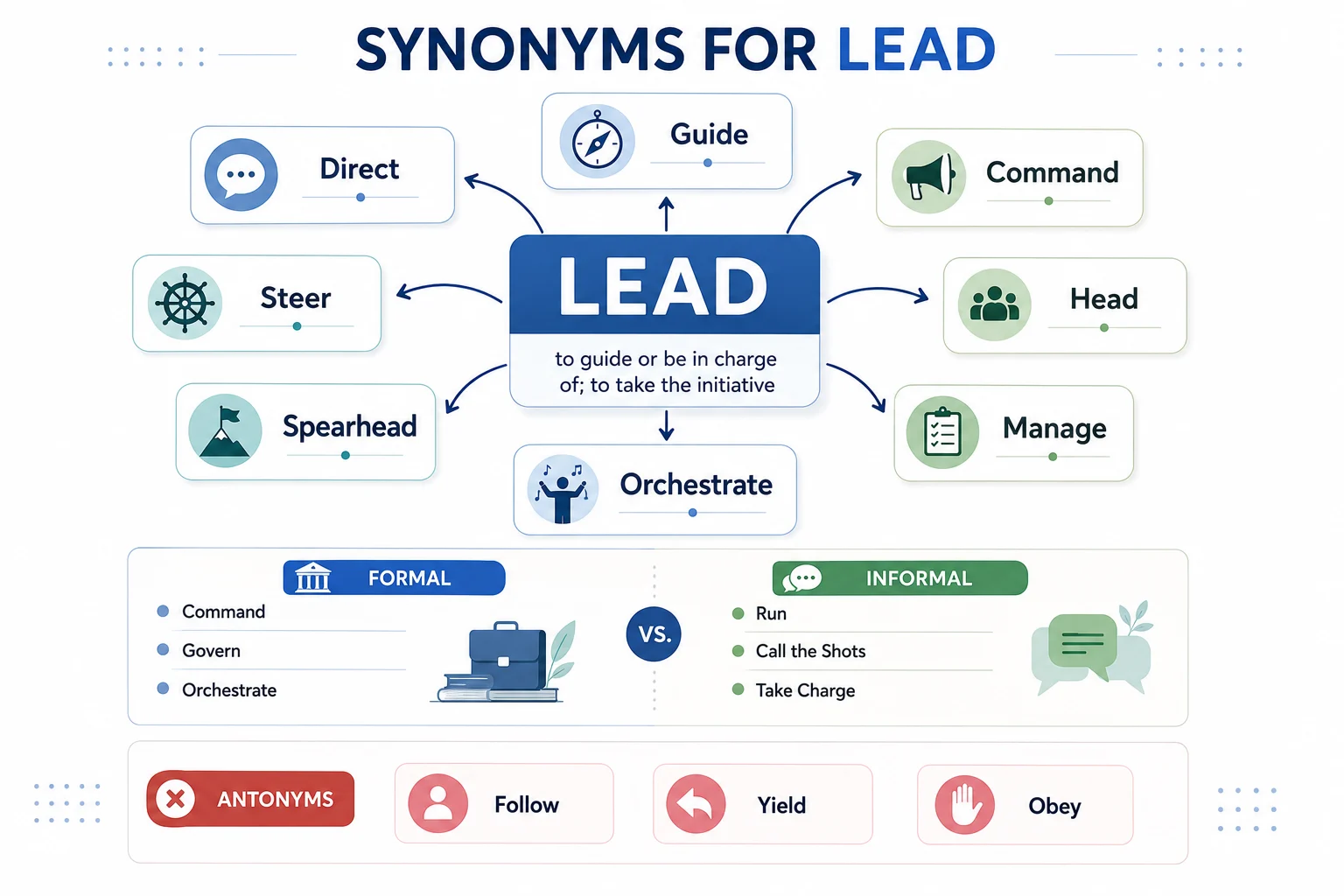
When you need another word for lead, the right choice depends on what you mean. Are you talking about guiding a group, holding the top position, giving someone a tip, or something else entirely? The best synonyms for lead include guide, direct, head, command, steer, and manage but each one carries a slightly different feeling. This article breaks them all down so you can pick the one that fits your sentence perfectly.
Best Synonyms for Lead
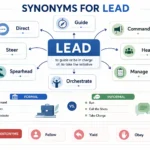
The best synonyms for lead are guide, direct, head, command, steer, and manage. For a stronger tone, try spearhead or helm. For a softer tone, oversee or coordinate work well. The right word depends on your context, tone, and how much authority or direction you want to imply.
What Does Lead Mean?
Lead is one of those versatile English words that pulls multiple roles depending on how you use it.
As a verb, it most often means to show the way, to be in charge, or to influence others toward a goal. It implies a position of authority or influence someone who leads is ahead of others, either physically or in terms of responsibility.
As a noun, lead can refer to the front position (“she took the lead”), a clue or tip (“the detective followed every lead”), or the starring role in a performance (“he played the lead”).
Example sentences:
- She was chosen to lead the research team through the final phase of the project.
- After two strong quarters, the company held a comfortable lead in the market.
The verb form is by far the most commonly searched when people look for synonyms, so that’s the primary focus here though noun synonyms are covered too.
Core Meaning of Lead
At its heart, lead is about being in front whether that means directing people toward a goal, making the key decisions, or simply going first. It suggests movement, purpose, and influence. A person who leads isn’t just present; they’re actively shaping what happens next.
That combination of authority, direction, and forward movement is what sets lead apart from many of its synonyms. Words like manage often imply administration rather than inspiration. Words like guide suggest collaboration rather than command. Knowing what shade of meaning you need helps you choose the right replacement.
Grammar and Usage Notes
Part of speech: Lead functions most often as a verb or a noun. As a verb, it’s irregular the past tense is led (not leaded), which is one of the most common spelling mistakes in English.
Common verb patterns:
- lead + noun: lead the team, lead the way, lead the charge
- lead + to: this decision led to major changes
- lead + someone + somewhere: she led them through the corridor
Common noun patterns:
- take the lead
- in the lead
- follow a lead
- a strong lead performance
When lead sounds natural: In leadership, direction, and forward-movement contexts. “She leads the department” feels natural. “The team is led by an experienced manager” is standard in professional writing.
When a synonym works better: When lead starts to feel repetitive, or when you need more precision direct is better when giving specific instructions, guide is better when the process is collaborative, and head is better when emphasizing title or role.
Best Synonyms for Lead
| Synonym | Meaning | Tone | Best Use Case | Example Sentence |
|---|---|---|---|---|
| Guide | Show the way, help navigate | Collaborative | Mentorship, education, collaboration | She guided the new team through the onboarding process. |
| Direct | Give specific instructions | Neutral–formal | Management, film, project work | He directed the crew with quiet confidence. |
| Head | Be at the top of | Neutral | Job titles, organizational structure | She heads the compliance division. |
| Command | Have authority over | Formal–strong | Military, leadership, authority | He commanded the unit with discipline and calm. |
| Steer | Guide toward a direction | Neutral | Strategy, navigation, business | They steered the company away from unnecessary risk. |
| Manage | Oversee and organize | Neutral | Business, daily operations | She manages a team of twelve analysts. |
| Oversee | Watch and supervise | Neutral–formal | Projects, departments, quality control | He oversaw the transition to the new software. |
| Helm | Be at the controls | Semi-formal | Leadership, business | She helmed the organization through a turbulent year. |
| Spearhead | Drive something forward | Strong | Campaigns, initiatives, innovation | He spearheaded the company’s digital transformation. |
| Pilot | Test or navigate | Neutral | Programs, aviation, new ventures | They piloted the new curriculum in three schools. |
| Orchestrate | Arrange and coordinate carefully | Formal | Complex events, strategic plans | She orchestrated a seamless product launch. |
| Marshal | Organize and lead firmly | Formal | Military, large-scale coordination | He marshaled resources from across the organization. |
Common Synonyms for Lead
These are the everyday alternatives you’ll reach for most often in normal writing and conversation.
Guide Means to show someone the way or help them through a process. Best when the relationship is supportive or collaborative rather than authoritative. Example: He guided the volunteers through every step of the setup.
Direct Means to give clear instructions and control the flow of work or people. Works well in professional and creative contexts. Example: She directed the project from planning through delivery.
Head Emphasizes being at the top of an organization or group. Often used in titles or to describe someone’s role. Example: He heads the national task force on cybersecurity.
Manage Focuses on organizing, controlling, and keeping things running. Implies day-to-day oversight more than vision or inspiration. Example: She managed the department with efficiency and care.
Run Casual but widely understood. Means to be in charge of something and keep it moving. Example: He runs the creative side of the agency.
Formal Synonyms for Lead
Use these in academic writing, business reports, professional emails, and formal essays.
Command Carries a strong sense of authority. Common in military writing and formal leadership contexts. Best for: reports, organizational writing, leadership descriptions Example: The general commanded the operation with precision.
Oversee Implies monitoring and ensuring quality without necessarily being hands-on. Widely used in professional writing. Best for: job descriptions, project summaries, formal reports *Example: The director will oversee all international partnerships.
Orchestrate Suggests careful, complex coordination. Works well when multiple parts need to come together. Best for: event planning narratives, strategic communication, press releases Example: The CEO orchestrated a smooth merger between the two firms.
Govern Best when discussing rules, authority, and institutional control. Best for: policy writing, academic papers, civic writing Example: A newly elected board will govern the foundation going forward.
Administer Focuses on managing processes and resources formally. Less inspiring than lead but precise. Best for: formal reports, government writing, institutional documents Example: She administered the grant program for three consecutive years.
Informal Synonyms for Lead
These fit casual conversation, friendly writing, social media, and personal messages.
Run the show Means to be fully in charge. Slightly playful and very conversational. Example: She basically runs the show around here.
Call the shots Means to make the important decisions. Works well in everyday talk about authority. *Example: After the promotion, he was finally calling the shots.
Be at the helm A bit more vivid than formal use. Works well in casual writing with a slightly dramatic tone. Example: She’s been at the helm ever since the founder stepped back.
Take charge Means to step up and start leading. Works in both casual and semi-formal settings. Example: When things got chaotic, she took charge and kept everyone focused.
Steer Works in both formal and informal registers but feels approachable and conversational. Example: He’s been steering the team in a good direction lately.
Strong Synonyms for Lead
These carry more weight, power, or urgency than lead on its own. Use them when you want to emphasize boldness, drive, or authority.
Spearhead Suggests driving something forward with energy and determination. Great for campaigns, movements, or major initiatives. Example: She spearheaded the city’s push for renewable energy. Caution: Can sound overstated in low-stakes contexts.
Command Implies total authority and confident control. Powerful in leadership narratives but can feel heavy in casual settings. Example: He commanded the respect of everyone in the room.
Champion Means to actively fight for and lead a cause. More passionate and advocacy-focused than plain lead. Example: She championed the new policy until it passed.
Drive Suggests pushing people or processes forward with force and momentum. Example: He drove the initiative through despite heavy resistance.
Marshal Formal and strong. Suggests organizing large forces or resources with authority. Example: The project manager marshaled the entire department to meet the deadline.
Mild Synonyms for Lead
These are softer alternatives when you want to avoid implying heavy authority or force.
Coordinate Focuses on bringing parts together smoothly. Suggests teamwork over hierarchy. Example: She coordinated the volunteers across all three locations.
Facilitate Means to make something easier or help a process move forward. Less directive than lead. Example: He facilitated the discussion without pushing any particular outcome.
Oversee Implies watching over without micromanaging. Professional but not overbearing. Example: She oversaw the intern program with a light but steady hand.
Support Even softer implies helping and enabling rather than directing. Example: He supported the team’s efforts throughout the campaign.
Steer Gentle enough for collaborative settings, strong enough for professional writing. Example: She steered the conversation toward a productive solution.
Synonyms for Lead by Context
Everyday Conversation
In casual talk, run, take charge, call the shots, and be at the helm all work naturally. People say “she runs the team” far more often than “she governs the team” in everyday speech.
Professional Writing
Head, direct, manage, oversee, and coordinate fit well in emails, proposals, and business reports. They signal responsibility without sounding dramatic.
Academic Writing
Govern, administer, orchestrate, and direct are appropriate in essays and research papers. Avoid casual phrasing like “runs the show” in academic work.
Creative Writing
Steer, pilot, marshal, and helm add texture to narratives. They’re vivid without being clichéd, and they work well in character descriptions or action-driven scenes.
Marketing Copy
Spearhead, champion, drive, and lead itself work well in marketing. They suggest momentum and bold action, which suits brand messaging.
Emotional Expression
When capturing a personal or emotional tone someone stepping up in a difficult moment take charge, rise to lead, or guide feel more human and relatable than formal terms like administer.
Another Word for Lead in a Sentence
Here are natural example sentences using different synonyms for lead:
- She was asked to guide the committee through a difficult set of decisions.
- He directed every aspect of the production from casting to final cut.
- The new VP will head the company’s North American division.
- She commanded the attention of every person in the auditorium.
- He steered the negotiations away from a costly dispute.
- The team managed a major product rollout with very few issues.
- She oversaw the renovation of three school buildings over two summers.
- He helmed the startup through its earliest and most uncertain days.
- The director orchestrated a flawless transition between leadership teams.
- She spearheaded the organization’s push into international markets.
- He piloted a new mentorship program across four departments.
- The senator championed the bill until it reached the floor for a vote.
- She coordinated relief efforts across a wide area with limited resources.
- He drove the team to exceed expectations every quarter.
- She ran the entire operation from a small office downtown.
Lead Synonyms Compared
Some synonyms for lead look interchangeable but carry meaningful differences.
| Word Pair | Key Difference |
|---|---|
| Guide vs. Direct | Guide is collaborative and supportive; direct implies clear authority and instruction. |
| Head vs. Command | Head describes a role or title; command describes the exercise of authority. |
| Manage vs. Lead | Manage is about organization and process; lead implies vision and influence. |
| Steer vs. Drive | Steer suggests gentle course-correction; drive suggests force and urgency. |
| Orchestrate vs. Coordinate | Orchestrate implies complex, deliberate arrangement; coordinate is more neutral and practical. |
| Spearhead vs. Head | Spearhead suggests energetic, forward momentum; head is a more neutral title-based term. |
| Helm vs. Run | Helm is slightly more formal and vivid; run is casual and widely understood. |
The key takeaway: If you want to show active, energetic leadership, reach for spearhead, drive, or champion. If you want to describe a title or role, head or oversee work better. If the relationship is collaborative, guide or coordinate feel more appropriate.
Words Similar to Lead
These words belong to the same general world as lead but aren’t always direct synonyms. Use them carefully.
Influence Related because leaders often influence people but influence doesn’t imply formal authority. You can influence without leading.
Inspire Connected to leadership but focused on emotional motivation rather than direction. You can inspire without managing.
Mentor A mentor guides and develops others, but the relationship is about growth, not authority or direction.
Pioneer To pioneer means to be first in a new area. It’s related to lead in the sense of going ahead, but it focuses on novelty and exploration rather than direction.
Preside Means to be in charge of a formal meeting or organization. Narrower than lead you preside over sessions, not daily operations.
Navigate Suggests finding a path through difficulty. It’s related to leadership but focuses more on problem-solving than people-management.
None of these can simply replace lead in most sentences without changing the meaning. They’re useful for describing aspects of leadership, but not direct substitutes.
Antonyms of Lead
| Antonym | Meaning | Example Sentence |
|---|---|---|
| Follow | To go after or obey someone else’s direction | He chose to follow rather than take charge. |
| Obey | To comply with instructions given by others | She was expected to obey the chain of command. |
| Trail | To fall behind or come last | The candidate was trailing in the polls by a wide margin. |
| Submit | To accept another’s authority or decision | He submitted to the board’s final ruling without objection. |
| Yield | To give way to another’s lead | She yielded control to her successor after the restructure. |
| Retreat | To pull back or move away from the front | The team retreated from the original plan after poor results. |
How to Choose the Right Synonym for Lead
Match the context. Spearhead works for bold campaigns. Facilitate works for meetings. Don’t swap them.
Match the tone. Formal documents need words like govern or oversee. Casual writing is fine with run or take charge.
Check the intensity. If you want to show strong, determined leadership, command or drive land harder. If the situation calls for a lighter touch, coordinate or guide are better choices.
Think about the relationship. Leading a team implies authority. Guiding a student implies support. The relationship between the people involved often determines the best word.
Check whether the synonym is exact. Inspire and motivate are related to lead, but they can’t replace it in most sentences without changing the meaning.
Keep the sentence natural. Read your sentence out loud after the swap. If it sounds off, try a different option.
When in doubt, use simpler words. Direct, head, and guide are always safe choices that work across most contexts without sounding too formal or too casual.
Common Mistakes When Using Synonyms for Lead
Using command in a collaborative context. Command implies hierarchy and authority. Saying someone “commanded a brainstorming session” sounds strange and heavy.
Treating manage and lead as identical. Managing focuses on process and efficiency. Leading focuses on vision and direction. They overlap but aren’t the same.
Using spearhead for small or routine tasks. Spearhead suggests boldness and scale. Using it for something minor sounds exaggerated.
Mixing formal and informal registers. Writing “she orchestrated the project” in one sentence and “he runs the show” in the next creates an uneven tone. Stay consistent.
Forgetting about noun vs. verb. Lead as a noun (a clue, an advantage, a starring role) needs different synonyms than lead as a verb. The two uses aren’t interchangeable.
Assuming every synonym fits every sentence. Always check that the meaning, tone, and intensity of your synonym match the original message.
Quick Synonym List for Lead
Common synonyms guide, direct, head, manage, run, steer, oversee
Formal synonyms command, govern, orchestrate, administer, marshal, preside
Informal synonyms run the show, call the shots, take charge, be at the helm
Strong synonyms spearhead, command, champion, drive, marshal
Mild synonyms coordinate, facilitate, oversee, support, steer
Related words influence, inspire, mentor, pioneer, navigate, preside
FAQs
What is the best synonym for lead?
The best synonym for lead depends on the context.
- For everyday writing, direct and guide are the most versatile choices.
- For strong leadership or bold initiatives, spearhead or command work well.
- For formal writing, oversee or head are reliable options.
What is another word for lead?
Another word for lead includes guide, direct, head, manage, steer, command, and helm. Each carries a slightly different meaning depending on the level of authority or style of direction involved.
What is a formal synonym for lead?
Formal synonyms for lead include command, govern, oversee, orchestrate, administer, and marshal. These work well in academic papers, business reports, policy documents, and professional communication.
What is an informal synonym for lead?
Informal alternatives include run (as in “she runs the team”), call the shots, take charge, and be at the helm. These work well in casual conversation, social media posts, and everyday writing.
What is a stronger word for lead?
Stronger words for lead include spearhead, command, champion, drive, and marshal. These carry more energy, authority, or urgency than the plain word lead, making them good choices when you want to emphasize boldness or determination.
What is a milder word for lead?
Milder alternatives include coordinate, facilitate, oversee, and steer. These imply a lighter form of direction helpful for collaborative contexts or when you want to avoid implying heavy authority.
What words are similar to lead but not exact synonyms?
Words similar to lead but not always direct replacements include influence, inspire, mentor, pioneer, and navigate. These are connected to the idea of leadership but focus on different aspects motivation, exploration, or guidance rather than directing or commanding.
What is the opposite of lead?
The main antonyms of lead are follow, obey, trail, yield, and submit. Each suggests moving away from the front or giving authority to someone else rather than holding it yourself.
How do I choose the right synonym for lead?
Start by deciding how much authority the word needs to convey, what tone fits your setting (formal, casual, strong, or gentle), and whether the relationship is collaborative or directive. Then pick the synonym that matches all three. Reading your sentence out loud after the swap is the simplest way to check if it sounds natural.
Conclusion
Lead is a powerful, flexible word but it’s not always the only option. Whether you need something more formal, more casual, more forceful, or more collaborative, there’s a synonym that fits. Guide and direct cover most everyday needs. Command and spearhead add intensity. Coordinate and facilitate soften the tone. And head or oversee work cleanly in professional and formal settings.
The most important thing is to match the synonym to your meaning, your reader, and your context. A well-chosen word makes your writing feel more natural and precise and that always matters more than variety for its own sake.
Read More Related Articles:
Synonyms For Keep | Expand Your Expression Instantly In 2026- Synonyms For Feel | Upgrade How You Describe Thoughts & Emotions In 2026
- Synonyms For Mean | Smarter Ways to Express Yourself In 2026

Ethan Caldwell is a writer who enjoys exploring the nuances of language and how words shape everyday communication. His work focuses on making complex ideas easier to understand through clear, engaging and accessible writing.