The word mean shows up constantly in everyday writing and conversation, but it rarely tells the whole story on its own. If you’re looking for synonyms for mean, the best options include cruel, unkind, spiteful, nasty, and malicious but each one carries its own flavor, strength, and best-fit situation. Choosing the right word depends on what you’re trying to say, who you’re saying it to, and how strongly you want to express it. This article breaks down every useful alternative with clear examples and practical guidance.
Note on meaning: “Mean” has several different senses it can be an adjective (unkind), a verb (to signify or intend), or a noun (average). This article focuses primarily on the adjective sense, which is by far the most commonly searched for synonyms. Where the verb sense is relevant, it is covered separately.
Best Synonyms for Mean
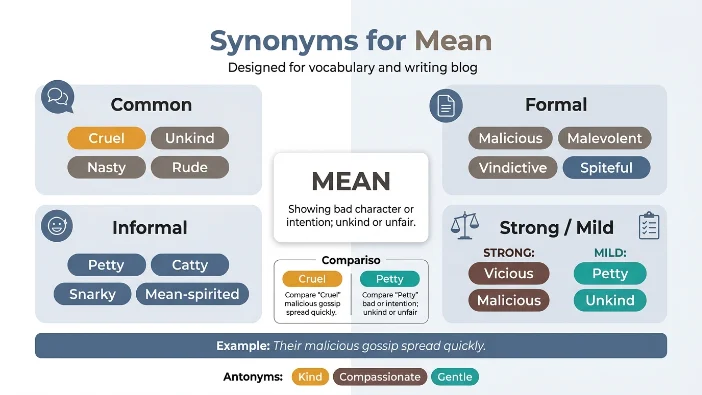
The best synonyms for mean (adjective: unkind, cruel) are cruel, unkind, spiteful, nasty, and malicious. The right choice depends on tone, context, and intensity. For formal writing, try callous or contemptible. For casual use, nasty or petty often work well. When the behavior is deliberately harmful, malicious or vicious are the stronger picks.
What Does Mean Mean?
Mean is most commonly used as an adjective to describe someone or something that is unkind, cruel, or hurtful either in behavior, attitude, or intent.
Simple definition: Deliberately unkind or cruel toward others; showing a lack of care for other people’s feelings.
Part of speech: Adjective (primary focus here); also a verb (to signify) and a noun (mathematical average).
Common usage: Describing a person’s behavior, a comment, an action, or a general attitude that causes hurt or discomfort.
Example sentences:
- “That was a really mean thing to say to her.”
- “He’s not always like this he was just being mean because he was frustrated.”
Core Meaning of Mean
At its heart, mean (adjective) describes behavior or attitudes that harm, dismiss, or belittle others often without good reason. It implies a certain smallness of character, whether that shows up as teasing, cruelty, pettiness, or outright hostility.
What separates mean from stronger words like vicious or malicious is that mean behavior doesn’t always involve serious harm or a deep desire to destroy.
- Sometimes it’s petty.
- Sometimes it’s thoughtless.
- Sometimes it’s habitual.
The word covers a wide emotional range, which is exactly why finding the right synonym matters each alternative narrows that range in a specific direction.
Grammar and Usage Notes
Part of speech: Adjective
Common sentence patterns:
- Subject + to be + mean: She was being mean.
- Mean + noun: a mean comment, a mean person, a mean trick
- Mean + to + person: He was mean to his little sister.
- It + to be + mean + to do: It was mean to leave without saying goodbye.
Common collocations:
- mean-spirited
- mean-tempered
- downright mean
- just plain mean
- mean-hearted
When “mean” sounds natural:
In everyday conversation, mean is perfectly natural especially when talking about behavior in social situations, school environments, or interpersonal conflicts. “That was mean” rolls off the tongue easily and everyone understands it.
When a synonym may work better:
In formal writing, mean can feel too casual. In creative writing, it may feel too flat. When the situation calls for more specificity distinguishing between a coldly calculated act and a petty slight, for example a more precise synonym does the job better.
Best Synonyms for Mean
| Synonym | Meaning | Tone | Best Use Case | Example Sentence |
|---|---|---|---|---|
| Cruel | Causes pain without remorse | Strong / Neutral | Both formal and informal | “It was cruel to ignore her when she needed help.” |
| Unkind | Lacking warmth or consideration | Mild / Neutral | Everyday and professional | “His unkind remarks upset everyone in the room.” |
| Spiteful | Acting out of malice or revenge | Moderate / Negative | Personal conflicts, storytelling | “Her spiteful comment was clearly meant to wound.” |
| Nasty | Unpleasant, hostile, or offensive | Informal / Strong | Casual conversation, social media | “Don’t be nasty she didn’t do anything to you.” |
| Malicious | Intending to do harm on purpose | Formal / Very Strong | Legal, formal, serious contexts | “The malicious rumors spread quickly through the office.” |
| Callous | Emotionally cold and indifferent | Formal / Cold | Professional writing, character analysis | “Her callous response shocked everyone present.” |
| Vicious | Brutally cruel or deeply hurtful | Very Strong | Describing extreme behavior | “The vicious attack left everyone speechless.” |
| Petty | Small-minded, trivial in cruelty | Informal / Dismissive | Casual, social situations | “It was petty of him to complain about such a small thing.” |
| Harsh | Severe or unnecessarily tough | Neutral / Moderate | Feedback, criticism, tone | “That was a harsh way to put it.” |
| Contemptible | Deserving disgust or scorn | Formal / Very Negative | Essays, opinions, formal critique | “His behavior was contemptible and unacceptable.” |
Common Synonyms for Mean
These are the words most people reach for first familiar, everyday alternatives that work in most situations.
Unkind
A gentle but clear alternative. It points to a lack of kindness rather than active cruelty. Works well in most neutral contexts.
“Making fun of his mistake was unkind, no matter how small it seemed.”
Cruel
A step up from unkind. Cruelty implies that the hurt is intentional that the person knew they were causing pain and didn’t care.
“Leaving the animal outside in that storm was cruel.”
Nasty
More emotional and informal. Often used in spoken language or personal writing to describe someone or something that offends or hurts.
“She gave him a nasty look when he walked in late.”
Harsh
More about tone or delivery than character. A harsh person or comment is overly blunt or severe not always cruel by intent, but rough in effect.
“The professor’s feedback was harsh, but some of it was useful.”
Spiteful
Implies that the person is acting out of personal resentment or the desire to hurt someone back. It has a vindictive quality.
“She didn’t need to say that it was just spiteful.”
Formal Synonyms for Mean
These alternatives suit academic papers, professional reports, journalism, and formal essays.
Malicious
The most formal way to say someone intended to cause harm. Often used in legal, journalistic, or official writing.
“The investigation revealed a pattern of malicious behavior within the department.”
Callous
Describes a person who shows no emotional sensitivity cold and indifferent to others’ suffering. Works well in formal character analysis or ethics discussions.
“The callous disregard for human welfare in the report was deeply troubling.”
Contemptible
Means something or someone is worthy of contempt morally low or deeply objectionable. Use it in formal opinion writing or serious critique.
“His refusal to help was contemptible given the circumstances.”
Vindictive
Formal and specific means someone is motivated by a desire for revenge. Slightly more precise than spiteful.
“The vindictive nature of the accusation made the board uncomfortable.”
Reprehensible
Describes behavior that deserves strong moral condemnation. Carries significant weight in formal writing.
“The way the situation was handled was reprehensible.”
Informal Synonyms for Mean
These fit casual writing, texts, social media posts, and everyday conversation.
Petty
Describes someone who is small-minded or unnecessarily cruel over trivial things. A popular informal word with a slightly dismissive tone.
“Don’t be petty about it he said sorry.”
Rotten
Old-fashioned but still used casually to describe someone acting badly toward others.
“That was a rotten thing to do to someone who trusted you.”
Horrible
More about the overall feeling than the specific act, but widely used in casual language to describe mean behavior.
“She was horrible to him the entire evening.”
Hateful
Strong and informal used to describe comments or behavior dripping with negativity or hostility.
“Don’t say hateful things about people you barely know.”
Lousy
Casual and somewhat mild describes behavior that is poor in quality or character.
“It was lousy of him to cancel on you last minute like that.”
Strong Synonyms for Mean
Use these when the behavior goes beyond ordinary unkindness when it’s deliberate, severe, or deeply harmful.
Vicious
Suggests a brutal or extreme cruelty. Use carefully it implies real emotional or physical intensity.
“The vicious gossip nearly destroyed her reputation.”
Malevolent
Means having a deep desire to harm others darker and more literary than most alternatives. Common in fiction and formal essays.
“The story’s antagonist had a malevolent presence that unsettled everyone around him.”
Sadistic
Takes cruelty a step further describing someone who takes pleasure in causing others pain. A very strong word that should only be used when the meaning fits precisely.
“The sadistic tone of the messages shocked investigators.”
Ruthless
Describes someone with no mercy or compassion willing to harm others to get what they want.
“The ruthless takeover left dozens of employees without jobs.”
Be careful with these stronger words they carry serious connotations and can feel exaggerated in everyday situations.
Mild Synonyms for Mean
Sometimes you need to point to unkind behavior without dramatic language. These softer alternatives do the job without escalating the tone.
Inconsiderate
Doesn’t focus on cruelty but on thoughtlessness the person just didn’t think about how their actions would affect others.
“It was inconsiderate to take the last piece without asking.”
Thoughtless
Similar to inconsiderate, but highlights a lack of reflection rather than any bad intent.
“His thoughtless comment wasn’t meant to hurt, but it did.”
Tactless
Describes someone who says things bluntly without considering how they’ll land not necessarily cruel, just lacking in social grace.
“She’s not mean, really just tactless.”
Ungracious
A polite way of saying someone behaved rudely or without warmth. Works well in formal contexts where stronger words would feel out of place.
“His ungracious response after losing the award surprised many in the audience.”
Synonyms for Mean by Context
Everyday Conversation
In casual talk, nasty, petty, rotten, and horrible are the go-to choices. They’re easy to say, easy to understand, and match the emotional pitch of real conversation. “That was really nasty of him” or “Don’t be so petty” feel natural between friends.
Professional Writing
Stick to callous, harsh, vindictive, or malicious when writing in a professional or business context. These carry weight without sounding heated. “The callous handling of complaints was noted in the audit” reads far more credibly than “The mean handling of complaints.”
Academic Writing
For essays, research, and formal analysis, malicious, reprehensible, contemptible, and callous are the strongest choices. They signal precise thinking and align with the elevated register academic writing demands.
Creative Writing
Fiction gives you the most flexibility. Vicious, malevolent, cruel, and spiteful all paint vivid pictures of characters and their motivations. Match the word to the intensity of the scene a spiteful sibling doesn’t need the same language as a malevolent villain.
Emotional Expression
When someone wants to express how hurt they feel, hateful, cruel, and horrible land with emotional force. These words communicate personal pain rather than objective analysis, which is exactly what personal writing often needs.
Another Word for Mean in a Sentence
Here are natural example sentences using different synonyms for mean:
- “She gave him a cruel look that stopped the conversation cold.”
- “His spiteful comment came out of nowhere and left everyone uncomfortable.”
- “The harsh review was hard to read, but it wasn’t entirely wrong.”
- “It was unkind to point that out in front of everyone.”
- “The malicious intent behind the email was clear from the first line.”
- “Don’t be so petty he made a simple mistake.”
- “The callous disregard for her feelings was hard to watch.”
- “She left a nasty message on his voicemail that he didn’t expect.”
- “His vicious criticism went far beyond honest feedback.”
- “She was ruthless in how she handled the negotiation.”
- “It was rotten of him to lie after everything she did for him.”
- “The vindictive tone in the letter made the lawyer uneasy.”
- “She wasn’t cruel just thoughtless about how her words landed.”
- “That was a contemptible way to treat someone who trusted you.”
- “His ungracious response after the loss embarrassed the whole team.”
Mean Synonyms Compared
Some of the closest synonyms share meaning but differ in important ways. Here’s how to tell them apart:
| Word | Core Idea | Intensity | Formality | Key Difference from “Mean” |
|---|---|---|---|---|
| Cruel | Causes pain deliberately | Strong | Neutral | Implies active intent to hurt |
| Unkind | Lacks warmth | Mild | Neutral | Softer; no bad intent required |
| Spiteful | Driven by resentment | Moderate | Slightly formal | Adds a motive: revenge or grievance |
| Nasty | Unpleasant, hostile | Moderate | Informal | More visceral and emotional |
| Malicious | Intends real harm | Very strong | Formal | Most serious; often used in legal contexts |
| Callous | Emotionally cold | Strong | Formal | Focus is on indifference, not active cruelty |
| Petty | Small-minded cruelty | Mild | Informal | Adds an element of triviality or smallness |
| Harsh | Overly severe in tone | Moderate | Neutral | Often about delivery, not character |
The key takeaway: Cruel implies intent. Unkind doesn’t have to. Spiteful brings motive into the picture. Callous is about emotional cold-bloodedness. Malicious is the most formal and serious. Choose based on what you’re actually trying to say.
Words Similar to Mean
These words live in the same neighborhood as mean but aren’t always exact replacements. Knowing the difference helps you avoid misuse.
Aggressive Related because aggressive people can seem mean, but aggression is about forcefulness or confrontation, not necessarily cruelty. Someone can be assertively aggressive without being mean at all.
Selfish A selfish person may come across as mean, but selfishness is about prioritizing oneself rather than actively hurting others. Not a direct synonym.
Rude Rudeness is about bad manners or disrespectful behavior, which overlaps with mean but doesn’t always involve the same intent to hurt. You can be rude accidentally; being mean usually carries more deliberate weight.
Bitter Bitterness describes an emotional state resentment that builds over time. A bitter person may act mean, but bitterness is an inner condition, not a behavior.
Cold Describes someone emotionally distant or unresponsive. A cold person might not be intentionally mean they may simply lack emotional expressiveness.
Hostile Closer to mean in feeling, but more confrontational and adversarial. Hostility tends to be more outward and combative.
All of these are worth knowing in context, but substituting them for mean without checking the precise meaning can change your message in ways you didn’t intend.
Antonyms of Mean
Understanding opposites can be just as useful as finding synonyms.
| Antonym | Meaning | Example Sentence |
|---|---|---|
| Kind | Warm, generous, and caring | “She was unfailingly kind to everyone she met.” |
| Compassionate | Deeply understanding of others’ pain | “A compassionate response can change someone’s day.” |
| Gentle | Soft, tender, and considerate | “He had a gentle way of correcting mistakes.” |
| Generous | Giving freely without selfishness | “Her generous spirit made her easy to be around.” |
| Benevolent | Warm-hearted and well-meaning | “The principal took a benevolent approach with struggling students.” |
| Tender | Soft and emotionally warm | “She gave him a tender smile when he apologized.” |
| Gracious | Polite, warm, and courteous | “Despite the criticism, she gave a gracious response.” |
| Charitable | Inclined to think the best of others | “Try to take a more charitable view of what she said.” |
How to Choose the Right Synonym for Mean
A few practical questions can help you land on the best word every time:
Match the context. Is this formal writing or a casual conversation? Callous and malicious belong in reports and essays. Nasty and petty belong in text messages and social media.
Match the intent. Did the person mean to hurt someone, or were they just thoughtless? If it’s intentional, use cruel, spiteful, or malicious. If it wasn’t deliberate, unkind, thoughtless, or inconsiderate fit better.
Check the intensity. Vicious and sadistic are serious words. Don’t reach for them when harsh or unkind would do. Overusing strong language makes your writing feel melodramatic.
Think about the reader. A child reading about a “malevolent” character needs more context than an adult reader would. Use simpler words when your audience skews younger or non-specialist.
Ask whether the synonym is exact or related. Words like selfish and rude are related to mean but don’t fully replace it. Make sure your chosen word actually matches what you’re describing.
Keep the sentence natural. Say it out loud. If the sentence sounds stilted or strange with your chosen synonym, try another one. Natural rhythm matters.
Common Mistakes When Using Synonyms for Mean
Using malicious for small, everyday unkindness. Calling someone malicious because they skipped your birthday text is an overstatement. Save that word for situations involving genuine, deliberate harm.
Confusing harsh with cruel. Harsh feedback is tough but may be fair. Cruel behavior is purposefully hurtful. These are not the same thing, and using one when you mean the other shifts the reader’s understanding significantly.
Using formal words in casual writing. Writing “He was rather contemptible at the party last night” in a text message will sound strange. Know when your word fits the register of the moment.
Treating Rude and mean as interchangeable. Rude behavior breaks social norms. Mean behavior intentionally causes hurt. Someone can be rude without being mean, and mean without being conventionally rude.
Stacking synonyms to sound emphatic. Writing “He was cruel, vicious, and malicious” back to back doesn’t add emphasis it just sounds repetitive. One strong, precise word does more work than three weak ones piled together.
Using petty when you mean spiteful. Petty implies something trivial and small-minded. Spiteful implies a motive revenge or resentment. The emotional logic behind the behavior is different.
Forgetting that intensity matters. Choosing a word that’s too strong or too mild for the situation sends the wrong signal to readers. Calibrate your word to the actual severity of what you’re describing.
Quick Synonym List for Mean
Common synonyms
cruel, unkind, nasty, harsh, spiteful
Formal synonyms
malicious, callous, contemptible, vindictive, reprehensible
Informal synonyms
petty, rotten, horrible, hateful, lousy
Strong synonyms
vicious, malevolent, ruthless, sadistic
Mild synonyms
inconsiderate, thoughtless, tactless, ungracious
Related words (not exact synonyms)
rude, selfish, hostile, bitter, aggressive, cold
FAQs
What is the best synonym for mean?
The best synonym depends on the context.
- For everyday use, cruel or unkind are the most accurate replacements.
- For formal writing, try malicious or callous.
- For casual conversation, nasty or petty often work best.
What is another word for mean?
Some of the most common alternatives to mean are cruel, unkind, spiteful, harsh, and nasty. Each one has a slightly different focus cruel stresses intentional hurt, while unkind is gentler and more neutral about intent.
What is a formal synonym for mean?
Strong formal options include malicious, callous, contemptible, and vindictive. These work well in academic papers, business reports, journalism, and legal writing where everyday words like mean or nasty would feel too casual.
What is an informal synonym for mean?
In everyday conversation or casual writing, petty, nasty, rotten, and horrible are widely used alternatives to mean. They carry emotional weight without sounding stiff or formal.
What is a stronger word for mean?
If you need more intensity, try vicious, malevolent, ruthless, or sadistic. These words indicate a deeper, more serious level of cruelty and should be used only when the situation genuinely calls for that level of weight.
What is a milder word for mean?
For softer language, unkind, inconsiderate, thoughtless, and tactless are effective alternatives. They describe behavior that falls short without labeling the person as fundamentally cruel.
What is the opposite of mean?
Key antonyms of mean (adjective) include kind, compassionate, generous, gentle, and gracious. These describe warmth, care, and consideration the opposite end of the emotional spectrum.
How do I choose the right synonym for mean?
Think about three things: intent (was the harm deliberate?), intensity (how serious was the behavior?), and context (formal or casual setting?). Match your word to all three, and your writing will feel both accurate and natural.
Conclusion
Mean is a simple word carrying a wide range of emotional weight, which is exactly why its synonyms matter so much. Whether you’re writing a formal essay, a personal message, or a piece of fiction, the word you choose in place of mean shapes how the reader understands the intent, severity, and character behind the behavior you’re describing.
Cruel and unkind are your most reliable everyday replacements. Malicious and callous work best in formal or serious contexts. Petty and nasty fit casual tone and conversational writing. And if you need to signal extreme cruelty, vicious or ruthless carry that weight.
The best synonym is always the one that’s most accurate not the most dramatic, not the most formal, not the most impressive. When you match the word to the meaning, the tone, and the situation, your writing becomes clearer and more convincing every time.
Read More Related Articles:
- Synonyms for Hopeful | Which Word Fits Your Situation Best In 2026
- Synonyms for Blessed | Improve Your Word Choice Naturally In 2026
- Synonyms for Multifaceted | From Basic to Brilliant Vocabulary In 2026

Evelyn Turner is a content creator at SynonymsAura.com who enjoys exploring the richness of the English language. Her work focuses on word meanings, synonyms, expressions and everyday language usage, helping readers communicate with greater clarity and confidence.