“Put” is one of the most common verbs in English, and that’s exactly why it’s so easy to overuse. It’s a useful, flexible word but sometimes your writing needs something more specific, more formal, or more vivid. This guide walks through accurate synonyms for put, grouped by tone and context, so you can choose a word that actually fits your sentence instead of guessing.
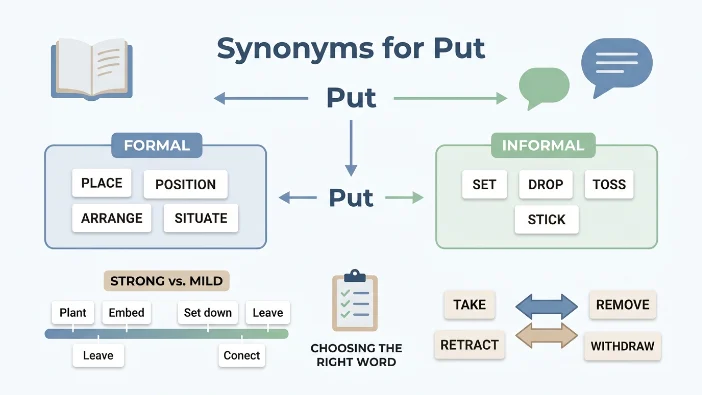
The best synonyms for put are place, set, position, and lay. Beyond these core options, the right word still depends on how formal your writing is, how strong you want the action to sound, and what exactly is being moved or placed somewhere.
Best Synonyms for Put
The best synonyms for put are place, set, position, and lay. The right choice depends on tone, context, and intensity for example, “place” works well in most writing, “position” suits precise or technical placement, and “lay” fits flat or horizontal placement.
What Does Put Mean?
At its core, “put” means to move something to a particular location or into a particular state. It’s a transitive verb, which means it needs an object you put something somewhere.
- Part of speech: verb (transitive)
- Core meaning: to move or place something in a specific spot, position, or condition
- Common usage: everyday speech, instructions, casual and formal writing alike
Example sentences:
- She put the keys on the table before she left.
- Put your name at the top of the form.
“Put” is neutral. It doesn’t carry much emotion or specificity on its own that’s part of why so many synonyms exist to add precision or feeling.
Core Meaning of Put
The idea behind “put” is simple: something moves from one place (or state) to another, and a person or force causes that movement. It can describe:
- Physical placement putting a cup on a shelf
- Abstract placement putting pressure on someone, putting an idea into words
- Change of state putting a plan into action
Because “put” covers so much ground, synonyms often narrow the meaning down. “Insert” suggests fitting something into a tight space. “Deposit” suggests setting something down carefully or officially. “Shove” suggests force. Choosing the right synonym means choosing how specific or emotional you want the action to sound.
Grammar and Usage Notes
“Put” is irregular in one useful way: its past tense and past participle are also “put” (not “putted,” except in golf). This makes it grammatically simple, even though its meanings are broad.
Common sentence patterns:
- Put + object + location (Put the box on the floor.)
- Put + object + into + state (Put the plan into motion.)
- Put + object + adjective (Put the room in order.)
Common phrases and collocations:
- put something away
- put something off (delay)
- put something out (extinguish)
- put someone up (host)
- put your mind to something
When “put” sounds natural: It works in almost any context casual conversation, instructions, business writing, and storytelling. It rarely sounds wrong.
When a synonym works better: If you’re writing something formal, technical, or descriptive, “put” can feel too plain. In those cases, words like “position,” “situate,” or “insert” carry more precision.
Best Synonyms for Put
| Synonym | Meaning | Tone | Best Use Case | Example Sentence |
|---|---|---|---|---|
| Place | To put something carefully in a spot | Neutral | General writing, instructions | She placed the vase on the windowsill. |
| Set | To put something down, often gently | Neutral | Everyday actions | He set his bag by the door. |
| Position | To put something in a precise spot | Formal/Technical | Technical or design contexts | Position the camera at eye level. |
| Lay | To put something down flat | Neutral | Physical, flat placement | Lay the blanket on the grass. |
| Insert | To put something into a space or opening | Formal/Technical | Fitting objects into slots or systems | Insert the key into the lock. |
| Deposit | To put something down, often officially or carefully | Formal | Banking, formal writing | He deposited the documents with the clerk. |
Common Synonyms for Put
These are everyday alternatives you’ll hear in regular conversation and casual writing.
Place to put something somewhere with a bit of care. Works in almost any everyday context. Example: Please place your order on the counter.
Set similar to place, often used for putting something down briefly. Example: I set my coffee on the desk and started typing.
Lay to put something down in a flat or resting position. Example: Lay the papers on the table so I can sign them.
Drop to put something down quickly or informally. Example: Just drop your coat on the chair.
Stick a casual way to say put, often used loosely. Example: Stick the leftovers in the fridge.
Formal Synonyms for Put
These fit academic writing, business communication, reports, and professional contexts where “put” can feel too casual.
Position used when precise placement matters, especially in technical or design writing. Example: Position the sensor two inches from the wall.
Situate a more formal way to describe placing something within a broader setting. Example: The new office is situated near the city center.
Deposit implies careful or official placement, often financial or procedural. Example: The auditor deposited the files in the secure archive.
Install used specifically for setting up equipment, systems, or fixtures. Example: The technician installed the new server rack.
Affix to attach or fasten something in place, often used in legal or technical writing. Example: Affix your signature at the bottom of the contract.
Informal Synonyms for Put
These work well in conversation, texting, social media, and relaxed writing.
Pop a light, casual way to describe putting something somewhere quickly. Example: Just pop it in the microwave for a minute.
Chuck implies putting something somewhere without much care. Example: Chuck your shoes by the door.
Stick again casual, common in spoken English. Example: Stick a note on the fridge so I don’t forget.
Dump implies putting something down carelessly or in bulk. Example: He dumped his bag on the couch and collapsed.
Toss suggests a quick, light throwing motion when placing something. Example: Toss your jacket on the bed for now.
Strong Synonyms for Put
These carry more force, emotion, or physical intensity. Use them when the action truly involves pressure, speed, or aggression otherwise they can sound exaggerated.
Thrust to push something forcefully into place. Example: She thrust the letter into his hands and walked off.
Jam to force something into a tight space, often with effort. Example: He jammed the suitcase into the overhead bin.
Shove to push something roughly. Example: She shoved the papers into her bag and ran out the door.
Slam to put something down hard and fast, often with emotion behind it. Example: He slammed the phone down on the counter.
Hurl to throw something with force, often angrily. Example: She hurled the report across the room in frustration.
Use these only when the sentence genuinely calls for force or emotion. In a calm, neutral sentence, “thrust” or “hurl” will feel out of place.
Mild Synonyms for Put
These are softer, gentler alternatives good for sensitive contexts, careful writing, or calm tones.
Rest to put something down gently, often against or on top of something. Example: She rested her hand on his shoulder.
Tuck to put something into a small, snug space carefully. Example: He tucked the note into her coat pocket.
Settle to put something down and leave it undisturbed. Example: She settled the tray on the nightstand.
Ease to put something into place slowly and carefully. Example: He eased the chair back into the corner.
Mild synonyms work well in descriptive or emotional writing where a soft, careful tone matters more than speed or force.
Synonyms for Put by Context
Everyday Conversation
“Put,” “pop,” “stick,” and “drop” all sound natural here. They’re short, familiar, and require no extra explanation.
Professional Writing
“Position,” “place,” “deposit,” and “install” sound more polished and precise, especially in reports, instructions, or business documents.
Academic Writing
“Situate,” “position,” and “insert” fit best. Academic tone favors precision over casual phrasing.
Creative Writing
Strong or mild synonyms like “thrust,” “ease,” “rest,” or “settle” add texture and emotion that plain “put” can’t offer.
Technical Writing
“Insert,” “position,” and “install” are standard in manuals, specs, and instructions where exact placement matters.
Personal Communication
Casual words like “stick,” “pop,” and “toss” fit texts, emails to friends, and everyday messages.
Another Word for Put in a Sentence
- Place your bag by the entrance.
- He set the plate down carefully.
- Lay the towel flat on the sand.
- Position the lamp closer to the desk.
- Insert the card into the slot.
- Deposit your application at the front desk.
- Pop the leftovers in the freezer.
- Chuck your keys in the bowl by the door.
- He shoved the folder into his backpack.
- She slammed the mug down on the table.
- Tuck the letter under the doormat.
- Ease the vase onto the shelf slowly.
- Install the new software before the meeting.
- Affix the label to the front of the box.
- He hurled the ball across the yard.
Put Synonyms Compared
Some synonyms overlap so closely that the difference comes down to tone or precision rather than meaning.
| Word Pair | Key Difference |
|---|---|
| Place vs. Put | “Place” suggests more care and intention; “put” is more neutral and general. |
| Set vs. Lay | “Set” often implies placing something upright or in position; “lay” implies flat placement. |
| Position vs. Place | “Position” implies precision, often technical; “place” is more general. |
| Shove vs. Put | “Shove” adds force and speed; “put” carries no emotion or intensity. |
| Insert vs. Put | “Insert” only works for fitting something into a space or opening; “put” works anywhere. |
Words Similar to Put
These words share meaning with “put” in certain situations but aren’t direct replacements in every sentence.
Leave implies putting something down and walking away, not just placing it. Why it’s different: “Leave” focuses on departure, not the act of placement itself. Example: She left her umbrella by the door.
Arrange implies organizing multiple items, not just placing one. Why it’s different: “Arrange” suggests order and structure, which “put” doesn’t require. Example: He arranged the chairs in a circle.
Locate implies finding a spot for something, often permanently. Why it’s different: “Locate” is more about establishing a lasting position than a quick action. Example: The company located its headquarters downtown.
Store implies putting something away for future use. Why it’s different: “Store” adds the idea of saving something, not just placing it. Example: They store extra supplies in the garage.
These words can sometimes substitute for “put,” but only when the sentence’s meaning matches their added nuance.
Antonyms of Put
| Antonym | Meaning | Example Sentence |
|---|---|---|
| Remove | To take something away from a place | Remove your shoes before entering. |
| Take | To move something away from its spot | She took the folder off the shelf. |
| Withdraw | To pull something back or out | He withdrew his hand from the box. |
| Extract | To pull something out, often with effort | The dentist extracted the tooth carefully. |
| Empty | To take everything out of a container | Empty the bag before you pack it again. |
How to Choose the Right Synonym for Put
- Match the context. Technical writing calls for “position” or “insert”; casual writing calls for “pop” or “stick.”
- Match the tone. Formal documents need formal words; friendly messages need relaxed ones.
- Check the intensity. Don’t use “hurl” or “slam” for a calm, ordinary action.
- Think about the reader. A reader expecting professional language will notice if your word choice feels too casual or too dramatic.
- Check whether it’s an exact match. Words like “arrange” or “store” add meaning that plain “put” doesn’t have. Make sure that extra meaning fits your sentence.
- Keep the sentence natural. If the synonym makes the sentence sound stiff or forced, it’s probably the wrong choice.
- Use simple words when clarity matters. “Put” and “place” are rarely wrong. Reach for something fancier only when it truly adds value.
Common Mistakes When Using Synonyms for Put
- Choosing a word with the wrong tone using “thrust” in a calm business email.
- Using a synonym that’s too strong “hurl” instead of “toss” for a light, casual action.
- Using a formal word in casual writing “situate” in a text to a friend sounds stiff.
- Using a casual word in professional writing “chuck” in a business report feels unprofessional.
- Replacing “put” without checking meaning “insert” only works for spaces or openings, not general placement.
- Treating related words as exact synonyms “arrange” and “store” both add meaning that “put” doesn’t carry.
- Making the sentence sound unnatural forcing a fancier word where a simple one reads better.
Quick Synonym List for Put
Common synonyms: place, set, lay, drop, stick
Formal synonyms: position, situate, deposit, install, affix
Informal synonyms: pop, chuck, stick, dump, toss
Strong synonyms: thrust, jam, shove, slam, hurl
Mild synonyms: rest, tuck, settle, ease
Related words: leave, arrange, locate, store
FAQs
What is the best synonym for put?
The best all-purpose synonym for put is place. It works in nearly every context casual, formal, written, or spoken without sounding too strong or too soft.
What is another word for put?
Common alternatives include place, set, lay, and position. The right one depends on whether you need a neutral, formal, or precise tone.
What is a formal synonym for put?
Position and situate are strong formal choices. They fit business, academic, and technical writing where precision matters more than casual phrasing.
What is an informal synonym for put?
Pop and stick are common informal choices. Both are used often in speech and casual writing, like texting a friend.
What is a stronger word for put?
Shove, thrust, and slam all carry more force or emotion than put. Use them only when the action itself involves speed, pressure, or intensity.
What is a milder word for put?
Rest, tuck, and ease describe a gentler, more careful version of putting something down.
What words are similar to put?
Words like leave, arrange, locate, and store are related but add extra meaning they aren’t always direct replacements.
What is the opposite of put?
Common antonyms include remove, take, withdraw, and extract all describing the act of taking something away rather than placing it.
Conclusion
“Put” is a simple, flexible word, but it isn’t always the most precise one. Whether you need something more formal, more casual, more forceful, or gentler, there’s a synonym that fits better than a generic word repeated over and over. The right choice always comes down to meaning, tone, context, and intensity match those four things, and your sentence will read naturally every time.
Read More Related Articles:
- Synonyms for excited and happy | Complete Guide to Stronger Emotional Vocabulary In 2026
- Synonyms for Hopeful | Which Word Fits Your Situation Best In 2026
- Synonyms for Broken | A Writer’s Guide to Precise Language In 2026

Ethan Caldwell is a writer who enjoys exploring the nuances of language and how words shape everyday communication. His work focuses on making complex ideas easier to understand through clear, engaging and accessible writing.