Finding the right word to describe the beginning of something can make your writing clearer and more engaging. If you’re looking for synonyms for start, you have many excellent options to choose from. The best choice depends entirely on what you’re describing, your audience, and the tone you want to set.
Whether you need a formal alternative for a business report, a casual word for a text message, or a stronger verb to add impact, this guide covers over 50 synonyms for start with clear explanations and real-world examples. Let’s explore the best ways to say start in any situation.
Best Synonyms for Start
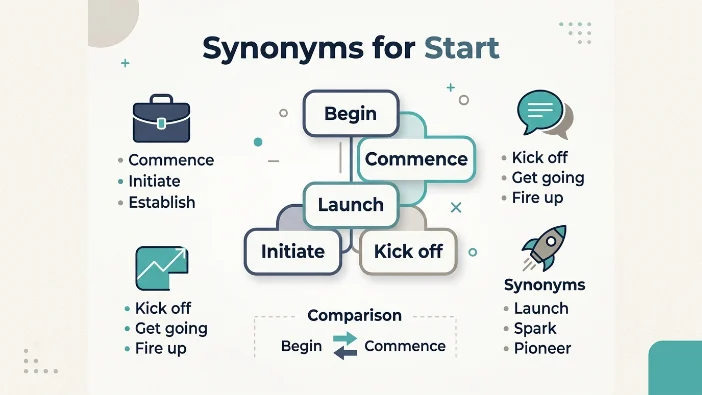
The best synonyms for start are begin, commence, launch, initiate, kick off, embark on, open, originate, establish, and activate. The right choice depends on whether you need a formal, informal, strong, or mild word and the specific context of your sentence.
What Does Start Mean?
Start is a versatile verb and noun that generally refers to the beginning of something. As a verb, it means to begin doing something, set something in motion, or cause something to happen. As a noun, it refers to the point at which something begins, an advantage in a competition, or a sudden movement.
The core idea behind start is the transition from inaction to action or from a state of not existing to existing. It’s a fundamental word in English with many applications.
Example sentences:
- “We need to start the meeting on time.”
- “The race had a clean start.”
- “She gave a start when the door slammed.”
Core Meaning of Start
At its heart, start is about the first moment or action of something. It represents the point at which a process, event, journey, or activity begins. It can refer to:
- The beginning of an action: “Start writing your essay.”
- The creation of something new: “They plan to start a business.”
- The activation of a mechanism: “Start the car.”
- The initial point of something: “The trail starts at the parking lot.”
- A sudden movement or reaction: “He woke with a start.”
This core meaning makes start one of the most commonly used words in English, which is why having a range of synonyms for start at your disposal is so valuable for effective communication.
Grammar and Usage Notes
Part of speech: Verb and noun.
Common sentence patterns:
- Verb: Start + [noun/gerund/infinitive]
- “She started the project.”
- “He started running.”
- “They started to work.”
- Noun: The/ a + start + [of/in/at]
- “The start of the movie.”
- “At the start of the day.”
Common collocations:
- Start a business / family / conversation / job / new chapter
- Start from scratch / the beginning / nothing
- Get started / off to a start
- From start to finish
- For a start
When start sounds natural:
Start works well in most everyday contexts, both spoken and written. It’s appropriate for general conversation, instructions, and informal writing.
When a synonym may work better:
A synonym for start may work better when you need a more formal tone (e.g., commence), a more vivid or impactful word (e.g., launch), a specific nuance (originate), or when you want to avoid repetition.
Best Synonyms for Start
Here is a curated list of the best synonyms for start, categorized by meaning, tone, and use case.
Common Synonyms for Start
These everyday alternatives to start are used in normal writing and conversation. They are safe, neutral, and widely understood.
Begin
The closest and most common synonym for start. It carries the same basic meaning and can be used interchangeably in almost any context.
- Best context: General use when you want a simple, clear word.
- Example: “Let’s begin the presentation.”
Commence
A more formal word for start often used in official settings or written instructions .
- Best context: Formal events, ceremonies, written legal or official documents.
- Example: “Construction is scheduled to commence next month.”
Get Going
An informal phrase meaning to start moving or to begin an activity.
- Best context: Casual conversation and informal writing.
- Example: “We should get going if we want to be on time.”
Set About
This phrasal verb means to start doing something with determination.
- Best context: Starting a task or project, often one that requires effort.
- Example: “She set about cleaning the house.”
Take the Plunge
An idiomatic expression that means to start doing something risky or bold .
- Best context: Starting a new venture, making a big life change, or doing something you’ve been hesitant about.
- Example: “They finally took the plunge and bought a house.”
Formal Synonyms for Start
In academic, business, and professional writing, a more formal synonym for start can elevate your language and convey a more serious or official tone .
Commence
This is a classic formal synonym for start . It is the preferred term for academic ceremonies, legal proceedings, and formal statements.
- Best use: Use in official announcements, academic texts, and formal letters.
- Example: “The court session will commence at 10:00 a.m.”
Initiate
To initiate is to cause a process to start . It implies that someone takes the first step in a series of actions.
- Best use: Use when describing the beginning of a policy, procedure, or process.
- Example: “The government plans to initiate new trade talks.”
Inaugurate
This formal word suggests the start of something significant or important, often with a ceremony .
- Best use: Use for new eras, major policies, or new leadership terms.
- Example: “The new president was inaugurated, inaugurating a new era in politics.”
Open
In a formal context, to open means to start an event, session, or discussion .
- Best use: Use at the beginning of a meeting, conference, or official event.
- Example: “The mayor will open the new community center.”
Embark On
This phrase is used for starting a significant or lengthy endeavor .
- Best use: Use for projects, ventures, or journeys that require a lot of commitment.
- Example: “The university will embark on a large-scale fundraising campaign.”
Establish
To establish is to set up something that is meant to last, such as an organization or a rule .
- Best use: Use for starting a company, a foundation, a law, or a custom.
- Example: “The founders aimed to establish a lasting institution.”
Informal Synonyms for Start
When you’re writing a text message, posting on social media, or having a casual conversation, informal synonyms for start are often the best choice.
Kick Off
This energetic phrase is perfect for starting an event or activity with enthusiasm .
- Tone: Casual, lively.
- Example: “Let’s kick off the weekend with a BBQ.”
Get the Ball Rolling
This expression means to start an activity or project.
- Tone: Casual, idiomatic.
- Example: “Let’s get the ball rolling on this project.”
Fire Up
To fire up means to start a machine, computer, or engine .
- Tone: Informal, slightly technical.
- Example: “Fire up the computer so I can check my email.”
Set Off
To set off means to start a journey or to cause a reaction to begin .
- Tone: Casual.
- Example: “We’ll set off for the airport at dawn.”
Take the First Step
This phrase emphasizes the action of beginning a process, often one that is difficult or requires courage .
- Tone: Encouraging, conversational.
- Example: “Just take the first step and apply for the job.”
Jump In
To jump in means to start an activity or conversation quickly and without hesitation.
- Tone: Very casual.
- Example: “Feel free to jump in with any questions.”
Strong Synonyms for Start
For writing that needs impact, these stronger synonyms for start carry more energy, power, or significance.
Launch
To launch suggests starting something with force and intention, often something new and public .
- When to use: Use when you want to emphasize the visibility and ambition of the new beginning, like a product, a campaign, or a major project.
- Warning: It can sound overly dramatic for small, everyday tasks.
- Example: “The company will launch its new line of products next month.”
Initiate
This word emphasizes the act of setting a course of action in motion . It implies agency and authority.
- When to use: Use in formal contexts where someone is responsible for starting a process.
- Warning: It can feel too formal for casual writing.
- Example: “The board voted to initiate a review of the policy.”
Pioneer
To pioneer means to be the first to develop or start something .
- When to use: Use when someone creates or starts something new and innovative.
- Warning: It is a strong word that should be reserved for truly novel efforts.
- Example: “She helped pioneer new techniques in the field.”
Spark
To spark means to cause something to start suddenly, especially an idea, a discussion, or a movement.
- When to use: Use for the beginning of an event, a debate, a war, or a significant change.
- Warning: It sounds unnatural if you use it for mundane activities.
- Example: “The event sparked a debate about climate change.”
Instigate
To instigate is to cause an event or situation to happen, often something negative or controversial .
- When to use: Use when starting something that may be provocative, such as a conflict or a rebellion.
- Warning: It often carries a negative connotation.
- Example: “They were accused of trying to instigate a riot.”
Mild Synonyms for Start
Sometimes, a softer word is better. These mild synonyms for start are neutral and less forceful.
Begin
Once again, begin is the most neutral and mild synonym. It doesn’t convey any extra energy or formality .
- Best context: When you want a simple, unobtrusive word.
- Example: “The story begins with a sad event.”
Initiate
While it can be formal, initiate can also be a neutral way to say something has started .
- Best context: In professional contexts where a formal or official tone is needed.
- Example: “We will initiate the new protocol next week.”
Open
To open can be a gentle way to start a conversation or a meeting .
- Best context: For starting discussions or formal events with a calm tone.
- Example: “I’d like to open the floor for questions.”
Set Off On
This phrase is a mild way to say you are starting a journey.
- Best context: Starting a trip or a new phase of life.
- Example: “Tomorrow, they set off on their long-awaited vacation.”
Synonyms for Start by Context
The best synonym for start often depends on the context in which you are writing or speaking. Here are the best options for different situations.
Everyday Conversation
In casual conversation, keep it simple.
- Best synonyms: Begin, start, get going, kick off, set off.
- Example: “Let’s kick off the game.”
Professional Writing
In emails, reports, and business documents, choose a more formal word.
- Best synonyms: Commence, initiate, launch, establish, open.
- Example: “We will initiate the project once the funding is approved.”
Academic Writing
For essays and research papers, accuracy and formality are key.
- Best synonyms: Commence, originate, initiate, embark on.
- Example: “The study originated from a need to address these issues.”
Creative Writing
Creative writing allows for more variety and expressive words.
- Best synonyms: Launch, spark, originate, pioneer, embark on.
- Example: “The incident sparked a series of unexpected events.”
Marketing Copy
Marketing requires energetic and persuasive language.
- Best synonyms: Launch, kick off, introduce, roll out.
- Example: “We are thrilled to launch our new collection.”
Technical Writing
Instructions and manuals need precise language.
- Best synonyms: Activate, power up, initialize, engage.
- Example: “Press the button to activate the system.”
Personal Communication
Texts and personal messages are informal.
- Best synonyms: Get going, kick off, start up, jump in.
- Example: “I’ll jump in and start dinner.”
Another Word for Start in a Sentence
Here are 15 natural example sentences using different synonyms for start.
- “Let’s begin the meeting with a quick update.”
- “The concert will commence at eight o’clock sharp.”
- “They plan to launch their new website next month.”
- “We’ll kick off the event with some opening remarks.”
- “She decided to embark on a new career as a writer.”
- “The two leaders initiated a dialogue to resolve the conflict.”
- “Please open the discussion with your thoughts.”
- “They hope to establish a new school in the region.”
- “Can you activate the security system before we leave?”
- “The fight was instigated by a few hotheaded fans.”
- “The discovery sparked a revolution in medicine.”
- “We need to get going if we don’t want to be late.”
- “The idea for the business originated from a simple observation.”
- “He plans to set up his own consulting firm.”
- “The runner got a good head start at the beginning of the race.”
Start Synonyms Compared
Some synonyms for start are very close in meaning but have important distinctions. Here’s how to understand the differences.
Begin vs. Commence vs. Start
- Begin is the most general term . You can begin a journey, a book, or a conversation.
- Start is also general but often suggests a first step in a process .
- Commence is more formal and is often used in official contexts .
- Example: You begin or start a new hobby, but a ceremony commences.
Launch vs. Initiate
- Launch implies a public, dynamic beginning, often for a product or campaign .
- Initiate suggests starting a process, procedure, or formal action .
- Example: A company launches a new smartphone; a government initiates an investigation.
Start vs. Kick Off
- Start is the standard verb.
- Kick off is a colorful, informal way to say start, often used for events, parties, or games .
- Example: You start a project, but you kick off a party.
Words Similar to Start
These words relate to the same semantic field as start but are not always exact synonyms. They may describe a part of the process or have a slightly different meaning.
Origin
Origin refers to the source or cause of something, rather than the action of beginning it.
- Why it’s related: It is about where something comes from, which is often the beginning point of a story or concept.
- Why it’s not an exact replacement: You can’t always use origin when you mean start. “The origin of the problem” is different from “Let’s start the problem.”
- When it’s useful: Use origin to talk about the root or source of something.
Initiation
Initiation is the noun form of initiate . It refers to the act of starting a process.
- Why it’s related: It’s the formal noun for the act of starting.
- Why it’s not an exact replacement: It’s a more formal noun. “The initiation of the plan” sounds official, whereas “the start of the plan” is more neutral.
- When it’s useful: Use it in formal contexts to describe the beginning of a process.
Outset
Outset means the very beginning of something .
- Why it’s related: It is a synonym for the start of something.
- Why it’s not an exact replacement: It’s a noun and doesn’t function as a verb. “At the outset” is a common phrase meaning “at the start.”
- When it’s useful: Use it to emphasize the initial point of a process or event.
Opening
Opening can refer to the beginning of an event or a gap or opportunity .
- Why it’s related: It describes the initial part of something, such as the opening of a play.
- Why it’s not an exact replacement: It has multiple meanings and may not fit as a verb. You open an event, but you don’t usually say you “opening a project.”
- When it’s useful: Use it for the beginning of a show, meeting, or to describe a job opportunity (“a job opening”).
Antonyms of Start
It’s just as important to know the words that mean the opposite of start. These antonyms describe the end, stop, or completion of something.
Stop
This is the direct opposite of start as a verb . It means to bring an action or movement to an end.
- Example: “Please stop talking during the movie.”
End
End means the final part of something or to bring something to a conclusion .
- Example: “The school year will end in June.”
Finish
To finish means to complete a task or reach the end of something.
- Example: “They hope to finish the project by Friday.”
Close
To close means to shut something down or bring something to an end, especially a business or a meeting .
- Example: “The store will close for the day at 9 p.m.”
Terminate
This is a formal antonym for start . It means to bring something to an end.
- Example: “They decided to terminate the contract.”
Cessation
This is the noun form of cease, meaning the ending or stopping of something.
- Example: “The war ended with the cessation of hostilities.”
How to Choose the Right Synonym for Start
Choosing the right word is easier when you consider a few key factors. Here is a practical guide to picking the best synonym for start.
- Match the context: What kind of writing are you doing? A formal report needs commence or initiate. A casual email can use get going or kick off .
- Match the tone: Do you want to sound serious, energetic, neutral, or friendly? Commence and inaugurate sound official. Launch and kick off sound energetic. Begin and start are always neutral .
- Check the intensity: Is the beginning a major event or a small step? Use launch and pioneer for big events. Use begin or open for small ones. Example: You launch a new business, but you begin a new book.
- Think about the reader: Who is your audience? A lawyer or a professor will expect formal language like initiate. Your friends on social media will respond better to informal words like fire up.
- Ensure it’s an exact synonym: Spark and instigate mean to cause a start, often with a specific type of beginning. Check that the nuance fits.
- Keep the sentence natural: If a formal word sounds clunky in a casual sentence, it’s the wrong choice. The best word is the one that sounds natural and clear.
- Use simple words when clarity matters: When the goal is simply to be understood, begin or start are almost always the best and clearest choices .
Common Mistakes When Using Synonyms for Start
Even experienced writers can make mistakes when choosing synonyms for start. Avoid these common pitfalls.
- Choosing a word with the wrong tone: Using commence in a text message sounds pretentious. Using kick off in a business report sounds too casual.
- Using a synonym that is too strong: Using launch or instigate for a simple, everyday task will sound overly dramatic.
- Using a formal word in casual writing: Commence, initiate, and establish can feel stiff and unnatural in an informal email or social media post.
- Using a casual word in professional writing: Kick off, get going, and fire up may be too colloquial for a formal report or a cover letter.
- Replacing start without checking the meaning: Spark implies a sudden or explosive beginning; originate means to have a specific source. Using them incorrectly changes the meaning of your sentence.
- Treating related words as exact synonyms: While origin and start are related, they are different parts of speech and are not interchangeable.
- Making the sentence sound unnatural: Sometimes the best choice is the simplest one. Forcing a synonym into a sentence where start or begin fits perfectly can ruin the flow of your writing.
Quick Synonym List for Start
Here is a clean, scannable list of all the synonyms for start mentioned in this article.
Common Synonyms
Formal Synonyms
Informal Synonyms
Strong Synonyms
Mild Synonyms
Related Words (Not Always Exact Synonyms)
FAQs
What is the best synonym for start?
The best synonym depends on your context. Begin is the most common and neutral alternative. For a more formal tone, use commence or initiate. For an energetic, informal setting, try kick off .
What is another word for start?
Many words can replace start. Common ones include begin, commence, initiate, launch, kick off, open, originate, embark on, and establish .
What is a formal synonym for start?
The most common formal synonyms for start are commence, initiate, and inaugurate . Embark on and establish are also formal choices for specific contexts.
What is an informal synonym for start?
An informal synonym for start is kick off . Other casual options include get going, fire up, set off, and jump in .
What is a stronger word for start?
Stronger words for start include launch, initiate, pioneer, spark, and instigate . These words imply more energy, power, or significance.
What is a milder word for start?
Begin is the mildest and most neutral synonym for start . Open is also mild when used in the context of starting a discussion or meeting .
What words are similar to start?
Words similar to start include origin, initiation, outset, and opening . These are related but may not be exact synonyms. For example, origin refers to the source of something, while start refers to the beginning.
What is the opposite of start?
The opposite of start is stop . Other antonyms include end , finish, close , and terminate .
How do I choose the right synonym for start?
To choose the right synonym, consider the context (formal vs. informal), the tone you want to set, the intensity of the beginning, and your audience. When in doubt, begin and start are always clear and safe choices.
Conclusion
Finding the right synonym for start can significantly improve your writing. Whether you need a formal term like commence for a business proposal, an informal phrase like kick off for a team meeting, or a strong verb like launch for a marketing campaign, there is a perfect word for every situation.
Remember to consider the context, tone, and intensity of your message. The best word is the one that fits naturally and communicates your meaning clearly. With the many synonyms for start now at your disposal, you can write with greater precision and confidence.
Read More Related Articles:
- Synonyms For School | Smarter Words for Every Learning Space In 2026
- Synonyms for Just | From “Only” to “Fair” Choose the Right Fit In 2026
- Synonyms For Teacher | Better Words to Describe Educators with Precision In 2026

Evelyn Turner is a content creator at SynonymsAura.com who enjoys exploring the richness of the English language. Her work focuses on word meanings, synonyms, expressions and everyday language usage, helping readers communicate with greater clarity and confidence.