“Help” is one of the most common words in English, which is exactly why it’s easy to overuse. If you’re searching for synonyms for help, you’re probably trying to make your writing sound more precise, more formal, more emotional, or just less repetitive. The good news: English has dozens of solid alternatives. The catch is that not every synonym fits every situation the right one depends on meaning, tone, context, and intensity.
This guide breaks it all down in plain language, with real examples you can actually use.
Best Synonyms for Help
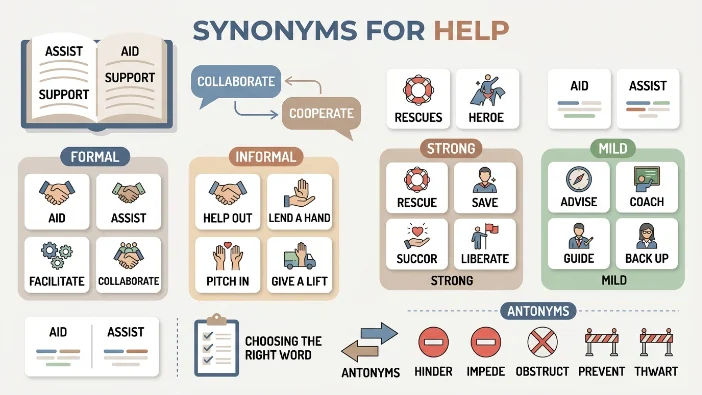
The best synonyms for help are assist, support, aid, and guide. Each one works a little differently depending on how formal your writing is and how much support you’re actually describing.
- Support good for emotional, financial, or ongoing help
- Assist a neutral, slightly formal choice for everyday and professional writing
- Aid common in formal, medical, or humanitarian contexts
- Guide best when the help involves direction or teaching
What Does Help Mean?
At its core, “help” means to make something easier for someone, or to provide what someone needs to do a task, solve a problem, or get through a difficult situation.
It works as both a verb and a noun.
- As a verb: “Can you help me carry these boxes?”
- As a noun: “I really appreciate your help this week.”
It’s one of the most flexible words in English. You can use it for small favors, emergencies, emotional support, professional assistance, or even general encouragement. That flexibility is exactly why so many writers look for alternatives “help” can start to feel vague or repeated if it shows up in every sentence.
Core Meaning of Help
Strip away the different sentence structures, and “help” always points to the same basic idea: contributing something time, effort, knowledge, money, or comfort so someone else has an easier time reaching a goal.
That “something” can be physical (helping someone move furniture), mental (helping someone understand a concept), or emotional (helping someone through grief). This is why so many synonyms exist English has separate words for physical assistance, emotional support, financial aid, and guidance, even though they all fall under the general umbrella of “help.
Grammar and Usage Notes
Part of speech: Help functions as a verb (to help) and a noun (some help, a lot of help). It’s rarely used as an adjective, though “helpful” is the related adjective form.
Common sentence patterns:
- Help + someone + verb → “Help me finish this.”
- Help + someone + with + noun → “Help her with the paperwork.”
- Need/want help → “I need help understanding this chart.”
Common collocations: ask for help, get help, need help, offer help, helping hand, help out, help desk.
When “help” sounds natural: in everyday speech, casual writing, instructions, and general requests. It’s the default word for a reason it’s simple and universally understood.
When a synonym works better: in formal writing where “assist” or “aid” sounds more polished, in emotional contexts where “support” carries more warmth, or in creative writing where repeating “help” five times in one paragraph starts to feel flat.
Best Synonyms for Help
| Synonym | Meaning | Tone | Best Use Case | Example Sentence |
|---|---|---|---|---|
| Assist | To give support in doing a task | Neutral to formal | Workplace, instructions | “The technician will assist you with setup.” |
| Support | To provide encouragement or backing | Neutral, warm | Emotional or ongoing help | “Her family supported her through the surgery.” |
| Aid | To give relief or assistance, often urgent | Formal | Medical, disaster relief, official writing | “Volunteers arrived to aid the flood victims.” |
| Guide | To help by directing or teaching | Neutral | Learning, mentorship | “She guided the new employees through onboarding.” |
| Assist (verb) | To lend a hand with a specific task | Formal-neutral | Professional settings | “He assisted the manager with the report.” |
| Back | To support someone’s decision or effort | Informal | Casual encouragement | “My friends backed me up when I quit my job.” |
| Facilitate | To make a process easier | Formal | Business, academic writing | “The app facilitates faster communication between teams.” |
| Contribute | To add effort toward a shared goal | Neutral | Teamwork, projects | “Everyone contributed to finishing the project early.” |
Common Synonyms for Help
These are the everyday alternatives you’ll use most often in regular writing and conversation.
Assist A slightly more formal version of help, common in workplaces and instructions. Example: “Please assist the customer at the front desk.”
Support Focuses on encouragement, backing, or ongoing help rather than a one-time task. Example: “I want to support you during this transition.”
Aid Suggests relief or assistance, often in a serious or official context. Example: “The charity provides aid to families in need.”
Guide Emphasizes direction, teaching, or showing someone the way. Example: “The mentor guided him through his first year on the job.”
Back (someone) up A casual way to say you’ll support or defend someone. Example: “Don’t worry, I’ve got your back on this.”
Formal Synonyms for Help
Use these in academic writing, business communication, reports, and professional emails.
Assist The safest formal replacement for help; works almost anywhere in professional writing. Example: “Our team is available to assist with any technical issues.”
Facilitate Best when help means making a process, meeting, or system run more smoothly. Example: “The new software facilitates faster onboarding.”
Aid Common in formal reports, especially around relief efforts, medical support, or policy. Example: “The grant will aid small businesses recovering from the storm.”
Contribute Fits when the help involves adding effort, resources, or ideas to a larger goal. Example: “Each department contributed to the final proposal.”
Render assistance A very formal, almost official phrase, best for legal, government, or ceremonial writing. Example: “Emergency crews were dispatched to render assistance to residents.”
Informal Synonyms for Help
These work well in conversation, texting, social media, and casual writing.
Give a hand A friendly, everyday way to offer help. Example: “Can you give me a hand with this couch?”
Pitch in Suggests helping as part of a group effort. Example: “We all pitched in to clean up after the party.”
Back up Means to support or stand behind someone, often in a disagreement or challenge. Example: “My roommate backed me up when I talked to the landlord.”
Chip in Usually about contributing money, time, or effort in small amounts. Example: “Everyone chipped in for the office gift.”
Lend a hand A warm, casual phrase for offering short-term help. Example: “He lent a hand while I moved into my new apartment.”
Strong Synonyms for Help
These carry more urgency, effort, or emotional weight than a plain “help.” Use them when the situation genuinely calls for intensity using them casually can sound dramatic or out of place.
Rescue Implies saving someone from real danger or a serious problem. Example: “Firefighters rescued the family from the burning building.” Too strong for: “Can you rescue me with this spreadsheet?” (sounds exaggerated for a small task)
Save Similar to rescue, often used for both literal and figurative emergencies. Example: “That last-minute idea saved the whole presentation.”
Champion Suggests strongly supporting a cause, person, or idea, often publicly. Example: “She championed the new policy through months of pushback.”
Bail out Implies rescuing someone from a difficult or embarrassing situation, often financial. Example: “His parents bailed him out when the car broke down.”
Mild Synonyms for Help
These are softer, more neutral, and useful when you don’t want to overstate the level of assistance involved.
Assist Neutral enough to work in almost any low-stakes situation. Example: “I can assist with a few small tasks today.”
Support Gentle and warm without sounding urgent. Example: “I’ll support you however I can.”
Ease Suggests making something a little less difficult, not solving it completely. Example: “This tool eases the process, but it won’t do everything for you.”
Facilitate Calm and process-focused, without emotional weight. Example: “The guide facilitates a smoother setup.”
Synonyms for Help by Context
Everyday Conversation
Stick with simple, familiar words: help, give a hand, pitch in, back up. These sound natural between friends, family, or coworkers and don’t feel forced.
Professional Writing
Lean on assist, support, facilitate, and contribute. These match the tone of emails, reports, and workplace communication without sounding stiff.
Academic Writing
Facilitate, aid, and contribute work well in essays, research papers, and formal analysis. Avoid casual phrases like “give a hand” entirely.
Creative Writing
Rescue, save, guide, and champion add emotional texture to stories, especially in scenes involving conflict, danger, or personal growth.
Marketing Copy
Support and guide often work better than help because they sound more benefit-focused. “We guide you through the process” feels more confident than “We help you through the process.”
Emotional Expression
Support and back (someone) up carry warmth and connection that plain “help” doesn’t always convey, especially when someone is going through something difficult.
Another Word for Help in a Sentence
- “She offered to assist with the presentation slides.”
- “The community rallied to support the family after the fire.”
- “International aid arrived within days of the earthquake.”
- “He guided the new intern through her first project.”
- “We all pitched in to finish the mural before sunset.”
- “The app facilitates communication between remote teams.”
- “Neighbors chipped in to fix the shared fence.”
- “Rescuers reached the hikers just before nightfall.”
- “Her mentor’s advice saved her from a costly mistake.”
- “I appreciate you backing me up in that meeting.”
- “The nonprofit works to aid families facing eviction.”
- “Can you lend a hand with these grocery bags?”
- “The volunteers contributed hundreds of hours this year.”
- “His calm presence eased her nerves before the interview.”
- “The coalition championed the bill for over a year.”
Help Synonyms Compared
| Word | Meaning | Tone | Intensity | Formality | Best Use Case |
|---|---|---|---|---|---|
| Assist | General support with a task | Neutral | Low-medium | Formal | Workplace, instructions |
| Support | Ongoing backing or encouragement | Warm | Medium | Neutral | Emotional situations |
| Aid | Relief or assistance, often urgent | Serious | Medium-high | Formal | Medical, disaster relief |
| Guide | Direction or teaching | Neutral | Low-medium | Neutral | Mentorship, learning |
| Rescue | Saving from danger | Urgent | High | Neutral-formal | Emergencies |
| Pitch in | Group contribution | Friendly | Low | Informal | Casual teamwork |
The biggest difference between these words isn’t meaning it’s how much weight they carry. “Assist” and “help” describe the same basic action, but “assist” sounds more polished. Rescue” and “help” can technically describe the same event, but “rescue” implies real danger while “help” could mean almost anything.
Words Similar to Help
These words share a connection to “help” but aren’t always direct replacements. Swapping them in without checking the meaning can change what your sentence actually says.
Encourage This is about motivating someone emotionally, not doing something for them. “She encouraged him to apply” isn’t the same as “She helped him apply.” Encouragement is emotional support; help often involves direct action.
Cooperate This means working together toward a shared goal, but it doesn’t imply one person is assisting another. Two coworkers can cooperate on a project without either one “helping” the other in the traditional sense.
Serve This can mean providing help, but it more often describes a role or duty, like a waiter serving customers or a volunteer serving a community. It’s broader than help.
Rescue As covered above, this implies danger or crisis. Not all help involves rescuing someone, so this word only fits specific, serious situations.
Enable This means making something possible, often indirectly. “The new software enabled faster reporting” describes a cause-and-effect relationship, not direct assistance from a person.
These words are useful when the exact meaning of “help” doesn’t quite fit your sentence, but they shouldn’t be treated as interchangeable with it.
Antonyms of Help
| Antonym | Meaning | Example Sentence |
|---|---|---|
| Hinder | To slow down or make something harder | “Poor planning hindered the project’s progress.” |
| Obstruct | To block or get in the way of something | “The fallen tree obstructed the rescue effort.” |
| Hamper | To limit or restrict someone’s ability to act | “Bad weather hampered the search operation.” |
| Impede | To slow or delay progress | “Red tape impeded the approval process.” |
| Sabotage | To deliberately damage or ruin something | “He sabotaged the meeting by leaking the plan early.” |
How to Choose the Right Synonym for Help
Match the context. A workplace email calls for “assist” or “support,” while a text to a friend calls for “give a hand” or “pitch in.”
Match the tone. If you’re writing something warm and personal, “support” fits better than the clinical-sounding “facilitate.”
Check the intensity. Don’t use “rescue” for small favors, and don’t use “help” for genuine emergencies where “save” or “rescue” is more accurate.
Think about the reader. Formal audiences expect polished words like “aid” or “facilitate.” Casual audiences respond better to natural, conversational choices.
Check whether the synonym is exact or only related. Words like “encourage” or “enable” are close in meaning but describe something slightly different from direct help.
Keep the sentence natural. If a synonym makes your sentence sound stiff or forced, it’s probably the wrong choice even if it’s technically accurate.
Use simple words when clarity matters. In instructions, tutorials, or safety information, “help” is often clearer than a fancier synonym. Don’t sacrifice clarity for variety.
Common Mistakes When Using Synonyms for Help
- Choosing a word with the wrong tone, like using “render assistance” in a casual text message.
- Using a synonym that’s too strong, such as “rescue” for something as small as proofreading an email.
- Using a formal word in casual writing, which can make friendly messages sound distant or robotic.
- Using a casual word in professional writing, like “pitch in” in a formal business report.
- Replacing “help” without checking meaning, especially with words like “enable” or “encourage” that describe something different.
- Treating related words as exact synonyms, such as assuming “cooperate” always means the same thing as “help.
- Making the sentence sound unnatural, by forcing a fancier word into a sentence where “help” would flow better.
Quick Synonym List for Help
Common synonyms: assist, support, aid, guide, back up, lend a hand
Formal synonyms: assist, facilitate, aid, contribute, render assistance
Informal synonyms: give a hand, pitch in, chip in, back up, lend a hand
Strong synonyms: rescue, save, champion, bail out
Mild synonyms: assist, support, ease, facilitate
Related words: encourage, cooperate, serve, enable
FAQs
What is the best synonym for help?
The best overall synonym for help is “assist.” It’s neutral, works in both formal and casual writing, and rarely sounds out of place. It keeps the original meaning of help while sounding slightly more polished.
What is another word for help?
Common alternatives include support, aid, guide, and assist. The right one depends on whether you need a formal, informal, strong, or mild tone.
What is a formal synonym for help?
“Facilitate” and “aid” are strong formal choices. They’re common in business writing, academic papers, and official reports where a more polished tone is expected.
What is an informal synonym for help?
“Pitch in” and “give a hand” work well in casual conversation, texting, and everyday writing. They sound natural between friends, family, or coworkers.
What is a stronger word for help?
“Rescue” and “save” carry much more intensity than help. They’re best for genuine emergencies or high-stakes situations, not everyday favors.
What is a milder word for help?
“Ease” and “assist” are softer choices that don’t overstate the level of support involved. They work well for small tasks or minor contributions.
What words are similar to help?
Encourage, cooperate, serve, and enable are related but not identical in meaning. They describe support-adjacent ideas without always meaning direct assistance.
What is the opposite of help?
Common antonyms include hinder, obstruct, hamper, and impede. These all describe actions that make something harder instead of easier.
How do I choose the right synonym for help?
Match your word choice to the context, tone, and intensity of the situation, and check whether the synonym truly matches your meaning before using it in place of help.
Conclusion
“Help” is a simple word, but the language around it is anything but limited. Whether you need something formal like “facilitate,” something warm like “support,” something urgent like “rescue,” or something casual like “pitch in,” English gives you plenty of room to match your exact meaning and tone. The right synonym isn’t the fanciest one it’s the one that fits your context, your reader, and how much help you’re actually describing.
Read More Related Articles:
- Synonyms For Spirituality | Creative Ways to Describe Your Higher Self and Awakening In 2026
- Synonyms for Most | Better Words for Maximum Impact In 2026
- Synonyms For Ask | Powerful Words That Get Results In 2026

Ethan Caldwell is a writer who enjoys exploring the nuances of language and how words shape everyday communication. His work focuses on making complex ideas easier to understand through clear, engaging and accessible writing.