“Happen” is one of those words we use constantly, sometimes too often. Whether you’re writing an essay, a story, or a text to a friend, repeating “happen” in every other sentence can make your writing feel flat.
The good news: English has plenty of solid alternatives. The best synonym for happen depends on what you’re describing a sudden event, a planned occurrence, a slow development, or something dramatic. This guide breaks down the most useful synonyms by tone, formality, and strength, with real examples so you can see exactly how each one works.
Best Synonyms for Happen
The best synonyms for happen are occur, take place, come about, and arise. The right choice depends on tone, context, and intensity “occur” fits formal writing, “take place” suits planned events, “come about” works for gradual causes, and “arise” fits problems or new situations.
What Does Happen Mean?
“Happen” means for something to take place or come into existence, usually without a fixed plan behind it. It describes an event, action, or situation existing in time something that occurs, whether expected or not.
Part of speech: Verb (intransitive)
Common usage: “Happen” is used to describe events, accidents, changes, or occurrences in everyday speech and writing.
Example sentences:
- “I don’t know what happened at the meeting.”
- “Accidents happen when people rush.”
Core Meaning of Happen
At its core, “happen” describes something entering reality an event moving from possibility to fact. It doesn’t specify whether the event was planned, sudden, good, or bad. That neutrality is exactly why it’s so common: it works in almost any situation.
This also means synonyms for happen aren’t all interchangeable. Some imply planning (“take place”), some imply randomness (“come about”), and some imply drama (“transpire,” “unfold”). Picking the right one adds precision that “happen” alone doesn’t offer.
Grammar and Usage Notes
Part of speech: Verb
Common sentence patterns:
- Something happens (subject + verb)
- Something happens to someone (“What happened to your car?”)
- It so happens that… (idiomatic phrase)
Common phrases and collocations:
- “happen to” (by chance)
- “as it happens”
- “what happened”
- “happen upon” (to find by accident)
When “happen” sounds natural: In everyday conversation, casual writing, and general storytelling, “happen” almost always sounds right. It’s simple and neutral.
When a synonym works better: In formal reports, academic writing, or when you want to add a specific tone (drama, gradual change, official timing), a synonym gives you more control than the generic “happen.
Best Synonyms for Happen
| Synonym | Meaning | Tone | Best Use Case | Example Sentence |
|---|---|---|---|---|
| Occur | To take place or exist | Neutral, formal | Reports, academic writing | “The error occurred during the final test run.” |
| Take place | To happen, usually as planned | Neutral | Scheduled events | “The ceremony will take place at noon.” |
| Come about | To happen through a series of causes | Neutral, conversational | Explaining how something developed | “The friendship came about after years of working together.” |
| Arise | To come into existence, often as a problem | Neutral to formal | Issues, opportunities, situations | “A conflict arose between the two departments.” |
| Transpire | To happen or become known | Formal | Narrative, news reporting | “It later transpired that the funds were misused.” |
| Unfold | To happen gradually, often dramatically | Neutral to literary | Stories, developing events | “The events of that night unfolded slowly.” |
| Ensue | To happen as a result of something else | Formal | Cause-and-effect writing | “A heated argument ensued after the announcement.” |
| Come to pass | To happen (older, literary usage) | Formal, literary | Storytelling, biblical or classic tone | “Everything he predicted eventually came to pass.” |
Common Synonyms for Happen
These are the words most people already use naturally in speech and everyday writing.
Occur A neutral, slightly more formal way to say something happened. Best context: General writing, reports, explanations. Example: “The power outage occurred around midnight.”
Take place Used for events that were scheduled or expected. Best context: Announcements, invitations, planning. Example: “The meeting will take place in Room 204.”
Come about Describes how something developed over time or through circumstances. Best context: Explaining causes or backstory. Example: “Nobody really knows how the rumor came about.”
Go on A casual way to describe something happening, often ongoing. Best context: Conversation, informal questions. Example: “What’s going on in there?”
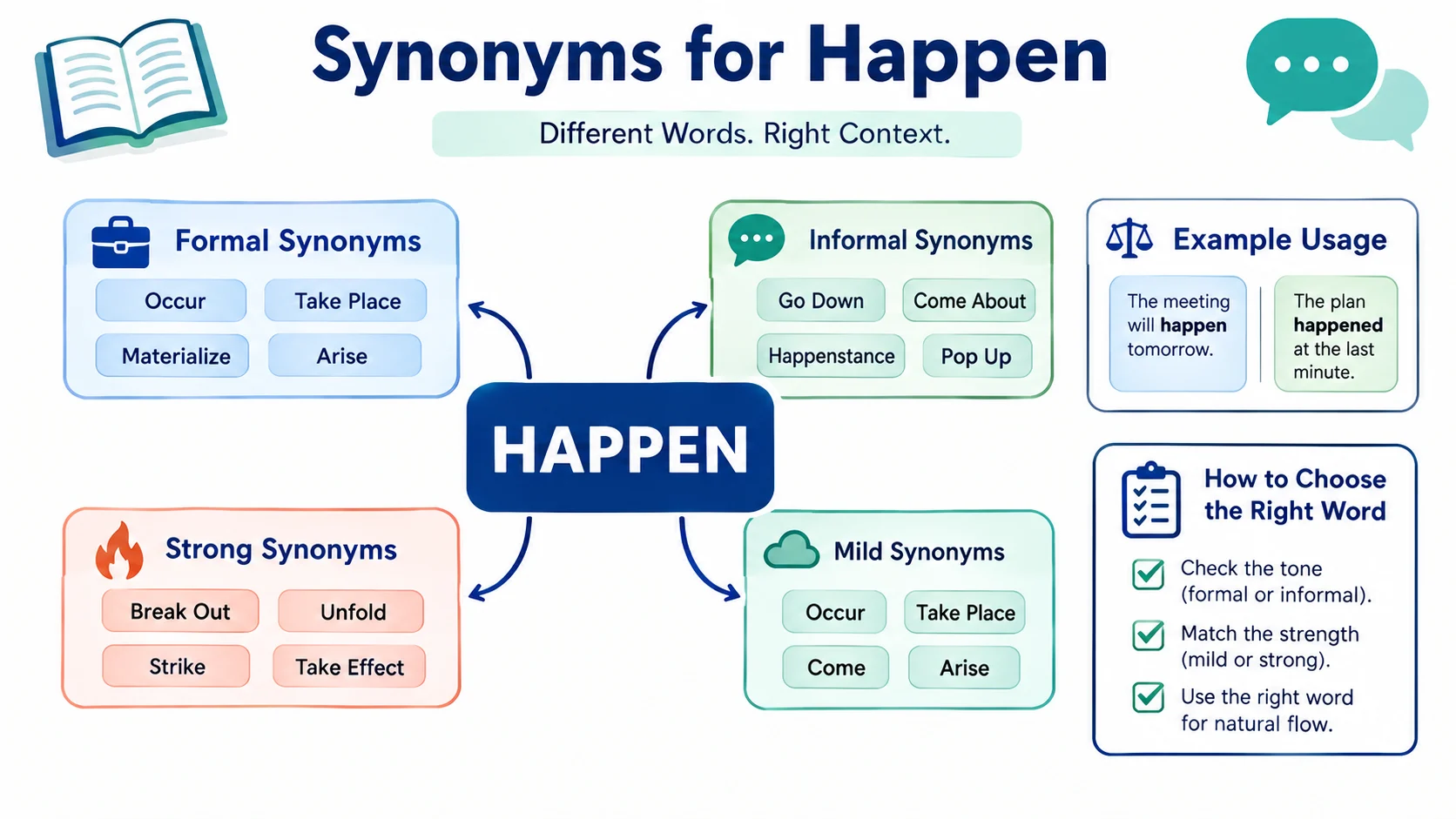
Formal Synonyms for Happen
Formal synonyms work well in academic writing, business reports, and professional communication where precision matters.
Occur The standard formal choice. Works in nearly any professional context. Best use: “Several delays occurred during the shipping process.”
Transpire Suggests something became known or happened, often after the fact. Best use: “It transpired that the report contained several errors.”
Arise Common in formal writing to describe problems, questions, or new situations appearing. Best use: “Should any issues arise, please contact support immediately.”
Ensue Implies one event directly caused another. Best use: “A lengthy investigation ensued following the audit.”
Materialize Suggests something moves from possibility to reality, often in plans or opportunities. Best use: “The proposed merger never materialized.”
Informal Synonyms for Happen
Casual alternatives fit conversation, texting, and relaxed writing where a formal word would feel stiff.
Go down Slang for something happening, often unexpected or dramatic. Best use: “You won’t believe what went down at the party.”
Come off Describes whether a plan or event succeeded. Best use: “The surprise party actually came off without a hitch.”
Crop up Something appears or happens unexpectedly. Best use: “A few problems cropped up during setup.”
Pop up Similar to “crop up,” used for sudden, small occurrences. Best use: “New issues keep popping up every week.”
Strong Synonyms for Happen
These carry more drama, weight, or emotional charge. Use them when the event itself is significant.
Erupt Implies something happens suddenly and forcefully. Best use: “Violence erupted after the announcement.” Caution: Too strong for minor or routine events.
Unfold Suggests a dramatic or complex event revealing itself over time. Best use: “The tragedy unfolded on live television.”
Break out Used for sudden, often negative events like conflict or disease. Best use: “Fighting broke out near the border.”
Strong synonyms work well in news writing, storytelling, and dramatic description. They can sound exaggerated if used for small, everyday events save them for moments that genuinely feel significant.
Mild Synonyms for Happen
Milder words keep the tone calm, neutral, or low-key. They’re useful when you don’t want to overstate an event.
Come about Neutral and gentle, good for explaining gradual causes. Best use: “The change came about slowly, over several months.”
Take place Calm and factual, ideal for routine or scheduled events. Best use: “The interview took place last Tuesday.”
Go on Casual and low-key, good for background activity. Best use: “Nothing much is going on today.”
Mild synonyms work best when the event is ordinary, planned, or not particularly dramatic using a strong word here would feel out of place.
Synonyms for Happen by Context
Everyday Conversation
“Happen,” “go on,” and “come about” all sound natural here. Formal words like “transpire” or “ensue” would feel out of place in casual talk.
Professional Writing
“Occur,” “arise,” and “materialize” fit reports, emails, and business documents. They sound precise without being overly dramatic.
Academic Writing
“Occur,” “arise,” and “ensue” work well for describing results, events, or cause-and-effect relationships in essays and research papers.
Creative Writing
“Unfold,” “transpire,” and “come to pass” add narrative texture. They’re useful when you want the reader to feel the pacing of events, not just read a fact.
Marketing Copy
“Happen” itself often works best here for its simplicity (“Big things are about to happen”). “Take place” fits event promotion (“The launch takes place next week”).
Emotional Expression
“Erupt,” “break out,” and “unfold” carry emotional weight, useful when describing conflict, crisis, or intense moments.
Another Word for Happen in a Sentence
- “The accident occurred just before sunrise.”
- “The wedding will take place at the botanical garden.”
- “Nobody expected the merger to come about so quickly.”
- “A strange feeling arose as she opened the door.”
- “It later transpired that he had lied about his job.”
- “The story unfolded slowly across three chapters.”
- “A serious argument ensued after the vote.”
- “Everything the fortune teller said eventually came to pass.”
- “You won’t believe what went down last night.”
- “The trip almost didn’t come off due to bad weather.”
- “A few technical issues cropped up during the demo.”
- “Riots broke out shortly after the announcement.”
- “New opportunities kept popping up all year.”
- “The plan never materialized due to lack of funding.”
- “Nothing interesting is going on around here.”
Happen Synonyms Compared
| Word | Meaning Focus | Tone | Intensity | Best Use Case |
|---|---|---|---|---|
| Occur | Neutral fact of an event | Formal | Low-medium | General formal writing |
| Take place | Planned or scheduled event | Neutral | Low | Announcements, schedules |
| Arise | Something appears, often a problem | Formal | Medium | Issues, situations |
| Transpire | Something becomes known | Formal | Medium | Reveals, reporting |
| Unfold | Gradual, often dramatic development | Literary | Medium-high | Storytelling |
| Ensue | Direct result of a prior event | Formal | Medium | Cause and effect |
| Erupt | Sudden, forceful occurrence | Strong | High | Conflict, crisis |
| Come about | Gradual development from causes | Casual-neutral | Low | Explaining backstory |
The key difference between many of these words isn’t meaning alone it’s implication. “Arise” hints at a problem forming. “Ensue” hints at consequence. “Transpire” hints at something coming to light. “Happen” carries none of these hints, which is exactly why it’s so flexible but also less descriptive.
Words Similar to Happen
These words share meaning with “happen” but aren’t always direct replacements.
Exist Describes a state of being, not an event unfolding. “The problem exists” is different from “the problem happened.” Use “exist” for ongoing conditions, not one-time events.
Result Focuses on the outcome of a cause, not the event itself. The delay resulted in a loss” describes a consequence, not simply that something happened.
Do Sometimes confused with “happen,” but “do” requires an actor performing an action. “What did you do?” is different from “What happened?” the second doesn’t assume anyone caused it.
Change Describes a shift in state, not necessarily a single event. Something can change gradually without a clear moment of “happening.”
Perform Implies intentional action by a person, unlike “happen,” which is often accidental or uncontrolled.
These related words are useful in nearby contexts, but swapping them in for “happen” directly usually changes the meaning of the sentence.
Antonyms of Happen
| Antonym | Meaning | Example Sentence |
|---|---|---|
| Cease | To stop happening or existing | “The noise ceased after a few minutes.” |
| Vanish | To disappear completely | “All evidence of the event vanished overnight.” |
| Fail to occur | To not happen at all | “The expected rainfall failed to occur that season.” |
| Prevent | To stop something from happening | “Quick action prevented the accident.” |
| Avoid | To keep something from happening to you | “She avoided the confrontation entirely.” |
How to Choose the Right Synonym for Happen
Match the context. A scheduled wedding “takes place.” A sudden accident “occurs” or “happens.” Don’t use “unfold” for a routine meeting it implies drama that isn’t there.
Match the tone. Formal writing calls for “occur” or “arise.” Casual writing calls for “go on” or “come about.”
Check the intensity. “Erupt” and “break out” suggest force and urgency. Save them for events that are actually dramatic, not everyday occurrences.
Think about the reader. Academic and business readers expect precise, formal words. Friends and casual audiences expect natural, relaxed language.
Check whether the synonym is exact or only related. Words like “result” or “exist” describe related ideas but don’t mean the same thing as “happen.” Don’t force them into a sentence where they don’t fit logically.
Keep the sentence natural. If a synonym makes the sentence sound stiff or overly formal for the situation, it’s the wrong choice even if the definition technically fits.
Use simple words when clarity matters. In instructions, warnings, or clear communication, “happen” is often better than a fancier synonym. Precision beats variety when the message needs to be understood instantly.
Common Mistakes When Using Synonyms for Happen
Choosing a word with the wrong tone. Using “transpire” in a text message to a friend sounds stiff and unnatural.
Using a synonym that’s too strong. Saying “chaos erupted” when describing a minor scheduling mix-up overstates the situation.
Using a formal word in casual writing. “Ensue” in a casual blog post can feel awkward and out of place.
Using a casual word in professional writing. “Stuff went down at the office” doesn’t belong in a business report.
Replacing “happen” without checking meaning. “Result” and “happen” aren’t interchangeable one describes a cause-and-effect outcome, the other describes an event itself.
Treating related words as exact synonyms. “Exist” describes a state, not an event. Swapping it in for “happen” can confuse the sentence’s meaning.
Making the sentence sound unnatural. If a synonym forces you to restructure the whole sentence awkwardly, it’s probably not the right fit.
Quick Synonym List for Happen
Common synonyms: occur, take place, come about, go on
Formal synonyms: occur, arise, transpire, ensue, materialize
Informal synonyms: go down, come off, crop up, pop up
Strong synonyms: erupt, break out, unfold
Mild synonyms: come about, take place, go on
Related words: exist, result, change, perform
FAQs
What is the best synonym for happen?
Occur” is the best all-purpose synonym for happen. It fits formal and general writing without sounding too casual or too dramatic, making it the safest choice in most situations.
What is another word for happen?
Common alternatives include occur, take place, come about, and arise. Each fits slightly different contexts “take place” suits planned events, while “arise” often signals a problem or new situation forming.
What is a formal synonym for happen?
“Occur” and “transpire” are strong formal choices. Occur” works in reports and general professional writing, while “transpire” fits situations where something becomes known after the fact.
What is an informal synonym for happen?
“Go down” and “come off” are common informal choices. “Go down” fits casual conversation about events, while “come off” specifically describes whether a plan succeeded.
What is a stronger word for happen?
Erupt” and “break out” are stronger alternatives, best used for sudden, forceful, or dramatic events like conflict, violence, or crisis not everyday occurrences.
What is a milder word for happen?
“Come about” and “take place” are milder, more neutral choices. They work well for calm, planned, or gradual events without adding drama.
What words are similar to happen?
Words like “exist,” “result,” and “change” are related in meaning but aren’t exact synonyms. They describe states or outcomes rather than the event of something happening.
What is the opposite of happen?
Common antonyms include cease, vanish, and fail to occur. These describe something stopping, disappearing, or never coming into existence.
How do I choose the right synonym for happen?
Match the word to your context, tone, and intensity. Formal writing calls for words like “occur” or “arise,” casual writing calls for “go on” or “come about,” and dramatic events call for stronger words like “erupt.”
Conclusion
“Happen” is simple and reliable, but it isn’t your only option. Words like “occur,” “take place,” “arise,” and “unfold” each add a slightly different shade of meaning some more formal, some more dramatic, some more neutral.
The best synonym isn’t the fanciest one. It’s the one that matches your context, tone, and the actual weight of the event you’re describing. Once you get a feel for these small differences, choosing the right word becomes second nature.
Read More Related Articles:
- Synonyms for Prove | Sound Smarter Instantly In 2026
- Synonyms for Resonate | Express Ideas More Powerfully In 2026
- Synonyms for Kill | From Basic to Advanced Words In 2026

Grace Phillips contributes content to SynonymsAura.com, where she writes about language, vocabulary and everyday communication. Her work is centered on helping readers find the right words and express themselves with greater clarity and confidence.