Sometimes the word “sadly” feels a bit tired. You might use it in an email, a story, or a casual conversation, and it does the job. But other times, you need a word that carries more weight, fits a formal report, or sounds natural in a quick text.
The best synonyms for sadly depend entirely on your tone and meaning.
- For expressing regret, try unfortunately.
- For deep sorrow, use mournfully or grievously.
- For a mild letdown, disappointingly works well.
This guide breaks down every option so you can pick the perfect word every time.
Best Synonyms for Sadly
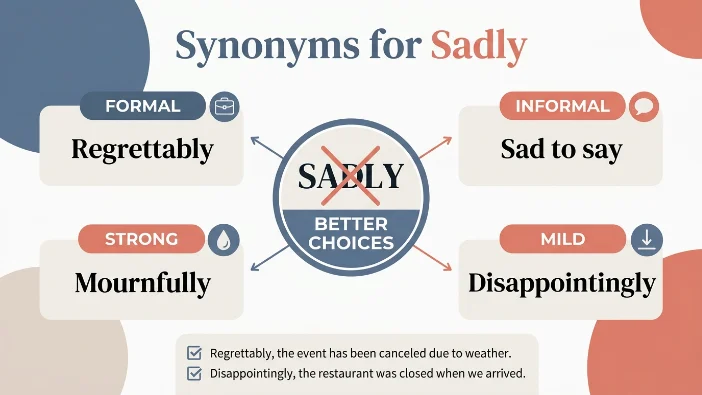
The best synonyms for sadly are unfortunately, regrettably, mournfully, and disappointingly. Unfortunately is best for bad news, regrettably for formal apologies, mournfully for deep emotional sorrow, and disappointingly for mild failures or letdowns.
What Does Sadly Mean?
Sadly is an adverb. It has two main jobs in a sentence.
First, it describes how someone does something—with sadness or sorrow. Second, it acts as a sentence adverb to express that something is unfortunate or regrettable.
- Simple definition: In a sad manner; it is a sad or unfortunate fact that.
- Part of speech: Adverb
- Example (manner): She looked at the old photograph sadly and put it back in the drawer.
- Example (sentence adverb): Sadly, the bakery closed its doors after forty years.
Core Meaning of Sadly
The core feeling behind “sadly” is a mix of disappointment, sorrow, or regret. When you use it, you are signaling that something has happened that you wish had not happened.
It can point to a small loss, like a rained-out picnic, or a huge one, like the death of a loved one. The word itself is neutral enough to work in both situations, but that neutrality is also its weakness. It rarely captures the exact shade of feeling you want to share.
Grammar and Usage Notes
- Position matters: As a sentence adverb, “sadly” usually starts a clause (Sadly, the team lost). As an adverb of manner, it follows the verb (He smiled sadly).
- Common patterns: It often pairs with verbs of emotion or observation (said sadly, noted sadly, shook his head sadly).
- When it sounds natural: In everyday storytelling, simple news, or personal reflection.
- When to switch: When you need more formality (reports, academic writing), more intensity (grief, tragedy), or more precision (disappointment vs. sorrow).
Best Synonyms for Sadly
This table gives you the most accurate and useful synonyms, organized for quick comparison.
| Synonym | Meaning | Tone | Best Use Case | Example Sentence |
|---|---|---|---|---|
| Unfortunately | It is unlucky or regrettable that | Neutral, common | Delivering bad news politely | Unfortunately, your application was not selected. |
| Regrettably | Causing sorrow or disappointment, often with a sense of personal responsibility | Formal, apologetic | Formal apologies, public statements | Regrettably, we must cancel the event. |
| Mournfully | Feeling or showing deep sorrow, like grieving | Emotional, literary | Describing grief, funerals, loss | The widow walked mournfully through the cemetery. |
| Disappointingly | Failing to meet expectations | Mild, critical | Reviews, performance feedback | The sequel was disappointingly short. |
| Alas | An exclamation of grief or pity | Old-fashioned, humorous | Creative writing, ironic statements | Alas, the cookies were all gone. |
| Woefully | In a way that expresses sorrow or misery; also means very badly | Strong, emphatic | Describing inadequacy or failure | The report was woefully incomplete. |
| Sorrowfully | Full of or showing sorrow | Formal, emotional | Literary or high-emotion contexts | He sorrowfully accepted the verdict. |
Common Synonyms for Sadly
These are the everyday words you can use in normal writing and conversation.
Unfortunately
This is the closest and most common replacement for “sadly” when giving bad news.
- Context: Emails, casual updates, news.
- Example: I’d love to come, but unfortunately, I have another meeting.
Regrettably
Slightly more formal than “unfortunately.” It often implies you or someone else should have done better.
- Context: Professional apologies, official statements.
- Example: Regrettably, an error was made in your billing statement.
Alas
An old-fashioned word that sounds charming or slightly funny today. Use it for effect.
- Context: Humorous writing, fairy tales, nostalgic posts.
- Example: She wanted the last slice of pizza, but alas, her brother had already eaten it.
Formal Synonyms for Sadly
In academic papers, business reports, or professional communications, you need precise and serious language.
Regrettably (as above) is your best choice for most formal writing.
Lamentably
This word means something is deserving of grief or regret. It is stronger and more formal than “regrettably.”
- Best use: Critiques, legal or policy documents.
- Example: The company’s response to the crisis was lamentably slow.
Tragically
Use this only when the outcome involves real harm, loss of life, or extreme misfortune. Do not use it for small problems.
- Best use: News reports, historical accounts, serious essays.
- Example: Tragically, the fire crew arrived moments too late.
Deplorably
This means something is shockingly bad or worthy of strong disapproval.
- Best use: Moral or ethical criticism.
- Example: The prison conditions were deplorably inhumane.
Informal Synonyms for Sadly
For texts, social media, or talking with friends, keep it simple and real.
Sad to say
A very common spoken phrase.
- Tone: Conversational, personal.
- Example: Sad to say, the restaurant we loved is closing down.
Bummer
A noun used as an exclamation. It is very casual.
- Tone: Slang, youthful.
- Example: You can’t come to the beach? Bummer.
Sorely
Often used with words like “missed” or “needed.”
- Tone: Slightly old but still natural.
- Example: His sense of humor will be sorely missed at the office.
No such luck
A phrase meaning something good did not happen.
- Tone: Casual, mildly disappointed.
- Example: I hoped for rain to cancel the game, but no such luck.
Strong Synonyms for Sadly
When simple sadness is not enough, use these words to show deep grief, tragedy, or intense regret.
Grievously
This means causing great pain or suffering. It is a heavy word.
- When to use: Describing injury, harm, or severe wrongs.
- Example: The community was grievously affected by the factory closure.
Mournfully (as above)
Focuses on the outward expression of grief.
Dolefully
This describes a sad appearance or manner, often with a sense of hopelessness.
- When to use: Character descriptions in writing.
- Example: The lost dog looked dolefully at every passing car.
Heavily
When sadness feels like a weight.
- When to use: Emotional or poetic descriptions.
- Example: She sighed heavily and turned away.
Mild Synonyms for Sadly
For small disappointments or low-stakes situations, softer words work better than dramatic ones.
Disappointingly (as above)
Best for things that did not meet a standard or hope.
Unluckily
Focuses on chance or bad luck, not deep emotion.
- Example: Unluckily for him, it started raining right as he left.
Regrettably (can be mild or formal)
In a light context, it sounds slightly polite but not heavy.
- Example: Regrettably, the store was out of my favorite coffee.
Sadly enough
Adding “enough” makes the tone more conversational and less intense.
- Example: Sadly enough, no one remembered her birthday.
Synonyms for Sadly by Context
Everyday Conversation
Stick with unfortunately, sad to say, or disappointingly. These sound natural and not overly dramatic.
- “I wanted to go, but unfortunately, I’m sick.”
Professional Writing
Use regrettably or unfortunately. Avoid emotional words like “tragically” or “mournfully” unless the situation truly calls for them.
- “Regrettably, your proposal did not meet the selection criteria.”
Academic Writing
Regrettably and lamentably are strong choices. Be specific about the nature of the sadness or failure.
- “The study’s sample size was lamentably small, limiting its conclusions.”
Creative Writing
This is where you have the most freedom. Use mournfully, dolefully, sorrowfully, or alas for character voice.
- “The old man sat alone, staring mournfully at the empty chair.”
Emotional Expression
When you need to express genuine grief, use grievously, tragically, or sorrowfully.
- “She spoke sorrowfully of the years they had lost.”
Another Word for Sadly in a Sentence
Here are realistic examples showing different synonyms in action.
- Unfortunately, the flight was delayed by six hours.
- She shook her head regrettably and admitted her mistake.
- Alas, the hero arrived too late to save the village.
- The movie was disappointingly predictable from start to finish.
- He looked dolefully at his empty wallet.
- Tragically, the manuscript was destroyed in the fire.
- The software performed woefully below expectations.
- “I cannot help you,” the clerk said sorrowfully.
- Sad to say, I think we chose the wrong contractor.
- The garden had been grievously neglected for years.
- Unluckily for the batter, the sun was directly in his eyes.
- She smiled sadly and walked away without another word.
Sadly Synonyms Compared
Two pairs of synonyms cause the most confusion. Here is the difference.
| Pair | Key Difference | Example |
|---|---|---|
| Unfortunately vs. Regrettably | Unfortunately is neutral about blame. Regrettably often implies someone (even the speaker) could have changed the outcome. | Unfortunately, it rained. (No one is at fault). Regrettably, I forgot to save the file. (I feel some responsibility). |
| Sadly vs. Mournfully | Sadly can be mild or deep. Mournfully always refers to the visible, outward signs of deep grief. | She sadly returned the lost wallet. (She feels bad). She held the old letter mournfully. (She is actively grieving). |
Words Similar to Sadly
These words live in the same neighborhood as “sadly” but are not direct replacements. Use them when you want a related but distinct meaning.
- Solemnly: Seriously, with dignity or ceremony. Not the same as sadness. A judge speaks solemnly, not sadly.
- Wistfully: With a vague, yearning sadness for something in the past. It is softer and more nostalgic.
- Despondently: Showing a loss of hope. This is much stronger than simple sadness.
- Melancholically: A thoughtful, gentle, long-term sadness. More of a mood than a reaction to an event.
Antonyms of Sadly
These words express the opposite of sadness, regret, or misfortune.
| Antonym | Meaning | Example Sentence |
|---|---|---|
| Happily | In a happy way; fortunately | Happily, the children were found safe and sound. |
| Fortunately | By good luck | Fortunately, I had an extra key. |
| Joyfully | With great joy | She joyfully accepted the award. |
| Thankfully | Expressing relief or gratitude | Thankfully, the storm passed without damage. |
| Cheerfully | In a cheerful manner | He cheerfully agreed to help with the move. |
How to Choose the Right Synonym for Sadly
Follow these steps to pick the best word.
- Match the context. Is this a text to a friend, a work email, or a novel? Choose a formal or informal word accordingly.
- Check the intensity. Did someone die, or did you just miss the bus? Use a strong word like grievously only for serious situations. Use disappointingly for small things.
- Decide who is at fault. Use regrettably if you or the subject bears some responsibility. Use unfortunately for random bad luck.
- Read the sentence aloud. Does the new word sound natural? If it feels forced or dramatic, try a simpler synonym.
- Avoid overuse. Sometimes one “sadly” per paragraph is plenty. Vary your sentence structure instead of just swapping synonyms.
Common Mistakes When Using Synonyms for Sadly
Even good writers make these errors. Here is what to watch for.
- Using “tragically” for minor problems. Missing a sale is not a tragedy. Reserve the word for real loss.
- Using “mournfully” in a business email. It sounds strange and overly emotional. Stick with “regrettably.”
- Using “alas” in serious writing. It will sound like you are joking or writing a Shakespeare play.
- Forgetting sentence position. “Unfortunately” works at the start of a sentence. “Sadly” as a manner word works after the verb. Do not mix them up.
- Treating all synonyms as equal. “Woefully incomplete” is not the same as “disappointingly incomplete.” The first is much stronger.
Quick Synonym List for Sadly
- Common: Unfortunately, regrettably, disappointingly
- Formal: Lamentably, tragically, deplorably
- Informal: Sad to say, bummer, no such luck, sorely
- Strong: Grievously, mournfully, dolefully, sorrowfully
- Mild: Unluckily, sadly enough
- Related Words: Solemnly, wistfully, despondently, melancholically
FAQs
What is the best synonym for sadly?
Unfortunately is the best all-purpose synonym. It works in almost any situation where you need to express that something is sad or regrettable, from casual conversation to professional writing.
What is another word for sadly in a formal letter?
Use regrettably. It sounds professional, polite, and accepts a degree of responsibility. For example: “Regrettably, we cannot offer you a refund at this time.”
What is an informal synonym for sadly?
Sad to say is the most natural informal synonym. Bummer is also common but very casual and used more as an exclamation than in a sentence.
What is a stronger word for sadly?
Mournfully and grievously are much stronger. Mournfully describes the act of grieving. Grievously describes a situation that causes severe harm or suffering.
What is a milder word for sadly?
Disappointingly is milder. It focuses on unmet expectations rather than deep emotional pain. Unluckily is also mild and emphasizes chance.
What words are similar to sadly but not exact synonyms?
Wistfully (a longing sadness for the past) and solemnly (seriously, without humor) are similar but not interchangeable with sadly.
What is the opposite of sadly?
The most direct opposites are happily and fortunately. Use happily for emotional opposites. Use fortunately for situational opposites (good luck vs. bad luck).
How do I choose the right synonym for sadly in my writing?
First, decide if you are expressing emotion (manner) or giving bad news (sentence adverb). Then, match the formality to your audience. Finally, pick an intensity that fits the event.
Conclusion
Finding the right word for “sadly” comes down to knowing what you really mean. Are you sharing bad news? Use unfortunately. Are you apologizing with weight? Use regrettably. Are you writing a character who has lost everything? Use mournfully.
Keep this guide handy. The next time you type “sadly,” pause and ask yourself if a more precise word would say it better. Your readers will feel the difference.
Read More Related Articles:
- Synonyms for Embarrassed | Smarter Word Choices for Every Context In 2026
- Synonyms For Felt | Make Your Writing More Descriptive In 2026
- Synonyms for Stress | Meaning, Examples, and Better Word Choices In 2026

Evelyn Turner is a content creator at SynonymsAura.com who enjoys exploring the richness of the English language. Her work focuses on word meanings, synonyms, expressions and everyday language usage, helping readers communicate with greater clarity and confidence.