Feeling stressed? You have plenty of company. But when you sit down to write about that feeling in an email, a report, or a journal entry the word “stress” can start to feel overused.
The best synonyms for stress are pressure, strain, tension, and worry. The right choice depends on your tone, context, and how intense the feeling really is. A student before an exam feels different stress than a working parent juggling late meetings and a sick child. A formal business report needs different language than a text to a close friend.
This guide gives you accurate synonyms for stress, organized by formality, strength, and real-world situation. You will find clear definitions, example sentences, and practical advice to help you choose the right word every time.
Best Synonyms for Stress
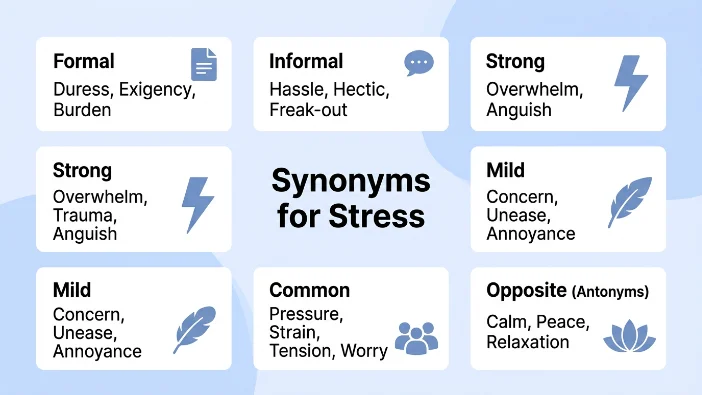
The best synonyms for stress are pressure, strain, tension, and worry. Use pressure for external demands, strain for the feeling of being stretched too thin, tension for a strained mental or emotional state, and worry for stress caused by anxious thoughts. For a stronger word, try overwhelm or trauma. For a milder word, use hassle or nuisance.
What Does Stress Mean?
Stress is a state of mental or emotional strain caused by difficult or demanding situations.
The core idea behind stress is pressure that feels hard to handle. It can come from outside forces, like a tight deadline or heavy traffic. It can also come from inside, like worry about the future or frustration with a situation.
As a noun, stress refers to the feeling or condition. As a verb, “to stress” means to emphasize something or to become anxious.
Example sentences:
- Financial stress kept her awake at night.
- He stressed the importance of meeting the deadline.
Core Meaning of Stress
At its heart, stress is the body and mind’s response to a challenge or demand. When you face something that requires extra effort, focus, or energy, you feel stress. A little stress can sharpen your performance. Too much stress wears you down.
Stress often involves a mix of physical sensations (tight muscles, fast heartbeat), emotions (irritability, fear), and thoughts (”I cannot handle this”). The word covers everything from mild daily frustrations to serious, long-term pressure.
Grammar and Usage Notes
Part of speech: Noun (most common) and verb.
Common sentence patterns:
- Noun: “She is under a lot of stress.”
- Verb: “Please do not stress me out.”
- Verb (different meaning): “Let me stress that this is urgent.”
Common phrases and collocations:
- under stress
- cause stress
- relieve stress
- stress level
- emotional stress
- work-related stress
When “stress” sounds natural:
Use “stress” for general, everyday situations involving pressure, worry, or strain. It works in almost any context, from casual conversation to professional writing.
When a synonym may work better:
Use a synonym when you need a specific tone (formal, informal, strong, mild), when you want to avoid repetition, or when “stress” feels too vague for a particular situation.
Best Synonyms for Stress
This table shows the most useful synonyms for stress at a glance.
| Synonym | Meaning | Tone | Best Use Case | Example Sentence |
|---|---|---|---|---|
| Pressure | Demands or expectations that push on you | Neutral | Work or performance situations | The pressure to hit sales targets is constant. |
| Strain | The feeling of being stretched beyond your limit | Neutral | Long-term or accumulating stress | Caring for an aging parent put a strain on their marriage. |
| Tension | A strained mental or emotional state, often with anxiety | Neutral | Interpersonal or internal conflict | There was clear tension in the room before the meeting. |
| Worry | Stress caused by anxious thoughts about the future | Neutral | Everyday stress about specific problems | Money worries kept him up at night. |
| Anxiety | Persistent, often unfounded fear or unease | Formal/Clinical | Mental health or medical contexts | His anxiety about public speaking was hard to manage. |
| Burden | A heavy load of responsibility or problems | Neutral/Formal | Moral or emotional weight | The burden of leading the team fell on her. |
| Hassle | A minor, annoying source of stress | Informal | Daily irritations | Finding parking downtown is such a hassle. |
| Overwhelm | Stress that feels impossible to handle | Strong | Extreme emotional states | She felt complete overwhelm after the accident. |
Common Synonyms for Stress
These everyday words work in most situations, from conversation to basic writing.
Pressure
The feeling that demands or expectations are pushing on you.
- Best context: Work, school, or performance situations.
- Example: The pressure to finish the project by Friday got to everyone.
Strain
The sense of being stretched too thin, mentally or physically.
- Best context: Long-term situations or relationships under stress.
- Example: You could hear the strain in her voice during the call.
Tension
A feeling of nervousness or strain before or during a difficult situation.
- Best context: Conflict with others or internal unease before an event.
- Example: There was a lot of tension before the test results came out.
Worry
Stress that comes from thinking too much about possible bad outcomes.
- Best context: Everyday concerns about health, money, family, or work.
- Example: His constant worry about being late made him leave an hour early.
Anxiety
A feeling of unease, nervousness, or fear, often without a clear cause.
- Best context: Mental health discussions or strong, persistent stress.
- Example: Job interviews always give her a low level of anxiety.
Formal Synonyms for Stress
Use these words in academic writing, business reports, professional emails, and official documents.
Duress
Threats, imprisonment, or other force used to make someone do something.
- Best context: Legal or formal agreements signed under pressure.
- Example: The contract was signed under duress and later voided.
Exigency
An urgent need or demand that requires immediate action.
- Best context: Formal writing about emergencies, military situations, or critical business needs.
- Example: The company responded to the financial exigency by cutting costs.
Burden
A heavy responsibility or difficult duty that causes ongoing stress.
- Best context: Leadership, caregiving, or moral obligations.
- Example: The burden of making the final decision rested on the committee.
Hardship
Severe suffering or difficult conditions that cause long-term stress.
- Best context: Discussions of economic, personal, or social challenges.
- Example: The family endured years of financial hardship after the factory closed.
Adversity
Difficulties or misfortune that create sustained stress over time.
- Best context: Personal growth stories, historical accounts, or resilience research.
- Example: His ability to remain calm in the face of adversity impressed everyone.
Informal Synonyms for Stress
These casual words work well in conversation, text messages, social media posts, and friendly emails.
Hassle
A minor annoyance or inconvenience that causes low-level stress.
- Tone: Light, slightly complaining but not serious.
- Example: Dealing with customer service is always such a hassle.
Hectic
Very busy, fast-paced, and full of stressful activity.
- Tone: Describes situations more than feelings.
- Example: This week has been so hectic. I need a break.
Upset
Mildly stressed, bothered, or unhappy about something specific.
- Tone: Softer than “stress,” more emotional.
- Example: She was upset about missing the train.
Rattled
Briefly stressed, shaken, or thrown off balance by something unexpected.
- Tone: Temporary, caused by a surprise or shock.
- Example: The loud noise left him rattled for a few minutes.
Freak-out (noun)
A sudden, intense episode of stress or panic.
- Tone: Very informal, slightly humorous or dramatic.
- Example: He had a mini freak-out when he saw the bill.
Strong Synonyms for Stress
Use these words when “stress” does not feel strong enough. They carry more weight, emotion, or intensity.
Overwhelm
A state of being completely buried by stress, unable to cope.
- When to use: Extreme situations, burnout, mental health discussions.
- Example: New parents often feel total overwhelm in the first few weeks.
Trauma
Deeply distressing or disturbing emotional pain that has lasting effects.
- When to use: Serious events like abuse, violence, accidents, or severe loss.
- Example: The trauma of the car accident stayed with her for years.
Torment
Extreme mental or physical suffering, often continuous.
- When to use: Literary or very serious emotional descriptions.
- Example: The constant worry about his safety was a torment she could not escape.
Anguish
Severe emotional pain, grief, or distress.
- When to use: Deep suffering related to loss, betrayal, or tragedy.
- Example: She felt real anguish when her best friend moved away.
Distress
Serious pain, suffering, or trouble that causes high stress.
- When to use: Medical, legal, or serious personal situations.
- Example: The missing child’s family was in obvious distress.
Mild Synonyms for Stress
These softer words work when the situation is annoying or uncomfortable but not truly overwhelming.
Concern
Mild worry or interest about something that might be a problem.
- When mild wording is better: When you do not want to sound dramatic or overly emotional.
- Example: Her main concern was whether the flight would be delayed.
Discomfort
A slight feeling of unease, awkwardness, or mild stress.
- When mild wording is better: Physical or social situations that are not serious.
- Example: He felt some discomfort during the difficult conversation.
Annoyance
Mild irritation from a small, repeated problem.
- When mild wording is better: Daily frustrations that are not worth getting upset about.
- Example: Slow internet is a minor annoyance, not a real crisis.
Nuisance
Something or someone that causes minor trouble or stress.
- When mild wording is better: Complaining politely about an inconvenience.
- Example: Construction noise outside the office is a daily nuisance.
Unease
A vague, low-level feeling that something is wrong.
- When mild wording is better: Gut feelings or intuitions without a clear cause.
- Example: She felt a slight unease walking home alone at night.
Synonyms for Stress by Context
The best word depends on where you are and who you are talking to.
Everyday Conversation
Use simple, common words like pressure, worry, hassle, or strain. Keep it natural.
- Example: “The pressure at work is real lately.”
Professional Writing
Use neutral, precise words like pressure, strain, demands, or burden. Avoid overly emotional or informal words.
- Example: “The strain on our department has reduced productivity.”
Academic Writing
Use formal, specific words like exigency, adversity, distress, or anxiety (with clear definitions).
- Example: “Students from low-income households face unique academic adversities.”
Creative Writing
Match the tone of your scene. Use anguish or torment for deep suffering, tension for suspense and unease for quiet dread.
- Example: “A slow tension built as the clock ticked toward midnight.”
Emotional Expression
Choose words that match your true intensity. Do not overdo it. Use overwhelm for real overwhelm. Use annoyance for a small frustration.
- Example: “I feel complete overwhelm before the holidays, but only mild annoyance about the decorations.”
Another Word for Stress in a Sentence
Here are 15 natural sentences using different synonyms for stress.
- The pressure of the final exam got to him more than he expected.
- Financial strain forced them to cancel their vacation plans.
- You could cut the tension in the negotiation room with a knife.
- Her main worry was whether her daughter would make friends at the new school.
- Social anxiety made parties feel exhausting instead of fun.
- The burden of caring for two aging parents fell on the oldest sibling.
- Changing a flat tire on the highway is a serious hassle.
- He felt sudden overwhelm when he saw the pile of unread emails.
- The witness signed the statement under duress, not freely.
- The family faced years of hardship after the fire destroyed their home.
- Running late for every meeting is a minor annoyance for the whole team.
- She felt a quiet unease about the陌生人 in the elevator.
- The trauma of the accident took years of therapy to process.
- His anguish at losing the championship was clear on his face.
- The exigency of the situation required immediate evacuation.
Stress Synonyms Compared
Some synonyms for stress are very close in meaning but have small, important differences.
| Synonym | Core Difference | Best Use |
|---|---|---|
| Pressure | Focuses on the external force or demand causing the feeling. | Work, deadlines, expectations. |
| Strain | Focuses on the internal feeling of being stretched or exhausted. | Long-term stress, relationships. |
| Tension | Focuses on the anticipation, conflict, or nervous energy before an event. | Interpersonal conflict, suspense. |
| Worry | Focuses on the thought-based, anxious side of stress. | Specific problems, overthinking. |
| Anxiety | Focuses on persistent, often irrational fear, sometimes without a clear cause. | Mental health, chronic unease. |
Simple rule: Use pressure for the cause, strain for the effect, tension for the atmosphere, worry for the thoughts, and anxiety for the condition.
Words Similar to Stress
These words belong to the same family of ideas as “stress” but are not always exact synonyms. Use them when you want to talk about related concepts.
Demand
A requirement or expectation that creates pressure. Related because high demands cause stress. But “demand” refers to the request itself, not the feeling.
- Example: “The demands of the job are high.”
Burnout
The complete physical and emotional exhaustion caused by long-term, unmanaged stress. Burnout is a result of stress, not the same as stress itself.
- Example: “Teacher burnout is a serious problem in many districts.”
Frustration
The annoyed feeling that comes from being blocked from a goal. Frustration often leads to stress but focuses more on anger than anxiety.
- Example: “His frustration grew as the computer crashed again.”
Fatigue
Extreme tiredness from mental or physical effort. Stress can cause fatigue, but fatigue does not always involve worry or pressure.
- Example: “Decision fatigue set in after hours of choices.”
Antonyms of Stress
These words mean the opposite of stress. Use them to describe calm, peaceful, or relaxed states.
| Antonym | Short Meaning | Example Sentence |
|---|---|---|
| Calm | A peaceful, quiet state without worry or pressure | After yoga, she felt a deep sense of calm. |
| Peace | Freedom from disturbance, conflict, or anxiety | He moved to the countryside for some peace. |
| Relaxation | The process or state of resting and becoming less tense | True relaxation felt impossible during the busy season. |
| Ease | A state of comfort, freedom from difficulty or worry | She answered the questions with surprising ease. |
| Serenity | A very calm, untroubled, and peaceful state | The lake view gave him a feeling of serenity. |
How to Choose the Right Synonym for Stress
Follow these seven steps to pick the best word.
- Match the context. Are you writing a business email, a text to a friend, or a novel? Choose formal, informal, or creative words accordingly.
- Match the tone. Do you want to sound serious, dramatic, lighthearted, or professional?
- Check the intensity. Is the situation a minor hassle or serious trauma? Do not call a small problem “anguish” or a big problem a “nuisance.”
- Think about the reader. Will they understand your word choice? Do not use “exigency” in a casual conversation.
- Check for exact meaning. Does the synonym truly fit? “Pressure” is external. “Strain” is internal. Use the right one.
- Keep the sentence natural. Read the sentence aloud. If it sounds strange, try a different word.
- Use simple words when clarity matters. When in doubt, “pressure,” “worry,” and “strain” work in almost any situation.
Common Mistakes When Using Synonyms for Stress
Avoid these errors to sound natural and accurate.
Choosing the wrong tone. Using “duress” in a casual text sounds odd. Using “hassle” in a legal document sounds unprofessional.
Using a synonym that is too strong. Calling a missed bus “trauma” sounds dramatic and inaccurate. “Hassle” or “annoyance” works better.
Using a synonym that is too weak. Calling the loss of a job a “slight discomfort” minimizes a real problem. “Hardship” or “strain” is more honest.
Using a formal word in casual writing. “The exigency of the dinner rush overwhelmed the kitchen staff” sounds strange in a blog post. “The pressure of the dinner rush” is cleaner.
Treating related words as exact synonyms. “Burnout” is not the same as stress. It is the result of long-term stress. Use the right word for the right stage.
Making the sentence sound unnatural. If you have to force a synonym in, do not use it. Natural writing always beats fancy vocabulary.
Quick Synonym List for Stress
Common Synonyms
- Pressure
- Strain
- Tension
- Worry
- Anxiety
Formal Synonyms
- Duress
- Exigency
- Burden
- Hardship
- Adversity
Informal Synonyms
- Hassle
- Hectic (describes situations)
- Upset
- Rattled
- Freak-out (noun)
Strong Synonyms
- Overwhelm
- Trauma
- Torment
- Anguish
- Distress
Mild Synonyms
- Concern
- Discomfort
- Annoyance
- Nuisance
- Unease
Related Words (Not Exact Synonyms)
- Demand
- Burnout
- Frustration
- Fatigue
FAQs
What is the best synonym for stress?
The best synonym depends on your situation. For general use, pressure (external demands) and strain (internal feeling) are the most accurate and flexible.
What is another word for stress?
Another word for stress is tension, pressure, strain, or worry. Each has a slightly different meaning, so choose carefully based on context.
What is a formal synonym for stress?
Formal synonyms for stress include duress (legal contexts), exigency (urgent demands), burden (heavy responsibility), and adversity (long-term difficulties).
What is an informal synonym for stress?
Informal synonyms for stress include hassle (minor annoyance), hectic (busy chaos), rattled (briefly shaken), and freak-out (sudden panic).
What is a stronger word for stress?
Stronger words for stress include overwhelm (unable to cope), trauma (lasting emotional pain), anguish (severe suffering), and torment (continuous distress).
What is a milder word for stress?
Milder words for stress include concern (slight worry), unease (vague discomfort), annoyance (minor irritation), and nuisance (small trouble).
What words are similar to stress?
Words similar to stress include demand (the cause), burnout (the result), frustration (blocked goals), and fatigue (mental exhaustion).
What is the opposite of stress?
The opposite of stress includes calm, peace, relaxation, ease, and serenity.
How do I choose the right synonym for stress?
Match the synonym to your context (formal or informal), tone (serious or light), and intensity (mild or strong). Read the sentence aloud to check if it sounds natural.
Conclusion
Stress is a common experience, but the English language gives you many ways to describe it. Do not settle for the same word every time.
The best synonym for stress depends on your meaning, tone, context, and intensity. Use pressure for external demands, strain for internal exhaustion, tension for nervous anticipation, and worry for anxious thoughts. Match formal words like duress to professional settings and informal words like hassle to everyday conversation. Choose strong words like overwhelm only for real intensity, and mild words like concern when you want to stay calm.
Now you have the tools to describe stress with accuracy, variety, and confidence.

Grace Phillips contributes content to SynonymsAura.com, where she writes about language, vocabulary and everyday communication. Her work is centered on helping readers find the right words and express themselves with greater clarity and confidence.


1 thought on “Synonyms for Stress | Meaning, Examples, and Better Word Choices In 2026”