When you search for synonyms for thoughts, you want more than a raw list of words. You want to know which one actually fits what you’re trying to say. The word thoughts is one of the most common words in English, but it carries a lot of different meanings depending on context from a passing mental note to a deeply reasoned opinion.
The best synonym depends on tone, context, and what kind of mental activity you mean. This article covers accurate alternatives, example sentences, and practical guidance to help you pick the right word every time.
Best Synonyms for Thoughts
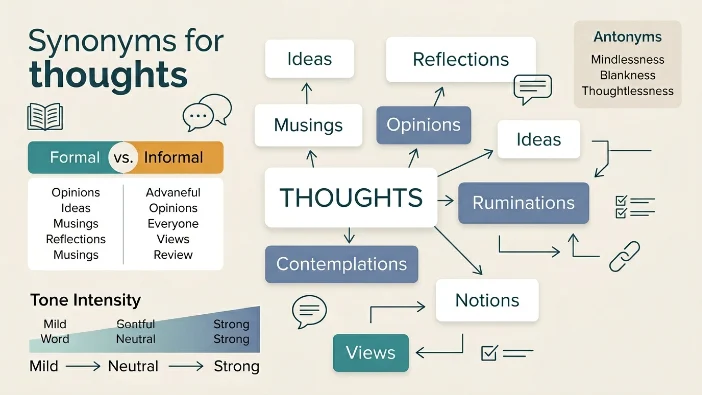
The best synonyms for thoughts are ideas, reflections, opinions, musings, and contemplations. The right choice depends on tone, context, and intensity. Use ideas for creative or practical mental content, reflections for deeper or more personal thinking, opinions for views or judgments, musings for informal or wandering thoughts, and contemplations for slow, deliberate mental focus.
What Does “Thoughts” Mean?
Thoughts is the plural noun form of thought. It refers to the products of mental activity everything your mind produces when it processes information, experiences feelings, forms opinions, or imagines possibilities.
Part of speech: Noun (plural)
Core meaning: The things a person thinks; mental content generated by the brain
Common usage: Used to describe internal ideas, opinions, reflections, or mental processes in everyday conversation and formal writing alike.
Example sentences:
- She kept her thoughts to herself during the meeting.
- His thoughts wandered while he stared out the window.
Core Meaning of “Thoughts”
At its core, thoughts describes everything that moves through your mind plans, judgments, memories, imaginings, concerns, and ideas. The word is broad enough to cover both fleeting mental chatter and deep deliberate reasoning.
Because it’s so flexible, thoughts appears in casual conversation (“What are your thoughts on this?”), emotional contexts (“My thoughts are with you”), professional settings (“I’d like to share a few thoughts”), and philosophical discussions alike.
That flexibility is also why finding the right synonym matters. Saying someone “shared their reflections” after a loss feels appropriate; saying they “shared their musings” in the same situation would feel oddly light. The synonym you choose signals tone so it’s worth choosing carefully.
Grammar and Usage Notes
Part of speech: Noun (plural). The singular form is thought.
Common patterns:
- share one’s thoughts to express what you’re thinking
- gather one’s thoughts to organize your thinking before speaking
- lost in thought absorbed in mental activity (note: singular here)
- my thoughts on [topic] used to introduce an opinion or view
- train of thought a connected sequence of ideas
Natural usage:
Thoughts sounds natural when referring to general mental content, informal opinions, or emotional reflections. It’s casual enough for conversation but formal enough for professional emails.
When a synonym may work better:
- Use ideas when referring to creative or original thinking
- Use opinions when stressing personal views or judgments
- Use reflections when describing a more deliberate, retrospective kind of thinking
- Use deliberations in legal or formal decision-making contexts
- Use musings when the thinking is light, exploratory, or playful
Best Synonyms for Thoughts
| Synonym | Meaning | Tone | Best Use Case | Example Sentence |
|---|---|---|---|---|
| Ideas | Original or creative mental content | Neutral to positive | Creative writing, brainstorming | She wrote down her ideas before the meeting. |
| Reflections | Considered, retrospective thinking | Formal/thoughtful | Personal essays, memoirs, eulogies | He shared his reflections on the past year. |
| Opinions | Personal views or judgments | Neutral | Discussions, debates, feedback | What are your opinions on the proposal? |
| Musings | Informal, wandering, or exploratory thinking | Casual/playful | Blogs, casual writing, journals | Her musings filled three notebooks. |
| Contemplations | Deep, sustained mental focus | Formal/serious | Philosophy, religious writing, essays | His contemplations on mortality shaped the poem. |
| Notions | Impressions or loosely held ideas | Neutral to informal | Conversation, light writing | She had some notions about how to fix it. |
| Views | Positions or perspectives on a topic | Neutral to formal | Professional discussions, editorial | Please share your views on the matter. |
| Ruminations | Repeated, deep (sometimes obsessive) thinking | Slightly heavy | Psychology, serious writing | His ruminations kept him awake at night. |
| Impressions | Initial or surface-level mental reactions | Neutral | Casual feedback, first-response | What were your impressions of the film? |
| Deliberations | Careful, formal reasoning toward a decision | Formal | Legal, academic, official contexts | The committee’s deliberations lasted two hours. |
Common Synonyms for Thoughts
These are the everyday alternatives you’ll naturally reach for in normal conversation and general writing.
Ideas
Ideas refers to specific mental content that is original, creative, or practical. It’s probably the most commonly used synonym for thoughts in everyday speech.
- Best context: Brainstorming, creative projects, everyday conversation
- She finally put her ideas on paper.
Views
Views suggests a position or perspective on a topic. It often implies some degree of judgment or opinion.
- Best context: Discussion, feedback, professional communication
- I’d love to hear your views on the new policy.
Opinions
Close to views, but slightly more personal. Opinions implies a subjective stance rather than an objective assessment.
- Best context: Debates, surveys, casual discussion
- Everyone had different opinions about the decision.
Impressions
Impressions refers to thoughts formed from initial contact or perception often spontaneous and surface-level.
- Best context: Reviews, first reactions, personal feedback
- My first impressions of the city were overwhelmingly positive.
Notions
Looser and more informal than ideas, notions suggests vague or preliminary thinking.
- Best context: Everyday speech, casual or slightly ironic writing
- She had some notions about quitting her job.
Formal Synonyms for Thoughts
Use these alternatives in academic papers, professional reports, business writing, or essays where a more elevated register is appropriate.
Reflections
Reflective thinking that looks back on experience, events, or meaning. Common in academic essays, memoir, and formal personal writing.
- The author offers thoughtful reflections on grief and recovery.
Contemplations
Deep, sustained mental attention on a subject. Often used in philosophical or spiritual contexts.
- The essay explores his contemplations on the nature of justice.
Deliberations
Refers to careful, reasoned thinking toward a decision. Used in legal, governmental, and academic contexts.
- The board’s deliberations concluded with a unanimous vote.
Cogitations
A more elevated word for deep thinking or pondering. Less common but recognized in formal writing.
- Her cogitations on the subject ran to several pages.
Ruminations
Detailed, often prolonged consideration of a topic. Can carry a slightly heavy connotation, suggesting the thinking is persistent or recurring.
- The philosopher’s ruminations on free will fill two volumes.
Informal Synonyms for Thoughts
These casual alternatives fit everyday conversation, social media posts, personal messages, and informal blogs.
Musings
Light, exploratory, sometimes whimsical thinking. Great for personal essays, journals, and blog posts.
- Just some late-night musings feel free to ignore them.
Two Cents
A very casual idiom meaning one’s opinion or personal view. Common in North American English.
- Here’s my two cents on the whole situation.
Head Space
What’s occupying your mental attention. Informal and conversational.
- I’m in a weird head space today too much going on.
Brain Waves
Informal term for sudden ideas or creative flashes of thought.
- She had a few brain waves during the drive home.
Takes
Informal way of saying opinions or reactions, popular in media and online discussion.
- What are your takes on the latest update?
Strong Synonyms for Thoughts
These alternatives carry more weight, intensity, or intellectual gravity. Use them when you want to emphasize the depth or importance of the mental activity.
Convictions
Strong, firmly held beliefs or positions. Much more powerful than casual thoughts.
- She spoke with conviction these weren’t just idle thoughts.
- Caution: Only use when the person genuinely holds a deep belief. Using convictions for light opinions will feel exaggerated.
Deliberations
Implies serious, formal reasoning often toward a consequential decision.
- After long deliberations, the team reached a consensus.
Meditations
Deep, focused thought often spiritual or philosophical in nature. Implies both depth and sustained attention.
- His meditations on suffering shaped his entire worldview.
Ruminations
Persistent, deep, sometimes obsessive mental churning. Useful in serious literary or psychological writing.
- Her ruminations on the accident wouldn’t let her rest.
Mild Synonyms for Thoughts
These softer alternatives are better when you want to understate, be tentative, or signal that the thinking is casual or preliminary.
Notions
Suggests loosely held, informal ideas not deeply processed.
- I have some notions about where we went wrong.
Impressions
Lightweight, initial reactions rather than considered positions.
- Those were just my first impressions I could be wrong.
Inklings
Very vague or early-stage thinking; barely formed ideas.
- I had an inkling something wasn’t right.
Musings
Exploratory, drifting thinking with no particular conclusion.
- These are just idle musings nothing decided yet.
Synonyms for Thoughts by Context
Everyday Conversation
In casual speech, ideas, views, opinions, and takes all work well. They’re direct, accessible, and natural.
- “What are your thoughts?” → “What’s your take on this?” or “What do you think?”
Professional Writing
In business emails, reports, and professional communication, prefer views, opinions, reflections, or input. These are precise and appropriately formal without being stiff.
- Please share your views on the proposal before Friday.
Academic Writing
Academic contexts favor reflections, deliberations, contemplations, and analysis. These signal careful, reasoned mental engagement.
- The author’s reflections on postcolonial identity are central to the argument.
Creative Writing
For fiction, poetry, or creative nonfiction, musings, imaginings, reveries, and ruminations add texture and interiority.
- Her ruminations grew darker as the winter deepened.
Emotional Expression
When writing about grief, compassion, or personal struggle, thoughts itself is often best warm and sincere. Reflections and feelings also work. Avoid overly clinical or formal words here.
- My thoughts are with you and your family.
Personal Communication
In journals, letters, or personal messages, musings, reflections, feelings, and ideas all feel appropriate. Match the tone to how you naturally speak.
Another Word for Thoughts in a Sentence
Here are natural example sentences using different synonyms:
- Her ideas about the project surprised everyone in the room.
- He jotted down his reflections after the long conversation.
- The journal was full of late-night musings about her future.
- She shared her views on the matter without hesitation.
- His ruminations on the past kept him from moving forward.
- I have a few notions about how we could improve the process.
- Her contemplations on the meaning of home shaped the entire essay.
- What were your impressions after meeting the new team?
- The committee’s deliberations lasted well past midnight.
- He kept his opinions to himself during the heated debate.
- My initial inklings turned out to be completely wrong.
- She felt her convictions growing stronger with every passing day.
- Just some random brain waves nothing worth writing home about.
- His meditations on justice informed every page of the book.
- I’d love to hear your takes on what happened.
Thoughts Synonyms Compared
Some of these synonyms are so close that it’s easy to mix them up. Here’s how the most similar ones actually differ:
| Word | Intensity | Formality | Implies… |
|---|---|---|---|
| Thoughts | Neutral | Neutral | General mental content |
| Ideas | Neutral–positive | Neutral | Creative or original content |
| Reflections | Medium | Formal | Retrospective, considered thinking |
| Musings | Light | Informal | Wandering, exploratory thinking |
| Ruminations | Heavy | Semi-formal | Persistent, possibly obsessive thinking |
| Opinions | Neutral | Neutral | Personal views or judgments |
| Convictions | Strong | Formal | Firm, deep beliefs |
| Deliberations | Heavy | Very formal | Formal reasoning toward a decision |
| Notions | Light | Informal | Vague, loosely held ideas |
| Contemplations | Deep | Formal | Slow, sustained mental focus |
Key distinctions to remember:
- Reflections looks back; contemplations looks inward and deep. Both are formal, but reflections often involves reviewing past experience while contemplations can be more abstract.
- Ruminations and deliberations both suggest deep thinking, but ruminations has a repetitive, sometimes negative connotation (like mental loops), while deliberations implies purposeful, rational decision-making.
- Ideas and notions both suggest specific mental content, but ideas is more positive and purposeful, while notions can feel vaguer or more skeptical in tone (“she had some strange notions”).
Words Similar to Thoughts
These words belong to the same general area of meaning as thoughts but are not always direct synonyms. They’re related concepts rather than interchangeable alternatives.
Feelings
Feelings refers to emotional states, not cognitive content. A feeling is something you experience; a thought is something you think. Though they often overlap, you wouldn’t always replace one with the other.
- She had many feelings about the situation this is about emotion, not reasoning.
Imagination
Imagination refers to the faculty or process of forming mental images and scenarios, not the content itself. It’s closer to a mechanism than a product.
- You can say someone has “vivid thoughts” or “vivid imaginings,” but imagination as a stand-alone noun means something slightly different.
Consciousness
A broader term that refers to the entire state of being mentally aware and awake. Thoughts are part of consciousness, not a synonym for it.
Reasoning
Refers specifically to the logical, analytical process of working through a problem. More focused and purposeful than thoughts in general.
Insights
Insights are a specific kind of thought sudden, clear understanding of something. Not all thoughts are insights, but all insights begin as thoughts.
Perceptions
Perceptions refer to how the mind interprets sensory input. They can lead to thoughts, but they’re not the same thing.
Antonyms of Thoughts
| Antonym | Meaning | Example Sentence |
|---|---|---|
| Mindlessness | Absence of deliberate thinking | The task required pure mindlessness no strategy needed. |
| Ignorance | Lack of knowledge or awareness | His ignorance of the facts showed in every response. |
| Blankness | Complete absence of mental content | She stared ahead in total blankness. |
| Thoughtlessness | Acting without consideration | The comment was pure thoughtlessness on his part. |
| Unconsciousness | State of no mental awareness | He drifted into unconsciousness before finishing the sentence. |
| Vacancy | Empty, unfocused mental state | The look on his face was one of complete vacancy. |
How to Choose the Right Synonym for Thoughts
Picking the right word matters more than picking a “better” word. Here’s a practical approach:
Match the context first.
Professional writing calls for views, reflections, or deliberations. Casual writing calls for ideas, musings, or takes. When in doubt, consider where the writing will be read.
Match the tone.
Light, exploratory thinking → musings or notions. Serious, committed thinking → convictions or ruminations. Middle-of-the-road → ideas, opinions, or views.
Check the intensity.
Don’t say convictions when you mean a passing opinion. Don’t say musings when you mean a serious judgment. Intensity mismatch is one of the most common synonym errors.
Think about the reader.
Would a formal word feel out of place? Would an informal one seem disrespectful? A eulogy is not the place for musings or brain waves.
Test whether the synonym is exact or just related.
Feelings and imaginings are related to thoughts, but they don’t always substitute for it. Read the sentence aloud after swapping the word if it sounds off, it probably is.
Keep it natural.
If you have to stop and think about whether a word fits, that hesitation is worth listening to. Simple, clear language almost always serves better than a showy synonym.
Common Mistakes When Using Synonyms for Thoughts
Using a word with the wrong tone. Saying someone “shared their ruminations” in a light blog post gives the writing an unexpectedly heavy, even gloomy weight. Musings would serve far better.
Using too strong a word. Describing a casual opinion as a conviction overstates the person’s actual mental commitment. Reserve strong words for strong situations.
Using formal words in casual writing. Writing “I have some deliberations about this” in a text message sounds stiff and unnatural. In casual contexts, just say thoughts or ideas.
Using casual words in professional writing. Submitting a report that describes “some brain waves we had in the meeting” undercuts the professional tone of the document.
Treating related words as exact synonyms. Feelings and thoughts often appear together but are not the same. Swapping them without checking meaning can change what you’re actually saying.
Choosing a word based on length or sophistication alone. Cogitations is not inherently better than thoughts it’s just more formal and less common. Only use it when the register genuinely calls for it.
Forcing a synonym to avoid repetition. Sometimes the best word really is thoughts, used again. Unnecessary synonym swapping can make writing feel labored or inconsistent.
Quick Synonym List for Thoughts
Common synonyms: ideas, views, opinions, impressions, notions
Formal synonyms: reflections, contemplations, deliberations, ruminations, cogitations, meditations
Informal synonyms: musings, takes, two cents, brain waves, inklings
Strong synonyms: convictions, ruminations, deliberations, meditations
Mild synonyms: notions, impressions, inklings, musings
Related words (not always direct synonyms): feelings, insights, perceptions, reasoning, imagination, consciousness
FAQs
What is the best synonym for thoughts?
The best synonym depends on the context. Ideas is the most versatile and widely used alternative. For formal writing, reflections or contemplations work well. For casual use, try musings or takes. The right choice matches the tone and context of the sentence.
What is another word for thoughts?
Common alternatives include ideas, opinions, views, reflections, musings, and notions. Each one carries a slightly different tone or level of formality, so always consider the context before choosing.
What is a formal synonym for thoughts?
Formal synonyms include reflections, contemplations, deliberations, ruminations, and meditations. These suit academic papers, professional reports, essays, and serious writing where an elevated register is appropriate.
What is an informal synonym for thoughts?
Informal alternatives include musings, takes, two cents, brain waves, and inklings. These fit conversations, social media posts, casual blogs, and personal messages.
What is a stronger word for thoughts?
Stronger alternatives include convictions, ruminations, and deliberations. These imply deeper, more persistent, or more purposeful thinking. Use them only when the intensity is warranted they can easily sound over-the-top in lighter contexts.
What is a milder word for thoughts?
Milder options include notions, impressions, inklings, and musings. These are useful when you want to signal that an idea is tentative, preliminary, or not yet fully formed.
What words are similar to thoughts?
Related words include feelings, insights, perceptions, reasoning, and imagination. These belong to the same general mental domain but are not always exact synonyms they often refer to specific types or aspects of mental activity.
What is the opposite of thoughts?
Antonyms of thoughts include mindlessness, thoughtlessness, blankness, vacancy, and unconsciousness all of which describe the absence of deliberate mental activity.
How do I choose the right synonym for thoughts?
Match the word to the context and tone of your writing. Formal settings call for words like reflections or deliberations. Casual settings work better with musings, ideas, or takes. Check that the synonym doesn’t carry an unintended emotional weight, and read the sentence aloud to hear whether it sounds natural.
Conclusion
The word thoughts covers a wide range of mental activity from idle daydreams to carefully reasoned arguments and that range is exactly why so many synonyms exist for it. Words like ideas, reflections, musings, opinions, and contemplations each describe something slightly different, and the right choice depends on the meaning you want to convey, the tone that fits your writing, and the intensity of the mental activity involved.
No synonym is universally better than thoughts itself. In many cases, the plain word is the right one. But when precision, style, or variety calls for something more specific, the alternatives in this article give you solid options to work with. Choose the word that fits the moment and when in doubt, keep it simple.

Ethan Caldwell is a writer who enjoys exploring the nuances of language and how words shape everyday communication. His work focuses on making complex ideas easier to understand through clear, engaging and accessible writing.