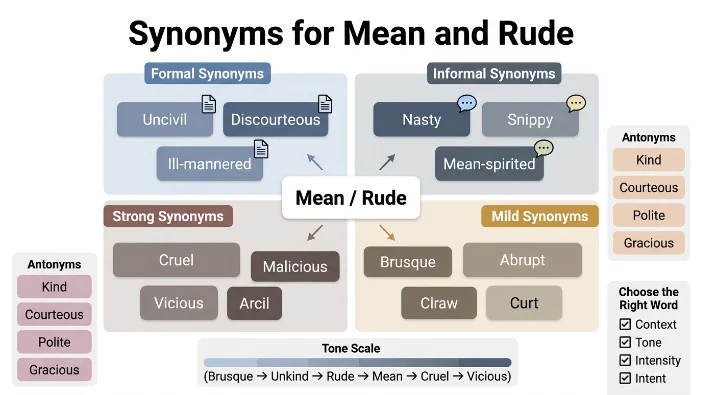
When you need to describe behavior that is unkind, disrespectful, or hurtful, the words “mean” and “rude” often come to mind first. But these two words only scratch the surface. The best synonyms for mean and rude include cruel, spiteful, discourteous, contemptuous, harsh, inconsiderate, and insolent and the right choice depends on tone, context, and how strong you want the word to feel. Whether you’re writing a professional email, working on a story, or just searching for a more precise word, this guide covers everything you need.
Best Synonyms for Mean and Rude
The best synonyms for mean (as in unkind or cruel) are cruel, spiteful, unkind, nasty, and malicious.
The best synonyms for rude (as in disrespectful or impolite) are discourteous, insolent, impolite, disrespectful, and contemptuous.
The right choice depends on tone, context, and intensity. A word like insolent fits formal writing; nasty fits casual speech; contemptuous fits situations involving open scorn.
What Does “Mean and Rude” Mean?
“Mean” and “rude” are two separate adjectives that are often grouped together because they describe overlapping types of bad behavior.
Mean describes someone who is unkind, spiteful, or deliberately hurtful often in an emotional or personal way. It can describe cruelty in action or attitude.
Example: “It was mean of him to laugh at her mistake in front of everyone.”
Rude describes someone who is disrespectful, impolite, or lacking in basic courtesy often in a social or communicative way.
Example: “She was rude to the waiter, ignoring his greetings and snapping her fingers.”
Both words are adjectives. They can describe a person, a behavior, a comment, or an attitude. “Mean” carries more emotional weight, often implying deliberate harm. “Rude” focuses more on social behavior and lack of manners.
Core Meaning of “Mean and Rude”
The core idea behind mean is intentional unkindness doing or saying something that hurts another person, often on purpose. It’s less about manners and more about character and intent.
The core idea behind rude is social disrespect ignoring basic norms of courtesy, politeness, or respect in how you speak to or treat others. Rude behavior may or may not be intentional, but it still signals disregard for others.
Together, “mean and rude” covers a wide range of negative interpersonal behavior from snapping at someone in public to deliberately humiliating a coworker.
Grammar and Usage Notes
Both mean and rude function as predicate adjectives and attributive adjectives.
As predicate adjectives:
- “That comment was mean.”
- “He was incredibly rude during the meeting.”
As attributive adjectives:
- “She gave him a mean look.”
- “It was a rude interruption.”
Common collocations for mean:
- mean-spirited, mean-tempered, downright mean, cruel and mean
Common collocations for rude:
- rude behavior, rude remark, rude awakening (figurative), blunt and rude
When a synonym may work better: If you want to emphasize deliberate cruelty, words like malicious or spiteful are stronger than mean. If you want to emphasize social impropriety, words like discourteous or impolite are more precise than rude.
Best Synonyms for Mean and Rude
| Synonym | Meaning | Tone | Best Use Case | Example Sentence |
|---|---|---|---|---|
| Cruel | Causing pain or suffering without empathy | Serious | Describing severe or deliberate harm | “The cruel remarks left her in tears.” |
| Spiteful | Acting out of desire to hurt or annoy | Negative, sharp | Personal conflicts, emotional writing | “His spiteful comment was completely unprovoked.” |
| Discourteous | Failing to show basic politeness | Formal | Professional or academic writing | “The discourteous reply shocked the entire team.” |
| Insolent | Boldly disrespectful or rude | Formal, strong | Authority situations, formal complaints | “The insolent tone of the message was unacceptable.” |
| Nasty | Unpleasant, unkind, or offensive | Informal | Casual speech, personal writing | “Why does she always have to be so nasty?” |
| Contemptuous | Showing open disrespect or scorn | Formal, sharp | Describing condescending behavior | “He gave her a contemptuous glance and walked away.” |
| Inconsiderate | Not thinking about others’ feelings | Neutral to mild | Everyday criticism, polite correction | “Leaving without a word was inconsiderate. |
| Hostile | Unfriendly, aggressive, or antagonistic | Strong | Conflict situations, workplace writing | “The hostile tone of the email alarmed her manager.” |
| Abrasive | Harsh in manner, irritating to others | Moderate | Describing difficult personalities | “His abrasive communication style pushed people away.” |
| Unkind | Lacking kindness or warmth | Mild to moderate | General use, children’s contexts | “That was an unkind thing to say to your sister.” |
Common Synonyms for Mean and Rude
These are everyday words that most readers will recognize and that work well in general writing or conversation.
Unkind Softer than “mean,” this word points to a lack of warmth or care. Best for everyday situations where the behavior is hurtful but not extreme. “It was unkind of her to leave without saying goodbye.”
Nasty Casual and punchy, nasty covers both mean and rude behavior. It fits informal speech and personal writing but sounds out of place in professional documents. “He made a nasty remark and walked off.”
Disrespectful A clear, direct word for rude behavior. It works across most contexts and is easy for any reader to understand. “Talking over your coworkers is disrespectful.”
Impolite A milder synonym for rude that focuses on poor manners rather than outright hostility. “Checking your phone during a conversation is considered impolite.”
Inconsiderate Points to thoughtlessness rather than deliberate cruelty. The person may not be trying to hurt anyone, but their behavior still affects others negatively. “Blasting music at midnight is inconsiderate to your neighbors.”
Formal Synonyms for Mean and Rude
Use these alternatives in academic writing, business emails, formal complaints, or professional reports.
Discourteous A polished, professional way to say “rude.” Works well in formal correspondence and policy language. “The customer reported discourteous behavior from the front desk staff.”
Insolent Describes boldly rude behavior, often toward someone in authority. Strong and specific. “The insolent response from the intern surprised the entire department.”
Contemptuous Implies open scorn or disdain. More emotionally loaded than discourteous but still formal. “She delivered the news in a contemptuous tone that insulted the committee.”
Disdainful Close to contemptuous. Describes behavior or speech that suggests the other person is beneath consideration. “His disdainful attitude toward junior staff affected team morale.”
Malicious Formal and serious. Implies deliberate intent to harm. Use when the behavior goes beyond rudeness into active harm. “The malicious gossip spread by the manager led to an HR investigation.”
Antagonistic Describes a disposition or attitude that is actively hostile or combative. “Her antagonistic approach during negotiations made agreement impossible.”
Informal Synonyms for Mean and Rude
These words work in casual conversation, social media, friendly texts, and personal writing.
Snippy Describes a sharp, irritable way of speaking. Light and colloquial. “She’s been snippy with everyone since this morning something must be wrong.”
Snarky Combining sarcasm and rudeness. Very common in modern informal writing and online communication. “His snarky reply made everyone roll their eyes.”
Bitchy (informal, may be considered strong) Describes petty, catty, or deliberately hurtful behavior. Used more often in informal settings. “She’s been bitchy about everything since the argument.”
Obnoxious Rude or unpleasant in a loud, attention-grabbing way. “The obnoxious guy at the party kept interrupting everyone’s conversations.”
Catty Describes sly, spiteful, or subtly cruel behavior often verbal. “Those catty remarks at the office party didn’t go unnoticed.”
Jerky (very informal) A blunt, casual way to call out rude or mean behavior. “That was a really jerky thing to do.”
Strong Synonyms for Mean and Rude
These words carry more weight and emotional intensity. Use them when ordinary words feel too mild.
Cruel The strongest everyday synonym for mean. Implies causing real pain, emotional or physical. “The cruel treatment he received as a child shaped his entire life.”
Vicious Suggests deliberate, aggressive, or dreadful cruelty. “The vicious attack on her reputation was completely unjustified.”
Spiteful Describes behavior driven purely by a desire to hurt or annoy. “The spiteful review seemed designed to destroy her business.”
Vindictive Implies a desire for revenge. More specific than spiteful. “He was vindictive toward anyone who had ever crossed him.”
Dreadful Extremely harsh or brutal, especially in criticism. “The judge’s dreadful feedback left the contestant speechless.”
Vitriolic Filled with bitter anger or sharp, hurtful language. Often used for verbal attacks or written criticism. “The vitriolic column drew dozens of complaints from readers.”
When to be careful: These words are intense. Using vicious to describe a minor social slight can seem dramatic. Match the strength of the word to the severity of the situation.
Mild Synonyms for Mean and Rude
Sometimes softer language works better in polite correction, professional feedback, or situations where you don’t want to escalate tension.
Brusque Abrupt or curt in manner without being outright rude. Often unintentional. “He can come across as brusque, but he doesn’t mean any harm.”
Curt Short and sharp in speech. Implies impatience more than cruelty. “Her curt reply made it clear she didn’t want to talk.”
Blunt Direct to the point of being harsh, but not necessarily unkind. “He’s blunt, which some people appreciate and others find off-putting.”
Short Used informally to describe a curt or impatient tone. “She was a bit short with me on the phone I think she was stressed.”
Tactless Describes a lack of sensitivity or awareness about how words land, rather than deliberate cruelty. “His tactless comment about her haircut made the room go quiet.”
Synonyms for Mean and Rude by Context
Everyday Conversation
In casual speech, nasty, snippy, snarky, and inconsiderate feel the most natural. They’re easy to understand and match the informal tone of everyday talk.
Professional Writing
Stick to discourteous, antagonistic, disrespectful, or inappropriate. Formal synonyms help you make a point without sounding emotional or unprofessional.
Academic Writing
Opt for contemptuous, disdainful, hostile, or antagonistic. These words carry authority and work well in analysis of behavior, social dynamics, or literary characters.
Creative Writing
This is where you have the most freedom. Use spiteful, vicious, cruel, vitriolic, or dreadful to paint vivid characters and scenes. Strong words create memorable moments.
Emotional Expression
When expressing personal hurt, words like cruel, unkind, hurtful, or spiteful connect emotionally. They’re honest and relatable without sounding clinical.
Marketing Copy
Negative words like these are rarely used directly in marketing, but they appear in contrast language (“Stop dealing with rude customer service we do it differently”). In this context, rude and dismissive work best because they’re widely understood.
Another Word for Mean and Rude in a Sentence
Here are 14 natural example sentences using different synonyms.
- “She gave the new employee a contemptuous look and kept walking.”
- “His spiteful comments during the meeting made the whole team uncomfortable.”
- “The hostile email from the client caught everyone off guard.”
- “It’s inconsiderate to take the last coffee without making a new pot.”
- “She was brusque on the phone, but I think she was just overwhelmed.”
- “The character in the novel was cruel to everyone around her.”
- “He made a snarky remark and then laughed like it was nothing.”
- “The professor’s disdainful tone made students hesitant to ask questions.”
- “She found his blunt feedback hard to hear, even if it was useful.”
- “The vitriolic comments online were reported and removed.”
- “Being tactless doesn’t make you honest it just makes you hurtful.”
- “Her catty remark about his presentation was the talk of the office.”
- “The discourteous behavior at the front desk was reported to the manager.”
- “He’s been snippy all week something is definitely bothering him.”
Mean and Rude Synonyms Compared
Some of these words overlap closely. Here’s how to tell them apart.
| Word | Core Feeling | Formality | Intensity | Best Use |
|---|---|---|---|---|
| Mean | Unkindness, emotional cruelty | Informal | Moderate | Casual, personal contexts |
| Cruel | Deliberate harm or pain | Neutral | High | Serious situations, fiction |
| Spiteful | Desire to hurt or annoy | Neutral | Moderate–High | Personal conflicts |
| Rude | Disrespect, poor manners | Informal | Moderate | Social situations |
| Discourteous | Lack of courtesy | Formal | Mild–Moderate | Professional settings |
| Insolent | Boldly disrespectful | Formal | High | Authority dynamics |
| Contemptuous | Open scorn or disdain | Formal | High | Analysis, formal writing |
| Nasty | Unpleasant, offensive | Informal | Moderate | Casual speech |
| Hostile | Aggressive, unfriendly | Neutral | High | Conflict, workplace issues |
Key distinctions to remember:
- Mean implies emotional cruelty; rude implies social disrespect.
- Cruel is stronger than mean and suggests real harm.
- Insolent and contemptuous are formal and high-intensity.
- Brusque and curt are mild and often unintentional.
- Spiteful and vindictive both imply intent, but vindictive adds a revenge motive.
Words Similar to Mean and Rude
These words are related to mean and rude behavior but don’t always work as direct replacements.
Aggressive Describes forceful, sometimes threatening behavior. It overlaps with hostile but adds a physical or confrontational dimension. Not every aggressive person is rude, and not every rude person is aggressive.
Arrogant Describes an inflated sense of self-importance. Arrogant people often come across as rude, but the root cause is different it’s about superiority, not social disrespect.
Cold Describes emotional distance rather than deliberate rudeness. A cold person may not be rude at all they may just be reserved or guarded.
Dismissive Describes behavior that ignores or minimizes others’ ideas or feelings. Related to rudeness but more about indifference than active disrespect.
Abusive Goes beyond mean and rude into a more serious territory involving harm, control, or verbal/physical attack. Use only when the behavior is genuinely harmful, not just unpleasant.
Difficult A very soft, vague term used to describe people who are challenging to deal with. It can imply rudeness or meanness but doesn’t name it directly. Good for polite or diplomatic contexts.
Antonyms of Mean and Rude
| Antonym | Meaning | Example Sentence |
|---|---|---|
| Kind | Warm, generous, caring | “She was kind to every student who walked into her class.” |
| Courteous | Polite and respectful in manner | “He was courteous to the staff despite his frustrating day.” |
| Gracious | Pleasantly kind, especially under pressure | “She remained gracious even when the questions got tough.” |
| Considerate | Thoughtful of others’ feelings and needs | “It was considerate of him to save her a seat.” |
| Polite | Following social norms of respectful behavior | “A polite response goes a long way in customer service.” |
| Gentle | Mild in tone, careful with others’ feelings | “She offered gentle feedback rather than sharp criticism.” |
| Warm | Friendly, approachable, emotionally open | “His warm greeting put the nervous applicant at ease.” |
| Thoughtful | Attentive to others’ needs and emotions | “A thoughtful note meant more to her than a formal gift.” |
How to Choose the Right Synonym for Mean and Rude
Picking the wrong word even a close synonym can change your meaning or tone completely. Here’s how to get it right.
Match the context. In a business complaint, discourteous or inappropriate will land better than nasty or snippy. In a casual conversation, the reverse is true.
Match the tone. Formal writing needs formal synonyms. If you’re writing a letter to HR, contemptuous fits. If you’re venting to a friend, snarky is fine.
Check the intensity. Don’t use vicious for a mildly impolite remark. Don’t use brusque for genuinely cruel behavior. The intensity of the word should match the intensity of the situation.
Think about intent. Spiteful implies the person meant to hurt. Tactless implies they didn’t think. Inconsiderate suggests they didn’t care. These are different.
Check the part of speech. Some synonyms only work in certain sentence structures. Contemptuous and insolent are adjectives. Contempt is a noun. Make sure you’re using the right form.
Read the sentence aloud. If the word sounds wrong or stiff when you say it, it probably is. Trust your ear.
Common Mistakes When Using Synonyms for Mean and Rude
Using a strong word for a mild situation. Calling someone vicious for being slightly blunt overstates things and makes your writing sound dramatic.
Using a formal word in casual writing. Writing “he was most discourteous to me” in a text message sounds stiff and awkward.
Confusing related words with exact synonyms. Arrogant and rude often co-exist, but they’re not the same thing. Don’t swap them without thinking.
Ignoring tone. Snarky has a slight humor to it. Spiteful is dead serious. These tones land very differently, even when the meaning is close.
Forgetting about intent. If you replace inconsiderate with malicious, you’re accusing someone of deliberate harm a very different claim.
Overusing strong synonyms. If every person in your story is cruel, vicious, or vindictive, the words lose their impact. Vary your choices.
Quick Synonym List for Mean and Rude
Common synonyms: Unkind, disrespectful, impolite, nasty, inconsiderate, obnoxious
Formal synonyms: Discourteous, insolent, contemptuous, disdainful, antagonistic, malicious
Informal synonyms: Snarky, snippy, catty, jerky, obnoxious, bitchy
Strong synonyms: Cruel, vicious, spiteful, vindictive, dreadful, vitriolic
Mild synonyms: Brusque, curt, blunt, short, tactless
Related words: Aggressive, arrogant, cold, dismissive, difficult, abusive
FAQs
What is the best synonym for mean and rude?
The best synonyms depend on context.
- For formal writing, discourteous and contemptuous work well.
- For everyday use, unkind and disrespectful are clear and widely understood.
- For strong situations, cruel or hostile carry more weight.
What is another word for mean and rude?
Some of the most useful single-word alternatives include nasty, spiteful, discourteous, insolent, contemptuous, and hostile. Each one has a slightly different flavor, so the best choice depends on the situation you’re describing.
What is a formal synonym for mean and rude?
For formal writing, discourteous, contemptuous, disdainful, antagonistic, and insolent are strong choices. They work well in professional emails, academic writing, and formal complaints.
What is an informal synonym for mean and rude?
In casual speech and personal writing, snarky, snippy, nasty, catty, and obnoxious are common. They feel natural in everyday conversation and social media writing.
What is a stronger word for rude or mean?
Stronger alternatives include cruel, vicious, vitriolic, spiteful, and vindictive. These carry significant emotional weight and should be used when the behavior is genuinely severe, not for everyday rudeness.
What is a milder word for mean and rude?
Milder options include brusque, curt, tactless, blunt, and short. These suggest a lack of polish or warmth without implying malice or deliberate cruelty.
What is the opposite of mean and rude?
The antonyms of mean include kind, generous, warm, and gentle. The antonyms of rude include courteous, polite, respectful, and gracious.
How do I choose the right synonym for mean and rude?
Think about three things: the tone you want (formal or casual), the intensity that fits the situation (mild or strong), and what the behavior is actually about (poor manners, deliberate cruelty, indifference, or hostility). Match the word to all three, and you’ll rarely go wrong.
Conclusion
Both mean and rude are useful everyday words, but English gives you many more precise tools to work with. Whether you need the formal weight of contemptuous, the sharp sting of spiteful, the casual punch of snarky, or the gentle softness of tactless, there’s a synonym that fits your exact situation.
The goal is always precision. The best synonym isn’t the most impressive one it’s the one that says exactly what you mean, in exactly the right tone, for exactly the right audience. Use this guide to move past the default and find the word that really lands.
Read More Related Articles:
- Synonyms for Embarrassed | Smarter Word Choices for Every Context In 2026
- Synonyms For Felt | Make Your Writing More Descriptive In 2026
- Synonyms for Stress | Meaning, Examples, and Better Word Choices In 2026

Evelyn Turner is a content creator at SynonymsAura.com who enjoys exploring the richness of the English language. Her work focuses on word meanings, synonyms, expressions and everyday language usage, helping readers communicate with greater clarity and confidence.