If you have ever felt unsure about someone’s motives or found a situation hard to trust, you have felt suspicious. The best synonyms for suspicious are distrustful, doubtful, leery, and dubious. But the right choice depends on your tone, context, and how strong the feeling really is. This guide walks you through every option so you can pick the perfect word.
Best Synonyms for Suspicious
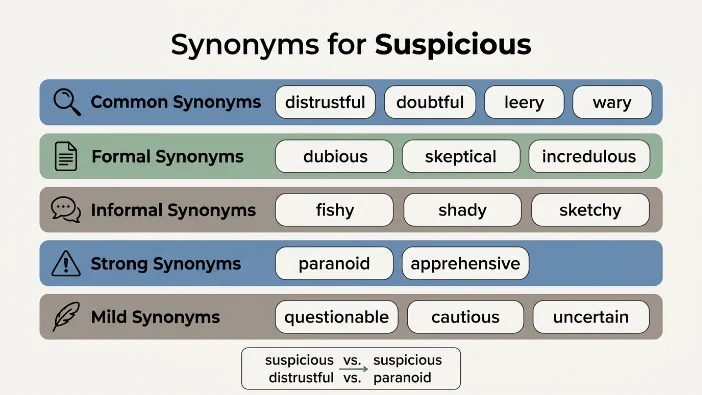
The best synonyms for suspicious are distrustful, doubtful, leery, and dubious. Use distrustful for a general lack of trust in someone. Use doubtful when you question whether something is true or honest. Use leery for a cautious, slightly uneasy feeling. Use dubious when you seriously question the credibility of a claim or person.
What Does Suspicious Mean?
Suspicious is an adjective. It describes a feeling that someone or something may be dishonest, dangerous, or wrong.
Simple definition: Having or showing a lack of trust, often without clear proof.
Core idea behind the word: Suspicion sits between uncertainty and accusation. You are not sure something is wrong, but you have a reason to question it.
Example sentences:
- The neighbors became suspicious when the same white van returned every night.
- She gave me a suspicious look after I gave my excuse.
Core Meaning of Suspicious
Suspicion can point in two directions. You can feel suspicious of someone (you do not trust them). Or something can seem suspicious to you (a situation looks questionable).
The word carries a quiet alarm. It is not full-blown accusation or certainty. But it is more than simple curiosity. Suspicion often comes from instinct, past experience, or small clues that do not add up.
When you call a person suspicious, you mean their behavior makes you wonder about their intentions. When you call a situation suspicious, you mean it does not feel right or honest.
Grammar and Usage Notes
Part of speech: Adjective
Common sentence patterns:
- [Someone] is suspicious of [someone or something] – “The manager was suspicious of the new vendor.”
- [Something] seems/looks suspicious – “The transaction looked suspicious.”
- [Someone] has a suspicious [noun] – “He has a suspicious mind.”
Common phrases and collocations:
- highly suspicious
- deeply suspicious
- suspicious behavior
- suspicious activity
- suspicious circumstances
- right to be suspicious
- naturally suspicious
When suspicious sounds natural:
Use it when you want to describe a feeling of doubt that is not yet proven. It works well in everyday speech, news reports, police work, relationships, and business settings.
When a synonym may work better:
Use a synonym when you need a different tone (more formal, more casual, stronger, or milder) or when you want to avoid repeating the word suspicious.
Best Synonyms for Suspicious
| Synonym | Meaning | Tone | Best Use Case | Example Sentence |
|---|---|---|---|---|
| Distrustful | Lacking trust due to past experience or instinct | Neutral to serious | Describing a general state of not trusting someone | After being lied to, she became distrustful of anyone who promised quick results. |
| Doubtful | Questioning whether something is true or right | Neutral to cautious | Expressing uncertainty about a claim, plan, or person | I am doubtful that his story about the lost wallet is completely true. |
| Leery | Cautious and slightly suspicious | Casual, conversational | Describing a wary feeling that makes you hold back | He was leery of the email asking for his password. |
| Dubious | Doubtful with a sense that something is off or unreliable | Slightly formal | Questioning the honesty or quality of something | The company’s claims about its product seemed dubious at best. |
| Wary | Watchful and careful because of possible danger | Neutral | Describing cautious alertness, often about safety | The hikers were wary of the stranger who offered to guide them. |
| Incredulous | Unwilling or unable to believe something | Formal, emotional | Showing shocked disbelief, often to someone’s face | She gave him an incredulous stare when he said he had never heard of taxes. |
| Skeptical | Doubting unless evidence is shown | Neutral, intellectual | Questioning claims, science, marketing, or arguments | He remained skeptical of the psychic’s predictions. |
| Paranoid | Suspicious in an unreasonable or extreme way | Strong, informal, clinical | Describing excessive, irrational suspicion | You are being paranoid; no one is secretly watching you. |
Common Synonyms for Suspicious
These are everyday words you can use in normal writing and conversation.
Distrustful
Short meaning: Not trusting someone, often because of a bad experience.
Best context: Relationships, workplaces, or any situation where trust has been broken.
Example sentence: The team was distrustful of the new manager after he took credit for their work.
Doubtful
Short meaning: Not convinced that something is true, honest, or reliable.
Best context: Questioning facts, promises, or plans.
Example sentence: She was doubtful that the sale price was the real deal.
Leery
Short meaning: Cautious because something feels slightly wrong.
Best context: Everyday warnings, online scams, unfamiliar offers.
Example sentence: I am leery of any restaurant with no posted prices.
Wary
Short meaning: Careful and alert because of possible danger or deception.
Best context: Safety, travel, financial decisions, new situations.
Example sentence: Parents are often wary of letting young kids use social media alone.
Formal Synonyms for Suspicious
Use these alternatives in academic writing, business reports, professional emails, and legal documents.
Dubious
This word fits formal settings where you need to question credibility without sounding emotional. It suggests that something is probably not honest or reliable.
Example: The audit raised dubious conclusions about the firm’s accounting methods.
Skeptical
Skeptical sounds educated and measured. It shows healthy doubt without paranoia. Use it in essays, scientific discussions, or professional debates.
Example: Economists remain skeptical of the company’s projected growth numbers.
Incredulous
Incredulous works well in formal storytelling, journalism, or literary analysis. It describes a state of disbelief so strong that it shows on someone’s face.
Example: The jury was incredulous when the defendant offered no alibi.
Untrusting
This word is straightforward and professional without being harsh. It describes someone who generally does not place trust in others.
Example: The diplomat remained untrusting of the ceasefire agreement.
Informal Synonyms for Suspicious
These casual alternatives work best in conversation, text messages, social media, and friendly writing.
Fishy
Tone: Very casual, slightly playful.
Best use: Describing a situation that feels wrong but is not serious enough for formal words.
Example: The whole deal sounds fishy to me.
Shady
Tone: Slang, informal.
Best use: Describing a person or business that seems dishonest.
Example: That guy hanging around the back entrance looks shady.
Sketchy
Tone: Slang, very common in US English.
Best use: A situation or person that feels unreliable or possibly dangerous.
Example: The neighborhood gets sketchy after dark.
Hinky
Tone: Slang, slightly dated but still used.
Best use: Something feels off in a way you cannot explain.
Example: The numbers in the report look hinky to me.
Strong Synonyms for Suspicious
Use these when you need more intensity, emotion, or seriousness.
Paranoid
Paranoid is much stronger than suspicious. It suggests unreasonable or excessive fear. Use it carefully. Calling someone paranoid can sound dismissive or insulting.
Example: He refuses to use any website with ads — that is paranoid, not careful.
Apprehensive
Apprehensive adds fear and anxiety to suspicion. You suspect something bad might happen, and you feel nervous about it.
Example: She felt apprehensive about walking into the empty office alone.
Jaundiced
This is a sophisticated, strong word. It means suspicion has colored your whole view, often because of bitter experience. Use it in literary or formal writing.
Example: Years of political scandals gave him a jaundiced view of all politicians.
Mistrustful
Mistrustful is slightly stronger than distrustful. It suggests active, ongoing refusal to trust.
Example: The old woman was deeply mistrustful of anyone in a uniform.
Mild Synonyms for Suspicious
Softer words work better when suspicion is light, polite, or only a passing thought.
Questionable
Meaning: Possibly wrong or dishonest, but not clearly so.
Tone: Neutral to mild.
Best use: Describing behavior, quality, or decisions that might be acceptable but raise a small concern.
Example: The contractor used questionable materials to cut costs.
Uncertain
Meaning: Not sure; lacking confidence.
Tone: Very mild, almost neutral.
Best use: When you are not sure about someone’s motives but do not want to accuse.
Example: She felt uncertain about his sudden offer to help.
Cautious
Meaning: Careful to avoid danger or problems.
Tone: Neutral, responsible.
Best use: Describing protective behavior rather than distrust.
Example: The buyer took a cautious approach to the investment opportunity.
Synonyms for Suspicious by Context
Everyday Conversation
Use leery, fishy, or doubtful. These words feel natural when you talk to friends or family.
Example: “I am leery of that new coffee shop. The reviews seem fake.”
Professional Writing
Use distrustful, skeptical, or untrusting. These words keep your tone serious without sounding emotional.
Example: The board remained skeptical of the merger benefits.
Academic Writing
Use skeptical, dubious, or incredulous. These words show critical thinking.
Example: Researchers have grown skeptical of the initial study’s methodology.
Creative Writing
Use wary, apprehensive, or jaundiced to show a character’s inner doubt.
Example: The detective gave the witness a wary look before writing down her statement.
Emotional Expression
Use paranoid (for extreme cases) or incredulous (for shocked disbelief).
Example: His friends thought he was paranoid, but he had seen the text messages.
Another Word for Suspicious in a Sentence
Here are fifteen natural sentences using different synonyms for suspicious.
- The bank flagged the transaction as dubious and froze the account.
- She has always been distrustful of politicians who promise too much.
- I am doubtful that the car’s mileage is accurate.
- Most investors remain skeptical about cryptocurrency long-term value.
- He gave a leery glance at the half-open door.
- The child was wary of the neighbor’s large dog.
- She was incredulous when her best friend blamed her for the broken vase.
- The offer seemed fishy, so he did not reply.
- Do not walk through that alley — it looks sketchy.
- The senator’s explanation struck reporters as questionable.
- After the robbery, the shop owner became mistrustful of all strangers.
- Her apprehensive silence told me she suspected bad news.
- Years of bad deals made him jaundiced toward real estate agents.
- The hikers were cautious of the unmarked trail.
- He felt a hinky feeling about the job interview that felt too easy.
Suspicious Synonyms Compared
Some synonyms for suspicious are close in meaning but not identical. Here is how to tell them apart.
| Pair | Key Difference | Example |
|---|---|---|
| Suspicious vs. Distrustful | Suspicious can be about a moment or event. Distrustful is often a longer-term attitude. | He was suspicious of the package. She is distrustful of all delivery services after a theft. |
| Doubtful vs. Dubious | Doubtful questions truth. Dubious adds a sense of low quality or dishonesty. | I am doubtful the sale is real. The product’s safety record is dubious. |
| Leery vs. Wary | Leery is slightly more informal and often about deception. Wary is more about danger. | She was leery of the stranger’s story. She was wary of the icy steps. |
| Skeptical vs. Paranoid | Skeptical is reasonable and evidence-based. Paranoid is extreme and irrational. | He is skeptical of the diet pill claims. He is paranoid that the company is spying on him. |
Words Similar to Suspicious
These words belong to the same family of meaning but are not always direct replacements. Use them when you need a related idea rather than an exact synonym.
Cynical: Believes people act only for selfish reasons. This is a worldview, not a momentary feeling. Example: A cynical person assumes every compliment has an ulterior motive.
Guarded: Speaks or acts carefully to avoid revealing too much. This is a behavior, not an inner doubt. Example: She gave guarded answers to the detective’s questions.
Unconvinced: Not persuaded by evidence or arguments. This is about logic, not instinct. Example: He remained unconvinced by the sales pitch.
Chary: Very cautious about giving trust or approval. This is an old-fashioned, formal word. Example: She was chary of making promises she could not keep.
Antonyms of Suspicious
| Antonym | Short Meaning | Example Sentence |
|---|---|---|
| Trusting | Willing to believe others are honest | The trusting child gave her phone number to the stranger. |
| Naive | Lacking experience and easily fooled | His naive belief in the email scam cost him $500. |
| Confiding | Willing to share private thoughts and trust others | They had a confiding relationship built over twenty years. |
| Credulous | Too ready to believe things without proof | The credulous audience believed every word of the hoax. |
| Unsuspecting | Not aware of possible danger or deception | The unsuspecting tourist handed over his wallet. |
How to Choose the Right Synonym for Suspicious
Use these seven steps the next time you write.
- Match the context. Formal writing needs dubious or skeptical. Casual talk needs fishy or leery.
- Match the tone. Angry or serious? Use mistrustful. Light and friendly? Use sketchy.
- Check the intensity. Is the suspicion a small doubt? Use doubtful or questionable. Is it extreme? Use paranoid.
- Think about your reader. A boss or professor expects formal language. A close friend expects casual words.
- Check if the synonym is exact or only related. Do not use cynical if you mean a temporary doubt.
- Keep the sentence natural. Read it out loud. If it sounds strange, try a different word.
- When in doubt, keep it simple. Distrustful and doubtful work in almost any situation.
Common Mistakes When Using Synonyms for Suspicious
Choosing the wrong tone
Mistake: Using paranoid in a professional email.
Better: “The client seemed skeptical about our timeline.”
Using a formal word in casual writing
Mistake: “That movie plot was incredulous.” (Sounds unnatural)
Better: “That movie plot was unbelievable.”
Using a casual word in formal writing
Mistake: “The audit found some sketchy records.”
Better: “The audit found some questionable records.”
Treating related words as exact synonyms
Mistake: “She is very cynical of my cooking.”
Better: “She is very skeptical of my cooking.” (Cynical is a worldview; skeptical is about a specific claim.)
Making the sentence unnatural
Mistake: “I am dubious regarding the fact that he arrived late.”
Better: “I am dubious that he actually arrived late.”
Quick Synonym List for Suspicious
Common synonyms:
- Distrustful
- Doubtful
- Leery
- Wary
Formal synonyms:
- Dubious
- Skeptical
- Incredulous
- Untrusting
Informal synonyms:
- Fishy
- Shady
- Sketchy
- Hinky
Strong synonyms:
- Paranoid
- Apprehensive
- Jaundiced
- Mistrustful
Mild synonyms:
- Questionable
- Uncertain
- Cautious
Related words:
- Cynical
- Guarded
- Unconvinced
- Chary
FAQs
What is the best synonym for suspicious?
The best synonym depends on your sentence.
- For general use, distrustful and doubtful work well.
- For casual conversation, use leery.
- For formal writing, use dubious or skeptical.
What is another word for suspicious in a relationship?
In a relationship, use distrustful, untrusting, or jealous (if suspicion involves infidelity). Example: “She grew distrustful after he lied about his schedule.”
What is a formal synonym for suspicious?
Dubious and skeptical are the best formal synonyms. They appear in academic papers, business reports, and professional correspondence.
What is an informal synonym for suspicious?
Fishy, shady, and sketchy are the most common informal synonyms. Use them with friends or in casual writing.
What is a stronger word for suspicious?
Paranoid is the strongest common synonym, but it implies unreasonable fear. Mistrustful and apprehensive are also stronger without sounding irrational.
What is a milder word for suspicious?
Questionable, uncertain, and cautious are milder. They show doubt without accusing anyone of dishonesty.
What words are similar to suspicious but not exact synonyms?
Cynical, guarded, and unconvinced are closely related. Cynical is a general attitude. Guarded describes careful behavior. Unconvinced is about persuasion, not character.
What is the opposite of suspicious?
The most direct opposites are trusting, naive, and unsuspecting. Trusting is neutral. Naive and unsuspecting suggest a lack of awareness or experience.
How do I choose the right synonym for suspicious?
Match the word to your context, tone, intensity, and reader. When in doubt, use doubtful for questioning a claim or distrustful for questioning a person.
Conclusion
The word suspicious has many useful synonyms, but no two are exactly alike. Some fit formal reports. Others work best in casual texts. Some carry mild doubt, while others describe extreme fear. The best writers choose their words carefully. They match the synonym to the situation, the tone to the reader, and the intensity to the feeling. Now you have the tools to pick the perfect word every time. Use them well.
Read More Related Articles:
- Synonyms for Embarrassed | Smarter Word Choices for Every Context In 2026
- Synonyms For Felt | Make Your Writing More Descriptive In 2026
- Synonyms for Stress | Meaning, Examples, and Better Word Choices In 2026

Grace Phillips contributes content to SynonymsAura.com, where she writes about language, vocabulary and everyday communication. Her work is centered on helping readers find the right words and express themselves with greater clarity and confidence.