The best synonyms for argument depend on what you’re trying to say. If you mean a heated disagreement, good alternatives include quarrel, dispute, altercation, and clash. If you mean a reasoned case supported by evidence, better choices are reasoning, rationale, justification, and contention. The right word changes everything.
This guide covers the most useful synonyms for argument across every context from casual conversations to academic writing, from mild disagreements to full-blown conflicts.
Best Synonyms for Argument
The best synonyms for argument are dispute, quarrel, debate, and reasoning. The right choice depends on tone, context, and intensity. For a hostile exchange, choose quarrel or altercation. For a logical presentation of evidence, choose reasoning or contention. For a formal discussion of differing views, choose debate or dispute.
What Does Argument Mean?
Argument has two main meanings, and understanding both is key to choosing the right synonym.
First meaning: A disagreement between two or more people, often involving strong emotions. This is the “fight” meaning.
Second meaning: A reason or set of reasons given to support or oppose an idea. This is the “logical case” meaning.
Part of speech: Noun
Common usage examples:
- “They had a heated argument about money.” (disagreement meaning)
- “Her argument was based on solid evidence.” (logical case meaning)
Core Meaning of Argument
At its heart, argument involves opposing viewpoints. Whether people are yelling at each other or calmly presenting evidence, the core idea is the same: two or more sides don’t agree on something.
The word comes from the 14th-century French word meaning “statements and reasoning in support of a proposition” . That origin explains the two meanings an argument can be a logical case or an emotional clash.
When you hear someone say “I don’t want to get into an argument,” they usually mean the disagreement version. When a lawyer says “My argument is that the evidence proves otherwise,” they mean the logical version.
Grammar and Usage Notes
Part of speech: Noun (countable)
Common sentence patterns:
- “They had an argument about…”
- “The argument for/against…”
- “She made a strong argument that…”
- “Their argument led to…”
Common collocations:
- Heated argument
- Strong argument
- Logical argument
- Get into an argument
- Win/lose an argument
- Present an argument
- Support an argument
When argument sounds natural:
Use argument when you need a general word that works in almost any situation. It’s neutral enough for most contexts.
When a synonym may work better:
- Use quarrel or row for personal, emotional disagreements
- Use dispute for formal or professional disagreements
- Use debate for structured, respectful exchange of views
- Use reasoning or rationale for the logical case meaning
Best Synonyms for Argument
Here are the most useful synonyms organized by tone and use case:
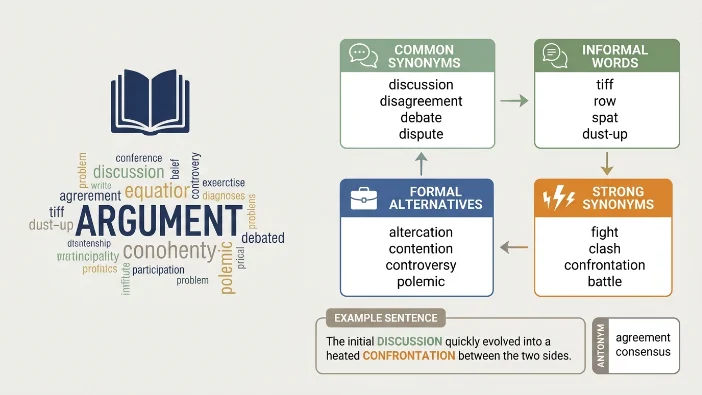
Common Synonyms for Argument
These everyday synonyms work well in normal conversation and general writing:
Disagreement
Short meaning: A difference of opinion, often mild
Best context: General use when no strong hostility is involved
Example sentence: “They had a disagreement about which movie to watch.”
Quarrel
Short meaning: An angry disagreement, often personal
Best context: Personal relationships, emotional conflicts
Example sentence: “The neighbors had a quarrel that lasted well into the night.”
Dispute
Short meaning: A disagreement, often formal or ongoing
Best context: Professional, legal, or official contexts
Example sentence: “The workers filed a dispute with management over pay.”
Debate
Short meaning: A structured exchange of opposing views
Best context: Formal discussions, public policy, academic topics
Example sentence: “The candidates engaged in a lively debate about healthcare.”
Squabble
Short meaning: A petty or minor argument
Best context: Trivial disagreements, children’s conflicts
Example sentence: “The children were squabbling over who got the bigger piece of cake.”
Controversy
Short meaning: Public disagreement involving strong opinions
Best context: Issues that generate strong public reaction
Example sentence: “The decision sparked widespread controversy.”
Clash
Short meaning: A sharp conflict or disagreement
Best context: Opposing views, interests, or personalities
Example sentence: “There was a clash of perspectives during the meeting.”
Formal Synonyms for Argument
Use these alternatives in academic writing, business reports, essays, and professional communication:
Dispute
Works in legal, business, and professional contexts. Dispute sounds more official and less emotional than argument. It suggests a disagreement that may have formal consequences.
Example: “The dispute between the two parties was settled out of court.”
Debate
Use for structured, respectful exchanges of views. Debate implies a formal or semi-formal discussion where opposing positions are presented clearly.
Example: “The proposal generated significant debate among board members.”
Controversy
Use for disagreements that attract public attention. Controversy suggests widespread disagreement and often implies that the issue is unresolved.
Example: “The controversy surrounding the new regulations continued for months.”
Contention
Use for a specific point or claim made in an argument. Contention is more precise than argument and works well in formal writing.
Example: “The researcher’s central contention was that the data had been misinterpreted.”
Rationale
Use for the logical basis or reasoning behind a decision. Rationale focuses on explanation rather than disagreement.
Example: “She outlined the rationale for restructuring the department.”
Justification
Use when explaining or defending a decision or action. Justification suggests providing reasons that make something acceptable.
Example: “He provided no justification for his decision to cancel the project.”
Informal Synonyms for Argument
Use these casual alternatives in conversation, social media, friendly writing, and personal messages:
Quarrel
Common in everyday speech. Quarrel suggests a personal, emotional disagreement. It’s stronger than a simple disagreement but less formal than a dispute.
Example: “My mom and I had a quarrel about my curfew.”
Squabble
Perfect for minor disagreements. Squabble implies that the argument is petty or trivial. It often describes children arguing or adults arguing about small things.
Example: “The couple had a squabble about whose turn it was to wash the dishes.”
Tiff
Use for small arguments between people in personal relationships. Tiff is lighter than quarrel and often suggests the disagreement is temporary.
Example: “They had a tiff over weekend plans but made up quickly.”
Row (UK)
A British English term for a noisy argument. Row is informal and suggests loud, emotional exchanges.
Example: “The pub landlord had a row with a customer last night.”
Falling out
Use for a disagreement that causes people to stop speaking or become distant. Falling out suggests a rift in a relationship.
Example: “The two friends had a falling out and stopped talking.”
Strong Synonyms for Argument
Use these stronger synonyms when you need to convey more emotion, power, intensity, or emphasis:
Altercation
A formal word for a noisy, heated argument. Altercation often suggests that the dispute might become physical. Use it when you want to emphasize the confrontational nature of the exchange.
Example: “The argument escalated into an altercation, and security had to intervene.”
Feud
A bitter, long-lasting disagreement. Feud suggests deep-seated hostility that persists over time, often involving multiple people or families.
Example: “The family feud had been going on for three generations.”
Clash
A sharp disagreement where opposing forces meet. Clash emphasizes the collision of opposing views, interests, or personalities.
Example: “The board meeting was marked by a clash between the CEO and the shareholders.”
Wrangle
A lengthy, complicated argument. Wrangle suggests a disagreement that is difficult to resolve and often involves legal or bureaucratic complexity.
Example: “They were involved in a legal wrangle with the insurance company.”
Bitter dispute
A disagreement involving strong resentment. Adding bitter intensifies the emotion and suggests the participants are deeply angry.
Example: “The bitter dispute over the inheritance split the family apart.”
When these are too strong: Avoid using altercation, feud, or wrangle for simple disagreements. Save them for situations where the conflict is genuinely intense or ongoing.
Mild Synonyms for Argument
Use these softer, more neutral alternatives when you want to avoid sounding confrontational:
Disagreement
The most neutral choice. Disagreement simply means a difference of opinion with no suggestion of hostility. It’s safe for almost any context.
Example: “We had a slight disagreement over the design, but we worked it out.”
Difference of opinion
A very polite way to describe an argument. Difference of opinion sounds diplomatic and minimizes the conflict.
Example: “There was a difference of opinion over how to proceed with the project.”
Discussion
Use when the exchange was respectful and constructive. Discussion emphasizes the exchange of ideas rather than conflict.
Example: “We had a discussion about the best way to handle the situation.”
Exchange
A neutral term for a back-and-forth conversation. Exchange doesn’t suggest strong emotion or hostility.
Example: “There was a brief exchange between the two candidates.”
Misunderstanding
Use when the disagreement stemmed from confusion. Misunderstanding suggests that if everyone had understood each other, there would have been no conflict.
Example: “It was just a misunderstanding about the meeting time.”
When mild wording is better: Choose mild synonyms when you want to maintain a positive tone, when the disagreement was minor, or when you’re describing a situation that doesn’t involve strong emotions.
Synonyms for Argument by Context
Everyday Conversation
In casual conversation, the best synonyms depend on the intensity of the exchange:
- For minor disagreements: squabble, tiff, difference of opinion
- For emotional fights: quarrel, row
- For polite exchanges: discussion, exchange
Example: “We had a little squabble about which restaurant to go to, but we ended up agreeing.”
Professional Writing
In workplace communication, choose formal synonyms that sound professional:
- For general disagreements: dispute, disagreement
- For structured discussions: debate
- For explaining decisions: rationale, justification
Example: “The dispute between departments was resolved during the weekly meeting.”
Academic Writing
In essays and research papers, use precise, formal language:
- For logical cases: reasoning, contention, argumentation
- For opposing positions: debate, controversy
- For evidence-based claims: justification, rationale
Example: “The researcher’s contention was supported by extensive data analysis.”
Creative Writing
In fiction and creative writing, choose synonyms that convey emotion and atmosphere:
- For dramatic conflicts: altercation, clash, confrontation
- For ongoing hostility: feud, vendetta
- For angry exchanges: quarrel, row
Example: “The altercation drew attention from everyone in the room.”
Emotional Expression
When emotions run high, these synonyms pack more punch:
- For anger: quarrel, altercation, clash
- For frustration: wrangle, squabble
- For bitterness: feud, bitter dispute
Example: “Their quarrel was so loud that the neighbors called the police.”
Another Word for Argument in a Sentence
Here are 15 natural example sentences using different synonyms for argument:
- Disagreement: “There was a brief disagreement about who should present the findings.”
- Quarrel: “His quarrel with his brother was about money, as usual.”
- Dispute: “The dispute over ownership of the property dragged on for years.”
- Debate: “The debate about whether to expand the campus remains unresolved.”
- Controversy: “The scientist’s claims sparked controversy in the academic community.”
- Altercation: “The altercation in the parking lot was captured on security footage.”
- Squabble: “The children’s squabble ended as quickly as it began.”
- Tiff: “They had a tiff over the color of the new curtains.”
- Feud: “The feud between the two politicians dominated the news cycle.”
- Clash: “The meeting turned into a clash between competing visions for the company.”
- Row: “My parents had a row that woke up the entire house.”
- Reasoning: “His reasoning was that the cheaper option would ultimately cost more.”
- Rationale: “The rationale for the decision was explained in the memo.”
- Contention: “Her main contention was that the policy was ineffective.”
- Justification: “The employee offered no justification for his unprofessional behavior.”
Argument Synonyms Compared
Some synonyms are close in meaning but have subtle differences that matter:
| Synonym | Meaning | Tone | Key Difference |
|---|---|---|---|
| Disagreement | Difference of opinion | Neutral | Mildest option; no hostility implied |
| Dispute | Formal disagreement | Formal | Suggests official or ongoing conflict |
| Quarrel | Angry disagreement | Neutral to informal | Emotional and personal |
| Debate | Structured exchange | Formal | Respectful and organized |
| Controversy | Public disagreement | Formal | Involves public attention |
| Altercation | Noisy, angry encounter | Formal | May involve physical elements |
| Squabble | Petty disagreement | Informal | Trivial, often childish |
| Feud | Long-term hostility | Formal | Lasts over time; often between groups |
Words Similar to Argument
These related words belong to the same semantic field but aren’t always exact synonyms:
Discussion
A conversation where ideas are exchanged. Discussion implies cooperation, not conflict. It’s related to argument but lacks the adversarial element.
When it works: When you want to describe a productive exchange of views.
When it doesn’t: When the exchange was confrontational.
Conversation
A general word for speaking with someone. Conversation is much broader than argument and doesn’t imply disagreement.
When it works: When the exchange was casual or friendly.
When it doesn’t: When there was actual conflict.
Conflict
A broad term for opposition that can include more than verbal disagreement. Conflict encompasses arguments, fights, and even wars.
When it works: When describing broader opposition beyond just words.
When it doesn’t: When you need to be specific about the exchange being verbal.
Disagreement
This is a true synonym, but it’s milder than argument. It suggests a difference of opinion without strong emotion.
When it works: Most general situations where you want to avoid sounding confrontational.
When it doesn’t: When the exchange was genuinely heated.
Issue
A topic or point of debate. Issue refers to the subject being argued about, not the argument itself.
When it works: When focusing on the topic rather than the exchange.
When it doesn’t: When describing the actual disagreement.
Antonyms of Argument
The opposites of argument focus on agreement, harmony, and accord:
| Antonym | Short Meaning | Example Sentence |
|---|---|---|
| Agreement | A shared view or consensus | “They reached an agreement after hours of discussion.” |
| Accord | Formal or official harmony | “The two parties were in full accord.” |
| Consensus | General agreement among a group | “There was a consensus that the plan would work.” |
| Harmony | Peaceful coexistence without conflict | “The family lived in harmony for years.” |
| Concurrence | Agreement or consent | “The board’s concurrence was required before the decision.” |
| Cooperation | Working together without conflict | “The success was due to their cooperation.” |
How to Choose the Right Synonym for Argument
Choosing the right synonym depends on several factors:
Match the Context
- Formal writing: Choose dispute, debate, controversy, contention, or rationale
- Casual conversation: Choose quarrel, squabble, tiff, or row
- Professional settings: Choose dispute, disagreement, or debate
- Academic writing: Choose reasoning, contention, or justification
Match the Tone
- Neutral: Disagreement, debate, dispute
- Hostile: Altercation, clash, feud
- Mild: Difference of opinion, discussion, tiff
- Formal: Controversy, contention, rationale
Check the Intensity
- Mild: Disagreement, difference of opinion, discussion
- Moderate: Quarrel, dispute, debate
- Intense: Altercation, feud, clash, wrangle
Think About Your Reader
- Are you trying to keep things polite? Use disagreement or discussion.
- Are you describing a serious conflict? Use dispute or altercation.
- Are you in a formal setting? Use debate, controversy, or dispute.
- Are you in a casual setting? Use quarrel, squabble, or tiff.
Check Exactness
Some words are related but not exact synonyms:
- Discussion implies cooperation, not conflict.
- Issue refers to the topic, not the exchange.
- Conflict includes physical confrontation, not just verbal disagreement.
Keep Your Sentence Natural
Try the synonym in your sentence. If it sounds awkward or changes the meaning too much, choose a different word. Read the sentence aloud to test it.
Use Simple Words When Clarity Matters
If your main goal is to be understood quickly, choose the simplest synonym that fits. Disagreement works in most situations and is easy to understand.
Common Mistakes When Using Synonyms for Argument
Choosing a Word with the Wrong Tone
- Using altercation to describe a polite difference of opinion sounds dramatic and overblown.
- Using discussion to describe a shouting match sounds understated and dishonest.
Fix: Match the intensity of the word to the intensity of the situation.
Using a Synonym That Is Too Strong
- Calling a minor disagreement a feud exaggerates the situation. Using altercation for a simple difference of opinion sounds unprofessional and misleading.
Fix: Start with milder words like disagreement or discussion. Upgrade only if the situation genuinely calls for it.
Using a Formal Word in Casual Writing
- Using contention in a text message sounds stiff and unnatural. Using rationale in a personal conversation might confuse the listener.
Fix: Choose words that fit your audience. Casual situations call for casual words.
Using a Casual Word in Professional Writing
- Using squabble in a business report sounds unprofessional. Using tiff in a legal document is inappropriate.
Fix: Reserve squabble, tiff, and row for informal contexts. In professional writing, use dispute, disagreement, or debate.
Replacing Argument Without Checking Meaning
Discussion and argument are not the same. Discussion implies collaboration; argument implies opposition. Choosing the wrong one changes the meaning of your sentence.
Fix: Check whether the synonym carries the same meaning as argument in your specific context.
Treating Related Words as Exact Synonyms
Issue is related to argument but refers to the topic, not the exchange. Conflict includes but is broader than verbal disagreement.
Fix: Understand what each word actually means before using it.
Making the Sentence Sound Unnatural
Some synonyms fit certain sentence patterns but not others. “They had a quarrel about money” sounds natural. “They had a contention about money” sounds awkward.
Fix: Read the sentence aloud. If it sounds wrong, choose a different synonym.
Quick Synonym List for Argument
Common Synonyms:
- Disagreement
- Quarrel
- Dispute
- Debate
- Discussion
- Controversy
Formal Synonyms:
- Dispute
- Debate
- Controversy
- Contention
- Rationale
- Justification
- Reasoning
Informal Synonyms:
- Quarrel
- Squabble
- Tiff
- Row
- Falling out
Strong Synonyms:
- Altercation
- Feud
- Clash
- Wrangle
- Confrontation
Mild Synonyms:
- Disagreement
- Difference of opinion
- Discussion
- Exchange
- Misunderstanding
Related Words:
- Discussion
- Conversation
- Conflict
- Issue
- Debate
FAQs
What is the best synonym for argument?
The best synonym depends on context.
- For a heated disagreement, quarrel or dispute work well.
- For a logical case, reasoning or contention are better.
- For a structured discussion, debate is the best choice.
What is another word for argument?
Common alternatives include disagreement, quarrel, dispute, debate, controversy, and discussion. The right choice depends on the intensity and formality of the situation.
What is a formal synonym for argument?
Good formal synonyms include dispute, controversy, contention, rationale, and justification. Use these in academic, professional, or legal contexts.
What is an informal synonym for argument?
Good informal synonyms include quarrel, squabble, tiff, and row. Use these in conversation, social media, or personal messages.
What is a stronger word for argument?
Stronger alternatives include altercation (suggests possible physical conflict), feud (long-lasting), and clash (sharp opposition). Use these when the conflict is intense.
What is a milder word for argument?
Milder alternatives include disagreement, difference of opinion, and discussion. Use these when you want to minimize the conflict.
What words are similar to argument?
Related words include discussion (collaborative exchange), conversation (general talk), conflict (broader opposition), and issue (the topic being argued about). These aren’t always exact synonyms, so check the context carefully.
What is the opposite of argument?
The main opposites are agreement, accord, and consensus. These indicate harmony and shared views.
How do I choose the right synonym for argument?
Match the context, tone, and intensity. Consider your audience and whether the situation calls for formal or informal language. Read the sentence aloud to check if the synonym sounds natural.
Conclusion
Argument has two main meanings: a disagreement between people and a logical case supported by evidence. The best synonym depends entirely on which meaning you intend and what tone you want to strike.
For disagreements, choose between quarrel (emotional, personal), dispute (formal, professional), squabble (trivial), altercation (hostile), and debate (structured, respectful). For logical cases, choose reasoning, contention, rationale, or justification.
Always match your word to your context, audience, and the intensity of the situation. When in doubt, disagreement is a safe, neutral choice for most situations.
Read More Related Articles:
- Synonyms for Thoughts | Enhance Clarity and Expression In Your Writing In 2026
- Synonyms for Trapped | Every English Learner and Writer Should Know In 2026
- Synonyms for Loving | Nuances, Examples, and Word Choice Tips In 2026

Ethan Caldwell is a writer who enjoys exploring the nuances of language and how words shape everyday communication. His work focuses on making complex ideas easier to understand through clear, engaging and accessible writing.