If you’re looking for synonyms for “show,” you likely need to move beyond this common word. The best synonyms for “show” include display, demonstrate, reveal, and exhibit. But the right choice depends entirely on your meaning, tone, and context. Are you trying to make something visible, prove a point, lead someone somewhere, or describe a performance? This guide covers all the best alternatives, from formal to informal, strong to mild, with examples to help you write more precisely.
Best Synonyms for Show
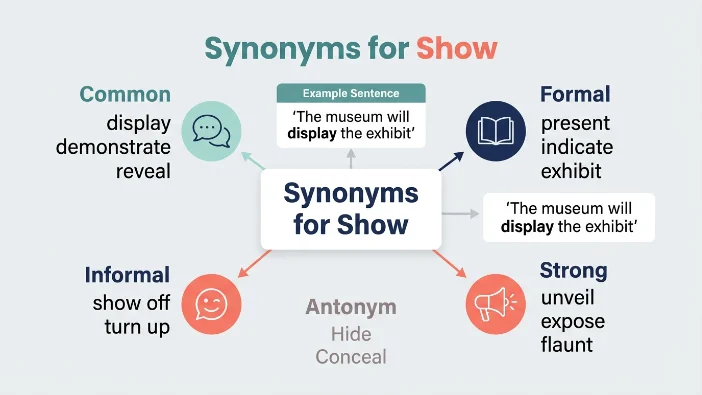
The best synonyms for “show” are display (to put something in view), demonstrate (to prove or explain), reveal (to make known something hidden), and exhibit (to present publicly). For a performance or event, use performance, production, or spectacle. For leading someone, use guide or escort. Your choice should match your exact meaning, formality level, and audience.
What Does Show Mean?
At its core, “show” means to make something visible or known. It can be a verb (action) or a noun (thing).
As a verb, “show” has several meanings:
- To cause or allow something to be seen
- To demonstrate or prove something
- To explain or make clear
- To guide or escort someone
- To be visible or noticeable
As a noun, “show” refers to:
- A public performance or entertainment
- A display or exhibition
- An outward appearance, sometimes deceptive
Example sentences:
- Verb (make visible): “Please show your ID at the door.”
- Verb (prove): “The data show a clear trend.”
- Noun (performance): “We went to a Broadway show.”
- Noun (display): “The art show opens next week.”
Core Meaning of Show
The central idea behind “show” is making something available to perception—whether through sight, understanding, or experience. It bridges the gap between what exists and what others can observe or comprehend.
When you show something, you move it from hidden to visible, from unknown to known, from private to public. This could be physical (showing a photograph), intellectual (showing how a math problem works), or emotional (showing gratitude). It’s about creating a connection between an object, idea, or feeling and an audience.
Grammar and Usage Notes
Part of Speech: Verb and noun.
Verb Forms: show (present), showed (past), shown (past participle) .
Common Patterns:
- Show + object: “Show me your work.”
- Show + object + to + person: “Show your work to the teacher.”
- Show + that + clause: “The results show that we were right.”
- Show + how + to + verb: “Show me how to do this.”
When “show” sounds natural:
- Everyday conversation and writing
- Neutral explanations and instructions
- General descriptions
When a synonym may work better:
- When you need more precision or formality
- When you want to emphasize a specific aspect (e.g., hidden information = reveal, proof = demonstrate)
- When you want to avoid repetition in your writing
Best Synonyms for Show
| Synonym | Meaning | Tone | Best Use Case | Example Sentence |
|---|---|---|---|---|
| Display | To put something in a place where it can be seen | Neutral | Exhibiting objects, arranging items, showcasing products | The museum displays artifacts from the ancient world. |
| Demonstrate | To prove or explain through evidence or action | Formal | Proving a point, teaching a skill, providing evidence | The instructor will demonstrate the proper technique. |
| Reveal | To make something hidden or secret known | Dramatic | Unveiling surprises, exposing secrets, disclosing information | The investigation revealed the truth about the accident. |
| Exhibit | To present something publicly, often in a formal setting | Formal | Art shows, museums, professional presentations | The gallery will exhibit the artist’s new collection. |
| Present | To formally offer or show something | Professional | Business pitches, speeches, introductions | She will present the quarterly results to the board. |
| Guide | To lead someone in a direction or through a process | Helpful | Giving directions, mentoring, teaching | The guide will lead us through the museum. |
| Indicate | To point out or be a sign of something | Neutral/Formal | Charts, data, signs, pointing | The arrow indicates the correct direction. |
| Performance | A public show, often involving acting or music | Neutral | Theater, concerts, entertainment | The evening performance was sold out. |
| Spectacle | An impressive or grand public display | Dramatic | Parades, ceremonies, large events | The parade was a spectacular celebration. |
| Unveil | To remove a cover and show something new | Dramatic | New products, plans, or secret reveals | The company unveiled its latest design. |
Common Synonyms for Show
These everyday synonyms work well in most conversations and general writing.
Display
- Meaning: To arrange or put something where it can be seen.
- Best Context: Showing off objects, products, or decorations.
- Example: “The store displayed the new phone in its window.”
Demonstrate
- Meaning: To show how something works or prove its truth.
- Best Context: Teaching, instructions, and making a case.
- Example: “Can you demonstrate how to use this software?”
Reveal
- Meaning: To show something that was previously hidden or secret.
- Best Context: Making discoveries, sharing secrets, uncovering truths.
- Example: “The doctor revealed the test results.”
Guide
- Meaning: To show the way or help someone navigate.
- Best Context: Giving directions, leading people, helping others learn.
- Example: “He guided us through the historic district.”
Present
- Meaning: To formally show or introduce something.
- Best Context: Giving a talk, launching a product, offering a gift.
- Example: “The committee presented its findings.”
Formal Synonyms for Show
These formal alternatives are suitable for academic, business, and professional communication.
Demonstrate
- Best Context: Academic writing and professional presentations where you need to prove or explain.
- Example: “The study demonstrates a clear link between diet and health.”
Exhibit
- Best Context: Official exhibitions, legal contexts, and scientific writing.
- Example: “The defendant exhibited signs of distress.”
Indicate
- Best Context: Reports, data analysis, and academic papers.
- Example: “The figures indicate a strong economic recovery.”
Evince
- Best Context: Formal writing, often legal or academic, to reveal or show clearly.
- Note: This is a more sophisticated and less common word.
- Example: “He evinced no interest in the proposal.”
Manifest
- Best Context: Formal writing, especially when a quality or condition appears.
- Example: “The illness manifested itself in unusual ways.”
Convey
- Best Context: Formal and professional communication for passing ideas or emotions.
- Example: “The letter conveyed a sense of urgency.”
Substantiate
- Best Context: Legal, academic, or professional writing where you need to support a claim.
- Example: “The witness substantiated the defendant’s alibi.”
Informal Synonyms for Show
These casual alternatives are great for conversations, personal messages, and social media.
Show Off
- Meaning: To display your abilities or possessions proudly (can be negative).
- Context: Boasting, seeking attention.
- Example: “He bought a sports car just to show off.”
Turn Up
- Meaning: To arrive or appear.
- Context: Events, meetings, getting together with friends.
- Example: “About fifty people turned up to the party.”
Let On
- Meaning: To reveal or hint at something.
- Context: Sharing secrets or information.
- Example: “She knows the surprise, but she won’t let on.”
Put On
- Meaning: To stage a performance or pretend.
- Context: Entertainment or deception.
- Example: “The kids put on a play for their parents.”
Demo
- Meaning: To demonstrate (shortened).
- Context: Tech, informal business, presentations.
- Example: “Let me demo the new feature for you.”
Strong Synonyms for Show
These synonyms carry more power, emotion, or intensity.
Expose
- Meaning: To reveal something negative or hidden.
- Example: “The article exposed the company’s unethical practices.”
Flaunt
- Meaning: To show off in a proud and obvious way.
- Note: Often implies showing wealth or success.
- Example: “He flaunted his new watch at every opportunity.”
Unveil
- Meaning: To reveal something new and important.
- Example: “The government unveiled a new economic plan.”
Proclaim
- Meaning: To announce something officially or publicly.
- Example: “The results proclaimed her the winner.”
Testify to
- Meaning: To provide evidence or proof.
- Example: “His test scores testify to his intelligence.”
When to use them: Use strong synonyms when you want to emphasize importance, create drama, or make a bold statement. Be careful—they can sound excessive in very casual or neutral situations.
Mild Synonyms for Show
These softer or more neutral synonyms are better when strong wording feels too forceful.
Suggest
- Meaning: To imply or indicate indirectly.
- Example: “The results suggest a possible connection.”
Hint At
- Meaning: To show in a subtle or indirect way.
- Example: “The email hinted at changes to come.”
Indicate
- Meaning: To point out or show indirectly.
- Example: “The sign indicates the exit is to the left.”
Demonstrate (milder use)
- Meaning: To show in a low-key way.
- Example: “His manner demonstrated respect.”
Register
- Meaning: To show an emotion or reaction on the face.
- Example: “Her face registered surprise.”
When mild wording is better: Use milder synonyms when you don’t want to be too direct, when you are speculating, or when a strong word would be inappropriate for the situation.
Synonyms for Show by Context
Everyday Conversation
In casual conversation, stick with simple, common synonyms:
- Show: “Can you show me your photos?”
- Display: “He displayed his collection.”
- Turn up: “Did many people turn up?”
- Let on: “Don’t let on that you know.”
Professional Writing
In a business or professional context, choose words that sound polished and clear:
- Present: “We will present the new budget.”
- Demonstrate: “The sales figures demonstrate our success.”
- Indicate: “The survey indicates high customer satisfaction.”
- Convey: “Your email conveyed the wrong message.”
Academic Writing
In academic contexts, precision and formality matter. Use:
- Demonstrate: “The experiment demonstrated a clear effect.”
- Indicate: “The data indicate a significant difference.”
- Exhibit: “The organisms exhibited similar behavior.”
- Evince: “The study evinces a new understanding of the problem.”
- Manifest: “The symptoms manifested after three days.”
Creative Writing
Creative writing needs variety and imagery. Choose words that fit the mood:
- Reveal: “The letter revealed long-held secrets.”
- Unveil: “He unveiled the painting with a flourish.”
- Flaunt: “She flaunted her diamond ring.”
- Expose: “The story exposed the town’s dark side.”
- Spectacle: “The sunset was a spectacular show.”
Emotional Expression
When showing emotions, pick the word that fits the intensity:
- Betray: “His trembling voice betrayed his nervousness.”
- Reveal: “Her smile revealed her happiness.”
- Manifest: “His patience manifested in calm reactions.”
- Register: “His face registered disappointment.”
Another Word for Show in a Sentence
Here are real-world examples using different synonyms for “show.”
- Display: The gallery displays modern art from around the world.
- Demonstrate: The teacher demonstrated the science experiment to the class.
- Reveal: The journalist’s research revealed corruption in the city council.
- Exhibit: The museum will exhibit the new dinosaur fossils next month.
- Present: She presented her ideas to the board of directors.
- Guide: The tour guide guided us through the ancient ruins.
- Indicate: The weather vane indicates the direction of the wind.
- Unveil: The tech giant unveiled its latest smartphone model.
- Convey: He tried to convey his feelings through his music.
- Flaunt: He likes to flaunt his expensive new car.
- Evince: The debate evinced a deep understanding of the issue.
- Suggest: These symptoms suggest a viral infection.
- Testify: Her grades testify to her hard work.
- Manifest: The plant disease manifested as yellow spots on the leaves.
Show Synonyms Compared
Some synonyms are very close but have distinct differences. Here’s a quick breakdown.
| Synonym | Key Difference from “Show” | Tone/Intensity |
|---|---|---|
| Display | Focuses on arranging things for viewing. Often visual. | Neutral, concrete. |
| Demonstrate | Emphasizes proving or explaining through evidence. | Formal, instructive. |
| Reveal | Suggests uncovering something hidden or secret. | Dramatic, personal. |
| Present | Connotes a formal offering or introduction. | Professional, formal. |
| Exhibit | Suggests a public, often artistic or scientific display. | Formal, official. |
| Evince | A more formal word for showing a quality or feeling. | Highly formal, rare. |
| Indicate | Suggests pointing to or being a sign of something. | Neutral, objective. |
| Guide | Relates to showing a person the way, not an object. | Helpful, personal. |
| Performance | A noun, meaning a public show or act. | Neutral, entertainment. |
| Spectacle | A noun, implying a grand or impressive show. | Dramatic, grand. |
Words Similar to Show
These words are related to “show” but may not be direct replacements.
“Expose” is close but has a more negative tone of revealing something hidden that shouldn’t be, like a scandal.
- Related but not always exact: Expose is stronger and often implies uncovering something shameful.
“Evidence” (verb) is a formal legal term meaning to prove or be evidence of.
- Related but not always exact: “Evidence” as a verb is much less common than “show” and is very formal.
“Air” is similar when referring to broadcasting something, like a TV show.
“Broadcast” is like “air,” specifically for TV and radio.
- Related but not always exact: “Broadcast” is narrow in application.
“Pretence” (or pretense) is related to the noun meaning of “show” as a false appearance.
- Related but not always exact: It’s a noun, not a verb, and means a false display.
Antonyms of Show
If you need the opposite of “show,” these words are good options.
Hide
Conceal
- Meaning: To deliberately keep something from being seen.
- Example: “She concealed the gift under her coat.”
Cover
- Meaning: To put something over or in front of to hide.
- Example: “The blanket covered the stain.”
Withhold
- Meaning: To refuse to give or reveal something.
- Example: “The company withheld the bad news.”
Suppress
- Meaning: To prevent something from being seen or known.
- Example: “He suppressed a smile.”
How to Choose the Right Synonym for Show
Choosing the best synonym is about more than finding a word that means roughly the same thing. Follow this guide for better choices.
1. Match the Context
Where is your writing going to appear? An academic paper, a business report, a text message, or a novel all require different levels of formality. Use “demonstrate” or “exhibit” for formal writing, “show off” or “turn up” for casual conversation.
2. Match the Tone
What feeling do you want to convey? “Reveal” has a dramatic feel, while “indicate” is much more neutral. Choose the tone that fits your message.
3. Check the Intensity
How strong is your meaning? “Flaunt” is intense, while “hint at” is mild. Use strong words sparingly and only when appropriate.
4. Think About Your Reader
Will your audience understand the word? A common word like “show” or “display” is always safe. A rarer word like “evince” might sound impressive but could confuse some readers.
5. Know the Exact Meaning
Always check that the synonym means exactly what you intend. Some words, like “expose,” have a specific emotional or negative weight.
6. Keep It Natural
Read your sentence aloud. Does the synonym fit naturally? If it sounds forced, try a simpler word.
Common Mistakes When Using Synonyms for Show
Even experienced writers can slip up. Here are the most common mistakes to avoid.
Choosing a Word with the Wrong Tone
Using a dramatic word like “reveal” for a routine announcement can sound odd. Save dramatic words for genuinely surprising or hidden information.
Using a Synonym That Is Too Strong
“He flaunted his new shoes” implies boastfulness. If you just want to say he was wearing them, use “showed” or “displayed.”
Using a Formal Word in Casual Writing
“Please evince your identification” sounds awkward. Use “show” in everyday situations.
Using a Casual Word in Professional Writing
“Let’s demo the strategy” is too informal for a board meeting. Use “present” or “demonstrate.”
Treating Related Words as Exact Synonyms
“Guide” means to lead a person, not an object. You wouldn’t say, “Guide the photo to your friend.” Use “show” instead.
Making the Sentence Sound Unnatural
“Her face displayed joy” sounds robotic. “Her face showed joy” or “Her face registered joy” are more natural.
Forgetting the Direct Object
“The teacher demonstrated” is vague. You need to demonstrate something: “The teacher demonstrated the formula.”
Quick Synonym List for Show
Here’s a clean, scannable list for quick reference.
Common Synonyms
- Display
- Demonstrate
- Reveal
- Exhibit
- Present
- Guide
- Indicate
Formal Synonyms
- Demonstrate
- Exhibit
- Indicate
- Evince
- Manifest
- Convey
- Substantiate
Informal Synonyms
- Show off
- Turn up
- Let on
- Put on
- Demo
Strong Synonyms
- Expose
- Flaunt
- Unveil
- Proclaim
- Testify to
Mild Synonyms
- Suggest
- Hint at
- Indicate
- Register
Related Words (not exact synonyms)
- Expose (negative revelation)
- Air (broadcast)
- Pretence (false appearance)
- Evidence (formal proof)
- Broadcast (TV/radio)
FAQs
What is the best synonym for show?
The best synonym depends on your context. For general use, display and demonstrate are excellent. Use reveal for hidden information. Use present for formal situations.
What is another word for show?
Another word for show could be display, demonstrate, reveal, exhibit, or present. For a public performance, you could use performance, production, or spectacle.
What is a formal synonym for show?
Good formal synonyms for show include demonstrate, exhibit, indicate, manifest, and evince. Use these in academic, legal, or professional writing.
What is an informal synonym for show?
Informal ways to say show include show off (to display boastfully), turn up (to arrive), let on (to reveal), and demo (to demonstrate).
What is a stronger word for show?
A stronger word for show is expose, unveil, proclaim, flaunt, or testify to. These words carry more intensity and emotion.
What is a milder word for show?
Milder alternatives include suggest, hint at, indicate, and register. These are softer and less direct.
What words are similar to show?
Words similar to show include expose (negative reveal), air (broadcast), evidence (formal proof), and pretence (false appearance). These are related but not always exact synonyms.
What is the opposite of show?
The opposite of show is hide, conceal, cover, withhold, or suppress.
How do I choose the right synonym for show?
Consider your context, tone, intensity, and audience. Match formal situations with formal words, casual situations with casual words, and choose the intensity that fits your meaning.
Is “show” a formal or informal word?
“Show” is generally neutral and can be used in both formal and informal contexts. Its synonyms often have more specific tones.
Conclusion
Finding the right synonym for “show” is about more than just swapping words. It’s about choosing the word that carries the right meaning, tone, and intensity for your specific situation. Whether you need a formal term like “demonstrate,” a casual word like “turn up,” or a dramatic one like “reveal,” there’s always a better word waiting. Keep this guide handy, and you’ll never be stuck using the same word again. The best synonym is the one that makes your writing clearer and more effective for your readers.
Read More Related Articles:
- Synonyms for Hopeful | Which Word Fits Your Situation Best In 2026
- Synonyms for Blessed | Improve Your Word Choice Naturally In 2026
- Synonyms for Multifaceted | From Basic to Brilliant Vocabulary In 2026

Grace Phillips contributes content to SynonymsAura.com, where she writes about language, vocabulary and everyday communication. Her work is centered on helping readers find the right words and express themselves with greater clarity and confidence.