The word understand is one of the most frequently used verbs in English. You use it when you grasp an idea, figure out instructions, or empathize with a friend. But sometimes, “understand” doesn’t quite say enough. If you’re looking for synonyms for understand, this article will help you find the right word for every situation.
The best synonyms for understand are comprehend, grasp, appreciate, and realize. However, the perfect choice depends on your tone, context, and how deeply you want to express your understanding. Whether you need a formal synonym for an essay or a casual word for a text message, this guide covers all the alternatives you need.
Best Synonyms for Understand
The best synonyms for understand are comprehend, grasp, appreciate, and realize. The right choice depends on tone, context, and intensity.
What Does Understand Mean?
Understand means to perceive the meaning of something, grasp the idea of it, or know how it works or why it happens. It is a verb (action word) and is used in many different ways, from understanding a simple instruction to understanding another person’s feelings.
Understanding is more than just knowing facts. It’s the ability to see connections, meanings, and significance.
Example sentences:
- I finally understand why she made that decision.
- Do you understand the directions to the new office?
- She doesn’t seem to understand what a big deal this is.
Core Meaning of Understand
The core meaning of understand is the mental process of grasping meaning. This can apply to several different areas. You can understand information, like the instructions for assembling a bookshelf or the rules of a board game. You can understand a situation, which means you know why something is happening or how it came to be.
Additionally, understand is essential for communicating with people. This is the emotional part. It means you know why someone feels a certain way or why they act the way they do. To understand a person is often to be able to see things from their perspective.
Grammar and Usage Notes
Understand is a verb. It is an irregular verb, so its past tense and past participle form is understood.
Common sentence patterns:
- Understand + [object]: I understand your concern.
- Understand + [question word]: Do you understand how this works?
- Understand + that [clause]: She understands that it will take time.
- “Make myself understood”: This phrase means to communicate clearly so that others know what you mean.
When it sounds natural: Understand is a versatile word. It sounds natural in almost every context, from casual conversation to professional settings. It is a safe default choice because it’s clear and widely accepted.
When a synonym may work better: Understand can sometimes feel too basic or not descriptive enough. You might want to use a synonym to:
- Be more precise about the type of understanding (e.g., appreciate for value, fathom for a deep mystery).
- Match the formality of a situation (e.g., comprehend for a report).
- Show a sudden realization (e.g., realize).
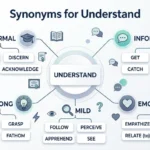
Best Synonyms for Understand
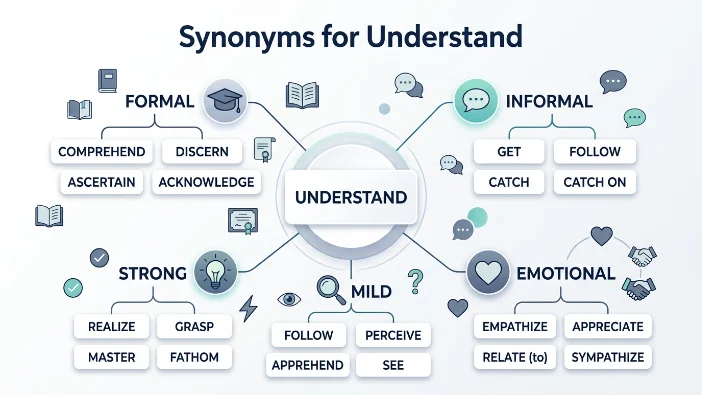
Common Synonyms for Understand
These are everyday synonyms used in normal writing and conversation.
Get
- Meaning: To understand something, usually without much effort.
- Best context: Casual conversations, explaining a joke or a simple point.
- Example sentence: “I don’t get it. Can you explain it one more time?”
Follow
- Meaning: To understand what someone is saying or what is happening in a sequence.
- Best context: Understanding a story, a speech, or a set of instructions.
- Example sentence: “I’m trying to follow the teacher’s argument, but I’m a bit lost.”
See
- Meaning: To understand a point someone is making or to visualize a concept.
- Best context: Acknowledging someone else’s perspective during a conversation.
- Example sentence: “I see what you’re saying, but I don’t agree with your conclusion.”
Grasp
- Meaning: To catch the meaning of something firmly in your mind.
- Best context: Understanding a key concept or the main idea of a topic.
- Example sentence: “She finally grasped the full meaning of the poem.
Know
- Meaning: To be familiar with information or a fact, sometimes without understanding the deeper meaning.
- Best context: Stating facts or being aware of a person or a subject.
- Example sentence: “I know about the problem, but I don’t understand why it’s happening.”
Formal Synonyms for Understand
These alternatives are suitable for academic writing, business communication, essays, and professional reports. They signal a higher level of sophistication and precision.
Comprehend
- This is the closest formal synonym to “understand” and is used in formal contexts to mean fully grasping the nature or meaning of something.
- Example: “The study aims to comprehend the complexities of the economic system.”
Appreciate
- In a formal context, “appreciate” shows you understand the full significance, value, or nuance of a situation or point of view, often implying sympathy or respect.
- Example: “We appreciate the challenges our international partners face.”
Perceive
- This is a formal word for understanding or becoming aware of something through your senses or intellect. It can imply an understanding that is slightly different from the obvious.
- Example: “The manager perceived a growing sense of unease among the employees.”
Discern
- “Discern” is used when you can detect or understand something that is not immediately obvious, requiring careful observation or thought.
- Example: “It’s difficult to discern the real intention behind his polite words.”
Fathom
- This is another formal synonym used to suggest you have deeply understood something puzzling or mysterious.
- Example: “After years of research, scientists are only beginning to fathom the power of the human brain.
Apprehend
- A formal synonym for understand that implies understanding in a deep, sometimes intuitive way.
- Example: “It is hard to apprehend the full extent of the damage.”
Informal Synonyms for Understand
These casual alternatives are perfect for everyday conversation, social media, friendly writing, and personal messages.
Get
- This is the most common informal word for “understand.” It’s used for quick and easy comprehension.
- Example: “That joke was so bad it was hilarious. Get it?”
- Context: Friends, family, casual chats.
Catch on
- This phrasal verb means to begin to understand something, especially after a little time or effort.
- Example: “It took me a minute to catch on to the rules of the game.”
Get the picture
- This informal phrase is used to tell someone you understand the general situation and don’t need further details.
- Example: “Okay, you’ve explained enough. I get the picture.”
Figure out
- This means to solve or understand something by thinking about it. It’s the action of working towards understanding.
- Example: “Can you figure out how to get this app to work?”
- Context: Problem-solving, understanding instructions.
Cotton on
- (British English) “Cotton on” means to figure something out or finally understand a secret or a simple concept, often after being confused for a bit.
- Example: “He didn’t cotton on to the fact that we were joking.”
Dig
- In very casual slang, “dig” can mean to understand, enjoy, or appreciate something.
- Example: “I dig what you’re saying, man.”
- Context: Very casual speech, often used with “man” or “dude.”
Strong Synonyms for Understand
These synonyms carry more emotion, power, or a sense of profound comprehension.
Grasp
- While used in general contexts, “grasp” can be strong when it implies a firm and quick mastery of the idea.
- Example: “As soon as he saw the diagram, he grasped the concept perfectly.”
Comprehend
- Beyond being formal, “comprehend” can show that you have gone beyond basic understanding to truly grasp every part of something.
- Example: “The tragedy was so immense that she simply could not comprehend it.”
Realize
- This has a strong punch because it describes the moment everything clicks into place. It shows a shift in awareness.
- Example: “I suddenly realized the truth that had been hiding in plain sight.”
Apprehend
- This is a powerful synonym as it suggests a deep, intuitive, and often intellectual understanding of something that may be abstract.
- Example: “Only now can I begin to apprehend the power of these forces.”
Fathom
- “Fathom” is a strong synonym because it implies you are trying to understand something extremely difficult or mysterious, requiring great mental effort.
- Example: “I can fathom almost anything, but I can’t fathom why he would lie to me.”
Mild Synonyms for Understand
These are softer, more neutral, or less emphatic ways to say “understand.”
Know
- “Know” is a mild synonym because it refers to having information or awareness, which is often a step below truly understanding.
- Example: “I know he’s unhappy, but I don’t know why.”
Follow
- “Follow” indicates you are keeping pace with an explanation or narrative. It’s a more passive form of understanding.
- Example: “Are you following the conversation, or is it too technical?”
Acknowledge
- This means to accept or recognize the truth of something, which can be a form of understanding.
- Example: “I acknowledge that you have a point, even if I disagree.”
Recognize
- “Recognize” means to remember or identify something from past experience, which is a gentle form of understanding.
- Example: “I recognize that this is a difficult decision for you.”
Take in
- This means to absorb information, often slowly. It is a mild way of saying you are processing something.
- Example: “Give me a minute to take in what you just said.”
Process
- Similar to “take in,” “process” means to think about and absorb information, but it can sound a bit more clinical and mild.
- Example: “I need time to process this news.”
Synonyms for Understand by Context
The best synonym for understand depends heavily on the situation. Here is how to choose the right word for different contexts.
Everyday Conversation
In casual settings, clarity and simplicity are key. Using a big formal word can make you sound stiff.
- Best synonyms: get, follow, see, catch on
- Example: “Do you get what I’m saying?” “I don’t follow you.”
Professional Writing
In business, you want to be polite, clear, and often show you appreciate the complexities of a situation.
- Best synonyms: appreciate, understand (itself), grasp, acknowledge
- Example: “We fully appreciate the workload your team is handling.”
- Tip: “Understand” is still great to use here. You can pair it with a word like “fully” or “clearly” for emphasis.
Academic Writing
Academics and essays require precision and a sophisticated vocabulary to show depth of thought.
- Best synonyms: comprehend, perceive, discern, apprehend
- Example: “The philosopher sought to comprehend the nature of existence.”
Creative Writing
Creative writing is where you can have the most fun. Words can show a character’s mind working, their emotions, or deep insight.
- Best synonyms: fathom, perceive, discern, realize, grasp
- Example: “She could perceive a world of sadness behind his forced smile.”
Marketing Copy
In marketing, you want to show you understand your customer’s problem.
- Best synonyms: appreciate, recognize, understand
- Example: “We recognize the challenge of finding an affordable, high-quality solution.”
- Tip: “Understand” is powerful in marketing because it shows empathy. “We understand you.”
Emotional Expression
When discussing feelings, you need words that show empathy and connection.
- Best synonyms: empathize, sympathize, appreciate, relate to
- Example: “I empathize with your feelings of frustration.”
- Tip: “Relate to” is a great casual alternative. “I can relate to what you’re going through.”
Another Word for Understand in a Sentence
Here are many natural example sentences using different synonyms for “understand.”
- It can be hard to comprehend the size of the universe.
- It took me a minute to grasp her main argument.
- I appreciate your concern, but I’m fine.
- I just realized I left my wallet at home.
- I couldn’t follow the plot of the film.
- After a few jokes, he began to catch on.
- I think you should discern the truth from the rumors.
- I can’t fathom why you would do something so risky.
- Many people perceive a change in the company’s culture.
- He truly empathizes with people who are going through a hard time.
- I see what you mean about the design being outdated.
- To be a good friend, you don’t always have to agree, but you should understand.
- When you acknowledge the risks, the plan seems less appealing.
Understand Synonyms Compared
Some synonyms are so similar that they can be easily confused. Here’s how to tell them apart.
Know vs. Understand
- “Know” is about having information. “Understand” is about what that information means. You can know a bunch of facts without understanding the bigger picture.
- Example: “I know all the rules of the game, but I don’t understand how to win.”
Realize vs. Understand
- “Realize” implies a sudden moment of awareness or an “aha” moment. “Understand” can describe a gradual process or a continuous state of knowing.
- Example: “I always understood her to be a quiet person, but I only just realized how shy she truly is.”
Comprehend vs. Appreciate
- “Comprehend” is about fully grasping the meaning of an idea. “Appreciate” is about understanding the value, importance, or nuance of something.
- Example: “I comprehend the theory of gravity. I really appreciate how it affects everything in our daily lives.”
Grasp vs. Get
- They are very similar. “Grasp” sounds slightly more formal and can imply a firmer understanding. “Get” is the casual, everyday word.
- Example: “Did you grasp the main points?” (More formal) vs. “Did you get it?” (Casual)
Words Similar to Understand
These words belong to the same semantic field but are not always exact synonyms. They might describe a related mental process.
Interpret
- “Interpret” is about explaining or understanding the meaning of something. It’s similar to understand, but has an added dimension of “translating” meaning for yourself.
- Why it’s different: You interpret something to understand it. It’s the process of figuring out the meaning.
- Example: “I interpreted his silence as agreement.”
Learn
- “Learn” is about gaining knowledge through study or experience. Understanding is often the result of learning.
- Why it’s different: Learning is the process. Understanding is the result.
- Example: “I want to learn history so I can understand the world today.
Infer
- To “infer” is to draw a conclusion or understand from evidence or reasoning, rather than from explicit statements.
- Why it’s different: Inferring is a specific way of arriving at understanding.
- Example: “I inferred from his annoyed tone that he was not happy with the plan.”
Recognize
- “Recognize” means to identify something or someone as already known.
- Why it’s different: It’s often about memory and identification, not necessarily comprehension of an abstract idea.
- Example: “I recognized the face but couldn’t understand the name.”
Antonyms of Understand
Antonyms are words with opposite meanings. If you understand something, you are not confused by it.
Misunderstand
- Meaning: To fail to interpret or understand correctly.
- Example: “I’m sorry, I misunderstood your question.”
Misinterpret
- Meaning: To understand or explain something incorrectly.
- Example: “It’s easy to misinterpret data if you don’t have all the facts.”
Overlook
- Meaning: To fail to notice or consider something.
- Example: “He overlooked a key detail in the contract.”
Ignore
- Meaning: To refuse to take notice of or to acknowledge; to disregard on purpose.
- Example: “Don’t ignore the warning signs.”
Confuse
- Meaning: To make unclear to the mind or to fail to distinguish.
- Example: “The politician’s explanation only confused the issue further.”
How to Choose the Right Synonym for Understand
Choosing the right word is like picking the right tool for a job. Here is a simple checklist to guide you:
- Match the context: Is this for a formal report, a casual conversation, or something in between? Use “comprehend” or “appreciate” for formal, and “get” or “catch on” for informal.
- Match the tone: Do you want to sound warm and empathetic, or cold and analytical? Use “empathize” for warmth and “discern” or “perceive” for analysis.
- Check the intensity: Is your understanding deep and firm, or light and quick? Use “fathom” or “grasp” for deep and “follow” or “see” for lighter.
- Think about the reader: Who is your audience? A group of experts might expect “apprehend,” while your friends might be weirded out by it.
- Keep it natural: The best word is the one that sounds like you. If a synonym feels forced, don’t use it.
- Is it exact or related? Make sure the word you’re using is a true synonym for the type of understanding you want to express.
Common Mistakes When Using Synonyms for Understand
It is easy to misuse synonyms. Here are the most common pitfalls to avoid.
- Choosing a word with the wrong tone: Using “get” in a cover letter will make you sound unprofessional. Using “comprehend” in a text message is overly formal and odd.
- Using a synonym that is too strong or too mild: “Fathom” is too strong to use for a simple instruction (“I can’t fathom how to make toast”). “Know” is too mild if you’re trying to show deep insight (“I know your feelings”).
- Using a formal word in casual writing: This often sounds pretentious.
- Using a casual word in professional writing: This can sound disrespectful or careless.
- Treating related words as exact synonyms: “Learn” is not the same as “understand.” “Realize” is not a direct substitute for “understand” in every context.
- Making the sentence sound unnatural: Word choice should improve a sentence, not make it awkward.
Quick Synonym List for Understand
Informal Synonyms
Mild Synonyms
Related Words
FAQs
What is the best synonym for understand?
The best synonym depends on the context.
- For a general, all-purpose formal substitute, comprehend is excellent.
- For casual conversation, get is the most common.
- For showing emotional depth, empathize is best.
What is another word for understand in an essay?
In an essay, you should use more formal synonyms like comprehend, appreciate, perceive, or discern to show a higher level of analysis and thought.
What is a formal synonym for understand?
The most common and precise formal synonym is comprehend, especially when discussing complex topics or in academic writing.
What is an informal synonym for understand?
The most common informal synonym is get. Other great options include follow, catch on, and see.
What is a stronger word for understand?
Words like grasp, fathom, and apprehend are stronger synonyms. They imply a deeper, more intuitive, or more complete level of understanding.
What is a milder word for understand?
Words like know, follow, acknowledge, and take in are milder and imply a more basic, passive, or partial understanding.
What words are similar to understand?
Words like learn, interpret, infer, and recognize are related to understanding but are not exact synonyms. They describe specific ways of arriving at understanding or being aware of something.
How do I choose the right synonym for understand?
To choose the right word, consider your context, the desired tone, the intensity of the understanding, and your audience. Formal situations call for formal synonyms, and casual ones call for casual alternatives.
Conclusion
There are many ways to say understand, and using a variety of synonyms can make your writing richer and your speech more expressive. The best synonym will always depend on your context, tone, and the exact meaning you want to convey. By understanding these options, you can choose the right word to express yourself with precision, whether you are having a casual conversation or writing a formal report.
Read More Related Articles:
Synonyms For Keep | Expand Your Expression Instantly In 2026- Synonyms For Feel | Upgrade How You Describe Thoughts & Emotions In 2026
- Synonyms For Mean | Smarter Ways to Express Yourself In 2026

Evelyn Turner is a content creator at SynonymsAura.com who enjoys exploring the richness of the English language. Her work focuses on word meanings, synonyms, expressions and everyday language usage, helping readers communicate with greater clarity and confidence.