“Change” is one of the most common words in English, but it’s also one of the easiest to overuse. Whether you’re revising an essay, polishing a business email, or just trying to avoid repeating the same word three times in one paragraph, you need synonyms for change that actually fit. The best synonym depends on what kind of change you mean, how formal your writing is, and how big or small the shift really is. This guide breaks it all down with real examples so you can pick the right word with confidence.
Best Synonyms for Change
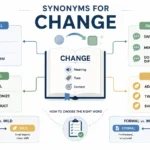
The best synonyms for change are transform, shift, alter, and adjust. The right choice depends on tone, context, and intensity. “Transform” suits dramatic or complete change, “shift” fits gradual or positional movement, “alter” works well in neutral or formal writing, and “adjust” is ideal for small, controlled updates.
What Does Change Mean?
At its core, “change” means to make or become different. It can describe something that happens on its own or something a person actively causes.
“Change” works as both a verb and a noun. As a verb, it means to make something different or to become different yourself. As a noun, it refers to the act or result of becoming different including a shift in a plan, a situation, or even loose coins in your pocket, though that meaning isn’t relevant here.
Common usage examples:
- Verb: “The weather can change quickly in the mountains.”
- Noun: “The company announced a change in leadership.”
The word is neutral in tone. It doesn’t imply whether the difference is good or bad, big or small that’s exactly why so many synonyms exist to add more specific meaning.
Core Meaning of Change
The idea behind “change” is simple: something moves from one state to another. That “something” can be a person, an object, a system, a feeling, or a plan.
Change can be:
- Gradual happening slowly over time, like a habit forming
- Sudden happening all at once, like a decision made in a moment
- Voluntary something a person chooses to do
- Involuntary something that happens to a person or situation
This range is exactly why one single word can’t cover every situation well. A slow personal shift in mindset doesn’t feel the same as a company undergoing a complete transformation, even though both technically involve “change.”
Grammar and Usage Notes
“Change” is flexible, which makes it easy to use but also easy to overuse.
Part of speech: Verb (change, changes, changed, changing) and noun (a change, the changes).
Common sentence patterns:
- Change + object: “She changed her plans.”
- Change + into: “The caterpillar changed into a butterfly.”
- Undergo a change: “The industry has undergone a major change.”
- Make a change: “We need to make a change to the schedule.”
Common collocations: climate change, change of heart, change of plans, sudden change, gradual change, change management, change course.
When “change” sounds natural: Use it when you want a plain, clear, neutral word that any reader will instantly understand. It’s rarely wrong.
When a synonym works better: Use a synonym when you want to be more specific about scale (small tweak vs. total overhaul), tone (formal vs. casual), or emotional weight (calm adjustment vs. dramatic transformation).
Best Synonyms for Change
| Synonym | Meaning | Tone | Best Use Case | Example Sentence |
|---|---|---|---|---|
| Transform | To change completely, often for the better | Strong, formal | Major, dramatic change | “The renovation transformed the old warehouse into a bright office space.” |
| Shift | To move or change position, focus, or direction | Neutral | Gradual or directional change | “Public opinion has shifted on this issue.” |
| Alter | To make something different, usually in a smaller way | Formal, neutral | Precise or technical change | “The tailor altered the suit to fit better.” |
| Adjust | To make a small change to improve fit or accuracy | Mild, neutral | Fine-tuning or small correction | “Please adjust the thermostat before you leave.” |
| Modify | To change a part of something without changing the whole | Formal | Technical or structural change | “The engineers modified the design after testing.” |
| Convert | To change from one form or use to another | Neutral, technical | Change in form, type, or function | They converted the garage into a home gym. |
| Revise | To change something, especially text, after review | Formal | Editing or updating a document | “She revised the report before sending it.” |
Common Synonyms for Change
These are the words people use most often in everyday writing and conversation.
Alter A neutral way to say something becomes different, often in a specific detail. Best context: writing, instructions, general conversation. Example: “A small mistake can alter the outcome of the whole experiment.”
Shift Suggests movement from one position, idea, or focus to another. Best context: describing trends, opinions, or gradual movement. Example: “The team’s strategy shifted after the first loss.”
Adjust A small, practical change meant to improve something. Best context: everyday tasks, settings, habits. Example: “You might need to adjust your schedule to fit the meeting in.”
Vary To change in small ways, often repeatedly or over time. Best context: describing patterns, results, or routines. Example: “Prices vary depending on the season.”
Switch An informal but common way to describe replacing one thing with another. Best context: casual writing, quick decisions. Example: “We switched suppliers after the delays got worse.”
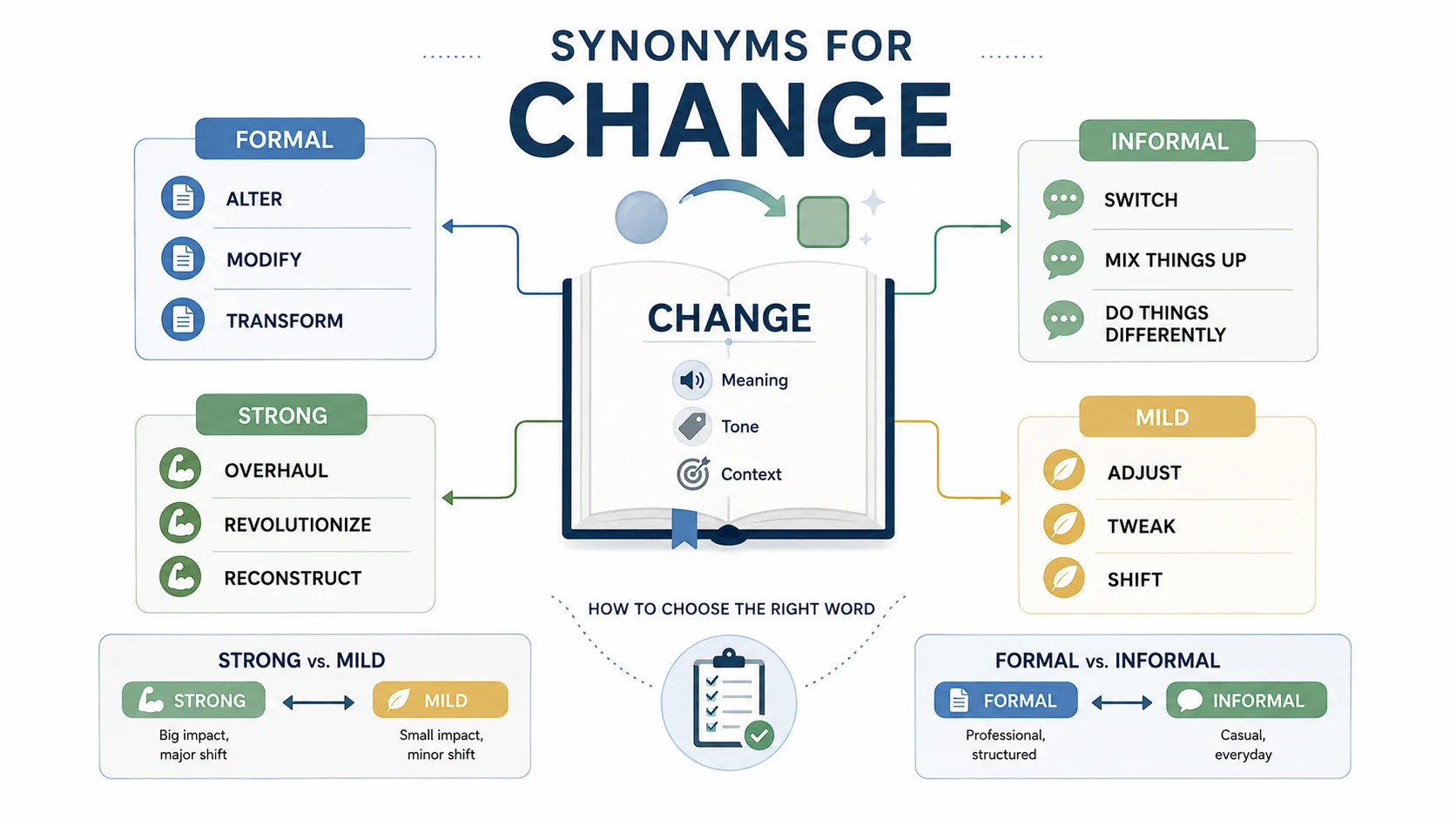
Formal Synonyms for Change
These fit academic papers, business writing, reports, and professional communication.
Transform Works well when describing a complete or significant shift in a formal report or proposal. Example: “The merger will transform how the two companies operate.”
Modify Common in technical, legal, and academic writing where precision matters. Example: “The committee voted to modify the existing policy.”
Revise Best for describing updates to documents, plans, or written work. Example: “The author revised the manuscript based on peer feedback.”
Restructure Useful for organizational or systemic change in business contexts. Example: “The company restructured its management team last quarter.”
Amend Common in legal or formal policy writing. Example: “Lawmakers amended the bill before the final vote.”
Informal Synonyms for Change
These fit casual conversation, texts, social posts, and friendly writing.
Switch Simple and direct, used constantly in daily speech. Example: “I think I’ll switch to decaf.”
Mix things up A relaxed phrase for adding variety or breaking routine. Example: “Let’s mix things up and try a new restaurant this weekend.”
Turn into Casual way to describe a transformation. Example: “That small argument turned into a big deal.”
Flip Informal, often used for quick or unexpected reversals. Example: “He flipped his opinion after hearing the new evidence.”
Strong Synonyms for Change
These carry more weight, drama, or intensity than a plain “change.”
Transform Implies a deep, often positive or dramatic shift. Use it when the change is genuinely major; using it for small tweaks feels exaggerated. Example: “Therapy completely transformed her outlook on life.”
Revolutionize Suggests a change so significant it reshapes an entire system or industry. Use with caution it can sound overblown for anything less than a game-changing shift. Example: “The internet revolutionized how people communicate.”
Overhaul Implies a thorough, often necessary rebuilding of something that wasn’t working. Example: “The government plans to overhaul the tax system.”
Upend Suggests a sudden, disruptive change that turns a situation upside down. Example: “The scandal upended the company’s reputation overnight.”
Mild Synonyms for Change
These work well when the shift is small, gentle, or ongoing rather than dramatic.
Adjust Implies a small correction rather than a major shift. Use this when precision and subtlety matter more than drama. Example: “We adjusted the plan slightly to save time.”
Tweak Casual and mild, perfect for minor improvements. Example: “Just tweak the wording and it’ll sound better.
Fine-tune Suggests careful, small improvements to something already mostly working. Example: “The team is fine-tuning the presentation before Friday.”
Ease into Describes a gentle, gradual transition rather than a sudden one. Example: “She’s easing into her new role slowly.”
Mild synonyms work best when strong words would overstate what actually happened. Calling a minor scheduling tweak a “transformation” would confuse or mislead the reader.
Synonyms for Change by Context
Everyday Conversation
“Switch,” “shift,” and “change” itself work naturally here. Casual phrases like “mix things up” also fit well in relaxed speech.
Professional Writing
“Modify,” “revise,” “restructure,” and “adjust” sound polished and precise without being overly dramatic.
Academic Writing
“Alter,” “modify,” and “transform” are common in formal analysis, especially when describing research findings or theoretical shifts.
Creative Writing
“Transform,” “morph,” and “shift” add texture and emotional weight to storytelling, especially in descriptions of character growth or setting.
Marketing Copy
“Transform” and “reinvent” work well for persuasive, benefit-driven messaging, since they suggest a meaningful improvement.
Emotional Expression
Shift” and “transform” describe internal or emotional change well, such as a shift in mood or a transformed perspective after a hard experience.
Another Word for Change in a Sentence
- The new manager plans to restructure the sales department.
- Her attitude shifted after the conversation with her mentor.
- We had to adjust our travel plans because of the storm.
- The recipe varies slightly depending on the region.
- He switched careers after ten years in finance.
- The editor revised the article for clarity.
- Years of hard work transformed the small shop into a national brand.
- The engineers modified the design to reduce weight.
- Public transportation transformed how the city grew.
- They converted the old barn into a guesthouse.
- The company decided to overhaul its entire website.
- I just want to tweak a few details before we finalize it.
- The economic downturn upended the industry’s usual patterns.
- Please amend the contract before signing.
- Her confidence grew as she slowly eased into the new role.
Change Synonyms Compared
| Word | Intensity | Formality | Best Use Case |
|---|---|---|---|
| Adjust | Low | Neutral | Small, practical corrections |
| Shift | Medium | Neutral | Gradual movement in position or focus |
| Alter | Medium | Formal | Precise, controlled changes |
| Modify | Medium | Formal | Technical or structural updates |
| Transform | High | Formal | Major, often positive shifts |
| Overhaul | High | Neutral/Formal | Thorough rebuilding of a system |
| Revolutionize | Very High | Formal | Industry- or field-wide impact |
The key differences come down to scale and formality. “Adjust” and “tweak” describe small moves, while “transform” and “revolutionize” describe sweeping ones. Mixing these up for example, calling a minor policy tweak a “revolution” makes writing sound inflated and less credible.
Words Similar to Change
These words share meaning with “change” but aren’t always direct replacements.
Evolve Implies gradual development over time, often through natural stages. It’s related to change but adds a sense of progress or growth, which “change” alone doesn’t guarantee. Useful when describing long-term development, like “the industry evolved over two decades.”
Adapt Focuses on adjusting to new conditions rather than simply becoming different. It implies a response to something external. Best used when the change is a reaction, such as “businesses had to adapt to remote work.”
Progress Suggests movement toward improvement, not just difference. Not every change is progress, so this word should only replace “change” when improvement is actually implied.
Fluctuate Describes repeated, often unpredictable ups and downs rather than a single shift. It fits data, prices, or moods that move back and forth, not a one-time change.
Reform Refers specifically to improving a system, often a political or institutional one, through structured change. It’s narrower than “change” and shouldn’t be used for personal or minor shifts.
Antonyms of Change
| Antonym | Meaning | Example Sentence |
|---|---|---|
| Stay | To remain the same or in the same place | “Despite the pressure, she decided to stay with her original plan.” |
| Remain | To continue without altering | “Prices remained steady throughout the year.” |
| Preserve | To keep something in its original state | “The team worked hard to preserve the building’s historic look.” |
| Maintain | To keep something consistent over time | “The company maintained its pricing structure for five years.” |
| Freeze | To stop something from changing, often temporarily | “The government froze wages during the crisis.” |
How to Choose the Right Synonym for Change
- Match the context. A business report calls for words like “modify” or “restructure,” while a text to a friend calls for “switch” or “mix things up.
- Match the tone. Formal writing needs formal words; casual writing sounds stiff with overly formal ones.
- Check the intensity. Don’t use “revolutionize” for a small update or “adjust” for a massive overhaul both feel misleading.
- Think about the reader. Choose words your audience will understand instantly, especially in professional or instructional writing.
- Check whether the synonym is exact or only related. Words like “adapt” or “evolve” add extra meaning that “change” doesn’t automatically include.
- Keep the sentence natural. If a synonym forces awkward phrasing, it’s not the right choice, even if it’s technically accurate.
- Use simple words when clarity matters. In instructions, manuals, or urgent communication, plain words like “change” or “adjust” beat fancier alternatives.
Common Mistakes When Using Synonyms for Change
- Choosing a word with the wrong tone, like using “revolutionize” in a casual text message.
- Using a synonym that’s too strong, such as calling a minor edit a “transformation.”
- Using a formal word in casual writing, which can sound stiff or unnatural, like saying “I shall modify my plans” to a friend.
- Using a casual word in professional writing, such as “switch things up” in a formal business proposal.
- Replacing “change” without checking meaning, which can shift the sentence’s intent, like confusing “adapt” (respond to conditions) with “alter” (make different).
- Treating related words as exact synonyms, such as using “evolve” when the change wasn’t gradual or natural.
- Making the sentence sound unnatural by forcing in a synonym that doesn’t fit the surrounding words or rhythm of the sentence.
Quick Synonym List for Change
Common synonyms: alter, shift, vary, switch, adjust
Formal synonyms: modify, revise, restructure, amend, transform
Informal synonyms: switch, flip, mix things up, turn into
Strong synonyms: transform, revolutionize, overhaul, upend
Mild synonyms: adjust, tweak, fine-tune, ease into
Related words: evolve, adapt, progress, fluctuate, reform
FAQs
What is the best synonym for change?
The best synonym depends on context, but “shift,” “alter,” and “transform” are among the most versatile. “Shift” works well for gradual movement, “alter” fits neutral or formal writing, and “transform” suits major, dramatic change.
What is another word for change?
Common alternatives include “alter,” “shift,” “modify,” “adjust,” and “transform.” The right one depends on how big the change is and how formal your writing needs to be.
What is a formal synonym for change?
“Modify,” “revise,” and “restructure” all work well in professional, academic, or legal writing. These words sound precise and neutral, making them safe choices for reports and formal communication.
What is an informal synonym for change?
“Switch,” “flip,” and “turn into” are common in casual conversation and everyday writing. They sound natural in texts, social posts, and relaxed speech.
What is a stronger word for change?
“Transform,” “revolutionize,” and “overhaul” all carry more intensity than a plain “change.” Use them for major shifts, not small updates, since overusing them can make writing feel exaggerated.
What is a milder word for change?
“Adjust,” “tweak,” and “fine-tune” describe small, controlled changes. These are ideal when the shift is minor and doesn’t need dramatic language.
What words are similar to change?
“Evolve,” “adapt,” “progress,” and “reform” are related but not exact matches. Each one adds extra meaning, like gradual growth, response to conditions, or improvement, so they should be used carefully.
What is the opposite of change?
Common antonyms include “stay,” “remain,” “preserve,” and “maintain.” These describe something staying the same rather than becoming different.
How do I choose the right synonym for change?
Match the word to your context, tone, and the size of the change you’re describing. A small tweak needs a mild word like “adjust,” while a major shift calls for a stronger word like “transform.
Conclusion
“Change” is a useful, flexible word, but it isn’t always the most precise one. The right synonym depends on how big the change is, how formal your writing needs to be, and how much emotional weight you want the sentence to carry. Once you understand the differences between words like “adjust,” “shift,” “modify,” and “transform,” picking the right one becomes second nature and your writing ends up clearer and more specific as a result.
Read More Related Articles:
- Synonyms for Suspicious | Clearer and More Precise Writing In 2026
- Synonyms for Harmful | Discover More Precise Word Choices In 2026
- Synonyms for Warrior | Synonyms That Make Your Writing Stand Out In 2026

Grace Phillips contributes content to SynonymsAura.com, where she writes about language, vocabulary and everyday communication. Her work is centered on helping readers find the right words and express themselves with greater clarity and confidence.