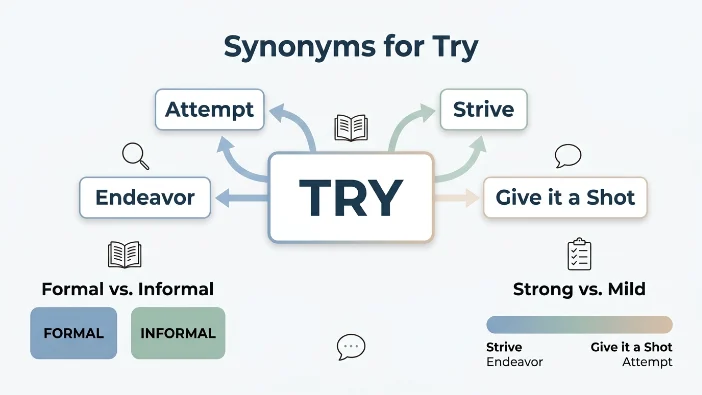
“Try” is one of the most common verbs in English, which is exactly why it’s easy to overuse. Whether you’re writing an email, a story, or a school essay, repeating “try” over and over makes your writing feel flat.
The best synonyms for try depend on how much effort is involved, how formal your writing needs to be, and how strong or gentle you want the word to sound. This guide breaks all of that down with clear examples so you can pick the right word every time.
Best Synonyms for Try
The best synonyms for try are attempt, endeavor, strive, and make an effort. The right choice depends on tone, context, and intensity.
- Use attempt for a neutral, general replacement.
- Use endeavor for formal or professional writing.
- Use strive when someone is trying hard over time toward a goal.
- Use make an effort for everyday, conversational writing.
What Does Try Mean?
“Try” means to make an effort to do something, especially when the result isn’t guaranteed. It’s a verb, and it’s one of the most flexible words in everyday English.
At its core, “try” describes the act of attempting a task, whether or not it succeeds. You can try a new recipe, try to fix a problem, or try your best in a competition.
Example sentences:
- She tried to open the jar, but the lid wouldn’t budge.
- I want to try that new coffee shop this weekend.
Core Meaning of Try
The idea behind “try” is action without a guaranteed outcome. It captures effort, willingness, and sometimes uncertainty. When you say you’ll “try” something, you’re signaling intention and effort not a promise of success.
This is what separates “try” from words like “achieve” or “complete.” Trying is about the process, not necessarily the result. That’s also why so many synonyms for try focus on effort, persistence, or willingness rather than outcome.
Grammar and Usage Notes
“Try” is a verb, and it works in a few common patterns:
- Try + to + verb: “I’ll try to call you later.”
- Try + verb-ing: “Try turning it off and on again.”
- Try + noun: “Let’s try a different approach.”
Common collocations include try hard, try again, try your best, try something new, and give it a try (used as a noun here).
Try” sounds natural in almost any setting casual conversation, business emails, or instructions. That’s part of why it gets overused. A synonym works better when you want to:
- Add more formality (use endeavor or attempt)
- Show sustained effort (use strive or work toward)
- Sound more casual (use give it a shot or have a go)
- Emphasize difficulty or determination (use struggle or push to)
Best Synonyms for Try
| Synonym | Meaning | Tone | Best Use Case | Example Sentence |
|---|---|---|---|---|
| Attempt | Make an effort to do something | Neutral | General writing, reports | He attempted to fix the leak himself. |
| Endeavor | Try earnestly, often over time | Formal | Business, academic writing | The team endeavored to meet the deadline. |
| Strive | Work hard toward a goal | Formal, motivational | Goals, personal growth | She strives to improve every day. |
| Make an effort | Put in work or energy | Neutral, conversational | Everyday speech and writing | Please make an effort to arrive on time. |
| Give it a shot | Try something casually | Informal | Friendly conversation, social media | Never tried sushi before, but I’ll give it a shot. |
Common Synonyms for Try
These are everyday synonyms you’ll hear in normal conversation and casual writing.
Attempt Meaning: to make an effort toward something, without guaranteed success. Best context: neutral writing, instructions, reports. Example: They attempted the hike despite the storm warning.
Test Meaning: to try something to see how it performs or works. Best context: product reviews, experiments, evaluations. Example: We tested three different recipes before picking one.
Sample Meaning: to try a small portion, especially food or experiences. Best context: food, products, experiences. Example: You can sample the cheese before buying a full block.
Have a go Meaning: to try something, usually informally. Best context: casual conversation, especially in British-influenced English but common in the US too. Example: I’ve never painted before, but I’ll have a go.
Formal Synonyms for Try
These synonyms work well in academic writing, business communication, reports, and professional emails.
Endeavor Best used when describing sustained, purposeful effort in professional or academic contexts. Example: The company endeavored to reduce its carbon footprint by 20 percent.
Attempt Works well in formal writing because it’s neutral and precise. Example: Researchers attempted to replicate the original results.
Undertake Suggests taking on a task with responsibility, often formal or official. Example: The committee will undertake a full review of the policy.
Pursue Implies ongoing, goal-directed effort, often used in professional or academic goals. Example: She plans to pursue a solution before escalating the issue.
Informal Synonyms for Try
These fit casual conversation, text messages, social media, and friendly writing.
Give it a shot Relaxed and encouraging. Example: I know you’re nervous, but just give it a shot.
Have a crack at it Casual and playful, common in spoken English. Example: Let me have a crack at fixing your printer.
Take a stab at Informal, suggests trying without full confidence. Example: I’ll take a stab at guessing the ending.
Mess around with Very casual, implies experimenting without a strict goal. Example: I messed around with the settings until it worked.
Strong Synonyms for Try
These carry more intensity, effort, or determination. Use them when the effort involved is significant or emotionally charged.
Strive Suggests real dedication toward a meaningful goal. Example: He strives to be a better father every single day. Use with care: too strong for small, everyday tasks like trying a snack.
Struggle Implies real difficulty, not just effort. Example: She struggled to finish the marathon in the heat. Use with care: this word signals hardship, not casual effort.
Push to Shows determined, active effort, often under pressure. Example: The team pushed to finish the project before the holiday.
Exert oneself Formal and physical, implying real energy spent. Example: He exerted himself to lift the heavy box alone.
Mild Synonyms for Try
These are softer, more neutral, and less intense than “strive” or “struggle.”
Attempt A calm, neutral choice for almost any situation. Example: She attempted the puzzle during her lunch break.
Sample Gentle and low-stakes, especially for food or short experiences. Example: Feel free to sample the desserts before ordering.
Give it a whirl Light, friendly, low-pressure. Example: I’ve never done yoga, but I’ll give it a whirl.
Dabble in Suggests light, casual involvement without deep commitment. Example: He dabbles in photography on weekends.
Mild synonyms work best when the stakes are low, or when you want to avoid sounding overly dramatic about a simple task.
Synonyms for Try by Context
Everyday Conversation
“Give it a shot,” “have a go,” and “take a stab at” sound natural and friendly. They fit casual talk without sounding stiff.
Professional Writing
“Attempt,” “endeavor,” and “undertake” carry the right level of formality for emails, reports, and workplace communication.
Academic Writing
Attempt” and “pursue” work well when describing research efforts or academic goals without sounding casual.
Creative Writing
“Strive,” “struggle,” and “push to” add emotional weight, which helps show character motivation or internal conflict in fiction.
Marketing Copy
“Give it a shot” and “give it a whirl” sound approachable and low-pressure, which works well for product trials or new offers.
Emotional Expression
“Strive” and “struggle” reflect real effort and feeling, useful when writing about personal goals or hardship.
Another Word for Try in a Sentence
- She attempted to solve the riddle before giving up.
- He endeavored to repair the relationship after the argument.
- I’ll give it a shot and see what happens.
- They strived to finish the marathon despite the heat.
- Let’s sample a few options before deciding.
- He struggled to stay awake during the long lecture.
- We’ll undertake the project once funding is approved.
- She pursued every possible lead in the investigation.
- I’m going to have a go at baking bread this weekend.
- He pushed to finish the report before his vacation.
- They dabbled in gardening last spring.
- I’ll take a stab at answering that question.
- She exerted herself to reach the finish line.
- Let’s have a crack at fixing this together.
- He messed around with the code until it finally worked.
Try Synonyms Compared
| Synonym | Intensity | Formality | Best Use Case |
|---|---|---|---|
| Attempt | Medium | Neutral | General, all-purpose replacement |
| Endeavor | Medium-High | Formal | Business, academic goals |
| Strive | High | Formal, emotional | Long-term personal or professional goals |
| Struggle | High | Neutral | Situations involving real difficulty |
| Give it a shot | Low | Informal | Casual, low-pressure attempts |
| Sample | Low | Neutral | Small, low-commitment trials |
The biggest difference between these words is how much effort or difficulty they imply. “Attempt” is neutral and safe in almost any sentence. “Strive” and “struggle” both suggest real effort, but “struggle” leans toward hardship, while “strive” leans toward determination. “Sample” and “give it a shot” both downplay the effort involved, making them useful for casual or low-stakes situations.
Words Similar to Try
Some words are closely related to “try” but don’t work as direct replacements in every sentence.
Experiment This means to test something to learn how it works, often with a scientific or exploratory angle. It’s related to trying, but it implies observation and learning, not just effort. Example: We experimented with different lighting setups for the photos. Why it’s different: “Try” doesn’t always involve testing or observing results; “experiment” does.
Practice This means repeating an activity to improve at it. It’s connected to trying, since you often try something while practicing, but “practice” emphasizes repetition, not a single effort. Example: She practices piano every evening. Why it’s different: You can try something once, but “practice” implies doing it repeatedly over time.
Explore This means to investigate or look into something, often without a fixed goal. It overlaps with trying new things but leans toward discovery rather than effort. Example: They explored a few different marketing strategies before settling on one. Why it’s different: “Explore” is about investigation, while “try” is about action and effort.
Antonyms of Try
| Antonym | Meaning | Example Sentence |
|---|---|---|
| Give up | To stop trying entirely | He gave up after the third failed attempt. |
| Quit | To stop doing something before finishing | She quit halfway through the project. |
| Abandon | To leave something incomplete or unattempted | They abandoned the plan due to lack of funding. |
| Avoid | To stay away from doing something | He avoided the difficult conversation altogether. |
| Ignore | To not attempt or address something at all | She ignored the warning signs completely. |
How to Choose the Right Synonym for Try
- Match the context. Formal writing calls for words like “attempt” or “endeavor,” while casual writing works better with “give it a shot” or “have a go.
- Match the tone. Ask whether the sentence should feel serious, playful, determined, or relaxed.
- Check the intensity. Words like “strive” and “struggle” carry more weight than “sample” or “dabble in.” Don’t use a strong word for a small task.
- Think about the reader. A business email needs different word choices than a text message to a friend.
- Check whether the synonym is exact or only related. Words like “experiment” and “practice” are related to trying but mean something slightly different don’t swap them in carelessly.
- Keep the sentence natural. If a synonym makes the sentence sound stiff or odd, it’s probably the wrong choice.
- Use simple words when clarity matters. In instructions or technical writing, “attempt” or “try” is often clearer than a fancier alternative.
Common Mistakes When Using Synonyms for Try
- Choosing a word with the wrong tone. Using “endeavor” in a text message to a friend can sound stiff and unnatural.
- Using a synonym that’s too strong. Saying you “struggled” to open a snack bag sounds overly dramatic for such a small task.
- Using a formal word in casual writing. “Undertake” feels out of place in everyday conversation.
- Using a casual word in professional writing. “Give it a shot” can sound too relaxed in a formal business report.
- Replacing “try” without checking meaning. Not every synonym fits every sentence always read it back before finalizing.
- Treating related words as exact synonyms. Words like “experiment” or “practice” aren’t always interchangeable with “try.
- Making the sentence sound unnatural. If a word choice feels forced, it usually is. Natural flow matters more than variety for its own sake.
Quick Synonym List for Try
Common synonyms: attempt, test, sample, have a go
Formal synonyms: endeavor, attempt, undertake, pursue
Informal synonyms: give it a shot, have a crack at it, take a stab at, mess around with
Strong synonyms: strive, struggle, push to, exert oneself
Mild synonyms: attempt, sample, give it a whirl, dabble in
Related words: experiment, practice, explore
FAQs
What is the best synonym for try?
The best overall synonym for try is attempt. It’s neutral in tone, works in both casual and formal writing, and closely matches the meaning of “try” in most sentences without changing the intensity or feel.
What is another word for try?
Another word for try is attempt, endeavor, or give it a shot, depending on how formal or casual your writing needs to be. Each carries a slightly different tone, but all describe making an effort toward something.
What is a formal synonym for try?
A formal synonym for try is endeavor or undertake. These words fit business, academic, and professional writing better than casual alternatives, and they signal deliberate, purposeful effort.
What is an informal synonym for try?
An informal synonym for try is give it a shot or have a go. These phrases sound natural in everyday conversation, texting, and casual writing without feeling stiff or overly proper.
What is a stronger word for try?
A stronger word for try is strive or struggle. These words suggest more effort, difficulty, or determination than a simple attempt, so they work best for meaningful goals or genuinely hard situations.
What is a milder word for try?
A milder word for try is sample or dabble in. These words downplay the effort involved, which makes them ideal for low-stakes or casual situations, like tasting food or briefly exploring a hobby.
What words are similar to try?
Words similar to try include experiment, practice, and explore. These aren’t exact synonyms, but they share a connection to effort, testing, or discovery, and can work well in the right context.
What is the opposite of try?
The opposite of try is give up or quit. These words describe stopping an effort instead of making one, which makes them useful antonyms in writing about persistence versus abandonment.
Conclusion
There’s no single “correct” synonym for try the right word depends on how formal your writing is, how much effort is involved, and how strong you want the sentence to feel. “Attempt” works almost anywhere, “endeavor” suits professional writing, “strive” fits determined effort, and “give it a shot” feels right in casual conversation.
The next time “try” starts repeating too often in your writing, look at the tone and intensity you actually need, then pick the synonym that matches not just the one that sounds fancier.
Read More Related Articles:
- Synonyms for Suspicious | Clearer and More Precise Writing In 2026
- Synonyms for Harmful | Discover More Precise Word Choices In 2026
- Synonyms for Warrior | Synonyms That Make Your Writing Stand Out In 2026

Evelyn Turner is a content creator at SynonymsAura.com who enjoys exploring the richness of the English language. Her work focuses on word meanings, synonyms, expressions and everyday language usage, helping readers communicate with greater clarity and confidence.