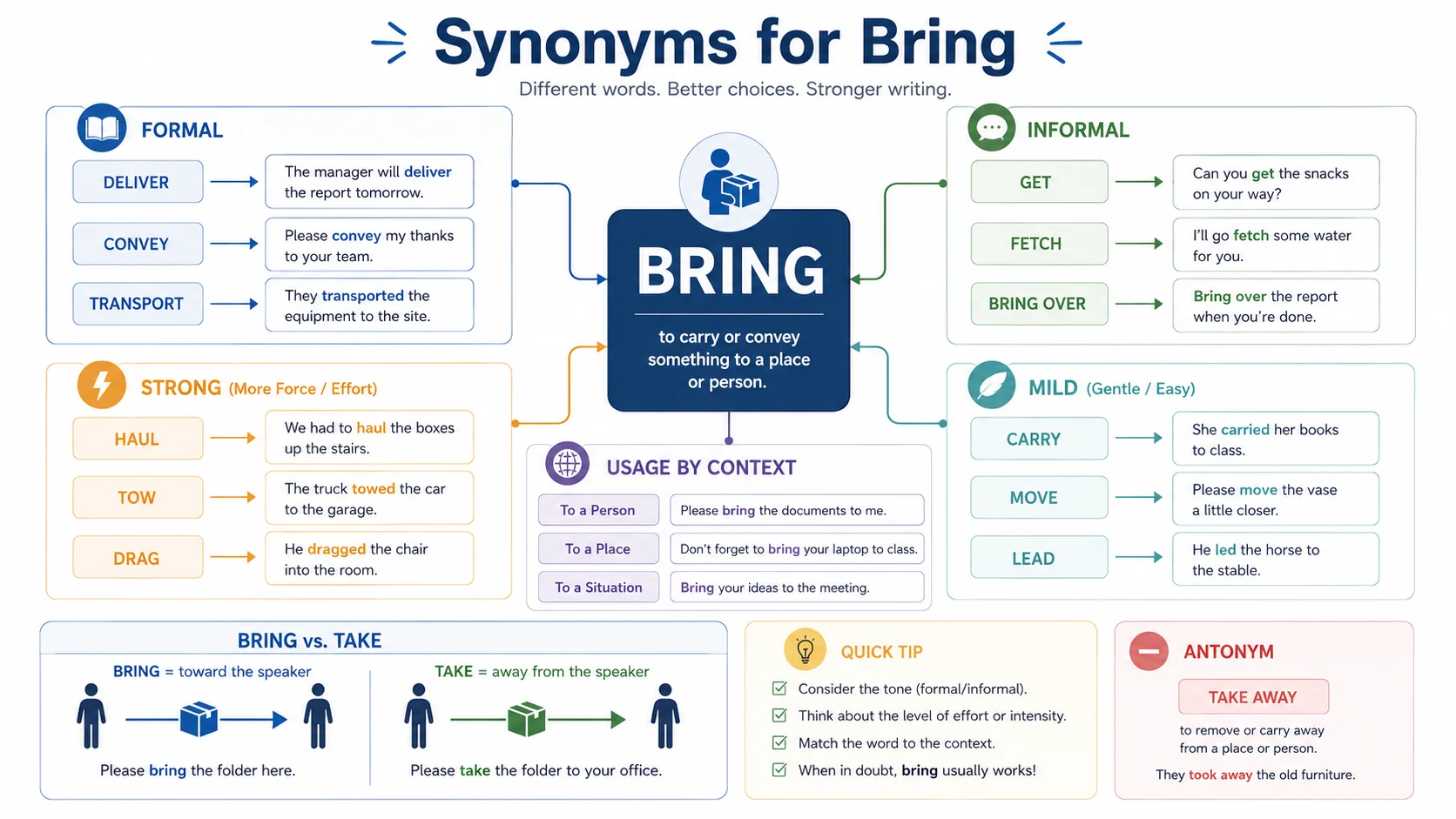
If you’re looking for synonyms for bring, you’re not alone. This common verb has dozens of alternatives, but the right choice depends on what you’re actually trying to say. The best synonyms for bring are carry, deliver, fetch, transport, and convey but the perfect word changes based on context, formality, and whether you’re moving an object, a person, or an idea. This guide gives you a complete list of bring synonyms, explains their differences, and helps you pick the strongest word for any situation.
Best Synonyms for Bring
The best synonyms for bring are carry, deliver, fetch, transport, and convey. For causal situations, take and get work well. For formal writing, choose deliver, transport, or convey. For strong emphasis, try compel, cause, or generate. The right choice depends on tone, context, and intensity.
What Does Bring Mean?
At its simplest, bring means to carry or move something or someone from one place to another person or location. It often implies movement toward the speaker or the current location.
Part of speech: Verb (irregular: bring, brought, brought)
Simple examples:
- Please bring your homework to class tomorrow.
- Can you bring me a glass of water?
- The new policy will bring many changes.
The core idea behind bring is movement with purpose. You are taking something or someone along with you to a place that matters in the moment.
Core Meaning of Bring
Bring” has several related meanings that matter when you’re choosing a synonym.
First, there’s the physical act: taking an object or person with you to a place. “Bring the groceries inside” means physically carrying bags from one spot to another.
Second, “bring” can mean causing something to happen or exist. “The new law will bring change” means the law will cause change to occur.
Third, it can mean producing a result or earning something. “The investment brought a good return” means it yielded or produced profit.
Understanding these meanings helps you pick the right synonym for your specific use case. Physical movement needs a physical synonym. Causing an effect needs a cause-related synonym. Earning or producing needs a result-focused word.
Grammar and Usage Notes
Common sentence patterns:
- Bring + object + to + place: “Bring the book to the library.”
- Bring + object + for + person: “Bring a gift for your mom.”
- Bring + someone + something: “Bring me the report.”
- Bring + object + back: “Bring back the memories.”
Common collocations with bring:
- bring about (cause to happen)
- bring up (mention or raise a child)
- bring in (introduce or earn)
- bring back (return or recall)
- bring out (reveal or publish)
- bring down (reduce or cause to fall)
When bring sounds natural:
- When you’re moving something toward you or the current location
- When you’re physically carrying an object
- When you’re causing an effect or change
When a synonym works better:
- When moving something away from you → use take instead
- When emphasizing the physical act of holding → use carry
- When emphasizing delivery to a recipient → use deliver
- When emphasizing long-distance movement → use transport
- When emphasizing causing a result → use cause or generate
Best Synonyms for Bring
| Synonym | Meaning | Tone | Best Use Case | Example Sentence |
|---|---|---|---|---|
| carry | Hold and move while supporting | Neutral | Physical movement | “Please carry these boxes to the truck.” |
| deliver | Take to a destination or recipient | Formal | Business and logistics | “We will deliver the package by noon.” |
| fetch | Go get and return with something | Casual | Everyday requests | “Can you fetch my keys from the car?” |
| transport | Move over a distance | Formal | Logistics and travel | “The truck transports goods across the state.” |
| convey | Carry or communicate | Formal | Communication and ideas | “The letter conveys our deepest sympathy.” |
| take | Move something away from the speaker | Neutral | Directional movement | “Take this form to the front desk.” |
| lead | Guide someone to a place | Neutral | Guiding people | “I will lead you to the meeting room.” |
| escort | Accompany someone officially | Formal | Professional and security contexts | “Security will escort you to the exit.” |
| cause | Make something happen | Neutral | Results and effects | “The storm caused major damage.” |
| produce | Bring into existence | Neutral | Creation and results | “The factory produces high-quality goods.” |
| generate | Bring into being or create | Formal | Business and technical contexts | “The campaign generated a lot of interest.” |
| attract | Draw toward or bring in | Neutral | Drawing attention or people | “The event attracted hundreds of visitors.” |
| earn | Gain through work or effort | Neutral | Income and rewards | “She earns a good salary.” |
| induce | Bring about or persuade | Formal | Medical and persuasive contexts | “The treatment induced a positive reaction.” |
| prompt | Cause or bring about | Neutral | Actions and decisions | The news prompted immediate action.” |
Common Synonyms for Bring
These are everyday words you can use in most writing and conversation.
Carry – physically hold and move something.
- Best context: When the emphasis is on holding or supporting the object.
- “She carried the baby in her arms.”
Take – move something to a place, especially away from the speaker.
- Best context: When direction matters.
- “Take this letter to the post office.”
Fetch – go get something and bring it back.
- Best context: Informal requests.
- “Can you fetch my glasses from the bedroom?”
Get – obtain and bring back.
- Best context: Casual conversation.
- “I need to get some milk from the store.”
Deliver – take something to the right person or place.
- Best context: Business, services, and formal situations.
- “The mail carrier delivers letters every afternoon.”
Transport – carry goods or people over a distance.
- Best context: Logistics, travel, and business.
- “The bus transports students to school.”
Formal Synonyms for Bring
Use these alternatives in academic writing, business reports, professional communication, and formal essays.
Convey – communicate or transport something.
- Best use: Emphasizing the message or idea being carried.
- “The report conveys the board’s concerns.”
Transport – move goods or people over a distance.
- Best use: Logistics, shipping, and professional contexts.
- “The company transports raw materials from overseas.”
Deliver – bring to a recipient or destination.
- Best use: Business, services, and professional settings.
- “The contractor delivered the project on time.”
Induce – bring about or cause something.
- Best use: Medical, scientific, and persuasive contexts.
- “The medication induced a rapid recovery.”
Effect – bring about as a result.
- Best use: Formal writing and business.
- “The new policy effected significant savings.”
Influence – bring about an effect through persuasion.
- Best use: Leadership and psychology contexts.
- “The mentor influenced her career choices.”
Incite – bring about action, especially forceful action.
- Best use: Legal and social contexts.
- “The speech incited a wave of protest.”
Accompany – go along with someone.
- Best use: Professional and formal contexts.
- “The CEO accompanied the delegation on the tour.”
Escort – accompany someone officially.
- Best use: Security, professional, and formal settings.
- “An usher escorted guests to their seats.”
Generate – bring into existence or create.
- Best use: Business, scientific, and technical writing.
- “The software generated a detailed report.”
Informal Synonyms for Bring
Use these in conversation, social media, personal messages, and casual writing.
Fetch – go get and bring back.
- Tone: Playful and casual.
- “Can you fetch me a coffee?”
Get – obtain and bring.
- Tone: Everyday conversation.
- “I’ll get you some water.”
Grab – take quickly and bring.
- Tone: Very casual.
- “Grab your jacket and let’s go.”
Haul – carry with effort.
- Tone: Emphasizes heavy or difficult carrying.
- “I had to haul all those boxes upstairs.”
Lug – carry with difficulty.
- Tone: Casual and often complains about weight.
- “I lugged this suitcase all the way from the station.”
Cart – carry or transport in a cart or roughly.
- Tone: Casual.
- “Can you cart these supplies to the garage?”
Drag – pull along with effort.
- Tone: Emphasizes effort or unwillingness.
- “I dragged him to the party.”
Dish up – serve food.
- Tone: Very casual, mealtime.
- “Dish up the potatoes.”
Round up – gather people or things.
- Tone: Casual group gathering.
- “Round up the kids for dinner.”
Bring along – take someone or something with you.
- Tone: Casual and friendly.
- “Feel free to bring along a friend.”
Strong Synonyms for Bring
These words carry more power, intensity, or emphasis. Use them when you want to sound forceful or when the action is significant.
Compel – force or bring about through pressure.
- Best use: When there’s no choice involved.
- “The circumstances compelled him to act.”
Force – make someone do something.
- Best use: Strong emphasis on lack of choice.
- “The situation forced her to resign.”
Cause – make something happen.
- Best use: Neutral but direct.
- “The misunderstanding caused the argument.”
Generate – produce or bring into being.
- Best use: Emphasizing creation.
- “The campaign generated massive support.”
Produce – bring forth or create.
- Best use: Strong on bringing into existence.
- “The research produced groundbreaking findings.”
Induce – bring about intentionally.
- Best use: Medical or persuasive contexts.
- “The drug induces sleep.”
Effectuate – bring about or make happen.
- Best use: Very formal and strong.
- “The board effectuated the merger.”
Engender – cause to develop.
- Best use: Emphasizing that something grows or develops.
- “Her speech engendered hope.”
Wreak – bring about as destruction.
- Best use: Negative consequences.
- “The storm wreaked havoc.”
Attract – draw toward or bring in.
- Best use: Drawing attention or interest.
- “The exhibit attracted a huge crowd.”
Prompt – cause action quickly.
- Best use: Immediate response.
- “The warning prompted evacuations.”
Sway – influence or bring around.
- Best use: Changing opinions.
- “His arguments swayed the committee.”
Mild Synonyms for Bring
These softer, more neutral alternatives work well when you want to avoid sounding forceful or direct.
Carry – simple physical movement.
- Tone: Neutral and gentle.
- “Please carry these papers to the office.”
Take – move away from the speaker.
- Tone: Neutral and simple.
- “Take this folder to the manager.”
Bring along – take with you casually.
- Tone: Friendly and informal.
- “Bring along your friend if you want.”
Provide – make available.
- Tone: Helpful and neutral.
- “The hotel provides towels.”
Offer – present for consideration.
- Tone: Polite and gentle.
- “He offered his assistance.”
Introduce – bring something into use.
- Tone: Gentle and new.
- “Let me introduce a new approach.”
Present – bring for consideration.
- Tone: Polite and professional.
- “The team presented their findings.”
Lead – guide gradually.
- Tone: Gentle direction.
- “The trail leads to a beautiful view.”
Guide – direct or influence.
- Tone: Helpful and supportive.
- “She guided him through the process.”
Synonyms for Bring by Context
Everyday Conversation
In casual speech, the best synonyms for bring are get, fetch, grab, and bring along. These words feel natural and unforced.
- “I’ll get the groceries from the car.”
- “Can you grab my jacket on your way out?”
- “Bring along some snacks for the trip.”
Professional Writing
In business settings, choose deliver, transport, convey, or present. These words sound competent and professional.
- “Please deliver the proposal by Friday.”
- “The courier transports sensitive documents.”
- “The report conveys the necessary information.”
Academic Writing
For essays and scholarly work, use convey, induce, effect, engender, or generate. These words match the formal tone of academic writing.
- “The study conveys the importance of early intervention.”
- “The experiment induced noticeable changes.”
- “The findings generate new questions.”
Creative Writing
In fiction and creative writing, choose words that paint pictures: haul, drag, cart, escort, lead, or guide.
- “He hauled the heavy trunk up the stairs.”
- “She guided the lost child to safety.”
- “The guard escorted him through the palace.”
Marketing Copy
For business marketing, use attract, generate, create, deliver, or provide.
- “Our product attracts new customers.”
- “We generate results you can see.”
- “We deliver exceptional service.”
Emotional Expression
When you want to express feelings or reactions, use move, touch, affect, inspire, or stir.
- “The story moved her to tears.”
- “His speech inspired the crowd.”
- “The music stirred deep emotions.”
Technical Writing
For technical or scientific writing, use transport, convey, generate, induce, or produce.
- “The system transports data at high speed.”
- “The sensor conveys temperature readings.”
- “The reaction produces heat.”
Another Word for Bring in a Sentence
These natural example sentences show how different synonyms for bring work in real situations:
- “Please carry these boxes to the storage room.”
- “Can you get me a glass of water from the kitchen?”
- “The courier will deliver the package by tomorrow morning.”
- “I need to fetch my car from the repair shop.”
- “The bus transports passengers to the city center.”
- “Her words convey the pain she feels.”
- “The new policy will bring about major changes.” (bring about as a phrasal verb)
- “His speech inspired everyone in the room.”
- “The chemical reaction produces a gas.”
- “The campaign attracted thousands of supporters.”
- “She accompanied her grandmother to the doctor.”
- “The guard escorted the visitor to the main office.”
- “He hauled the furniture up three flights of stairs.”
- “The news prompted immediate action from the mayor.”
- “Her kindness moved me more than she knew.”
Bring Synonyms Compared
Some synonyms for bring seem almost identical. Here’s how they differ.
Bring vs. Take
Bring means movement toward the speaker. Take means movement away from the speaker. “Bring me the book” means bring it to me. “Take the book to the library” means move it somewhere else. This is a key distinction in English usage .
Carry vs. Transport
Carry focuses on the physical act of holding and supporting. Transport focuses on the movement, especially over a distance. You carry a baby. A truck transports goods.
Deliver vs. Convey
Deliver is about transferring something to the right place or person. Convey often refers to ideas, messages, or feelings, not just physical objects .
Fetch vs. Get
Fetch implies going somewhere to retrieve something and return with it. Get is broader it can mean obtain or bring . “Fetch the mail” is specific. “Get the mail” can mean the same thing but is more general.
Cause vs. Generate
Cause is direct A causes B. Generate emphasizes creation, often from a source. “The storm caused flooding” versus “The campaign generated excitement.”
Lead vs. Guide
Lead can mean going first and showing the way, often implying authority. Guide is more about offering direction or assistance .
Words Similar to Bring
These words are related to “bring” but may not be perfect substitutes. Understanding the connection helps you avoid misuse.
Obtain – means to get something, but without the movement aspect of “bring.” “I obtained a copy of the report” (I got it, but I might not have physically moved it).
Acquire – similar to obtain, focuses on gaining possession. “She acquired a rare painting” (she got it, but “bring” would be wrong here).
Import – means to bring in from another country or source. “They import coffee from Brazil” (this is a specific type of bringing).
Introduce – means to bring something into use or to present someone. “We will introduce the new system next week” (this means bring it into use).
Restore – means to bring back to a former state. “The medicine restored his health” (bring back in a specific way).
Attract – means to draw toward. “The light attracts moths” (this is similar to bringing toward, but more about magnetism).
Include – means to bring in as part of a group. “Please include Sarah on the team” (bring in in a social sense).
These words belong to the same semantic field movement, causing, or obtaining. But check if they fit your context before swapping them for “bring.
Antonyms of Bring
Knowing the opposites of “bring” helps you understand its meaning more clearly.
Take away – remove from a place. “Please take away the dirty plates.”
Remove – take something off or away. “Remove the packaging.”
Withdraw – take back or away. “She withdrew her application.”
Take (when used as movement away) – “Take the kids to school” (while bring would be “Bring the kids to me”).
Leave – not bring or not take along. “Don’t leave your phone at home.”
Discard – throw away. “Discard the old documents.”
Abandon – leave behind permanently. “They abandoned the car.”
Remove – take away from a place. “Remove the books from the shelf.”
Dispossess – take away property. “The court dispossessed him.”
Withhold – refuse to give. “They withheld the information.”
Exclude – keep out or not bring in. “Exclude him from the decision.”
How to Choose the Right Synonym for Bring
Follow these practical steps to choose the best word.
Match the context. Are you writing a business email, a text message, or a novel? Formal contexts call for deliver, convey, or transport. Casual contexts call for get, fetch, or grab.
Check the direction. Are you moving something toward yourself or the listener? Use bring. Moving away? Use take . This one rule fixes many synonym mistakes.
Consider intensity. Do you need a strong word like compel or a mild word like provide? Choose based on how forceful you want to sound.
Think about the object. If you’re moving a person, escort, lead, or accompany may work better than carry. If you’re moving an idea, convey is more natural than transport.
Read the sentence aloud. The best synonym sounds natural in the sentence. If it feels forced or strange, choose a different word.
Use simple words when clarity matters. Don’t use effectuate when cause will do. Readers appreciate clarity over fancy vocabulary.
Don’t overthink it. In most everyday situations, bring, take, carry, and get cover almost everything. Save the fancier synonyms for when you really need them.
Common Mistakes When Using Synonyms for Bring
Using “bring” instead of “take.” This is the most common mistake. Remember: bring toward the speaker, take away from the speaker. “Bring the cake to me” and “Take the cake to Mom.”
Using a synonym with the wrong tone. Using induce in casual conversation sounds odd. Use get or fetch instead.
Using transport for small items. You transport goods by truck. You carry a bag. Choose based on scale.
Thinking all synonyms are interchangeable. They’re not. Fetch has a very specific meaning (go and return). Carry means hold and move. Deliver means bring to a recipient .
Forcing a synonym into a sentence. If the sentence sounds unnatural with the new word, go back to bring or a simpler alternative.
Overusing the same synonym. Vary your word choice for better writing, but don’t replace bring with random alternatives just to sound sophisticated.
Quick Synonym List for Bring
Common synonyms: carry, take, fetch, get, deliver, transport
Formal synonyms: convey, transport, deliver, induce, effect, influence, incite, accompany, escort, generate
Informal synonyms: fetch, get, grab, haul, lug, cart, drag, dish up, round up, bring along
Strong synonyms: compel, force, cause, generate, produce, induce, effectuate, engender, wreak, attract, prompt, sway
Mild synonyms: carry, take, bring along, provide, offer, introduce, present, lead, guide
Related words: obtain, acquire, import, introduce, restore, attract, include
FAQs
What is the best synonym for bring?
The best synonym depends on context. For physical movement, carry or take are excellent. For business, deliver or transport work well. For ideas or messages, convey is a strong choice. The right word matches your meaning, tone, and audience.
What is another word for bring?
Common alternatives include carry, take, fetch, get, deliver, transport, and convey. For causal situations, try grab or haul. For formal writing, use induce, effect, or generate.
What is a formal synonym for bring?
Formal synonyms include convey, transport, deliver, induce, effect, influence, generate, and effectuate. These suit academic writing, business reports, and professional communication.
What is an informal synonym for bring?
Informal synonyms include fetch, get, grab, haul, lug, cart, and bring along. These sound natural in conversation, social media, and friendly messages.
What is a stronger word for bring?
Stronger words include compel, force, generate, produce, induce, engender, wreak, and effectuate. These carry more intensity and are useful when you want to sound forceful.
What is a milder word for bring?
Milder alternatives include carry, take, provide, offer, introduce, present, lead, and guide. These sound gentler and less forceful.
What words are similar to bring?
Related words include obtain, acquire, import, introduce, restore, attract, and include. These belong to the same semantic field but may not be perfect substitutes.
What is the opposite of bring?
The primary antonym is take away. Other opposites include remove, withdraw, leave, discard, abandon, withhold, and exclude. Direction matters bring moves toward; take or take away moves away .
How do I choose the right synonym for bring?
Consider your context, tone, and meaning. Check whether you’re moving toward or away from the speaker. Think about the object (person, idea, or thing). Read the sentence aloud to see if it sounds natural. When in doubt, bring, carry, and take are safe bets.
Conclusion
Finding the right synonym for bring isn’t hard when you know what you’re trying to say. Physical movement calls for carry, deliver, or transport. Causing an effect calls for cause, generate, or produce. Direction matters too bring moves toward the speaker, while take moves away . The best synonym fits your context, matches your tone, and sounds natural in your sentence. Keep this guide handy, and you’ll always pick the right word.
Read More Related Articles:
- Synonyms for Embarrassed | Smarter Word Choices for Every Context In 2026
- Synonyms For Felt | Make Your Writing More Descriptive In 2026
- Synonyms for Stress | Meaning, Examples, and Better Word Choices In 2026

Evelyn Turner is a content creator at SynonymsAura.com who enjoys exploring the richness of the English language. Her work focuses on word meanings, synonyms, expressions and everyday language usage, helping readers communicate with greater clarity and confidence.



1 thought on “Synonyms for Bring | Expand Your Vocabulary With Ease In 2026”