“Run” is one of those words we use so often that we rarely stop to think about it. But not every situation calls for “run.” Sometimes you need something faster, softer, more formal, or more vivid. Finding the right synonyms for run comes down to matching meaning, tone, and intensity to your sentence.
This guide breaks down the best alternatives to “run,” organized by formality and strength, with real example sentences so you can see exactly how each word fits.
Best Synonyms for Run
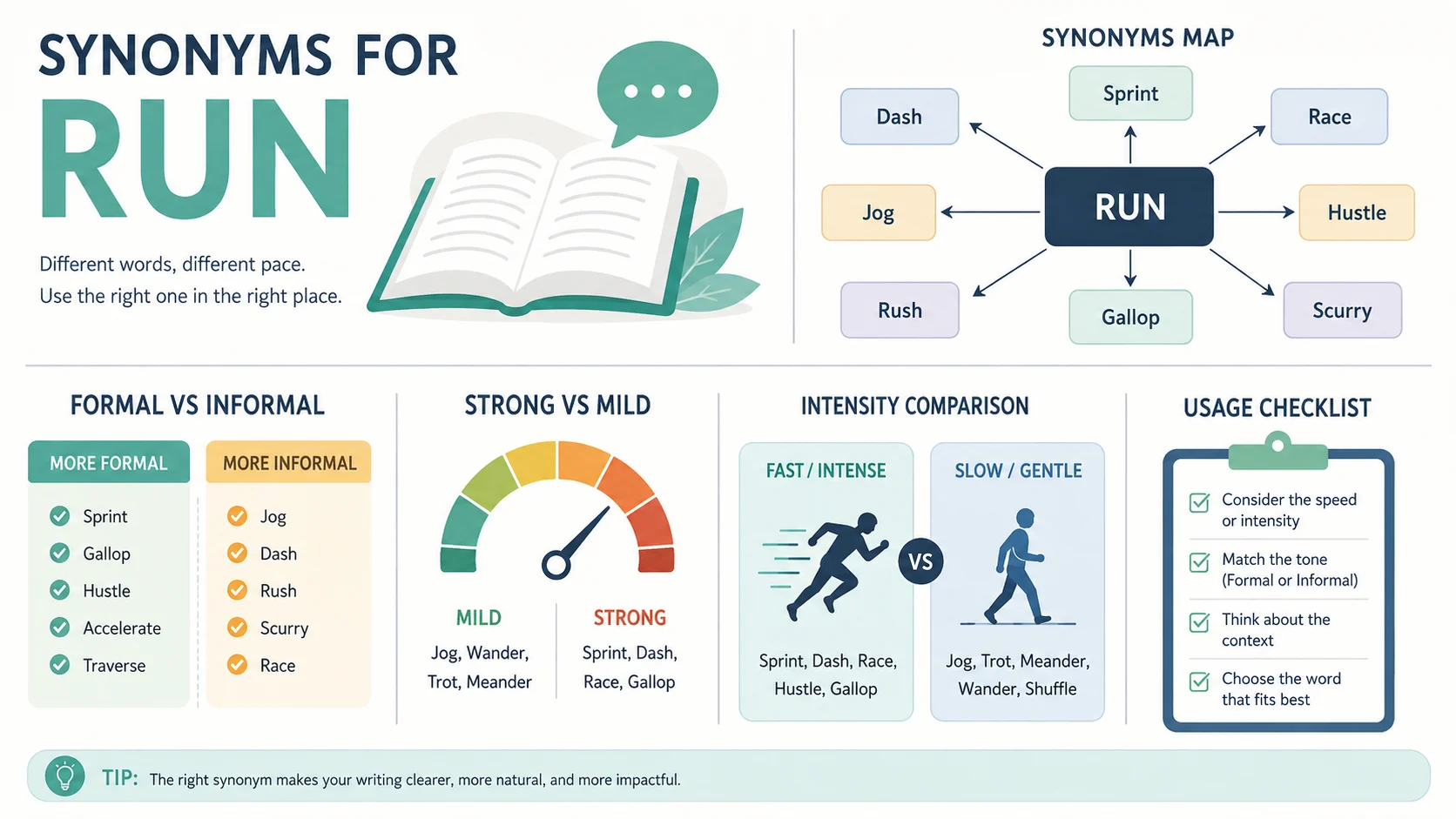
The best synonyms for run are sprint, dash, jog, and race. The right choice depends on tone, context, and intensity.
- Use sprint for a short, all-out burst of speed.
- Use dash for a sudden, quick movement.
- Use jog for a slow, steady pace.
- Use race for competitive or urgent running.
What Does Run Mean?
At its core, “run” means to move quickly on foot, faster than a walk, using a pattern of steps where both feet leave the ground briefly. It’s a verb, and it’s one of the most flexible words in English.
Part of speech: Verb (also used as a noun, as in “go for a run”)
Common usage: Physical movement, exercise, urgency, escape, or competition
Example sentences:
- She runs three miles every morning before work.
- The kids ran across the yard, laughing the whole way.
Outside of physical movement, “run” also shows up in other senses running a business, a machine running, or water running from a tap. This article focuses mainly on the physical movement sense, since that’s what most people mean when they search for synonyms.
Core Meaning of Run
The idea behind “run” is speed combined with foot movement. It captures urgency, energy, or effort. Whether someone is running to catch a bus, running from danger, or running for exercise, the underlying concept is the same: moving faster than a normal walking pace.
Synonyms shift that core idea slightly. Some add emotion (fear, panic, excitement). Some add pace (fast, steady, gentle). Some add purpose (competing, escaping, exercising). Choosing the right one means asking what extra meaning you want to add on top of “moving fast.”
Grammar and Usage Notes
“Run” is an irregular verb: run, ran, run. It works in simple sentences (“He runs daily”) and in phrasal combinations (“run away,” “run off,” “run through”).
Common collocations:
- run a race
- run late
- run errands
- run for office
- run out of time
When “run” sounds natural: In everyday speech and writing, “run” is almost always the safest, most natural choice. It’s neutral and doesn’t call attention to itself.
When a synonym works better: Use a synonym when you want to be more specific about speed (“sprint”), suddenness (“dash”), tone (“jog” for something gentler), or formality (“proceed swiftly” in stiff, official writing).
Best Synonyms for Run
| Synonym | Meaning | Tone | Best Use Case | Example Sentence |
|---|---|---|---|---|
| Sprint | Run at top speed for a short distance | Strong, energetic | Athletics, urgent short bursts | He sprinted the last fifty yards to win the race. |
| Dash | Move suddenly and quickly | Strong, sudden | Quick errands, surprise movement | She dashed to the store before it closed. |
| Jog | Run at a slow, steady pace | Mild, casual | Exercise, relaxed pace | They jog around the park every evening. |
| Race | Run competitively or with urgency | Neutral to strong | Competitions, time pressure | The two brothers raced each other home. |
| Bolt | Run away suddenly, often from fear | Strong, dramatic | Fear, escape, animals | The dog bolted when the fireworks started. |
| Dart | Move quickly in a sudden direction | Strong, quick | Small, fast movements | The squirrel darted across the road. |
| Scurry | Run with quick, small steps | Mild, informal | Nervous or hurried movement | The mice scurried behind the wall. |
| Hasten | Move or act quickly | Formal | Written, professional contexts | She hastened to correct her mistake. |
Common Synonyms for Run
These are the words people naturally reach for in everyday writing and conversation.
Sprint – A short, fast run at full effort. Best for athletic or urgent moments. Example: He sprinted to catch the closing elevator doors.
Dash – A quick, sudden run, often for a short distance. Example: We dashed across the street before the light changed.
Jog – A relaxed, steady run, often for exercise. Example: I jog every morning to clear my head.
Race – Running with speed and purpose, often against someone or something. Example: The kids raced to see who could reach the tree first.
Trot – A moderate pace, faster than walking but slower than a full run. Example: The horse trotted along the trail.
Formal Synonyms for Run
Formal writing reports, essays, business communication often avoids casual verbs like “dash” or “bolt.” These alternatives sound more polished.
Hasten – To move or act with speed. Works well in formal or literary writing. Example: The staff hastened to prepare the venue before guests arrived.
Proceed swiftly – A more formal phrase for moving quickly. Example: Employees were asked to proceed swiftly to the nearest exit.
Advance rapidly – Suggests forward movement with speed, common in reports or descriptions of events. Example: The rescue team advanced rapidly toward the stranded hikers.
These options work best when “run” feels too casual for the tone of your document, especially in official or academic writing.
Informal Synonyms for Run
Casual conversation and social writing call for looser, more expressive words.
Book it – Slang for running fast, often used among friends. Example: We had to book it to catch the bus.
Hightail it – To run away quickly, often to avoid trouble. Example: They hightailed it out of there when the alarm went off.
Take off – To leave suddenly and quickly, often running. Example: As soon as the bell rang, the kids took off toward the playground.
Hustle – To move fast and with energy, common in casual and sports contexts. Example: Come on, hustle, we’re going to be late!
Strong Synonyms for Run
These words add intensity, drama, or emotion. Use them when speed alone doesn’t capture the moment.
Tear – To run at a reckless, very fast pace. Example: He tore down the hallway, late for his flight.
Charge – To run forward with force or aggression. Example: The players charged onto the field as the crowd cheered.
Bolt – To run away suddenly, often out of fear or panic. Example: The cat bolted the moment the vacuum turned on.
Flee – To run away from danger, often used in serious or formal contexts. Example: Residents fled the area as the storm approached.
Strong synonyms work well in storytelling and dramatic writing but can feel exaggerated in plain, everyday sentences.
Mild Synonyms for Run
Sometimes you want a softer, calmer version of “run.”
Jog – A gentle, steady run, often for fitness rather than urgency. Example: She jogs a few laps around the block after dinner.
Trot – A light, easy pace, slightly faster than walking. Example: The dog trotted happily beside its owner.
Scamper – A light, quick run, often used for small animals or playful movement. Example: The puppy scampered across the yard chasing a leaf.
Mild synonyms fit calm, lighthearted, or descriptive writing where full speed isn’t the point.
Synonyms for Run by Context
Everyday Conversation
Run,” “jog,” and “dash” all sound natural here. “Book it” and “hustle” add a casual, friendly tone.
Professional Writing
Stick with “hasten,” “proceed swiftly,” or simply “move quickly.” Slang like “book it” or “hightail it” doesn’t belong in business or academic writing.
Academic Writing
Neutral, precise language works best: “run,” “sprint” (in a sports or physiology context), or “advance rapidly” when describing movement in a study or report.
Creative Writing
This is where strong synonyms shine. “Tore,” “bolted,” “charged,” and “fled” add energy and emotion to a scene.
Marketing Copy
Short, punchy words work well: “dash,” “race,” “sprint.” These create urgency without sounding overly dramatic.
Emotional Expression
Use words that reflect the feeling behind the action. Fear calls for “bolt” or “flee.” Excitement calls for “dash” or “race.” Calm exercise calls for “jog.”
Another Word for Run in a Sentence
- She sprinted across the finish line, arms raised in victory.
- The children dashed outside the moment recess started.
- He jogs along the river every morning before breakfast.
- The two friends raced each other to the corner store.
- A rabbit darted into the bushes as we approached.
- The staff hastened to finish setup before the doors opened.
- We had to book it to make our connecting flight.
- Startled by the noise, the deer bolted into the woods.
- The soldiers charged forward at the signal.
- Villagers fled as the floodwaters rose.
- The puppy scampered around the living room, full of energy.
- She trotted down the stairs, still half asleep.
- Mice scurried along the baseboards when the light turned on.
- He tore out of the driveway, already late for work.
- The team hustled back to the locker room at halftime.
Run Synonyms Compared
Several run-related words look similar but carry different meanings, tones, or intensity levels.
| Word | Speed | Emotion | Formality | Best Fit |
|---|---|---|---|---|
| Sprint | Very fast | Determined | Neutral | Short, intense bursts |
| Dash | Fast | Sudden | Neutral | Quick, unplanned movement |
| Jog | Moderate | Calm | Casual | Exercise, relaxed pace |
| Bolt | Very fast | Fearful | Neutral | Sudden escape |
| Flee | Fast | Fearful | Formal | Danger, serious situations |
| Hasten | Moderate | Purposeful | Formal | Official or written contexts |
The main differences come down to how much emotion the word carries and how formal the setting is. “Sprint” and “dash” are close in speed but “dash” often implies less planning. “Bolt” and “flee” both involve fear, but “flee” fits serious, formal writing while “bolt” feels more immediate and physical.
Words Similar to Run
These words share a connection to “run” but don’t always work as direct replacements.
Walk – Related because it’s also a way of moving on foot, but it’s slower and lacks the speed that defines “run.” Use it only when describing a calmer pace.
Operate – Used when “run” means managing something, like a business (“She runs the company”). It’s a different sense of the word entirely, not a physical-movement synonym.
Flow – Used when “run” describes liquid movement (“The river runs through the valley”). It shares the idea of continuous movement but has nothing to do with foot speed.
Function – Used when “run” describes a machine or system working (“The engine runs smoothly”). This is a mechanical sense, not a physical one.
Execute – Used when “run” means to carry out a program or task (“Run the software”). It’s accurate in tech contexts but wouldn’t work in a sentence about physical movement.
These words matter because search intent often includes people who typed “run” but meant one of these other senses. Knowing the difference helps you avoid picking a synonym that changes your meaning.
Antonyms of Run
| Antonym | Meaning | Example Sentence |
|---|---|---|
| Walk | Move at a normal, unhurried pace | He walked slowly along the beach. |
| Stroll | Walk in a relaxed, leisurely way | They strolled through the park after lunch. |
| Stand still | Not move at all | The guard stood still at the entrance. |
| Halt | Stop moving suddenly | The runner halted when she heard the whistle. |
| Crawl | Move slowly, often on hands and knees | The baby crawled across the floor. |
How to Choose the Right Synonym for Run
Picking the best word isn’t about finding the fanciest synonym. It’s about precision.
- Match the context. A sports article calls for “sprint” or “race.” A business report calls for “hasten” or “proceed quickly.”
- Match the tone. Casual writing welcomes “book it” or “hustle.” Formal writing does not.
- Check the intensity. “Dash” suggests a quick errand. “Tear” suggests near-panic speed. Don’t overstate a simple action.
- Think about the reader. A children’s story benefits from playful words like “scamper.” A news report needs plain, clear language.
- Confirm the word is an exact match. Some words, like “flow” or “operate,” look related but describe a different meaning of “run” entirely.
- Keep the sentence natural. If a synonym makes the sentence sound stiff or forced, it’s not the right choice, even if it’s technically accurate.
- Default to simplicity. When in doubt, “run” itself is almost always clear, correct, and natural.
Common Mistakes When Using Synonyms for Run
- Choosing the wrong tone. Using “hightail it” in a formal report feels out of place.
- Overstating the action. Saying someone “tore” down the hall to grab a coffee sounds exaggerated for such a small action.
- Mixing formality levels. Using “hasten” in a text message to a friend can sound stiff and unnatural.
- Ignoring word sense. Replacing “run” with “flow” in a sentence about jogging changes the meaning completely.
- Treating related words as synonyms. “Walk” and “operate” are connected to “run” but aren’t interchangeable with it.
- Forcing a synonym that breaks the sentence’s rhythm. If the replacement feels clunky, it’s often better to keep “run.”
Quick Synonym List for Run
Common synonyms: sprint, dash, jog, race, trot
Formal synonyms: hasten, proceed swiftly, advance rapidly
Informal synonyms: book it, hightail it, take off, hustle
Strong synonyms: tear, charge, bolt, flee
Mild synonyms: jog, trot, scamper
Related words: walk, operate, flow, function, execute
FAQs
What is the best synonym for run?
The best synonym depends on context, but “sprint,” “dash,” “jog,” and “race” cover most everyday situations. “Sprint” works for short bursts of top speed, while “jog” fits a slower, steady pace.
What is another word for run?
“Dash,” “sprint,” and “race” are common alternatives. Each one adds a slightly different sense of speed or urgency to the sentence.
What is a formal synonym for run?
“Hasten” and “proceed swiftly” work well in formal or professional writing. They convey speed without sounding casual.
What is an informal synonym for run?
“Book it” and “hightail it” are common informal choices, often used in casual conversation or between friends.
What is a stronger word for run?
“Tear,” “charge,” and “bolt” all carry more intensity than “run” and suggest urgency, panic, or force.
What is a milder word for run?
“Jog” and “trot” describe a gentler, steadier pace, useful when full speed isn’t the focus.
What words are similar to run?
“Walk,” “flow,” “operate,” and “function” are related but describe different meanings, from movement pace to machine operation.
What is the opposite of run?
“Walk,” “stroll,” and “stand still” are common antonyms, all describing slower or motionless states.
Conclusion
Run” is simple, but the right synonym can sharpen your writing and match the exact tone you’re going for. Whether you need something formal like “hasten,” something dramatic like “bolted,” or something calm like “jogged,” the goal is always the same: pick the word that fits the meaning, tone, and intensity of your sentence. When in doubt, go back to the basics context first, style second.
Read More Related Articles:
- Synonyms For Keep | Expand Your Expression Instantly In 2026
- Synonyms For Feel | Upgrade How You Describe Thoughts & Emotions In 2026
- Synonyms For Mean | Smarter Ways to Express Yourself In 2026

Ethan Caldwell is a writer who enjoys exploring the nuances of language and how words shape everyday communication. His work focuses on making complex ideas easier to understand through clear, engaging and accessible writing.