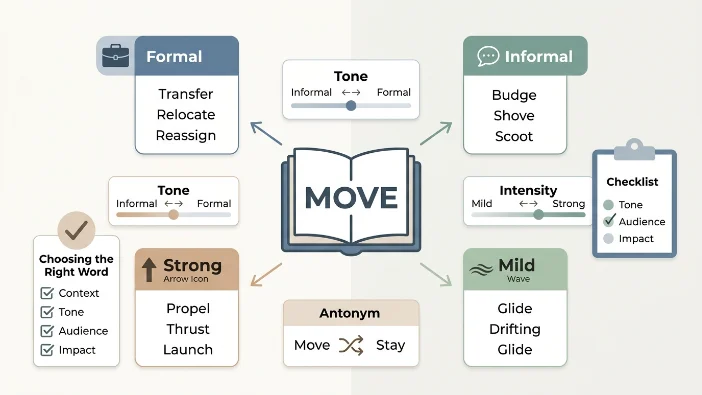
“Move” is one of the most flexible words in English, which is exactly why it’s so easy to overuse. The best synonyms for move are relocate, shift, transfer, and budge, but the right choice always depends on whether you’re talking about physical motion, changing position, emotional impact, or a strategic action. This guide breaks down those options by tone, strength, and context so you can pick a word that actually fits your sentence.
Best Synonyms for Move
The best synonyms for move are relocate, shift, transfer, and budge. The right choice depends on tone, context, and intensity relocate works for formal writing, shift fits everyday use, transfer suits structured changes, and budge works for small, physical motion.
What Does Move Mean?
At its core, “move” means to change position, location, or state either physically or figuratively. It can describe a person walking across a room, a company relocating its office, or a piece of writing that stirs someone’s emotions.
- Part of speech: Verb (also used as a noun, as in “a smart move”)
- Common usage: Physical motion, changes in position, progress, or emotional impact
Examples:
- She moved the chair closer to the window.
- His speech moved the entire audience to tears.
Core Meaning of Move
The idea behind “move” is change going from one place, condition, or state to another. That change can be small (sliding a cup across a table) or large (moving to a new country). It can also be emotional, describing how something affects a person’s feelings. This range is what makes “move” useful but also vague in writing that calls for more precision.
Grammar and Usage Notes
“Move” functions as both a verb and a noun. As a verb, it’s often paired with prepositions: move to, move into, move away, move on. Common phrases include “make a move,” “move forward,” and “move out.”
“Move” sounds natural in almost any context because it’s neutral and simple. A synonym works better when you need more precision for example, “relocate” for formal relocation, or “budge” when something resists moving even slightly.
Best Synonyms for Move
| Synonym | Meaning | Tone | Best Use Case | Example Sentence |
|---|---|---|---|---|
| Relocate | Move to a new place permanently | Formal | Business, housing | The company plans to relocate its headquarters next year. |
| Shift | Change position or focus | Neutral | Everyday writing | We need to shift the meeting to Thursday. |
| Transfer | Move something from one place/person to another | Neutral-formal | Work, finance, school | He requested a transfer to the Chicago office. |
| Budge | Move slightly, often with effort | Informal | Physical resistance | The stuck drawer wouldn’t budge. |
| Migrate | Move from one region or system to another | Neutral-formal | Biology, technology | The team plans to migrate the data to a new server. |
| Proceed | Move forward in a process | Formal | Procedures, instructions | Please proceed to the next step. |
Common Synonyms for Move
These are everyday words people use naturally in speech and writing.
Shift A general change in position or focus. She shifted her weight from one foot to the other.
Transfer Moving something or someone to a new place or owner. They transferred the funds to a new account.
Relocate Moving to a new location, often long-term. Our family relocated to Austin last spring.
Travel Moving from one place to another, usually over distance. We traveled across three states in one day.
Go A simple, broad way to describe movement. Let’s go before traffic gets worse.
Formal Synonyms for Move
Useful for reports, academic writing, and professional communication.
Relocate Best for business or housing contexts. The firm relocated its offices to downtown.
Transfer Common in legal, academic, and financial writing. Ownership of the property was transferred last month.
Reposition Often used in strategic or business contexts. The brand repositioned itself in the luxury market.
Migrate Common in technical or scientific writing. Engineers migrated the system to cloud servers.
Informal Synonyms for Move
Better suited for casual conversation, texts, or social posts.
Budge Small, often reluctant movement. He wouldn’t budge an inch.
Hop Quick, casual movement. Hop in the car, we’re leaving.
Scoot Light, friendly way to ask someone to move. Scoot over so I can sit down.
Bounce Slang for leaving quickly. We should bounce before it gets too crowded.
Strong Synonyms for Move
These carry more force, urgency, or emotional weight.
Uproot Suggests a forceful, disruptive move. The war uprooted thousands of families. Use this only when the move involves real disruption it’s too strong for a casual relocation.
Propel Implies powerful forward motion. The new funding propelled the project forward.
Stir Suggests emotional movement, often deep. Her story stirred something in the entire room.
Mild Synonyms for Move
Softer alternatives that work when you don’t want to overstate the action.
Shift Neutral and gentle, good for small changes. We shifted the schedule slightly.
Adjust Suggests a small, careful change. She adjusted her chair before sitting down.
Nudge A small, gentle push or change. He nudged the conversation toward a new topic.
Synonyms for Move by Context
Everyday Conversation
Words like shift, go, and scoot fit naturally here. They sound casual and don’t draw attention to themselves.
Professional Writing
Relocate, transfer, and reposition sound appropriate in business reports, emails, and formal documents.
Emotional Expression
Stir, touch, and affect describe how something impacts feelings rather than physical position. The film deeply moved her could become The film deeply touched her.
Technical Writing
Migrate and transfer are standard in IT and data contexts, where precision matters more than variety.
Another Word for Move in a Sentence
- The family decided to relocate closer to the coast.
- Could you shift your laptop to the other side of the desk?
- We transferred the files before the deadline.
- The old gate wouldn’t budge, no matter how hard we pushed.
- Birds migrate south every winter.
- Please proceed to gate 12 for boarding.
- The company repositioned its pricing strategy last quarter.
- His apology stirred something unexpected in her.
- The crowd began to scoot toward the exit.
- The new policy propelled change across the entire department.
- We need to adjust our plans slightly for the weather.
- A gentle breeze caused the curtains to shift.
- The toddler tried to nudge the box across the floor.
- The team is set to migrate to a new software platform.
- We bounced from the party around midnight.
Move Synonyms Compared
| Word | Meaning Difference | Best Fit |
|---|---|---|
| Move vs. Shift | “Move” is general; “shift” implies a smaller, often gradual change. | Use shift for subtle adjustments. |
| Move vs. Relocate | “Relocate” specifically implies a long-term change of location. | Use relocate for housing or business contexts. |
| Move vs. Transfer | “Transfer” implies movement between two defined points, people, or systems. | Use transfer for structured or official changes. |
| Move vs. Budge | “Budge” implies resistance or reluctance. | Use budge when something barely moves. |
Words Similar to Move
These words share meaning with “move” but aren’t always direct replacements.
Travel Implies distance and duration, not just a change in position. Good for trips, not for small physical actions.
Progress Focuses on forward development rather than physical movement. Works for projects or careers, not literal motion.
Affect Related to emotional movement, but doesn’t describe physical action at all. Use it when “move” means to influence feelings, not location.
Transition Refers to a process of change over time, often used for life stages or systems, not single physical actions.
Antonyms of Move
| Antonym | Meaning | Example Sentence |
|---|---|---|
| Stay | Remain in the same place | They decided to stay in the city instead of relocating. |
| Stop | Cease motion or action | The car stopped suddenly at the light. |
| Freeze | Become completely still | He froze when he heard the noise. |
| Remain | Continue in the same state or place | She chose to remain at her current job. |
How to Choose the Right Synonym for Move
- Match the context physical movement needs a different word than emotional impact.
- Match the tone formal writing calls for words like relocate or transfer, not bounce or scoot.
- Check the intensity don’t use uproot for a small change, or shift for a major life event.
- Think about the reader technical readers expect words like migrate; casual readers expect simpler terms.
- Confirm it’s an exact synonym some words, like travel or progress, only partially overlap with “move.
- Keep the sentence natural if the synonym feels forced, it’s probably the wrong choice.
Common Mistakes When Using Synonyms for Move
- Using uproot for a minor relocation, which sounds overly dramatic.
- Using budge in formal writing, where it sounds too casual.
- Swapping in transfer when there’s no clear destination or recipient involved.
- Treating travel or progress as exact substitutes when they describe different ideas.
- Choosing a strong synonym like propel for a small, everyday action.
- Forcing a synonym into a sentence where “move” already sounds natural.
Quick Synonym List for Move
Common synonyms: shift, transfer, relocate, travel, go
Formal synonyms: relocate, transfer, reposition, migrate
Informal synonyms: budge, hop, scoot, bounce
Strong synonyms: uproot, propel, stir
Mild synonyms: shift, adjust, nudge
Related words: travel, progress, affect, transition
FAQs
What is the best synonym for move?
The best general synonym for move is shift, since it works in both casual and semi-formal writing without sounding too strong or too weak.
What is another word for move?
Another word for move is relocate, especially when referring to a permanent change in location, such as moving homes or offices.
What is a formal synonym for move?
Relocate and transfer are common formal synonyms, frequently used in business, legal, and academic writing.
What is an informal synonym for move?
Scoot and budge are informal options, often used in casual conversation or quick instructions.
What is a stronger word for move?
Uproot and propel are stronger synonyms, useful when the movement is forceful, disruptive, or significant.
What is a milder word for move?
Nudge and adjust are milder alternatives, ideal for small, subtle changes.
What words are similar to move?
Travel, progress, and transition are similar but not exact synonyms they emphasize distance, development, or process rather than simple position change.
What is the opposite of move?
The opposite of move is stay or remain, both of which describe staying in the same place or state.
How do I choose the right synonym for move?
Match the synonym to the context, tone, and intensity of your sentence, and confirm the word fully fits the meaning before replacing “move.
Conclusion
“Move” works in almost any sentence, but it’s rarely the most precise choice. Whether you need a formal word like relocate, a casual one like scoot, a strong one like uproot, or a gentle one like nudge, the right synonym always comes down to matching meaning, tone, context, and intensity to what you’re actually trying to say.
Read More Related Articles:
- Synonyms for Balance | From Basics to Better Vocabulary In 2026
- Synonyms for Stubborn | Replace Basic Words Like a Pro In 2026
- Synonyms for Driven | Smart Word Choices That Impress In 2026

Evelyn Turner is a content creator at SynonymsAura.com who enjoys exploring the richness of the English language. Her work focuses on word meanings, synonyms, expressions and everyday language usage, helping readers communicate with greater clarity and confidence.