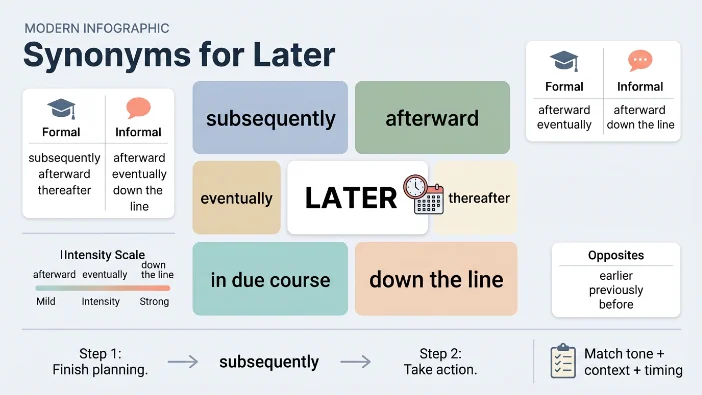
The word later comes up constantly in everyday writing, but repeating it too often can make your sentences feel flat. Whether you’re writing a professional email, a short story, or a casual text, you’ll find better options depending on your tone and context. The best synonyms for later include afterward, subsequently, eventually, in due course, and down the line. The right choice depends on how formal you need to sound, how much time has passed, and what you’re trying to convey.
Best Synonyms for Later
The best synonyms for later are afterward, subsequently, eventually, in due course, and thereafter. For casual use, soon, down the line, and at some point also work well. The right choice depends on tone, context, and intensity.
What Does Later Mean?
Later is an adverb that refers to a point in time that comes after the present moment or after another event. It signals that something will happen at a future time or that a previous event was followed by another one.
- Part of speech: Adverb (and occasionally adjective, as in “a later version”)
- Core function: Indicates time sequence or a deferred future moment
- Common uses: Casual conversation, time expressions, narrative writing, scheduling
Example sentences:
- “We can finish this later.”
- “She arrived later than expected.”
Core Meaning of Later
At its core, later communicates delay, sequence, or futurity. It answers the question “when?” without giving a specific time. You might use it to push something into the future (“we’ll deal with it later”), to show that one event followed another (“later, the situation improved”), or to say goodbye casually (“later!” meaning “see you soon”).
That range from vague future reference to time-sequence marker to informal farewellis exactly why choosing the right synonym matters. A word that works in a business report may sound stiff in a text message, and a casual replacement may undermine the tone of a formal essay.
Grammar and Usage Notes
Later works in several sentence positions and patterns:
- As a sentence adverb: “Later, he regretted the decision.”
- At the end of a clause: “She said she’d call later.”
- With a time modifier: “Three hours later, the meeting resumed.”
- In comparison: “The later model performed better.” (adjective form)
Common collocations:
- sooner or later
- later on
- see you later
- later in the day / week / year
- later that evening
When a synonym might work better: If you’re writing something formal or academic, later can sound too casual. In those cases, subsequently, thereafter, or in the following period carries more weight. In creative writing, eventually or in time often sounds more natural.
Best Synonyms for Later
| Synonym | Meaning | Tone | Best Use Case | Example Sentence |
|---|---|---|---|---|
| Afterward | After a previous event or time | Neutral | Narrative, general writing | “Afterward, they sat down to eat.” |
| Subsequently | Immediately or closely following | Formal | Academic, business, legal | “The report was subsequently revised.” |
| Eventually | At some unspecified future time | Neutral | General writing, storytelling | “He eventually came around to the idea.” |
| In due course | At the appropriate time | Formal | Professional, official | “You will be notified in due course.” |
| Thereafter | After that point in time | Formal | Legal, academic, narrative | “The policy changed, and thereafter everything was different.” |
| Down the line | At some point in the future | Informal | Casual writing, conversation | “We can sort that out down the line.” |
| At some point | At an unspecified future time | Neutral | General, flexible contexts | “At some point, we’ll need to revisit this.” |
| In time | Eventually, with the passage of time | Neutral–warm | Creative, personal writing | “In time, she learned to forgive.” |
| Presently | Soon or shortly after (US usage) | Slightly formal | Formal speech, some writing | “The doctor will see you presently.” |
| Following this | After the mentioned event | Neutral–formal | Reports, structured writing | “Following this, the team submitted its findings.” |
Common Synonyms for Later
These are the everyday alternatives most people reach for in normal writing or conversation.
Afterward
Means “after a particular event.” It’s clean and direct and works in almost any setting emails, stories, articles.
“We had dinner, and afterward walked along the waterfront.”
Eventually
Suggests something will happen, but with a sense of time passing or effort involved. Great when the outcome took a while.
“She eventually found the answer she was looking for.”
At some point
Vague on timing but clear on intent. Works well when you want to acknowledge something without committing to a schedule.
“At some point, we should revisit our pricing structure.”
Soon
Implies the next moment is close. Slightly different from later in that it signals urgency or nearness.
“I’ll get back to you soon.”
In a while
More casual. Suggests a gap in time but nothing too long.
“Check in again in a while.”
Formal Synonyms for Later
In academic writing, business reports, legal documents, or official communication, these options carry more authority.
Subsequently
The most commonly used formal substitute. It signals that one thing followed another in direct sequence.
“The contract was signed, and subsequently all payments were released.”
Thereafter
Works well in legal or narrative contexts to signal everything that comes after a specific moment.
“The agreement took effect on January 1st and remained binding thereafter.”
In due course
Implies things will happen on a proper schedule, without forcing timelines. Common in formal responses.
“Your application will be reviewed in due course.”
Following [event]
Precise and formal. Ties the time reference directly to the event that triggered it.
“Following the merger, the board reconvened.”
In the ensuing period
Rarely used in everyday writing, but fits academic and historical writing well.
“In the ensuing period, inflation rose sharply.”
Informal Synonyms for Later
These fit friendly messages, social media, casual blogs, or everyday speech.
Down the line
Breezy and conversational. Great for anything you plan to handle in the future without a firm deadline.
“We’ll figure out the design down the line.”
Later on
A slight expansion of later itself, but it sounds more natural in casual speech.
“Let’s talk about this later on.”
At some point
Relaxed and open-ended. No pressure on timing.
“We should grab coffee at some point.”
In a bit
Very casual. Works for short gaps in time.
“I’ll text you in a bit.”
Catch you later
Used as an informal farewell, synonymous with “see you later” not a time reference in the usual sense.
Strong Synonyms for Later
Sometimes you want a word with more emphasis or a clearer sense of sequence and consequence.
Subsequently carries a strong, almost cause-and-effect tone. It implies one thing led clearly to another.
Ultimately pushes the sense of later further it suggests a final outcome at the end of a process.
“He ultimately decided to resign.”
In the aftermath is stronger still, used when the later period follows something significant.
“In the aftermath of the storm, cleanup crews worked through the night.”
Eventually can also land with emphasis when paired with contrast:
“He dismissed every warning but eventually, the consequences caught up with him.”
Use these stronger words when you want the reader to feel the passage of time or the weight of what follows.
Mild Synonyms for Later
Sometimes you want to soften a statement or keep things vague and low-pressure.
In a while No urgency, easy pacing.
At some stage Open and uncommitted.
Down the road Friendly, relaxed future reference.
In time Gentle. Often used for comfort: “It will make sense in time.”
Someday Even more distant and emotional, often used in aspirational or nostalgic contexts.
Mild synonyms are best when you want to avoid pressure, keep tone warm, or leave a future timeline deliberately open.
Synonyms for Later by Context
Everyday Conversation
In casual speech, later on, in a bit, at some point, and down the line feel the most natural. They match the loose, relaxed pace of informal talk without sounding stiff.
Professional Writing
Stick with subsequently, thereafter, in due course, or following [event] in emails, reports, and proposals. These show precision and professionalism without sounding cold.
Academic Writing
Subsequently and thereafter are standard in academic prose. In the following section or in the ensuing discussion also work well to signal transitions between ideas.
Creative Writing
Eventually, in time, later that evening, and soon after all lend themselves to storytelling rhythm. They let the narrative breathe without forcing rigid time markers.
Personal Communication
Later, soon, in a bit, and at some point are all perfectly natural here. The choice depends on how close the future feels and how casual your relationship is with the reader.
Emotional Expression
Eventually and in time carry warmth and hope useful in supportive messages or reflective writing. Someday goes even further into emotional territory, suggesting a long-held wish or a distant possibility.
Another Word for Later in a Sentence
Here are 14 natural example sentences showing different synonyms in action:
- “The report was submitted and subsequently approved by the committee.”
- “Afterward, the two sides agreed to meet again.”
- “She said she’d explain eventually, but the days kept passing.”
- “In due course, you will receive your official results.”
- “Down the line, this decision could save us a lot of time.”
- “He made the call later that evening.”
- “In time, the wounds healed and life moved forward.”
- “Following the announcement, several employees resigned.”
- “We’ll circle back to that question at some point.”
- “Thereafter, all communications went through legal.”
- “The pain faded gradually over the following weeks.”
- “Presently, the team will share its findings.”
- “We can hash out the details further down the road.”
- “Soon after, the lights went out across the building.”
Later Synonyms Compared
Several synonyms for later look similar on the surface but carry different shades of meaning.
| Word Pair | Key Difference |
|---|---|
| Subsequently vs. Afterward | Subsequently implies close sequence and is more formal. Afterward is neutral and conversational. |
| Eventually vs. In time | Eventually can feel resigned or expectant. In time often feels hopeful or reassuring. |
| Thereafter vs. After that | Thereafter is more formal and literary. After that is everyday and relaxed. |
| Presently vs. Soon | In US English, presently usually means “soon” or “shortly.” Soon is clearer and less likely to confuse. |
| Down the line vs. Down the road | Nearly interchangeable in casual use, but down the road feels slightly more figurative and distanced. |
| Ultimately vs. Eventually | Ultimately emphasizes a final result. Eventually focuses on the passage of time. |
Words Similar to Later
These words share the same semantic space as later but don’t always substitute directly for it.
Soon Overlaps with later in meaning but implies something nearer in time. You’d say “I’ll call you soon” (close future) but not “I’ll call you soon” when you mean weeks from now.
Someday Points to the future but carries emotional weight and is far more indefinite than later. Better for wishes than plans.
Meanwhile Refers to time happening in parallel, not after. Often confused with later in sequence-heavy writing.
Before long Suggests the near future, making it closer to soon than later.
In the future Broader and more philosophical than later, which implies a concrete next moment.
These words are related and useful, but using them as direct swaps for later without checking meaning can shift what your sentence actually says.
Antonyms of Later
| Antonym | Meaning | Example Sentence |
|---|---|---|
| Earlier | Before the current or reference time | “She arrived earlier than the rest of the group.” |
| Previously | Before a mentioned time or event | “As previously mentioned, the report is due Friday.” |
| Before | Ahead of in time | “He had been warned before the incident occurred.” |
| Already | By now or before a specific point | “By the time we arrived, she had already left.” |
| Beforehand | In advance; before a certain event | “Please review the materials beforehand.” |
| Formerly | In the past, especially in a changed state | “He was formerly the director of the division.” |
How to Choose the Right Synonym for Later
Here are a few practical rules to help you pick well:
Match the formality of your writing. Subsequently fits a board report. In a bit fits a text message. Swapping them creates friction your reader will feel even if they can’t name it.
Think about how far in the future you mean. Soon and in a bit point to something near. Eventually, someday, and down the road point to something distant or indefinite.
Check whether sequence matters. If you mean “this happened and then that happened,” subsequently or afterward are more precise than later. If the timing is vague, eventually or at some point works better.
Consider the emotional tone. In time sounds hopeful. Ultimately sounds final. Later is neutral. Choose the emotion your sentence needs.
Test the sentence out loud. If a synonym sounds off when you read it aloud, it probably is.
Common Mistakes When Using Synonyms for Later
Using subsequently in casual writing. This word belongs in formal contexts. In a friendly email, it sounds unnecessarily stiff.
Treating eventually and subsequently as identical. Subsequently means “directly after.” Eventually means “at some undefined point, with time passing.” They are not interchangeable.
Using presently when you mean later. In US English, presently typically means soon or right now, not at a later time. This is a common source of confusion.
Replacing later with someday in concrete plans. Someday suggests a wish, not a commitment. “We’ll fix the issue someday” sounds dismissive compared to “we’ll fix it later this week.”
Using ultimately as a simple time word. Ultimately carries the meaning of “in the end” or “as a final outcome” it’s not a clean replacement when you just mean “at a later time.
Overusing eventually. It can start to sound like you’re uncertain whether something will happen at all.
Quick Synonym List for Later
Common synonyms:
afterward, eventually, at some point, soon, later on, in a while
Formal synonyms:
subsequently, thereafter, in due course, following [event], in the ensuing period
Informal synonyms:
down the line, later on, in a bit, at some stage, down the road
Strong synonyms:
ultimately, in the aftermath, subsequently, in the end
Mild synonyms:
in time, someday, at some point, before long, in a while
Related words:
soon, meanwhile, formerly, presently, before long, in the future
FAQs
What is the best synonym for later?
The best synonym for later depends on context. For general writing, afterward or eventually works well. For formal writing, subsequently or thereafter is stronger. For casual use, down the line or at some point fits naturally.
What is another word for later in formal writing?
The most reliable formal alternatives are subsequently, thereafter, and in due course. Subsequently is especially common in academic and professional writing because it clearly signals time sequence.
What is an informal synonym for later?
Down the line, later on, in a bit, and at some point are all relaxed, conversational options. They work well in texts, casual emails, and friendly blog writing.
What is a stronger word for later?
Subsequently adds formal intensity. Ultimately implies a final resolution. In the aftermath signals something significant happened and the “later” moment carries weight. Choose based on how much emphasis the moment deserves.
What is a milder word for later?
In time, at some point, and down the road are all softer than later. They work well when you want to avoid urgency or leave timing open without sounding dismissive.
What words are similar to later but not exact synonyms?
Soon, someday, before long, and in the future are related time words. They don’t always replace later directly because they differ in how near or how definite the future moment feels.
What is the opposite of later?
The clearest antonyms are earlier, previously, before, and already. Each refers to a time that came before the present or reference point, rather than after it.
How do I choose between eventually and subsequently?
Use subsequently when you want to show that one thing followed another in direct sequence. Use eventually when the future moment is vague, took a long time, or involved uncertainty before it arrived.
Conclusion
Later is one of those words that shows up everywhere in emails, stories, schedules, and small talk. When used repeatedly or in the wrong tone, it can weaken your writing without you noticing. Understanding the alternatives gives you more control over how your sentences feel.
The best synonym depends on what you’re writing, who you’re writing it for, and what kind of future you’re pointing to. Subsequently and thereafter carry precision and formality. Eventually and in time carry patience and feeling. Down the line and at some point keep things easy and conversational.
Go through your options, test them in context, and choose the word that actually fits not just the first one on the list.
Read More Related Articles:
- Synonyms for Nuanced | Powerful Word Choices for Creative Writing In 2026
- Synonyms for Vivid | Create Stronger Mental Images in Writing In 2026
- Synonyms for Compassionate | Upgrade Your Writing with Deeper Emotion In 2026

Grace Phillips contributes content to SynonymsAura.com, where she writes about language, vocabulary and everyday communication. Her work is centered on helping readers find the right words and express themselves with greater clarity and confidence.

1 thought on “Synonyms for Later | Sound More Natural in Conversation In 2026”