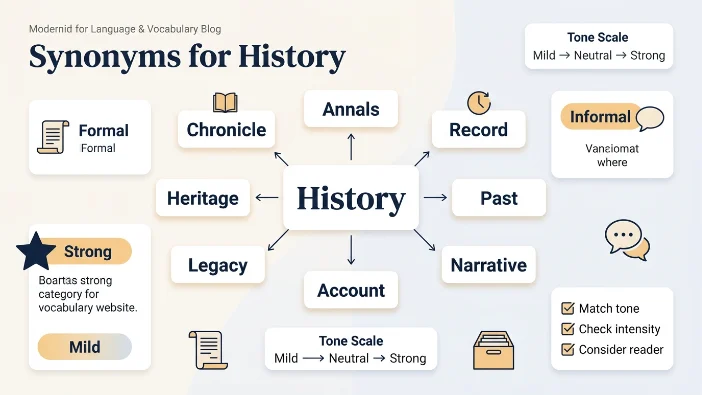
When you need another word for “history,” the right choice depends on what you actually mean. Are you talking about recorded events, someone’s personal background, or the broad sweep of the human past? The best synonyms for history are chronicle, record, account, annals, past, and narrative. Each carries a slightly different meaning, tone, and level of formality. Knowing which one fits your sentence makes your writing clearer and more precise.
Best Synonyms for History
The best synonyms for history are chronicle, record, account, annals, past, and narrative. The right choice depends on tone, context, and intensity. Use chronicle or annals in formal or academic writing, background or story in everyday contexts, and legacy or heritage when the focus is on what was passed down over time.
What Does History Mean?
“History” is a noun with two closely related meanings. First, it refers to the study of past events the academic discipline taught in schools and universities. Second, it means the collection of past events themselves, whether personal, regional, national, or global.
Part of speech: Noun (singular: history; plural: histories)
Common usage:
- Referring to the human past as a whole: “History shows us how empires rise and fall.”
- Referring to a personal or institutional record: “She has a long history with the company.”
The word comes from the Greek historia, meaning inquiry or knowledge gained through investigation. It entered English through Latin and Old French. Today, it sits comfortably in both academic prose and casual conversation.
Core Meaning of History
At its core, “history” captures the idea of what has already happened and the record of those happenings. It suggests time, sequence, and documented or remembered experience.
There are two layers worth separating:
The events themselves everything that took place in the past, from ancient civilizations to last Tuesday’s meeting.
The telling of those events the account, record, or narrative that gives shape to what happened.
This dual meaning is why choosing a synonym carefully matters.
- A word like chronicle emphasizes the telling.
- A word like past emphasizes the events themselves.
- A word like record focuses on documentation.
Understanding which layer you mean helps you pick the right word.
Grammar and Usage Notes
“History” is a countable noun, which means it can take singular or plural form:
- the history of Rome (singular one specific history)
- the histories of ancient civilizations (plural multiple accounts)
It also appears as part of common phrases and collocations:
- make history to do something so significant it becomes memorable
- go down in history to be remembered permanently
- a history of something a record of repeated behavior or events
- ancient/modern/recent history time-based classifications
- oral history history preserved through spoken accounts
When synonyms work better:
- If you’re emphasizing storytelling, narrative or account can feel more vivid.
- If you’re writing formally about documented records, annals or chronicle sounds more precise.
- If you’re talking about a person’s past, background is often more natural than history.
Best Synonyms for History
| Synonym | Meaning | Tone | Best Use Case | Example Sentence |
|---|---|---|---|---|
| Chronicle | A detailed record of events in time order | Formal / Neutral | Academic writing, literature | The chronicle of medieval Europe spans centuries of conflict. |
| Annals | Official yearly records; long historical accounts | Very Formal | Academic, historical texts | The annals of the Roman Empire fill entire libraries. |
| Record | A documented account of past facts or events | Neutral | Business, legal, general writing | The company’s record of growth speaks for itself. |
| Account | A description or report of what happened | Neutral | Journalism, storytelling, reports | Her account of the expedition was gripping. |
| Past | The time that has already happened | Informal / Neutral | Everyday conversation, personal writing | We can learn a great deal from the past. |
| Narrative | A story or connected account of events | Neutral / Literary | Creative writing, essays, media | The national narrative shifted after the war. |
| Background | The context or earlier events behind something | Informal / Neutral | Personal, professional communication | Tell me a bit about your background. |
| Legacy | What is passed down or remembered from the past | Neutral / Positive | Tribute, biography, journalism | Her legacy in science endures to this day. |
| Heritage | Cultural or historical traditions passed through generations | Neutral / Positive | Cultural, regional writing | The town celebrates its heritage every summer. |
| Archive | A collection of stored historical records | Formal / Technical | Research, library science, journalism | The archive holds letters from the 18th century. |
Common Synonyms for History
These are the words most people reach for in everyday writing and conversation.
Past The simplest and most direct alternative. Past refers to time that has already gone by, without implying any formal record or study.
- Best for: Casual conversation, personal reflection
- Example: We can’t change the past, but we can learn from it.
Record A word that emphasizes documentation something written down and preserved.
- Best for: Business communication, legal writing, general use
- Example: The city has a long record of flooding in this area.
Account A report or description of what took place. It implies someone telling or writing about events.
- Best for: Journalism, storytelling, reports
- Example: His account of the battle was the most detailed we had.
Background The past information or context behind a person, situation, or event.
- Best for: Professional profiles, introductions, casual conversation
- Example: Can you walk me through your professional background?
Story The most casual synonym. Implies a narrative structure with a beginning, middle, and end.
- Best for: Informal writing, personal narratives, media
- Example: Every city has a story worth telling.
Formal Synonyms for History
These alternatives fit well in academic papers, research reports, professional essays, and institutional writing.
Chronicle A word that suggests a careful, time-ordered record often associated with medieval or literary writing, but still used in formal contexts today.
- Example: This volume chronicles the political upheavals of the 20th century.
Annals Historically, this referred to yearly records kept by officials. Today it signals serious scholarly documentation.
- Example: Her discovery earned a place in the annals of medical science.
Archive Refers to a preserved collection of historical documents or records. Often used in research, library science, and digital preservation.
- Example: Researchers drew on the national archive to reconstruct wartime events.
Documentation Emphasizes the formal recording of facts, procedures, or events. Common in legal, governmental, and institutional writing.
- Example: The project requires full documentation of its historical impact.
Historiography Not a synonym for history itself, but for the study or writing of history. Useful in academic contexts.
- Example: Her thesis examines the historiography of colonial-era Africa.
Informal Synonyms for History
These fit casual writing, social media, personal messages, and friendly conversation.
Past Simple, clear, and natural in everyday use.
- Example: Let’s not dig up the past.
Story Works well when emphasizing the human or narrative side of events.
- Example: Every family has a story that deserves to be heard.
Background Ideal for describing someone’s personal or professional past in conversation.
- Example: He has a pretty interesting background in international trade.
Track record An informal but widely understood phrase for a documented pattern of past behavior or performance.
- Example: The team has a strong track record.
Backstory Popular in media, journalism, and casual writing. Refers to the events or context behind something or someone.
- Example: The documentary reveals the backstory behind the painting.
Strong Synonyms for History
These carry more weight, drama, or intensity than “history” alone.
Annals Sounds authoritative and grand. Use when you want to signal lasting, significant documentation.
- Example: This discovery will live in the annals of exploration.
Legacy More emotionally charged than “history.” It focuses on what was left behind and why it still matters.
- Example: His legacy shaped three generations of activists.
Saga Implies a long, dramatic sequence of events often with hardship, struggle, or grandeur.
- Example: The saga of the settlers stretched across two centuries.
Epic When used as a noun, it suggests a grand historical narrative of great scale.
- Example: Their journey became an epic of survival and endurance.
Use these stronger alternatives carefully. They can elevate your writing, but they can also feel excessive in neutral or factual contexts.
Mild Synonyms for History
Softer alternatives work better when you want to be factual without dramatizing.
Record Straightforward and neutral. Carries no emotional weight.
- Example: The council keeps a record of all public meetings.
Account Matter-of-fact and descriptive. Good for reports and factual summaries.
- Example: The account of the expedition was thorough and objective.
Background Non-dramatic, conversational, and context-focused.
- Example: Give me some background on what happened.
Notes Very casual. Best for internal documents or quick references.
- Example: Review the historical notes before the meeting.
Synonyms for History by Context
Everyday Conversation
In casual talk, use past, background, or story. These feel natural and approachable. Nobody says “the annals of my childhood” in conversation.
- “What’s your background?” smooth and professional
- “We can’t dwell on the past.” natural and conversational
Professional Writing
In business memos, reports, and professional emails, record, background, and account are your safest choices. They sound competent without being stuffy.
- “Based on our track record…”
- “Her professional background includes…”
Academic Writing
Stick with chronicle, annals, archive, or documentation. Academic contexts reward precision and formality. Narrative also works well in humanities disciplines.
- “The annals of colonial history reveal…”
- “This chronicle documents…”
Creative Writing
Narrative, saga, story, and chronicle all work well when you want richness and texture. Choose based on tone saga feels epic, narrative feels literary, story feels personal.
- “The saga of the frontier unfolds across two hundred pages.”
Emotional Expression
When writing about someone’s personal past with feeling or respect, legacy and heritage carry warmth and meaning.
- “Her legacy lives on in every student she taught.”
- “We honor the heritage of those who came before us.”
Another Word for History in a Sentence
Here are 14 example sentences using different synonyms for “history” in realistic contexts:
- The chronicle of ancient Rome remains one of the most studied texts in classical education.
- Looking at her background, it’s clear she was destined for a career in diplomacy.
- The record of negotiations shows both sides were willing to compromise.
- Every great city carries a legacy shaped by generations of ordinary people.
- The annals of the organization document over a hundred years of public service.
- The museum’s archive holds thousands of original letters from the 1800s.
- His account of the disaster was the first eyewitness report to reach the press.
- Learning from the past is not optional it’s essential.
- The film’s narrative blends personal memoir with broader social documentation.
- The festival celebrates the cultural heritage of the region’s indigenous communities.
- She brought her own backstory to the role, which made her performance feel genuine.
- The saga of the royal family filled tabloids for three decades.
- Understanding the background of the conflict helps explain why tensions run so high.
- His track record in the field earned him instant credibility.
History Synonyms Compared
Some synonyms for “history” are close enough that they’re easy to confuse. Here’s how they differ:
| Word | Focus | Tone | Best Use |
|---|---|---|---|
| History | Past events or their study | Neutral | General use |
| Chronicle | Time-ordered account of events | Formal / Literary | Academic, storytelling |
| Annals | Official long-term records | Very Formal | Scholarly, institutional |
| Record | Documented facts | Neutral | Legal, business |
| Account | Someone’s description of events | Neutral | Journalism, reports |
| Narrative | Shaped story of events | Neutral / Literary | Essays, media, creative |
| Past | The time before now | Informal | Conversation, personal |
| Legacy | What was left behind | Positive / Emotional | Tribute, biography |
| Heritage | Traditions passed through generations | Cultural / Positive | Cultural, regional |
Chronicle vs. Annals: Both are formal, but annals feels more institutional and archival. Chronicle implies active storytelling someone chose to write these events down in a purposeful way.
Record vs. Account: A record suggests cold documentation facts written down and stored. An account suggests someone actively describing or reporting events, often with a human voice behind it.
Legacy vs. Heritage: Legacy usually focuses on a single person or institution and what they left behind. Heritage refers to what a group, culture, or community inherits collectively over generations.
Narrative vs. Story: Narrative is more formal and literary. Story is warmer and more conversational. Both imply shaping events into a meaningful sequence, but they suit different tones.
Words Similar to History
These words belong to the same semantic space as “history” but aren’t always direct synonyms. They’re related in meaning, but each has its own scope.
Memoir A memoir is a personal account of someone’s life or experiences it’s a type of historical writing, not a synonym for history itself.
- Useful when: writing about personal or first-person records
Biography A biography covers one person’s life story. It draws on history but focuses on an individual.
- Useful when: discussing someone’s documented life
Timeline A visual or written sequence of events in chronological order. Related to historical recording, but more structural than narrative.
- Useful when: organizing events by date
Precedent A past event that serves as a guide or comparison for the present. Related to history but specifically used in legal and policy contexts.
- Useful when: legal writing or arguments about prior decisions
Tradition A set of behaviors or beliefs passed down over time. Overlaps with heritage and cultural history, but focuses on practice rather than events.
- Useful when: describing cultural continuity
Lore The body of knowledge, stories, or traditions about a particular subject often with a mythic or cultural flavor.
- Useful when: discussing folk history, cultural mythology, or group knowledge
Antonyms of History
| Antonym | Meaning | Example Sentence |
|---|---|---|
| Future | Time that has not yet happened | We can plan for the future, but we can’t undo the past. |
| Present | The current moment | Focus on the present rather than dwelling on history. |
| Fiction | Events that are invented, not real | History is documented fact; fiction is imagined narrative. |
| Ignorance | Lack of knowledge or record | Forgetting history can lead to ignorance of its lessons. |
| Amnesia (figurative) | Collective forgetting of the past | Cultural amnesia erases the history of marginalized groups. |
How to Choose the Right Synonym for History
Match the context. Annals works in an academic paper; backstory works in a podcast. The setting matters as much as the meaning.
Match the tone. If your writing is formal, choose chronicle, record, or annals. If it’s conversational, lean on past, background, or story.
Check the intensity. Saga and legacy carry emotional weight. Record and account are neutral. Pick the intensity that matches what you want to convey.
Think about the reader. A general audience responds better to simple words like past or story. A specialist audience may expect archive or historiography.
Check whether the synonym is exact or only related. Memoir and biography are types of historical writing, not pure synonyms for history. If you swap them in carelessly, the meaning shifts.
Keep the sentence natural. Read your sentence aloud after swapping in a synonym. If it sounds forced or unusual, try another word.
Default to simpler when clarity matters. In plain communication, past and record are almost always clearer than annals or chronicle.
Common Mistakes When Using Synonyms for History
Using “annals” in casual writing. It sounds pretentious in informal contexts. Save it for formal or literary work.
Treating “legacy” and “history” as identical. Legacy implies something positive or significant that was passed on. You wouldn’t say “his legacy of failure” in a neutral tone but you could say “his history of failure.”
Using “memoir” as a synonym. A memoir is a first-person account usually one book about one person’s life. It’s a form of historical writing, not another word for history.
Replacing “history” with “story” in formal writing. Story reads as casual. In an academic paper or professional report, it can undermine the tone of the whole piece.
Assuming “past” and “history” are always interchangeable. History often implies records, study, or significance. The past is simply time that has gone by. “She studied the past” is weaker than “She studied history.”
Ignoring connotation. Words like saga and epic carry drama. Use them only when the drama is earned and appropriate.
Forcing a word that sounds impressive. If you’re writing in plain English for a general reader, chronicle and annals can feel unnecessarily formal and create distance instead of clarity.
Quick Synonym List for History
Common Synonyms chronicle, record, account, past, background, story, narrative
Formal Synonyms annals, archive, documentation, chronicle, historiography
Informal Synonyms past, story, background, backstory, track record
Strong Synonyms annals, legacy, saga, epic
Mild Synonyms record, account, background, notes
Related Words memoir, biography, tradition, lore, precedent, timeline, heritage
FAQs
What is the best synonym for history?
The best synonym depends on context. For formal writing, chronicle or annals work well. For everyday use, past, record, or account are more natural. If the focus is on what was inherited or left behind, legacy or heritage fit better.
What is another word for history?
Common alternatives include chronicle, record, account, past, narrative, background, annals, and legacy. Each emphasizes a slightly different aspect of the past.
What is a formal synonym for history?
The most formal synonyms are annals, chronicle, and archive. These suit academic papers, historical texts, institutional reports, and scholarly writing.
What is an informal synonym for history?
In casual conversation and everyday writing, use past, background, story, or backstory. These feel natural without sounding stiff.
What is a stronger word for history?
Annals, legacy, and saga are stronger alternatives. They carry more weight, authority, or emotional resonance than “history” alone. Saga in particular suggests a grand or dramatic sequence of events.
What is a milder word for history?
Record, account, and background are all milder, neutral alternatives. They convey the same basic idea documented or remembered events without adding extra drama or gravity.
What words are similar to history but not exact synonyms?
Memoir, biography, timeline, tradition, and lore all belong to the same semantic space but have narrower meanings. A memoir is a personal account, a biography focuses on one life, and a timeline organizes events chronologically none of these is a direct substitute for “history.”
What is the opposite of history?
The most direct antonyms of history are future (time ahead) and present (time now). In a broader sense, fiction (invented events) and ignorance (lack of historical awareness) can also function as conceptual opposites.
Conclusion
History” is one of those words that carries real weight which is exactly why choosing the right synonym matters. Chronicle and annals suit formal contexts. Past, background, and story belong in casual writing. Legacy and heritage add warmth and cultural depth. Narrative works beautifully in essays and media.
No single synonym does everything “history” does, because the word covers both recorded events and the study of them. When you understand that distinction, every synonym becomes easier to place correctly.
The rule is simple: match the word to the tone, match the tone to the reader, and match the reader to the context. Do that, and your writing will always feel natural, precise, and purposeful.
Read More Related Articles:
- Synonyms for Embarrassed | Smarter Word Choices for Every Context In 2026
- Synonyms For Felt | Make Your Writing More Descriptive In 2026
- Synonyms for Stress | Meaning, Examples, and Better Word Choices In 2026

Evelyn Turner is a content creator at SynonymsAura.com who enjoys exploring the richness of the English language. Her work focuses on word meanings, synonyms, expressions and everyday language usage, helping readers communicate with greater clarity and confidence.