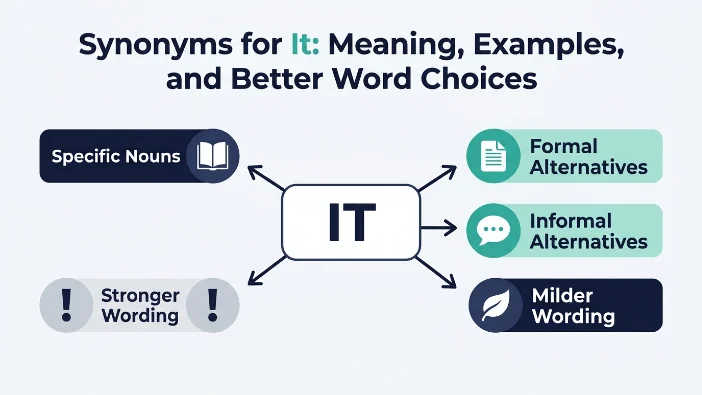
The word “it” is one of the most common pronouns in English, but relying on it too heavily can make your writing feel vague or repetitive. If you are looking for synonyms for it, the best replacement depends entirely on what “it” refers to. Instead of a single one-size-fits-all substitute, you can use specific nouns, noun phrases, or other pronouns like “this,” “that,” or “they” to improve clarity. The most effective way to find a synonym for “it” is to first identify the noun or concept it represents and then choose a more specific term. This article will guide you through the best strategies for finding perfect alternatives for your writing.
Best Synonyms for “It”
The best alternatives for the pronoun “it” are not a fixed set of words but rather the specific noun or noun phrase that “it” refers to in your sentence. Common substitutes include this, that, they, them, these, and those, but the most effective choice is often to use a specific noun like “the report,” “the situation,” or “the idea.” The right choice depends on your sentence’s context, tone, and need for clarity.
What Does “It” Mean?
- Simple Definition: A pronoun used to refer to a thing, animal, situation, or idea that has already been mentioned or is understood by the speaker and listener.
- Core Idea: “It” acts as a grammatical placeholder for a noun, allowing us to avoid repeating that noun unnecessarily.
- Part of Speech: Pronoun (personal pronoun).
- Common Usage:
- As a subject: “The coffee is hot. It burned my tongue.”
- As an object: “I found my wallet. I had lost it.”
- As an empty subject: “It is raining.”
- As an anticipatory subject: “It is important to study.”
Core Meaning of “It”
The fundamental purpose of “it” is to create cohesion in language by referring to a previously mentioned noun, known as its antecedent. For example, in the sentence, “We have a new policy, and it will take effect tomorrow,” the word “it” points back to “a new policy.” This linking is the core of how pronouns like “it” function: they connect ideas and create flow without repetition.
However, “it” can become problematic when its antecedent is unclear or when it’s used so often that the writing becomes monotonous. The search for synonyms for it is ultimately a search for more vivid, precise, and specific language to replace this functional but overused pronoun. By replacing “it” with a concrete noun or a more specific pronoun, you can transform a vague statement like, “We should discuss it,” into a clear one like, “We should discuss the budget,” or “We should discuss this proposal.”
Grammar and Usage Notes
- Part of Speech: Personal pronoun (third person, singular, neuter).
- Common Sentence Patterns:
- Subject-Verb: It works.
- Subject-Verb-Object: I saw it.
- Subject-Verb-Complement: It is a good idea.
- Prepositional Object: I looked at it.
- Common Phrases & Collocations: “It is,” “it was,” “it has,” “it seems,” “it appears,” “for it,” “of it,” “with it,” “get it,” “make it.”
- When “It” Sounds Natural: “It” sounds perfectly natural when its antecedent is immediately clear or when used as an “empty” or “anticipatory” subject (e.g., “It’s a beautiful day,” “It’s fun to play”). In these cases, replacing “it” is often unnecessary and would sound awkward.
- When a Synonym May Work Better: A synonym, or rather a replacement, works better when “it” is overused in a single paragraph, or when the antecedent is ambiguous. For example, “She picked up the vase and accidentally dropped it” is fine. But, “She picked up the vase. It was heavy. It was also valuable. She placed it on the shelf. It was the most prized piece in her collection,” is repetitive. Using a synonym, such as “the artifact,” “the treasure,” or even “this piece,” would greatly improve the text.
Best Synonyms for “It”
Because “it” is a pronoun, its synonyms are the nouns it replaces. Here is a table showcasing how to find the perfect synonym based on context.
| Synonym/Noun | Meaning (in this context) | Tone | Best Use Case | Example Sentence |
|---|---|---|---|---|
| This | Referring to a specific, recent idea or object | Neutral, Direct | When you want to point to or emphasize the specific thing being discussed. | “We need a new strategy. This is our main priority.” |
| That | Referring to an idea or object previously mentioned | Neutral, Distancing | To refer back to something that was just mentioned. | “I heard about the plan, but I don’t agree with that.” |
| The [Noun] | The specific thing itself | Formal, Precise | When you need absolute clarity in professional or academic writing. | “The CEO reviewed the proposal. The proposal needed revisions.” |
| These | Referring to multiple items or ideas | Neutral, Emphatic | When the antecedent is plural and has just been mentioned. | “The new policies are complex. These will take time to implement.” |
| They / Them | Plural nouns | Neutral | When “it” refers to a plural group or a singular entity that is considered a collective. | “I love the shoes. Can I try them on?” |
| – | – | – | – | – |
Common Synonyms for “It”
In everyday writing and conversation, the most common replacements for “it” are not a list of synonyms but rather the specific nouns or noun phrases they represent. When you hear someone ask for “another word for it,” they are almost always looking to replace a vague “it” with a clear subject.
Here are everyday ways to replace “it,” with the actual noun in parentheses.
- This: (the document) “I’ve read the document, and this needs editing.”
- That: (the event) “The event is scheduled for Friday. Please confirm that.”
- The [thing]: (the software) “The software is great, but the software is too expensive.”
- They: (the products) “These new products are excellent. They will sell well.”
- Our [thing]: (the project) “We have a new project, and our project is a top priority.”
- Such: (a decision) “They made a risky decision. Such decisions often backfire.”
Formal Synonyms for “It”
In formal writing, “it” is often replaced by the specific noun it refers to. This practice enhances precision, a key element of professionalism. The goal is to remove any potential for ambiguity.
- The aforementioned: Used in legal or bureaucratic documents to refer to a previously mentioned item.
- Example: “The board approved the budget. The aforementioned budget will now be implemented.”
- This proposal / The proposal: Replaces “it” when referring to a specific suggestion or plan.
- Example: “We have received a counter-offer. This proposal requires further review.”
- Such matters / These matters: Used to refer to a collection of issues or topics.
- Example: “The logistical challenges are significant. Such matters are often the most difficult to resolve.”
- The same: A very formal and somewhat archaic term for an antecedent.
- Example: “We received your application and have approved the same.”
- The [specific noun]: The most common and often best formal alternative is simply repeating the noun.
- Example: “The contract is lengthy. The contract must be signed by all parties.”
Informal Synonyms for “It”
In informal situations, such as text messages, conversations, or social media, people often replace “it” with more colloquial terms. These synonyms are often used to express a specific feeling or to add personality, especially when discussing “stuff.
- That thing: A very vague but common way to refer to something.
- Example: “I was in the car and saw that thing on the road.”
- This whole thing: Used to refer to an entire complex situation.
- Example: “I’m a bit overwhelmed by this whole thing.”
- The vibe: Used when “it” refers to an atmosphere or feeling.
- Example: “I love the new office. The vibe is great.”
- Stuff: A casual word used when “it” refers to a collection of things or activities.
- Example: “I have to take care of some stuff after work.”
- That business: Refers to an event or issue, often with a hint of annoyance.
- Example: “I don’t want to talk about that business.”
- It is what it is: A phrase itself, used to accept a situation.
Strong Synonyms for “It”
While “it” is a neutral pronoun, you can create a stronger statement by using a noun or phrase that carries more weight. This often means adding adjectives or using a more evocative noun for the concept you are describing.
- The crux: Replaces “it” when “it” is the central point of an argument.
- Example: “Many people debated the issue. The crux of the matter was funding.”
- The core: Similar to “the crux,” it refers to the central element.
- Example: “The new program is complex. The core of it is education.”
- The heart: Used to describe the most important emotional or central part.
- Example: “The company culture is unique. The heart of it is trust.”
- The foundation: When “it” refers to a basic principle.
- Example: “We have a solid theory. The foundation is data.”
- The solution: When the problem and solution have been discussed, “the solution” is a powerful synonym.
- Example: “We have considered all options. The solution is to automate.”
Mild Synonyms for “It”
Sometimes, a softer or more neutral word is needed to replace “it,” especially when you want to avoid pointing fingers or being too direct. A milder alternative often involves using slightly vague terms.
- This issue: Softens the focus on a problem or topic.
- Example: “We are aware of the complaint, and this issue is being addressed.”
- The situation: A neutral word for a complex or unspecified set of circumstances.
- Example: “The weather caused delays, but the situation is now under control.”
- The matter: A polite and slightly formal word for a topic.
- Example: “Thank you for bringing that to my attention. I will look into the matter.”
- The idea: A softer word than “the plan” or “the proposal.”
- Example: “Your concept is interesting. The idea has a lot of merit.”
Synonyms for “It” by Context
Choosing the right replacement for “it” is highly dependent on the context. Here is how to approach it in different writing scenarios.
Everyday Conversation
When speaking, people naturally use “it,” “that,” “this,” and “the thing.” The goal is usually speed and clarity, but if you find yourself being too vague, inserting a noun is the best solution.
- Best Fit: “This,” “that,” “the [noun].”
- Example: Instead of “I forgot to do it,” try “I forgot to do that” or “I forgot to do my chores.
Professional Writing
Precision is paramount in the workplace. Avoid vague pronouns that can lead to confusion. Repeating the noun is often the safest and most professional route.
- Best Fit: “The [noun],” “the proposal,” “the meeting,” “this policy.”
- Example: Instead of “The client approved the design, and we can start working on it,” write “The client approved the design, and we can start working on the project.”
Academic Writing
Academics value clarity and conciseness. Overusing “it” can make prose feel “hedgy” and imprecise. Use specific nouns and phrases to articulate your points with authority.
- Best Fit: “This theory,” “this phenomenon,” “the data,” “this argument.”
- Example: Instead of “The results were conclusive. It proves the hypothesis,” write “The results were conclusive. The data proves the hypothesis.”
Creative Writing
Here, you have the most freedom. You can use metaphor, simile, and descriptive nouns. If “it” is an object, describe it. If it’s a feeling, give it a name.
- Best Fit: Evocative nouns, personification, or descriptive phrases.
- Example: Instead of “The silence was heavy, and it pressed down on her,” write “The silence was heavy, and the weight of it pressed down on her.”
Marketing Copy
Marketing requires clear calls to action. Vague “it”s can confuse customers. Be direct and use nouns that are tied to the benefits of your product.
- Best Fit: “Our service,” “the product,” “this solution.”
- Example: Instead of “See how it can help you,” write “See how our software can help you.”
Emotional Expression
When discussing feelings, “it” is very vague. It’s often better to articulate the emotion.
- Best Fit: “The experience,” “the feeling,” “the anxiety,” “the joy.”
- Example: Instead of “I felt a pain in my chest. It was sharp,” write “I felt a pain in my chest. The sensation was sharp.”
Another Word for “It” in a Sentence
Here are 14 examples that demonstrate different ways to use synonyms for “it” in sentences.
- The document was due yesterday.
- Can you explain this to me?
- I don’t want to hear about that again.
- The team is confident, and this confidence is well-deserved.
- We have identified the problem. The problem is systemic.
- I’ll handle this matter personally.
- I purchased the flowers, and these will look beautiful in the vase.
- The new policy is strict, but the policy is clear.
- She gave a presentation. The presentation was engaging.
- Let’s not discuss the situation further.
- I need you to review the application.
- The idea was unique, but that uniqueness is what makes it special.
- He lifted the box and placed it carefully on the shelf. (Here, “it” is acceptable)
- I completed the tasks. These tasks were quite difficult.
“It” Synonyms Compared
The “synonyms” for “it” are not interchangeable in the same way “happy” and “joyful” are. They are different parts of speech serving different functions. Comparing them highlights their distinct roles.
| Word | Function | Tone | When to Use |
|---|---|---|---|
| It | Subject/Object Pronoun | Neutral | When the antecedent is obvious and doesn’t need repeating. |
| This | Demonstrative Pronoun | Emphatic, Pointing | To indicate a specific, just-mentioned idea, often in contrast to “that.” |
| That | Demonstrative Pronoun | Distancing | To refer to something previously mentioned, often further away in the text or time. |
| The [Noun] | Noun Phrase | Precise, Formal | When you need to be specific and avoid all ambiguity, especially in important documents. |
| They/Them | Pronoun | Neutral | When the antecedent is plural. |
Words Similar to “It”
This section includes related words that are functionally similar but not exact synonyms. They are often used in the same sentence structures as “it.”
- There: Often confused with “it” in existential constructions.
- Example: “It is a rabbit.” vs. “There is a rabbit.” “It” is specific; “there” introduces existence.
- This: Refers to something close in proximity or time. It’s a demonstrative pronoun, not a personal one.
- Example: “Look at this.” It points to something specific.
- That: Refers to something further away.
- Example: “Look at that.”
- These: The plural of “this.”
- Those: The plural of “that.”
- The one: A pronominal substitute for a specific singular noun.
- Example: “This is the best solution; the one we were looking for.”
Antonyms of “It”
As “it” is a pronoun, it does not have a direct antonym. The opposite concept is to name something specifically and directly rather than replacing it with a generic pronoun.
- The Specific: The opposite of a pronoun like “it” is using the specific noun.
- Example: “I saw it.” vs. “I saw the specific building.”
- All of it: Sometimes an antonym could be “nothing,” referring to the absence of the thing “it” represents.
- Example: “Do you have it?” vs. “Do you have nothing?”
How to Choose the Right Synonym for “It”
Choosing the best alternative for “it” is a simple process. Follow these practical guidelines.
- Find the Antecedent: First, find the noun “it” refers to. Is it a “project,” “feeling,” “policy,” or “weather”?
- Assess Your Audience: Are you writing a text to a friend or a report to your CEO? Your tone will dictate your word choice.
- Check for Clarity: Read the sentence with “it.” Is it clear what “it” is? If not, using the noun is mandatory.
- Vary Your Writing: If you’ve used “it” multiple times in a paragraph, change some to the noun or a demonstrative pronoun like “this” or “that.”
- Maintain Natural Flow: Avoid using a formal synonym like “the aforementioned” in a casual sentence. It should feel organic.
- Read It Aloud: This is the best test. If the sentence sounds jarring or unnatural, it’s the wrong choice.
Common Mistakes When Using Synonyms for “It”
Finding “synonyms for it” can lead to errors if you are not careful. Here are common pitfalls to avoid.
- The “This” Without a Noun: Starting a sentence with “This is…” when the “this” isn’t clearly defined is a common writing mistake. Always make sure “this” has a clear referent.
- Overusing “That”: Just like “it,” “that” can become vague if overused. Be specific.
- Repeating the Noun Too Much: While replacing “it” with a noun improves clarity, repeating the same noun five times in a paragraph can be clunky. Balance is key.
- Using a Formal Word Informally: Don’t say “Please review the aforementioned” in an email to a coworker. It sounds pompous. Use “the proposal” or “this document.”
- Forgetting the Grammar: Remember that “it” is singular. If you replace “it” with a different pronoun like “these,” you must ensure the rest of the sentence agrees.
Quick Synonym List for “It”
Common Synonyms (Substitutes)
- This
- That
- The [Noun]
- They/Them
- These/Those
Formal Alternatives
- The aforementioned
- The same
- This proposal
- Such matters
- The [specific noun]
Informal Alternatives
- That thing
- This whole thing
- The vibe
- Stuff
Stronger Substitutes
- The crux
- The core
- The foundation
- The solution
Milder Substitutes
- This issue
- The situation
- The matter
- The idea
Related Words & Pronouns
- There
- The one
- This one
- That one
FAQs
What is the best synonym for “it”?
The best “synonym” for “it” is the specific noun it refers to. For example, if “it” refers to a “report,” then “report” is the best synonym. If the context allows, using “this,” “that,” “these,” or “those” can also serve as effective substitutes.
What is another word for “it”?
There is no single perfect synonym for the pronoun “it.” The best strategy is to identify what “it” means and then use that specific noun (e.g., “the book,” “the idea,” “the plan”). Alternatively, you can use demonstrative pronouns like “this” or “that.”
What is a formal synonym for “it”?
In formal writing, you should simply use the specific noun that “it” refers to. Words like “the aforementioned” are also used but can be overly formal. Repeating the noun directly (e.g., “the contract,” “the data”) is the clearest and most professional approach.
What is an informal synonym for “it”?
In informal language, you can replace “it” with colloquial terms like “that thing,” “this whole thing,” “the vibe,” or “stuff.” For example, instead of “Let’s talk about it,” you might say “Let’s talk about that stuff.”
What is a stronger word for “it”?
To create a stronger statement, replace “it” with a more forceful noun like “the crux,” “the core,” “the foundation,” or “the solution.” This adds weight and specificity to your sentence.
What is a milder word for “it”?
If “it” sounds too direct or blunt, use milder alternatives like “the situation,” “the issue,” “the matter,” or “the idea.” For example, instead of “We need to address it,” you could say “We need to address the situation.”
What words are similar to “it”?
Words that serve a similar grammatical function are “this,” “that,” “these,” “those,” “there,” and “the one.” They are all used to point to or represent an idea or object without naming it directly.
How do I choose the right synonym for “it”?
To choose the right alternative for “it,” first find the noun it refers to. Then, consider your audience, the tone of the writing, and the need for clarity. Using the specific noun is almost always a safe and effective choice.
Conclusion
The quest for synonyms for “it” is different from finding alternatives for adjectives or verbs because “it” is a pronoun, not a content word. The most effective way to improve your writing is to identify the noun that “it” represents and use that specific noun. While “this,” “that,” and “these” serve as useful demonstrative substitutes, and words like “the situation” or “the matter” offer softer alternatives, the choice always depends on the context, tone, and need for absolute clarity. By following the guidelines in this article, you can avoid vague pronoun use and write with greater precision and confidence.
Read More Related Articles:
- Synonyms for Thoughts | Enhance Clarity and Expression In Your Writing In 2026
- Synonyms for Trapped | Every English Learner and Writer Should Know In 2026
- Synonyms for Loving | Nuances, Examples, and Word Choice Tips In 2026

Ethan Caldwell is a writer who enjoys exploring the nuances of language and how words shape everyday communication. His work focuses on making complex ideas easier to understand through clear, engaging and accessible writing.