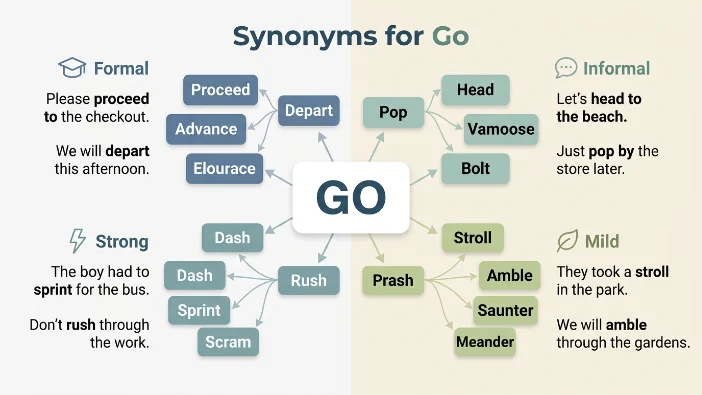
The word “go” is one of the most common verbs in English, but it is also one of the vaguest. If you are looking for synonyms for go, you are likely trying to find a more precise, vivid, or appropriate word for your specific situation. The best alternative to use depends entirely on your meaning, tone, and context. Whether you’re writing a formal report or a casual text, choosing a more specific word can make your writing clearer and more engaging.
Best Synonyms for Go
The best synonyms for go are proceed, travel, move, and depart. However, the right choice depends on tone, context, and intensity. For a casual conversation, “head” or “pop” might be perfect. For a formal business report, “proceed” or “advance” would be far more appropriate.
What Does Go Mean?
At its core, “go” is a verb that describes moving from one place to another or the act of leaving. It can also be used to describe how an action or event proceeds. It is a foundational word in English, representing the concept of movement, action, or transition.
- Simple definition: To move or travel from one place to another; to leave.
- Part of speech: Verb (irregular: go, went, gone).
- Common usage: Used to describe physical movement, starting an activity, or the state of a process.
Example sentences:
- “I need to go to the grocery store.”
- “How did the meeting go?”
Core Meaning of Go
The main concept behind “go” is movement or transition from one point to another. This can be physical, like walking to work, or metaphorical, like time passing. It can also signify a change in state or condition, such as “the milk went bad.” Understanding this broad core meaning is the first step to choosing the most precise synonym for your intended purpose.
Grammar and Usage Notes
Understanding the grammar and behavior of “go” will help you use its synonyms more effectively.
- Part of speech: Primarily a verb, but it can also be a noun (e.g., “have a go”).
- Common sentence patterns:
- Go + to + [place]: “I go to the park.”
- Go + [verb-ing]: “We go shopping.”
- Go + [preposition/adverb]: “The car goes fast.”
- Common phrases (collocations): “Go for a walk,” “go to work,” “go home,” “go well,” “go bad.
- When “go” sounds natural: Its simplicity makes it ideal for everyday, casual conversation and general instructions. It is the default choice for most basic movement.
- When a synonym may work better: A synonym works better when you need to be more formal, descriptive, emotional, or specific. For example, “proceed” is better in an official document, while “dash” is better for describing a sudden, fast movement.
Best Synonyms for Go
The following table provides a curated selection of the best synonyms for go, organized by their tone and best use case.
| Synonym | Meaning | Tone | Best Use Case | Example Sentence |
|---|---|---|---|---|
| Proceed | To continue or begin a course of action. | Formal | Professional writing, instructions. | “Please proceed to the checkout.” |
| Depart | To leave a place, especially to start a journey. | Formal | Travel, official communication. | “The train will depart at noon.” |
| Travel | To journey or move from place to place. | Neutral | Discussing journeys or trips. | “We love to travel abroad.” |
| Move | To change physical position. | Neutral | General movement. | “Please move to the front of the line.” |
| Head | To move in a specified direction. | Informal | Directions, casual conversation. | “Let’s head to the beach.” |
| Advance | To move forward, often with purpose. | Formal | Career, military, or strategic contexts. | “The troops advanced on the enemy.” |
| Amble | To walk at a slow, leisurely pace. | Literary/Creative | Descriptive writing. | “She ambled through the garden.” |
| Rush | To move quickly or hurry. | Strong | Urgent situations. | “I had to rush to the hospital.” |
| Pop | To go somewhere briefly or quickly. | Informal | Casual conversation. | “I just need to pop to the store.” |
Common Synonyms for Go
These are the most common synonyms for go, used in everyday writing and conversation. They are versatile and easy to understand.
Travel
This is the most direct alternative when discussing movement from one place to another, especially over a distance.
- Best context: Discussing trips, vacations, or general movement.
- Example: “She loves to travel to new countries every year.”
Move
A very broad synonym that focuses on the physical act of changing position.
- Best context: When the focus is on the physical change of location, rather than the destination.
- Example: “Can you please move your car from the driveway?”
Head
This means to go in a specific direction.
- Best context: Giving directions or suggesting a course of action in a casual setting.
- Example: “We should head home before it gets dark.”
Formal Synonyms for Go
When writing in a professional or academic setting, using formal synonyms is essential to maintain a professional tone.
Proceed
This is a classic formal synonym that implies continuing or starting a planned course of action.
- When it works best: Use in business memos, academic papers, and official instructions.
- Example: “Once we have approval, we will proceed with the project.”
Depart
This word is often used in travel and official communication to indicate leaving a specific place.
- When it works best: Use in flight announcements, official schedules, or formal invitations.
- Example: “The CEO will depart for the conference at 8 AM.”
Advance
This synonym suggests a purposeful forward movement, often in a strategic or organized way.
- When it works best: Use in military, business strategy, or career progression contexts.
- Example: “The company aims to advance into new markets by next quarter.”
Informal Synonyms for Go
For friendly writing, social media, or everyday conversation, these informal and casual synonyms are perfect.
Head (Out/Off/Over)
A very common casual way to say you are going somewhere or leaving.
- Tone and best use: Relaxed and conversational. Perfect for texts or chatting with friends.
- Example: “I’m going to head out now. See you later!”
Pop
This word describes a quick, brief trip to a place.
- Tone and best use: Light-hearted and very casual. Used when the trip is short and not significant.
- Example: “I just need to pop to the bank. I’ll be right back.”
Nip
Similar to “pop,” but often used in British English to describe a very quick outing.
- Tone and best use: British casual. Indicates a very fast, short trip.
- Example: “I’m just nipping to the shop for some milk.”
Buzz
This implies moving quickly and with energy, or leaving abruptly.
- Tone and best use: Energetic and a bit trendy. Used among friends.
- Example: “I’ve got to buzz off; my meeting starts in five minutes.”
Strong Synonyms for Go
These strong alternatives carry a sense of urgency, power, emotion, or intense emphasis. They are perfect when you need to describe a fast, forceful, or impactful action.
Rush
This word implies moving quickly, often because of an emergency or time pressure.
- When to use them: Use when describing urgency or the need to hurry. Be careful not to overuse them, as they can sound dramatic.
- Example: “We had to rush to the station to catch the last train.”
Dash
Similar to “rush,” “dash” suggests a sudden, rapid burst of speed.
- Example: “She dashed across the street to avoid the rain.
Bolt
This implies moving very quickly, often in a straight line, and can carry a connotation of fear or panic.
- Example: “The horse was spooked and bolted away.”
Surge
This is used for a powerful, often wave-like, forward movement. It’s a great choice for describing large groups or powerful forces.
- Example: “The crowd surged forward when the gates opened.”
March
This word gives a sense of purposeful, determined, and steady movement.
- Example: “The protesters marched on the capital building.”
Mild Synonyms for Go
These softer, more neutral synonyms are ideal when you want to downplay the action, describe a slow pace, or avoid strong or dramatic language.
Proceed
While also formal, “proceed” is quite neutral and lacks strong emotional intensity.
- When mild wording is better: Use “proceed” when you want to sound polite and orderly without being forceful.
- Example: “After the break, we will proceed with the next lesson.”
Move
As a neutral word, “move” is less colorful than “rush” or “dash.”
- Example: “The line is starting to move slowly.”
Amble / Stroll
These synonyms describe a slow, relaxed walk, perfect for a gentle or leisurely movement.
- Example: “We decided to stroll down to the park.”
Pass
This is a subtle and mild way to describe movement, often for time or through an area.
- Example: “The cars passed through the small town.”
Synonyms for Go by Context
Choosing the right synonym heavily depends on the context in which you’re writing or speaking. Here’s how to choose the best one for different scenarios.
Everyday Conversation
In casual conversation, the goal is clarity and a natural tone. Stick with common and informal synonyms.
- Best words: Head, pop, nip, move, go.
- Why: They are universally understood and don’t sound forced or overly formal. “I’m going to head to the store” sounds much more natural than “I’m going to proceed to the store.”
Professional Writing
For emails, reports, and business documents, clarity and professionalism are key. Words that sound formal and deliberate are preferred.
- Best words: Proceed, advance, continue, move forward.
- Why: They demonstrate a professional command of language. “We will now proceed with the agenda” sounds much more professional than “We will now go with the agenda.”
Academic Writing
Academic writing requires precise, formal language. Avoid contractions and overly simplistic words. The synonyms used here should be clear and academic.
- Best words: Progress, transition, advance, proceed, move from/to.
- Why: These words help to convey complex ideas with the necessary gravity. “The theory advanced to incorporate new variables” is more academic than “The theory went to incorporate new variables.”
Creative Writing
Creative writing is where you can be most expressive. The choice of synonym should convey the mood, pace, and atmosphere of your scene.
- Best words: Amble, meander, sprint, dart, stride, march, wander.
- Why: These words are more vivid. Describing a character as “striding purposefully” tells the reader much more than “the character went.”
Marketing Copy
Marketing copy aims to persuade and engage. Your word choice should be positive, action-oriented, and clear.
- Best words: Advance, progress, move forward, transition.
- Why: These words create a sense of momentum and progress. “Take your business to the next level” is more compelling than “Take your business and go to the next level.”
Another Word for Go in a Sentence
Seeing synonyms in context is one of the best ways to understand them. Here are 15 natural example sentences using different synonyms for “go.
- Proceed: “Please proceed to the waiting area after you have registered.”
- Travel: “My new job requires me to travel to London once a month.”
- Move: “If everyone could move to the right, we can fit more people in the elevator.”
- Head: “It’s getting late, so I think we should head home now.”
- Depart: “The bus will depart in exactly five minutes.”
- Advance: “The team was ordered to advance to the next village.”
- Rush: “I had to rush to the office this morning after my alarm didn’t go off.”
- Pop: “Can you pop to the store on your way home and grab some milk?”
- Amble: “We decided to amble along the beach as the sun was setting.”
- Sprint: “I saw him sprint down the street to catch the bus.”
- Stroll: “We took an hour to stroll through the beautiful gardens.”
- March: “The soldiers began to march across the field in perfect formation.”
- Wander: “I like to just wander through the city streets and see what I find.”
- Dash: “She had to dash to the airport to make her flight.”
- Pass: “The parade will pass by the town hall at 2 PM.”
Go Synonyms Compared
While many synonyms are similar, they have subtle differences that can change the meaning of your sentence.
| Synonym | Core Meaning | Tone/Intensity | Best Use Case | Key Difference from “Go” |
|---|---|---|---|---|
| Proceed | Continue/advance | Formal, neutral | Official procedures | Implies an orderly and planned action. |
| Advance | Move forward | Formal, purposeful | Military, careers, technology | Suggests progress and a strategic goal. |
| Travel | Journey | Neutral | General distance | Focuses on the journey itself, not just the action. |
| Head | Move toward | Informal, casual | Daily conversation | Always requires a direction or destination. |
| Rush | Hurry | Strong, urgent | Emergencies | Implies speed and time pressure, unlike the neutral “go.” |
| Amble | Walk slowly | Mild, leisurely | Descriptive writing | A specific, slow pace, unlike the generic “go.” |
| Depart | Leave | Formal, official | Schedules | Focuses on leaving a starting point, not the journey. |
| Move | Change position | Neutral | General | Broader, focusing on physical position. |
Words Similar to Go
These words are related to “go” but are not always exact synonyms. They often have specific connotations or are used as nouns or phrasal verbs.
- Departure: This is the noun form of “depart.” It means the act of leaving. “We are preparing for our departure.”
- Exit: An “exit” is a way out or the act of leaving, often from a building or vehicle. It’s related to going out. “Please use the emergency exit.”
- Flow: This relates to the way a process moves or continues. It is similar to the metaphorical sense of “go” (e.g., “let the conversation flow”). “The flow of traffic was heavy.”
- Progression: This is the noun form of “proceed” or “advance.” It refers to the process of developing or moving forward. “We are monitoring the progression of the project.”
- Phrasal Verbs: “Go off,” “go on,” “go through,” “go over” are all related but have distinct meanings. For example, “go on” means to continue, which is a specific action different from the basic meaning of “go.”
Antonyms of Go
Antonyms are words with opposite meanings. Knowing the opposites of “go” can help clarify its meaning.
| Antonym | Meaning | Example Sentence |
|---|---|---|
| Come | To move to the speaker. | “Please come here.” |
| Arrive | To reach a destination. | “We will arrive at noon.” |
| Remain | To stay in one place. | “I will remain here.” |
| Stay | To not leave. | “Should we stay or go?” |
| Stop | To cease movement. | “The car will stop at the red light.” |
| Halt | To bring to a stop. | “The project came to a halt.” |
How to Choose the Right Synonym for Go
Choosing the perfect word doesn’t have to be a guessing game. Follow these practical steps to find the best alternative for your writing.
- Match the context: Is the setting formal or informal? A business email requires a different word than a text message.
- Match the tone: The feeling of your message matters. Use strong words like “rush” for urgency and mild words like “amble” for relaxation.
- Check the intensity: “Go” is neutral. Decide if your action is fast, slow, purposeful, or careless to guide your choice.
- Think about the reader: Use words your reader will easily understand. Complex synonyms might confuse them in a casual context.
- Check if it is an exact fit: Is the word a synonym for movement, or does it simply describe the process? “Proceed” is great for action, while “travel” is better for distance.
- Keep the sentence natural: Say the sentence out loud. If it sounds forced or unusual, choose a simpler word.
- Prioritize clarity: When in doubt, the clearest word is almost always the best. It’s often better to use a simple word correctly than a fancy word incorrectly.
Common Mistakes When Using Synonyms for Go
Even experienced writers can fall into traps when using synonyms. Here are common mistakes to avoid.
- Choosing a word with the wrong tone: Using “depart” in a text message can sound pretentious. (“I must depart now.”) It’s better to say, “I have to go.”
- Using a synonym that is too strong: Saying “I had to rush to the kitchen” when you just walked at a normal pace sounds overly dramatic.
- Using a formal word in casual writing: “Proceed” sounds out of place in a friendly email.
- Using a casual word in professional writing: “Pop” is not appropriate for an official business report.
- Replacing “go” without checking its meaning: “The meeting went well.” If you replaced “went” with “departed,” it would make no sense.
- Treating related words as exact synonyms: “Travel” is a good synonym, but “I will travel to the meeting” sounds less natural than “I will go to the meeting.
- Making the sentence sound unnatural: Forcing a fancy synonym can make your writing sound awkward and confusing. Always prioritize natural flow.
Quick Synonym List for Go
For a quick reference, here’s a scannable list of synonyms for “go.
Common Synonyms
- Move
- Travel
- Head
- Pass
- Walk
Formal Synonyms
- Proceed
- Depart
- Advance
- Progress
- Continue
Informal Synonyms
- Pop
- Nip (UK)
- Buzz
- Head out/off
- Skedaddle
Strong Synonyms
- Rush
- Dash
- Bolt
- Sprint
- Surge
Mild Synonyms
- Stroll
- Amble
- Saunter
- Meander
- Wander
Related Words
- Departure (noun)
- Exit (noun/verb)
- Flow (noun/verb)
- Progression (noun)
FAQs
What is the best synonym for go?
The best synonym for “go” is proceed for formal situations and head for informal ones. For general movement, move or travel are excellent choices. The best one always depends on the context.
What is another word for go?
Another word for go could be proceed, travel, or head. The best alternative depends on the specific meaning and context of your sentence.
What is a formal synonym for go?
A formal synonym for go is proceed. You can also use depart (for leaving) or advance (for forward movement). They are used in business, academic, and official communications.
What is an informal synonym for go?
An informal synonym for go is head. Other casual alternatives include pop, nip, and buzz off, which are used in everyday conversation with friends and family.
What is a stronger word for go?
A stronger word for “go” is rush or dash. Bolt and surge are also powerful alternatives that carry more emotional intensity and urgency.
What is a milder word for go?
A milder word for “go” is stroll or amble. These words suggest a slower, more relaxed pace and are less intense than “go” or “rush.”
What words are similar to go?
Words similar to “go” include departure, exit, flow, and progression. While they are related and in the same semantic field, they are not always direct substitutes for the verb.
What is the opposite of go?
The opposite of go can be come, arrive, remain, or stop. For movement, “stop” is a direct antonym, while for direction, “come” is the most common opposite.
How do I choose the right synonym for go?
To choose the right synonym, consider the context (e.g., professional vs. casual), tone (formal vs. informal), and intensity (strong vs. mild). Always prioritize clarity and natural language.
Conclusion
Finding the perfect synonym for “go” can transform your writing from bland to brilliant. While “go” is a simple and useful word, relying on it too much can make your writing seem repetitive or vague. By understanding the subtle differences in tone, formality, and intensity between its many synonyms, you can communicate your ideas with much greater precision and impact. The best choice always comes down to the specific context, your intended audience, and the message you want to convey. So, next time you are about to write “go,” take a moment to consider if there is a more dynamic word waiting to be used.
Read More Related Articles:
- Synonyms For Expert | Powerful Alternatives for Skilled Professionals In 2026
- Synonyms For Boss | Level Up How You Describe Leadership Roles In 2026
- Synonyms For Area | Refine Your Vocabulary With Ease In 2026

Grace Phillips contributes content to SynonymsAura.com, where she writes about language, vocabulary and everyday communication. Her work is centered on helping readers find the right words and express themselves with greater clarity and confidence.