Snow is the soft, white frozen precipitation that falls from clouds in winter . But sometimes you need a more specific word. The best synonyms for snow are snowfall, flurries, powder, slush, and sleet. The right choice depends on the type of snow, the context, and your intended tone. This article explores the full range of synonyms for snow, from formal to informal and strong to mild, and explains how to choose the perfect word every time.
Best Synonyms for Snow
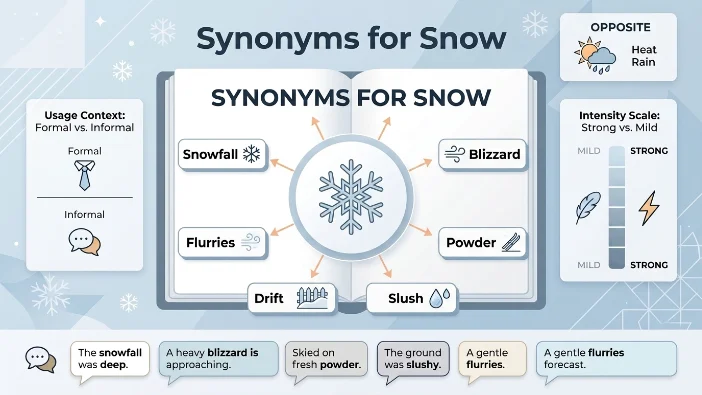
The best synonyms for snow are snowfall, flurries, sleet, slush, and powder. Use “snowfall” to describe the amount of snow, “flurries” for light snow, “sleet” for icy rain, “slush” for wet, partially melted snow, and “powder” for fresh, dry snow .
What Does Snow Mean?
Snow is precipitation in the form of ice crystals, usually intricately branched and hexagonal, that fall from the atmosphere . When these crystals accumulate, they form a white layer on the ground. The word can also refer to a snowfall or snowstorm. In slang, “snow” means cocaine . As a verb, it describes the falling of snow, as in “It snowed all night,” and informally, it can mean to deceive or overwhelm someone with insincere talk .
Here are a couple of simple example sentences:
- “The snow fell gently, covering the rooftops in a soft white blanket.”
- “He tried to snow his way into the job with a lot of fancy talk.”
Core Meaning of Snow
At its core, snow represents winter’s most iconic form of precipitation. It transforms landscapes into silent, white wonderlands and is fundamental to winter sports, culture, and ecosystems. The word conjures images of cold, quiet, and a unique kind of beauty. Beyond the literal meaning, “snow” has symbolic associations with purity, cleanliness, and sometimes isolation.
Grammar and Usage Notes
Part of Speech: Snow can function as a noun (the snow is falling) and a verb (it snowed yesterday).
Common Sentence Patterns:
- As a noun: “We had a lot of snow this winter.” “The snow is deep.”
- As a verb (intransitive, usually with “it” as the subject): “It is snowing.” “It snowed for three days.”
- As a verb (transitive, figurative): “He snowed the customers with technical jargon.”
Common Phrases and Collocations:
- Heavy snow, light snow, fresh snow, deep snow
- Snowfall, snowstorm, snowflake, snowman, snowplow
- “Snowed under” (overwhelmed) and “snow job” (a deception) .
When Snow Sounds Natural: Use “snow” in general conversation, weather reports, and any casual or formal writing about winter weather.
When a Synonym May Work Better: Use “slush” for melting snow, “flurries” for a light snowfall, “powder” for ideal skiing conditions, or “blizzard” for a severe snowstorm. Choose a synonym to be more descriptive and precise.
Best Synonyms for Snow
Common Synonyms for Snow
These are the everyday words you can use in normal conversation and writing when you want a more descriptive term for snow.
Snowfall
- Meaning: The amount of snow that falls in a given time .
- Best Context: Weather forecasts and general descriptions.
- Example Sentence: “The total snowfall for the season reached an impressive 50 inches.”
Flurries
- Meaning: A brief, light snowfall that often comes with wind .
- Best Context: Predicting a small amount of snow or describing it.
- Example Sentence: “Snow flurries are expected later this afternoon.”
Powder
- Meaning: Fresh, powdery snow that is ideal for skiing or snowboarding.
- Best Context: Describing good snow conditions for winter sports.
- Example Sentence: “The fresh powder made the ski slopes a delight.”
Slush
- Meaning: Snow that has begun to melt and is partially watery .
- Best Context: Describing wet, messy, or melting snow on roads and sidewalks.
- Example Sentence: “After the sun came out, the snow quickly turned to slush.”
Snowbank / Snowdrift
- Meaning: A mound or bank of snow, often piled up by the wind .
- Best Context: Describing piles of snow.
- Example Sentence: “We had to climb over a huge snowdrift to get to the door.”
Formal Synonyms for Snow
For academic writing, scientific reports, or formal business communication, these terms offer a more precise and professional tone.
Precipitation
- Meaning: Any form of water, liquid or solid, that falls from the atmosphere .
- Best Context: Scientific or meteorological reports.
- Example Sentence: “The city’s annual precipitation often exceeds 40 inches, much of it falling as snow.”
Snowfall
- Meaning: The accumulated or measured amount of snow.
- Best Context: Reports, statistics, and formal descriptions.
- Example Sentence: “The total snowfall for the region was recorded at 30 centimeters.”
Snowpack
- Meaning: The seasonal accumulation of snow that persists in a region.
- Best Context: Environmental and scientific writing, particularly in water resource discussions.
- Example Sentence: “The snowpack in the Sierra Nevada provides a critical water supply.”
Rime
- Meaning: A coating of frost or ice on surfaces .
- Best Context: Technical descriptions of weather conditions.
- Example Sentence: “Rime ice formed on the trees during the cold snap.”
Corn Snow
- Meaning: Coarse, granular snow formed by repeated melting and refreezing .
- Best Context: Technical descriptions of snow conditions, often in mountaineering.
- Example Sentence: “The morning’s corn snow offered challenging conditions for the climbers.”
Informal Synonyms for Snow
When you’re chatting with friends, posting on social media, or writing informally, these casual alternatives feel more natural.
Powder
- Meaning: Fresh, fluffy snow.
- Best Context: Casual talk about skiing or a pretty snowfall.
- Example Sentence: “We’re getting some fresh powder—grab your skis!”
Slush
- Meaning: Wet, watery snow.
- Best Context: Describing messy road conditions or melting snow.
- Example Sentence: “Ugh, I got soaked walking through that nasty slush.”
The White Stuff
- Meaning: A playful, informal term for snow.
- Best Context: Fun, friendly conversations.
- Example Sentence: “Looks like we’re getting some of the white stuff this weekend.”
Flurries
- Meaning: Light, passing snow showers.
- Best Context: Casual weather talk.
- Example Sentence: “We’re expecting a few flurries, nothing serious.”
Strong Synonyms for Snow
These words carry more intensity and are perfect for describing severe snow conditions or for creative writing.
Blizzard
- Meaning: A severe snowstorm with high winds and low visibility .
- Best Context: Describing a dangerous, heavy storm.
- Example Sentence: “The blizzard howled all night, covering everything in deep snow.”
Snowstorm
- Meaning: A heavy fall of snow accompanied by wind.
- Best Context: General weather description of a major event.
- Example Sentence: “The snowstorm brought the city to a standstill.”
Nor’easter
- Meaning: A powerful storm along the East Coast of the United States, often bringing heavy snow.
- Best Context: Regional weather reports or news.
- Example Sentence: “A nor’easter is expected to dump up to two feet of snow.”
Whiteout
- Meaning: A condition where blowing snow makes visibility very poor, often causing a uniform whiteness .
- Best Context: Describing extreme, blinding snow conditions.
- Example Sentence: “We had to stop driving when the conditions turned into a complete whiteout.”
Mild Synonyms for Snow
For a softer, more delicate description of snow, these words work well.
Flurries
- Meaning: Light, brief snowfall.
- Best Context: A gentle, non-threatening snow.
- Example Sentence: “The flurries were drifting down, covering the garden like a light dusting of sugar.”
Dusting
- Meaning: A light covering of snow.
- Best Context: Describing a small amount of snow.
- Example Sentence: “A dusting of snow coated the rooftops.”
Snowfall
- Meaning: The total amount of snow falling.
- Best Context: A neutral, gentle description of snow.
- Example Sentence: “The gentle snowfall created a perfect, quiet evening.”
Sleet
- Meaning: Frozen or partly frozen rain.
- Best Context: Describing a type of precipitation that can be sharp and unpleasant but is often less severe than a blizzard.
- Example Sentence: “The sleet tapped against the window, a sound that made me grateful to be indoors.”
Synonyms for Snow by Context
Everyday Conversation
For everyday chats, keep it simple and descriptive. Use “flurries” for a light snow, “slush” for melting snow, or “snowfall” for a general description. We might get a few flurries tonight” or “It’s just wet slush out there” are natural ways to describe snow in conversation.
Professional Writing
In a business or formal report, use precise, neutral terms. “Snowfall” and “snowpack” are excellent for business communications or weather-related reports for a professional audience. “Our team will monitor the snowfall and adjust operations accordingly.”
Academic Writing
For essays, research papers, or academic journals, use formal terms like “precipitation,” “snowpack,” and “snowmelt.” “The study examines the effect of varying snowpack levels on the regional water supply.” This uses a precise vocabulary that suits a scholarly audience.
Creative Writing
This is where you can get the most descriptive. Use “powder” for fresh snow, “blizzard” for a storm, “whiteout” for blinding conditions, or “rime” for frosty details. “The snow was a fine powder, glittering like diamonds under the full moon.”
Weather Reporting
For a meteorological or journalistic style, use words like “precipitation,” “snowfall,” “snow shower,” and “blizzard.” These terms are accurate and familiar to the audience. “The NWS has issued a blizzard warning for the region due to high winds and heavy snowfall.”
Another Word for Snow in a Sentence
Here are examples of how different synonyms for snow can be used in sentences.
- “The snowfall was so heavy that school was cancelled for the week.”
- “A few flurries started to fall, dusting the grass with white.”
- “Skiers were delighted by the fresh powder that had fallen overnight.”
- “The sleet turned the sidewalks into a sheet of ice.”
- “The warm sun turned the snow into dirty slush by the afternoon.”
- “A powerful blizzard howled for hours, leaving several feet of snow behind.”
- “The town was prepared for a major snowstorm with full salt trucks.”
- “The mountain snowpack is a crucial source of summer water.”
- “A dusting of snow covered the cars in the parking lot.”
- “We had to shovel a path through a huge snowdrift to get to the front door.”
- “A whiteout made it impossible to see the road ahead.”
- “Rime ice covered the branches, making the trees look like crystal.”
Snow Synonyms Compared
Choosing the right word often comes down to understanding the small but important differences between them.
Words Similar to Snow
These related words belong to the same semantic field but are not exact synonyms. They are related to cold, frozen water, or weather conditions.
Frost
- Why It’s Related: Frost is the thin layer of ice crystals that forms on surfaces . It is similar to snow as a form of frozen water vapor but is not falling precipitation.
- Why It’s Not an Exact Synonym: Frost is a coating, whereas snow is a form of precipitation that falls from the sky.
- When to Use It: Use “frost” to describe ice on the ground, windshields, or leaves, not falling snow. “The grass was covered in frost this morning.”
Ice
- Why It’s Related: Ice is frozen water. Snow is made of ice crystals . They are chemically the same.
- Why It’s Not an Exact Synonym: Ice is a solid mass, while snow is a collection of delicate crystals. Ice can fall as hail or form on surfaces.
- When to Use It: Use “ice” to describe frozen water that is solid, slippery, or forms a layer, not for falling snow. “The roads were treacherous with black ice.”
Hail
- Why It’s Related: Like snow, hail is a form of frozen precipitation that falls from the sky .
- Why It’s Not an Exact Synonym: Hail is composed of balls or lumps of ice, while snow is delicate, soft flakes. Hail also typically falls during thunderstorms, not snowstorms.
- When to Use It: Use “hail” for icy pellets that often fall during spring and summer storms, not for snow. “The storm brought large hail that damaged the cars.”
Antonyms of Snow
Here are common antonyms of snow, representing the opposite concepts of warmth, dryness, and heat .
How to Choose the Right Synonym for Snow
- Match the context: Is the situation informal or formal? Casual conversation can handle “powder” and “slush,” while a scientific report needs “snowpack” and “precipitation.”
- Match the tone: Are you being dramatic or mild? “Blizzard” has a much stronger tone than “flurries.”
- Check the intensity: How much snow are you describing? A “dusting” is very different from a “snowstorm.”
- Think about your reader: Will they understand the word? Use “slush” with friends, but “snowmelt” in a technical document.
- Check if the synonym is exact or only related: “Sleet” is not the same as “snow,” but it is a related form of winter precipitation. Make sure you’re using the right term.
- Keep the sentence natural: Read the sentence out loud. Does the synonym fit the rhythm and meaning you want?
- Use simple words when clarity matters: Sometimes, the best word for snow is simply “snow.”
Common Mistakes When Using Synonyms for Snow
- Using a word with the wrong tone: Don’t say “there was a blizzard on my windshield” (use “frost” or a “light dusting”).
- Using a synonym that is too strong: Describing a light snow as a “blizzard” sounds exaggerated and inaccurate.
- Using a formal word in casual writing: “Tonight’s precipitation total will be low” sounds strange; “We’re getting a few flurries” sounds natural.
- Using a casual word in professional writing: “The slush is causing flooding” is informal; “The snowmelt is contributing to elevated water levels” is more appropriate for a report.
- Replacing snow without checking meaning: Calling black ice “snow” is a mistake. “Ice” and “snow” are different things.
- Treating related words as exact synonyms: “Sleet” is not the same as “snow.” It’s a specific, unpleasant mix of rain and snow.
- Making the sentence sound unnatural: Forcing a big word into a sentence can break the flow and confuse readers. “The corn snow was challenging to traverse” might sound better as “The rough, frozen snow was hard to walk on.”
Quick Synonym List for Snow
Informal Synonyms
Strong Synonyms
Mild Synonyms
Related Words
FAQs
What is the best synonym for snow?
The best synonym for snow depends on the context.
- For a general description, snowfall is often the best choice.
- For fresh skiing snow, powder is ideal.
- For melting snow, use slush.
- For a severe storm, use blizzard .
What is another word for snow?
Another word for snow is snowfall or snowstorm. Other common synonyms include flurries, powder, slush, and sleet .
What is a formal synonym for snow?
A formal synonym for snow is precipitation . Snowfall and snowpack are also formal and frequently used in scientific and professional writing.
What is an informal synonym for snow?
An informal synonym for snow is powder or slush . A playful, informal term is the white stuff.
What is a stronger word for snow?
A stronger word for snow is blizzard or snowstorm. Whiteout is another strong term used for extreme conditions with heavy snowfall and poor visibility .
What is a milder word for snow?
A milder word for snow is flurries or a dusting. These terms describe a light, gentle snowfall.
What words are similar to snow?
Words similar to snow include frost, ice, and hail, although these are not exact synonyms . They are related terms that fall under the broader category of frozen precipitation.
What is the opposite of snow?
The opposite of snow is heat, sunshine, warmth, or rain . These represent the absence of cold, frozen precipitation.
How do I choose the right synonym for snow?
To choose the right synonym for snow, consider the context (formal vs. casual), the tone (dramatic vs. mild), and the intensity (light dusting vs. heavy blizzard). Think about your audience and what you want to emphasize.
Conclusion
Snow is a simple word for a complex and beautiful phenomenon. While “snow” covers the basics, choosing a more specific synonym can make your writing more vivid, accurate, and engaging. Whether you’re describing a gentle dusting, a fresh powder for skiing, or a dangerous blizzard, there’s a word that fits perfectly. The best synonym for snow is the one that best matches your context, tone, and meaning. Use this guide to pick the perfect word every time.
Read More Related Articles:
- Synonyms for Embarrassed | Smarter Word Choices for Every Context In 2026
- Synonyms For Felt | Make Your Writing More Descriptive In 2026
- Synonyms for Stress | Meaning, Examples, and Better Word Choices In 2026

Grace Phillips contributes content to SynonymsAura.com, where she writes about language, vocabulary and everyday communication. Her work is centered on helping readers find the right words and express themselves with greater clarity and confidence.