If you’re looking for synonyms for constant, the most common alternatives are continuous, steady, persistent, unceasing, and perpetual. But which word you should actually use depends on what you mean, how formal the writing is, and how strong you want the word to feel. This guide breaks all of that down clearly so you can pick the right word every time.
Best Synonyms for Constant
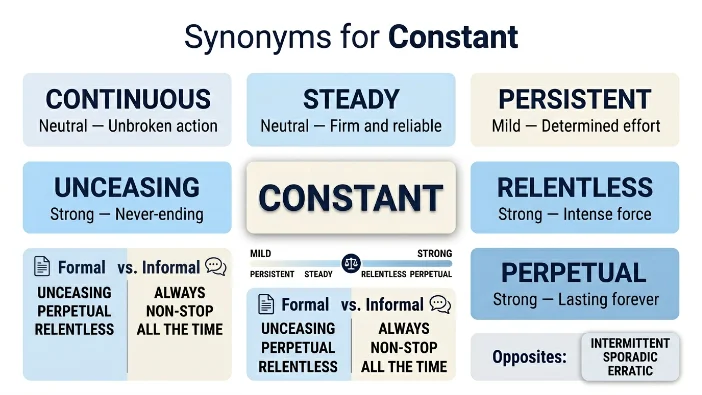
The best synonyms for constant are continuous, steady, persistent, unceasing, and perpetual. The right choice depends on tone, context, and intensity. Use continuous for unbroken action, steady for calm regularity, persistent when something keeps happening despite resistance, unceasing for a stronger or more literary feel, and perpetual when something seems to last forever.
What Does Constant Mean?
Constant is most commonly used as an adjective meaning happening all the time, without stopping, or staying the same over time. It can describe something that repeats continuously like constant noise or something that does not change, like a constant temperature.
As a noun, constant refers to a fixed value or principle that does not vary. You’ll see this use most often in math and science.
Part of speech: Adjective (most common), noun (math/science contexts)
Example sentences:
- She had to deal with constant interruptions during the meeting.
- The temperature in the lab must remain constant throughout the experiment.
Core Meaning of Constant
At its core, constant is about two related ideas: continuity and stability. Something that is constant either keeps happening without stopping a constant hum, constant pressure, constant updates or it stays at the same level without changing a constant speed, constant temperature.
These two senses slightly overlap, but they matter when choosing a synonym. If you mean “never stopping,” words like continuous or unceasing work well. If you mean “always the same,” words like stable, steady, or uniform fit better.
Grammar and Usage Notes
Part of speech: Adjective and noun
Common sentence patterns:
- Constant + noun → constant noise, constant pressure, constant support
- Subject + verb + constant → “The speed remained constant.”
- Constant as noun → “Speed of light is a constant.”
Common collocations:
- constant reminder
- constant companion
- constant stream
- constant pressure
- constant change (an ironic but common phrase)
When constant sounds natural: Constant works well when you want to say something continues without interruption or stays the same without variation. It’s neutral enough for both formal and informal writing.
When a synonym may work better:
- If the writing feels repetitive because constant has already appeared nearby, swap it for steady, continuous, or persistent.
- If the writing is highly formal, perpetual or unremitting may feel more precise.
- If the tone is casual, nonstop or ongoing reads more naturally.
Best Synonyms for Constant
| Synonym | Meaning | Tone | Best Use Case | Example Sentence |
|---|---|---|---|---|
| Continuous | Without interruption | Neutral | Describing unbroken action or flow | The machine ran on a continuous cycle. |
| Steady | Regular and even | Neutral/Calm | Describing calm, reliable repetition | She kept a steady pace throughout the race. |
| Persistent | Continuing despite resistance | Slightly strong | Challenges, problems, or determined effort | The persistent rain delayed the project by a week. |
| Perpetual | Lasting or seeming to last forever | Formal/Strong | Literary or formal writing | He was caught in a state of perpetual worry. |
| Unceasing | Not stopping at all | Formal/Strong | Emphasis on endlessness | The unceasing noise made concentration impossible. |
| Incessant | Annoyingly without pause | Informal/Negative | Complaints, irritations | The incessant buzzing drove everyone out of the room. |
| Nonstop | Without any pause | Casual | Conversation and informal writing | It rained nonstop all weekend. |
| Relentless | Unstoppable, often intense | Strong | Describing force, pressure, or determination | The relentless heat was exhausting by midday. |
| Sustained | Maintained over time | Formal | Academic and professional writing | The team showed sustained effort over three months. |
| Uniform | Staying consistently the same | Technical/Neutral | Math, science, formal reports | The coating was applied in a uniform layer. |
Common Synonyms for Constant
These are the everyday alternatives you’ll reach for in most writing situations.
Continuous Means happening without any break or gap. Best when describing actions or processes that don’t stop. The pipeline needs continuous monitoring to detect leaks early.
Steady Suggests calm, even regularity. Works well when you want to imply reliability or balance. He maintained a steady work schedule even during the busiest weeks.
Ongoing Describes something that is still in progress or has not yet finished. Less intense than constant. The investigation is ongoing, and results are expected next month.
Regular Suggests something that happens at predictable intervals. Not quite the same as constant but often a useful swap. Regular updates were sent to all team members throughout the process.
Persistent Adds a layer of determination or continuation despite obstacles. The persistent cough finally prompted her to see a doctor.
Formal Synonyms for Constant
Use these in academic writing, reports, essays, or professional communication.
Perpetual Suggests something lasts indefinitely, sometimes with a slightly dramatic weight. Fits well in formal essays or legal writing. The contract established a perpetual right to use the land.
Sustained Implies something is actively maintained over time. Common in academic and business writing. Sustained economic growth requires investment in infrastructure.
Unremitting Means not relaxing or easing up at any point. Slightly literary, very formal. The unremitting pressure of deadlines took a toll on the team.
Incessant (can be formal in context) Though often used in a slightly negative sense, it fits professional and academic writing when describing a persistent problem. The report noted incessant delays in the supply chain.
Invariable Useful when emphasizing that something never changes. Often found in scientific or analytical writing. The reaction produced invariable results across all test conditions.
Perennial Describes something that recurs regularly, often across seasons or long periods. Familiar in policy and social commentary. This is a perennial challenge for educators in underfunded districts.
Informal Synonyms for Constant
These feel natural in conversation, social media posts, personal messages, and casual writing.
Nonstop Very direct. Works great when you want to express something that never pauses. She’s been nonstop since she started that new job.
Never-ending Slightly exaggerated and conversational. Often used to express exhaustion or frustration. The never-ending list of tasks was starting to feel overwhelming.
Always-on A modern, tech-flavored phrase. Common in digital and startup culture. Remote workers often fall into an always-on mindset that hurts their mental health.
Round-the-clock Implies happening 24 hours a day. More vivid and informal than continuous. The customer support team works round-the-clock to resolve issues.
All the time The simplest, most conversational swap. Works in spoken language and casual writing. He’s complaining all the time and it’s getting exhausting.
Strong Synonyms for Constant
These alternatives carry more emotional weight or intensity than constant on its own.
Relentless Suggests something powerful that does not give up or let up. Works well for dramatic or emphatic writing. The relentless pressure of expectations wore him down over the years. Use carefully relentless is more intense than constant and implies force or aggression.
Unceasing A more literary choice that stresses the total absence of any pause. Slightly more elegant than incessant. The unceasing demands of the role left her little time for herself.
Incessant Carries a hint of annoyance or complaint. Good when the writer wants to signal frustration. The incessant noise from the construction site was impossible to ignore.
Unrelenting Similar to relentless but often describes conditions rather than people. The unrelenting pace of change in the industry challenged everyone.
When these words feel too intense, dial back to continuous or steady instead.
Mild Synonyms for Constant
These softer alternatives work when you want to describe regularity without stressing endlessness or intensity.
Regular Calm and predictable. Best for describing patterns, routines, and schedules. Regular check-ins helped the team stay on track.
Steady Implies smooth, even continuation. Less forceful than constant but still reliable. There has been a steady rise in user engagement over the past quarter.
Ongoing Suggests something is still happening, without implying it’s overwhelming or never-ending. The ongoing review process will continue through the end of the year.
Frequent Describes something that happens often, but not necessarily without pause. Frequent updates kept all stakeholders informed about progress.
Consistent Focuses on uniformity rather than continuity. Best when emphasizing quality or standards. Consistent performance is what sets this team apart.
Synonyms for Constant by Context
Everyday Conversation
In casual speech, nonstop, all the time, always, and never-ending feel the most natural. Nobody says “the incessant dripping” at home they say “it won’t stop dripping.”
“She’s been busy nonstop since the baby arrived.”
Professional Writing
In emails, reports, and business documents, ongoing, sustained, consistent, and steady are the clearest choices. They’re professional without feeling stiff.
“We expect sustained growth throughout the next fiscal quarter.”
Academic Writing
Persistent, perpetual, invariable, and sustained are all solid choices in research papers and essays. Unremitting and unceasing can also work, especially in humanities writing.
“The study found persistent disparities in access to healthcare across demographic groups.”
Creative Writing
Creative writing opens the door to richer options. Relentless, unceasing, perpetual, and unremitting all add texture and emotion that plain constant can’t match.
“A relentless wind swept across the plain, bending every blade of grass in the same defeated direction.”
Emotional Expression
When expressing strong feelings, incessant, never-ending, relentless, and unceasing capture emotional weight effectively.
“The incessant worry kept her awake long past midnight.”
Another Word for Constant in a Sentence
Here are 14 example sentences using a range of synonyms in realistic, practical contexts:
- The continuous flow of notifications made it hard to focus on any single task.
- A steady income gave the family a sense of security they hadn’t felt in years.
- Persistent headaches finally pushed him to schedule an appointment with his doctor.
- The company showed sustained growth even through the economic slowdown.
- Incessant arguing between the two colleagues disrupted the entire department.
- She maintained a relentless commitment to improving her craft over many years.
- The machine requires regular maintenance to operate at its best.
- An ongoing dispute between the two parties delayed the project significantly.
- The unceasing hum of the air conditioner became a strange kind of comfort.
- He was caught in a perpetual cycle of planning without ever taking action.
- Nonstop rain over three days caused flooding in several low-lying neighborhoods.
- The organization runs round-the-clock operations to serve clients in different time zones.
- Consistent practice turned what once felt awkward into a natural habit.
- The never-ending paperwork was the least glamorous part of the new role.
Constant Synonyms Compared
Some words are so close to constant that it’s worth looking at exactly how they differ.
| Word | Meaning Difference | Tone | Better When… |
|---|---|---|---|
| Constant | Continuing without stopping or changing | Neutral | General use in any register |
| Continuous | Emphasizes no break or gap in the flow | Neutral | Describing processes or actions |
| Steady | Emphasizes evenness and calm regularity | Calm | Describing controlled, reliable patterns |
| Persistent | Implies continuation despite obstacles | Slightly charged | Describing problems or determination |
| Perpetual | Implies it will never end, sometimes hyperbolic | Formal | Formal or dramatic effect |
| Incessant | Implies irritating or exhausting repetition | Negative | Expressing frustration or complaint |
| Relentless | Implies unstoppable, often overwhelming force | Strong/Intense | Creative or emotional writing |
| Consistent | Emphasizes uniformity, not just continuation | Neutral | When referring to quality or standards |
Key takeaway: Continuous is the closest plain swap for constant when describing something ongoing. Steady works when calm reliability matters. Persistent adds determination. Incessant adds frustration. Relentless adds force.
Words Similar to Constant
These words are related to constant but are not always direct replacements. They belong to the same semantic field ideas of regularity, repetition, or stability but each has a different shade of meaning.
Habitual Describes something done out of habit, not necessarily without stopping. A habitual morning runner isn’t the same as a constant runner. Use habitual when pattern matters more than continuity.
Chronic Often used in medical or negative contexts to describe a persistent condition. Chronic pain and constant pain overlap, but chronic carries a clinical weight that constant does not.
Frequent Something that happens often, but with gaps in between. Frequent interruptions may stop occasionally; constant interruptions do not.
Recurring Suggests something comes back repeatedly, not that it never stops. A recurring problem returns again and again; a constant problem never leaves.
Stable Describes a state that doesn’t change, similar to the “unchanging” sense of constant. But stable doesn’t carry the sense of ongoing action that constant often does.
Enduring Means lasting a long time, often with a positive tone. An enduring friendship suggests it has survived time, not that it runs without interruption.
Antonyms of Constant
| Antonym | Meaning | Example Sentence |
|---|---|---|
| Intermittent | Stopping and starting at intervals | The Wi-Fi signal was intermittent all evening. |
| Occasional | Happening only sometimes | He made occasional visits to his hometown. |
| Sporadic | Irregular and scattered | Progress was sporadic at best during those months. |
| Variable | Changing frequently | The weather this month has been highly variable. |
| Erratic | Unpredictable and inconsistent | Her performance became erratic under pressure. |
| Fleeting | Lasting only a very short time | The sense of calm was fleeting and quickly faded. |
| Temporary | Not permanent; expected to end | The fix was temporary and needed a permanent solution. |
How to Choose the Right Synonym for Constant
Match the context first. “Constant pain” in a medical record doesn’t work as “incessant pain” too informal. “Constant updates” in a business email might read better as “regular updates” if the updates aren’t actually every minute.
Match the tone. If the piece is calm and professional, steady or sustained fits. If it’s emotional or expressive, relentless or unceasing might work better.
Check the intensity. Constant is fairly neutral. Relentless and incessant are stronger. Regular and frequent are milder. Pick the level that matches what you actually mean.
Think about the reader. A reader who isn’t a native English speaker, or who reads quickly, benefits from clearer, more common words like continuous or ongoing over rarer words like unremitting.
Check whether it’s an exact synonym. Words like recurring, frequent, and habitual are related but not the same as constant. Don’t force them in unless they accurately describe the situation.
Read the sentence aloud. If the synonym makes the sentence clunky or sounds off, go back to constant or try another option.
Common Mistakes When Using Synonyms for Constant
Using incessant in professional writing without realizing the tone. Incessant carries a hint of complaint and irritation. In a formal report, it can sound unprofessional. Use persistent or sustained instead.
Treating frequent as the same as constant. Frequent means often, not always. If something happens every five minutes with pauses, it’s frequent. If it truly never stops, it’s constant or continuous.
Replacing constant with chronic outside of medical contexts. Chronic sounds clinical. Using it to describe, say, “chronic interruptions” in a casual email sounds odd unless you’re deliberately being dramatic.
Using relentless when you mean simply “ongoing.” Relentless is intense. Applying it to mild or neutral situations (“the relentless stream of thank-you emails”) sounds exaggerated.
Using perpetual when something actually has a foreseeable end. Perpetual implies it lasts forever. If the situation is temporary, use ongoing or continuous instead.
Forgetting the noun form. If constant is used as a noun (“the speed of light is a constant”), none of the adjective synonyms will work as replacements. The noun sense is specific to math and science.
Quick Synonym List for Constant
Common Synonyms
- Continuous, steady, ongoing, persistent, regular, consistent
Formal Synonyms
- Perpetual, sustained, unremitting, invariable, perennial, incessant (in formal context)
Informal Synonyms
- Nonstop, never-ending, always-on, round-the-clock, all the time
Strong Synonyms
- Relentless, unceasing, unrelenting, incessant
Mild Synonyms
- Regular, steady, ongoing, frequent, consistent
Related Words
- Habitual, chronic, recurring, stable, enduring, frequent
FAQs
What is the best synonym for constant?
The best synonym for constant is usually continuous or steady. Continuous works when you need to describe something that never pauses, while steady fits when the focus is on calm, even regularity. The right choice depends on your context and the tone of the writing.
What is another word for constant?
Another word for constant is persistent, perpetual, ongoing, or unceasing. Each has a slightly different shade of meaning, so it’s worth matching the word to the intensity and tone of the sentence.
What is a formal synonym for constant?
Formal synonyms for constant include sustained, perpetual, unremitting, invariable, and perennial. These work well in academic papers, formal reports, legal writing, and professional essays.
What is an informal synonym for constant?
Informal synonyms for constant include nonstop, never-ending, all the time, and round-the-clock. These feel natural in conversation, social media posts, and casual writing.
What is a stronger word for constant?
Stronger alternatives include relentless, unceasing, incessant, and unrelenting. These words carry more emotional intensity than constant and work best when you want to emphasize force, pressure, or exhaustion.
What is a milder word for constant?
Milder alternatives include regular, frequent, ongoing, and consistent. Use these when you want to describe something that happens often or regularly without implying it is overwhelming or never-ending.
What is the opposite of constant?
The main antonyms of constant are intermittent, sporadic, erratic, variable, and occasional. These all describe things that stop and start, change unpredictably, or happen only sometimes.
How do I choose the right synonym for constant?
Start by identifying which sense of constant you mean does it mean “never stopping” or “never changing”? Then match the tone (formal, informal, strong, mild), check the intensity, and read the sentence aloud to make sure it flows naturally. If the synonym makes the sentence sound awkward or changes the meaning slightly, go with constant itself or try a closer match.
Conclusion
Constant is a flexible, useful word, but it has plenty of strong alternatives once you know how each one differs. For plain, clear writing, continuous and steady are your safest swaps. For formal contexts, reach for sustained, perpetual, or unremitting. When you want emotional intensity, relentless and unceasing carry more weight. And when the writing is casual, nonstop or never-ending feels the most natural.
The best synonym is always the one that matches your meaning, fits your tone, and sounds natural in the sentence. When in doubt, constant itself is never a bad choice it’s neutral, widely understood, and works across almost every context.
Feature Image Prompt
- Synonyms for Embarrassed | Smarter Word Choices for Every Context In 2026
- Synonyms For Felt | Make Your Writing More Descriptive In 2026
- Synonyms for Stress | Meaning, Examples, and Better Word Choices In 2026

Evelyn Turner is a content creator at SynonymsAura.com who enjoys exploring the richness of the English language. Her work focuses on word meanings, synonyms, expressions and everyday language usage, helping readers communicate with greater clarity and confidence.