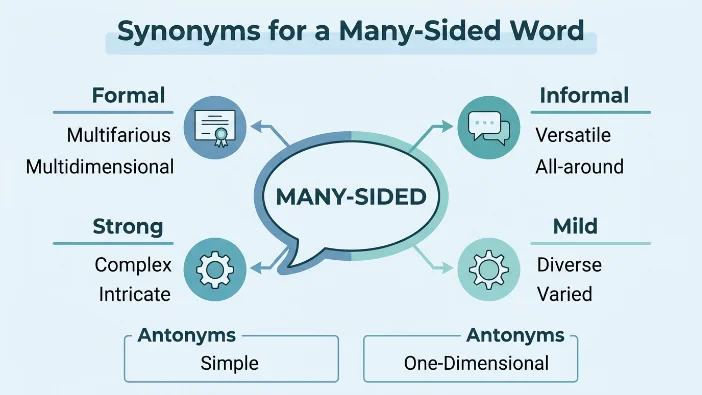
The best alternatives for this term are versatile, many-sided, complex, and diverse. It’s a word that sounds sophisticated, but picking the right replacement depends entirely on what you’re describing a person, a problem, or a gemstone. This guide explains the best alternatives for any context.
What Does the Word Mean?
At its most literal, this adjective describes a physical object, like a gemstone, that has many flat surfaces, or facets. The word comes from the French facette, meaning “little face.”
Figuratively, it means having many different aspects, features, or abilities. This is the most common usage today. A problem with many contributing factors is a complex issue. A person who is a talented artist, a brilliant scientist, and a caring parent is a person of great depth and variety.
- Part of Speech: Adjective.
- Example Sentence (Literal): The jeweler examined the diamond with many facets under the light.
- Example Sentence (Figurative): The human brain is a remarkably complex organ responsible for a vast array of functions.
Core Meaning of the Word
The core concept here is richness and complexity. It suggests something that cannot be understood or defined by a single quality or simple explanation. When you call an issue complex, you’re saying it has many different parts that interact in ways that can be difficult to untangle. When you call a person many-sided, you’re praising the depth and variety of their character. It is the direct opposite of words like simple, one-dimensional, or single.
Grammar and Usage Notes
- Part of Speech: Adjective.
- Common Sentence Patterns: It typically appears before a noun (e.g., a wide-ranging approach) or after a linking verb (e.g., The problem is highly complex).
- Common Collocations: It is frequently paired with words like approach, problem, personality, issue, strategy, and career.
- When It Sounds Natural: This word works well in formal discussions, professional writing, and when you want to emphasize the impressive breadth of a subject or person.
- When a Synonym May Be Better: In casual conversation, this word can sound overly formal or like a buzzword. In that case, a simpler word like “versatile” or “all-around” is often a better fit.
Best Synonyms for a Many-Sided Word
This table provides a quick overview of the most accurate and useful synonyms for describing something with many sides or aspects.
| Synonym | Meaning | Tone | Best Use Case | Example Sentence |
|---|---|---|---|---|
| Versatile | Able to adapt or be used for many different purposes. | Positive, practical | Describing a person’s skills or an object’s uses. | She is a versatile musician, playing both jazz and classical piano. |
| Many-sided | Having many different aspects or features. | Neutral, descriptive | Replacing the original word in a simple, clear way. | The novel presents a many-sided view of the main character. |
| Complex | Consisting of many different and connected parts. | Intellectual, sometimes negative | Describing problems, systems, or ideas. | Solving climate change is a complex global challenge. |
| Diverse | Showing a great variety of different elements. | Neutral, inclusive | Describing a group of people, things, or ideas. | The city has a diverse and vibrant culture. |
| Multidimensional | Having many different features or qualities. | Academic, analytical | Emphasizing depth and multiple layers. | The artist’s work is multidimensional, blending painting and sculpture. |
Common Synonyms for This Term
These are everyday alternatives that work well in both writing and speech.
Varied
- Meaning: Incorporating many different types or elements.
- Best Context: Describing a range of activities, experiences, or opinions.
- Example: My job is so varied; one day I’m in the lab, and the next I’m meeting with clients.
All-Around
- Meaning: Good at many different things; general in capability.
- Best Context: Describing a person with a broad set of skills.
- Example: He’s an all-around athlete who excels at basketball, baseball, and swimming.
Diversified
- Meaning: Having a wide range of different elements to increase variety or reduce risk.
- Best Context: Business, finance, or planning contexts.
- Example: The company has a diversified portfolio to protect against market volatility.
Formal Synonyms
These alternatives are excellent for academic writing, professional reports, and formal presentations.
Multifarious
This is a formal word meaning “having great diversity or variety.” It emphasizes a wide range of different parts. It’s often used to describe collections, interests, or a person’s activities. While not as commonly used as the original term, it’s a very precise and sophisticated choice.
- Example: Her multifarious interests include Renaissance art, marine biology, and astrophysics.
Multidimensional
This term is perfect for analytical contexts. It suggests a depth that goes beyond a single plane or viewpoint. You might use it to describe a character in a novel, a research study, or a historical event.
- Example: The historian presented a multidimensional analysis of the conflict, considering economic, social, and political factors.
Manifold
This word means “many and various” and has a slightly old-fashioned but highly respected feel. It is often used to describe the effects, results, or benefits of something.
- Example: The benefits of this new approach are manifold, promising improvements in both efficiency and employee satisfaction.
Informal Synonyms
When you’re in a casual setting, save your energy and use these simpler, more conversational words.
Versatile
This is perhaps the most popular and user-friendly synonym. It’s a great all-purpose word for praising someone’s adaptability.
- Example: You can do so many things with this app; it’s super versatile.
All-Round
Similar to “all-around,” this is common in British English but understood everywhere. It’s a great way to praise someone without sounding too academic.
- Example: He’s an all-round great guy who can fix a car, cook a meal, and tell a great story.
A Lot of Different Sides
Sometimes the simplest way to say it is the best. You can avoid jargon entirely and just describe someone or something directly. This phrase works for describing personality or a topic.
- Example: My grandmother is a person with a lot of different sides to her. She was a teacher, a painter, and a world traveler.
Strong Synonyms
These synonyms carry a heavier weight, emphasizing that something is not just complex, but also intricate, detailed, and difficult to grasp.
Complex
This is a strong, neutral word that is more direct than the original. It gets straight to the point: the thing has many parts, and those parts make it difficult.
- Use When: You are talking about a difficult problem, a complicated piece of machinery, or an intricate concept.
Intricate
This is even stronger than “complex.” It implies that the many parts are not just numerous, but also highly detailed and interconnected in a careful, almost delicate way.
- Use When: Describing a detailed plan, a beautiful piece of art, or a sophisticated mechanism.
Convoluted
This word has a negative connotation. It means something is “complex” in a way that is overly complicated, twisted, and difficult to follow.
- Use When: Describing a confusing legal argument, an unnecessarily complicated system, or a plot that is hard to track.
Mild Synonyms
If you want to describe something as having many parts without the heavy implication of confusion, these are your go-to words.
Diverse
This is a very mild and positive synonym. It focuses on the variety and differences within a group or collection, without judging whether those elements are easy or hard to understand.
- Use When: Describing a team, a culture, a city, or a set of opinions.
Varied
This is neutral and simply states that there is a mix of different things. It’s the simplest and most unassuming way to convey the idea.
- Use When: Describing your daily routine, the types of books you read, or your work responsibilities.
Many-sided
This is a direct translation of the core idea, but it lacks the formal weight of the original. It’s clear and simple but can feel a bit clunky.
- Use When: You want to be very clear and straightforward, perhaps when writing for a general audience.
Synonyms by Context
The best word to use depends on what you are describing. Here’s how to choose based on the context.
Everyday Conversation
For casual chats, keep it simple and practical. Versatile is the best choice for describing people and things. For personality, you could also say someone is “many-sided” or has “many different sides.”
Professional Writing (Business and Reports)
In business, you want to sound professional but not pretentious. Use versatile for describing employees or tools. For strategies and challenges, complex or multidimensional sound very professional. You could also consider using the original word itself, as it’s commonly used in this sphere for business strategies.
Academic Writing
Academics value precision and nuance. Your best options are multidimensional and multifarious. These words have a specific, formal feel that fits well in an academic paper or an essay.
Creative Writing
Creative writing is where you can really play with language. Protean (meaning able to change shape or form, often used for a character’s personality) is a beautiful, literary word. Multifarious also works well, as does manifold. You can also use metaphors, like “a prismatic personality” to imply many colors or facets.
Marketing Copy
In marketing, you want to be persuasive. Versatile is a perfect word to highlight a product’s many uses. Diverse is also good, but more for describing a line of products or a brand’s appeal. Avoid words like “complex” or “convoluted” in marketing.
Another Word in a Sentence
Here are real-world examples of synonyms in action.
- Versatile: Her versatile skill set makes her invaluable to the team.
- Complex: The issue is more complex than a simple yes-or-no answer.
- Diverse: The conference will feature a diverse range of speakers.
- Multidimensional: This research takes a multidimensional approach to understanding poverty.
- Varied: The menu offers a varied selection of dishes from around the world.
- Intricate: The detective untangled the intricate web of lies.
- All-around: He is a talented all-around performer.
- Many-sided: The debate revealed the many-sided nature of the problem.
- Multifarious: Her multifarious hobbies keep her busy and fulfilled.
- Manifold: The new policy has manifold implications for our industry.
- Convoluted: The writer’s convoluted explanation only confused the reader more.
- Mixed: The response to the new product has been mixed, with some loving it and others hating it.
- Composite: The sculpture is a composite of several different materials and styles.
Words Compared
While many of these words are often used interchangeably, they have distinct nuances.
| Word | Nuance | Best Use Case |
|---|---|---|
| Many-sided | Implies a rich variety of parts or aspects. | When you want to sound sophisticated or emphasize breadth. |
| Complex | Implies many parts that are interconnected and hard to understand. | When you want to emphasize the difficulty or intricacy of something. |
| Versatile | Implies adaptability and usefulness for many purposes. | When describing a practical skill, tool, or person’s ability. |
In short, calling a person “versatile” is a compliment about their skills.
- Calling them “many-sided” is a compliment about the depth of their personality.
- Calling a problem “complex” means it’s hard to solve.
- Calling it “complex” also implies it’s made up of many different parts.
Words Similar to This Concept
These words are related because they also imply “many,” but they have more specific meanings.
- Multifunctional: This means having many functions. It is more specific than the original idea. A smartphone is multifunctional. A person’s personality is many-sided.
- Multipurpose: Similar to multifunctional, this means designed for many uses. A multi-purpose tool is versatile but not necessarily complex.
- Multilateral: This is used primarily in politics and business to describe an agreement or action involving several different countries or groups. It has a very specific meaning that is not a direct substitute.
- Heterogeneous: A formal word meaning “diverse in character or content.” It usually describes a group of things that are different from each other, rather than a single thing having many different qualities.
Antonyms
Understanding what it is the opposite of can help clarify its meaning.
- Simple: Not complex or complicated. The solution was simple, not complex.
- One-Dimensional: Lacking depth; having only one quality or interest. The movie’s villain was one-dimensional.
- Narrow: Limited in range or scope. His interests are so narrow that he never tries anything new.
- Limited: Restricted or finite. Her experience was limited to one specific field.
- Homogeneous: Of the same or a similar kind. The community was homogeneous, unlike the many-sided city he was used to.
How to Choose the Right Synonym
- Define What You’re Describing: Is it a person, a problem, an idea, or an object? This is your most important step.
- Consider the Tone: Is your message formal or casual?
- Check the Intensity: Is it just “varied” or is it seriously “intricate”?
- Think About the Reader: Will your reader understand a word like “multifarious”? If not, choose a simpler word.
- Read It Out Loud: Does the word sound natural in the sentence? If it feels forced, try a different one.
Common Mistakes
- Using “Complex” as a compliment: Calling a person “complex” can mean they are interesting, but it can also mean they are difficult to understand. “Versatile” is a safer compliment.
- Using “Convoluted” for everything: “Convoluted” has a negative meaning and should only be used to describe something unnecessarily confusing.
- Using formal words in casual settings: Don’t say someone is “multifarious” at a dinner party. It will sound like you’re trying too hard.
- Assuming all words mean the same thing: As shown above, the subtle differences are key to good writing.
- Overusing the original word: If you’re describing a person or project, using the same adjective once in the text is usually enough. Try a synonym for variety.
Quick Synonym List
- Common: Versatile, varied, all-around, many-sided.
- Formal: Multifarious, multidimensional, manifold.
- Informal: All-around, versatile, a lot of different sides.
- Strong: Complex, intricate, convoluted.
- Mild: Diverse, varied, mixed.
- Related: Multifunctional, multipurpose, multilateral, heterogeneous.
FAQs
What is the best synonym for this word?
The best synonym depends on the context, but versatile is the most practical and common choice for describing people and things, while complex is best for describing problems.
What is another word for this concept?
Another word is many-sided or versatile. If you need a formal synonym, consider multidimensional.
What is a formal synonym?
Formal synonyms include multifarious, multidimensional, and manifold.
What is an informal synonym?
Informal synonyms include all-around and versatile.
What is a stronger word?
A stronger word, which suggests more complexity, is intricate. If you want to emphasize difficulty, use complex.
What is a milder word?
Milder synonyms include diverse, varied, and mixed.
What words are similar to this idea?
Similar words include multifunctional, multipurpose, and multidimensional.
What is the opposite of this concept?
The opposite is simple, one-dimensional, or limited.
Conclusion
This common adjective is a powerful word, but it can feel a bit heavy. The English language offers a treasure trove of alternatives that are more precise, more descriptive, and more appropriate for any given context. From the versatility of “versatile” to the depth of “multidimensional,” choosing the right word allows you to communicate with greater clarity and impact. The best choice is the one that fits your context, matches your tone, and resonates with your reader.
Read More Related Articles:
- Synonyms for Nuanced | Powerful Word Choices for Creative Writing In 2026
- Synonyms for Vivid | Create Stronger Mental Images in Writing In 2026
- Synonyms for Compassionate | Upgrade Your Writing with Deeper Emotion In 2026

Grace Phillips contributes content to SynonymsAura.com, where she writes about language, vocabulary and everyday communication. Her work is centered on helping readers find the right words and express themselves with greater clarity and confidence.