Do you need another word for messy? You’re not alone. While “messy” is a common and useful word, it can be vague. It can describe a cluttered desk, a person’s sloppy appearance, a complicated divorce, or even a chaotic work environment. The best synonyms for messy depend entirely on what you are describing.
This guide will show you the best synonyms for messy, from formal and mild to strong and informal. We will explain how to choose the right word based on context, tone, and intensity.
Best Synonyms for Messy
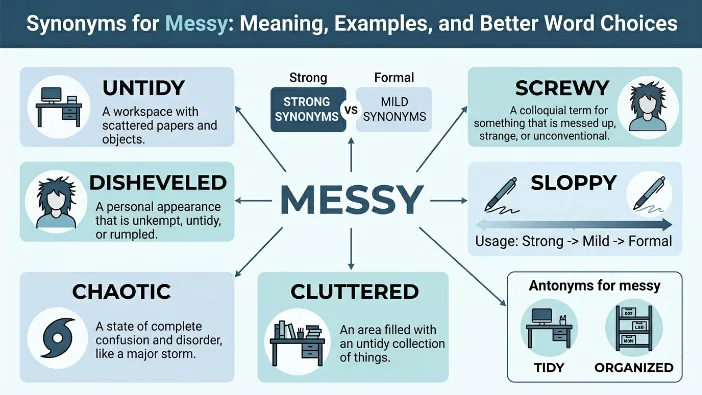
The best synonyms for messy are disheveled, untidy, chaotic, and sloppy. The right choice depends on tone, context, and intensity. For a cluttered room, use “untidy” or “disordered.” For a person’s appearance, “disheveled” is ideal. For a chaotic situation, “turbulent” or “disorderly” might be better.
What Does “Messy” Mean?
The core meaning of “messy” is untidy or dirty. It refers to a state of disorder, confusion, or a lack of neatness. It can describe physical spaces, a person’s appearance, a complex situation, or even a person’s habits.
- Simple definition: Not clean or tidy; in a state of disorder.
- Part of speech: Adjective.
- Example sentence: Her room is so messy you can barely see the floor.
- Example sentence: The messy divorce took years to settle.
Core Meaning of Messy
At its heart, “messy” describes a departure from order or cleanliness. It’s a versatile word because it can be applied to both concrete things (a messy room) and abstract concepts (a messy situation). The idea is that there is a lack of organization, clarity, or neatness.
The word derives from the Old French mesle, meaning “mixed” or “confused.” This history is helpful because it points to the core feeling of things being mixed up, jumbled, or not in their proper place.
Grammar and Usage Notes
“Messy” is an adjective. Its comparative form is “messier,” and the superlative is “messiest.”
- Common sentence patterns:
- It can be used with a linking verb: His handwriting is messy.
- It can be used before a noun: She had a messy bun.
- It can be used as a subject complement: The deal got messy.
- Common phrases and collocations:
- Messy room / house / desk / kitchen
- Messy hair / appearance
- Messy divorce / breakup / situation
- Messy eater
- Messy handwriting
It’s important to remember that when you say something is “messy,” you are usually making a negative judgment. If you want a more neutral description, you’d use a word like “disordered.” If you want a positive spin, you might say “lived-in” or “relaxed” for a room.
Best Synonyms for Messy
Here is a table with the most effective synonyms for “messy,” organized by their unique meaning and best use case.
| Synonym | Meaning | Tone | Best Use Case | Example Sentence |
|---|---|---|---|---|
| Untidy | Not neat or well-arranged. | Neutral, Common | Describing physical spaces like rooms, desks, or closets. | His desk is always untidy, covered in papers and coffee cups. |
| Disheveled | Untidy in appearance; rumpled, disordered. | Neutral, Descriptive | Describing a person’s messy appearance, clothes, or hair. | He arrived looking tired and disheveled after the long flight. |
| Chaotic | In a state of complete confusion and disorder. | Strong, Intense | Describing highly confusing or out-of-control situations, like an emergency or a busy first day. | The office was chaotic on the first day of the merger. |
| Sloppy | Careless and untidy in appearance or work. | Informal, Critical | Describing lazy work, poor performance, or a careless dress style. | That’s a sloppy job; you missed several errors in the report. |
| Cluttered | Filled with too many objects, causing disorder. | Neutral, Descriptive | Describing a physical space that is overcrowded with things. | A cluttered space can often lead to a cluttered mind. |
| Disordered | Lacking order; not organized. | Formal, Clinical | Used in psychology, medicine, or formal contexts to describe a lack of structure. | The patient’s thoughts were disordered and difficult to follow. |
| Muddled | Confused, vague, or not clearly thought out. | Neutral | Describing unclear ideas, thoughts, or an argument. | The article had a muddled argument that was hard to follow. |
| Bedraggled | Wet, dirty, and untidy; usually from being in the rain or mud. | Visual, Vivid | Describing someone or something that looks worn out and wet, like a dog after a storm. | The bedraggled kitten sat shivering on the porch. |
Common Synonyms for Messy
These are the everyday words you’ll hear in normal conversation and basic writing. They are versatile and easy to understand.
- Untidy: The most common and neutral synonym. It simply means not neat.
- Best context: Describing rooms, desks, closets, or any physical space.
- Example: She apologized for the untidy state of her living room.
- Sloppy: This word implies carelessness. It’s often used negatively to describe work, dress, or habits.
- Best context: When someone has not put in enough effort.
- Example: They fired him for his sloppy work on the project.
- Unkempt: Used almost exclusively to describe a person’s messy or uncared-for appearance, especially hair or general grooming.
- Best context: Personal appearance.
- Example: His unkempt beard made him look much older.
- Cluttered: Focuses on there being too many objects in a space, making it look messy.
- Best context: Describing physical spaces full of things.
- Example: My brain feels just as cluttered as my office.
Formal Synonyms for Messy
When writing an academic paper, a business report, or a formal email, you may want to avoid the casual tone of “messy.” These synonyms are more precise and professional.
- Disordered: A clinical and formal word meaning a lack of order. It’s often used in psychology or medicine.
- Best Use: Academic writing, clinical reports.
- Example: The study aimed to understand the neural mechanisms behind disordered thinking.
- Disorganized: This describes a system or person that lacks planning or structure.
- Best Use: Business settings, project management, evaluations.
- Example: The disorganized nature of the event led to significant delays.
- Turbulent: Describes a situation that is disorderly, chaotic, and unstable. Often used for political or economic upheaval.
- Best Use: Describing periods of transition, conflict, or volatility.
- Example: The company went through a turbulent period after the CEO resigned.
- Haphazard: Characterized by a lack of any obvious principle of organization. It suggests randomness and a lack of planning.
- Best Use: Describing methods, strategies, or layouts.
- Example: The haphazard layout of the city made navigation a nightmare.
- Disheveled (in a formal tone): While you can use “disheveled” in casual speech, it is also appropriate in formal writing to describe an untidy appearance.
- Best Use: Formal descriptions of people.
- Example: The witness appeared in court looking disheveled and anxious.
Informal Synonyms for Messy
These are the words you’ll use with friends, on social media, or in casual emails. They are relaxed and sometimes more colorful.
- Sloppy: As mentioned, this is a common informal word for careless or untidy work or behavior.
- Best Use: Casual criticism.
- Example: You need to stop being so sloppy with your shoes; you keep tripping over them.
- Rough: This implies a lack of refinement or sophistication in appearance or manners. “He looked a bit rough after the night out.”
- Best Use: Describing someone’s tired or unkempt appearance.
- Example: She was feeling rough after the long drive.
- Mussy: An old-fashioned or cute way to say messy. It’s often used for hair.
- Best Use: Playful or endearing descriptions.
- Example: The baby woke up with adorably mussy hair.
- A mess: (a noun used as an adjective) “He’s a mess” or “The room is a mess.”
- Best Use: General, strong statement of disorder.
- Example: The kitchen is an absolute mess after the party.
- All over the place: An idiom meaning disorganized, confused, or lacking focus.
- Best Use: Describing someone’s thoughts, plans, or performance.
- Example: His presentation was all over the place; it didn’t make much sense.
Strong Synonyms for Messy
These synonyms carry a lot of weight. They are perfect when you need to emphasize the severity of the disorder, chaos, or confusion.
- Chaotic: This is a very powerful word that suggests complete disorder and confusion. It implies a lack of control.
- When to use: When a situation is frantic, out-of-control, and noisy.
- Example: The scene outside the stadium was chaotic after the game.
- Anarchic: Similar to chaotic but with a nuance of a complete absence of rules or order. It’s a strong political or philosophical word.
- When to use: Describing a situation or group where rules have completely broken down.
- Example: The anarchic atmosphere of the protest made the police nervous.
- Havoc: Often used as a noun, but its synonyms (like ‘devastating’ or ‘turmoil’) carry its power. The situation “causes havoc.”
- When to use: When describing massive disruption.
- Example: The storm caused havoc with the town’s infrastructure.
- Frantic: While this usually describes a mental state of panic, a “frantic” atmosphere is messy in the sense of being highly active and disorganized.
- When to use: Describing a situation with panicked activity.
- Example: It was a frantic morning trying to get everyone out the door on time.
- Bewildering: Describes a situation so messy it causes confusion and a feeling of being lost.
- When to use: Describing a complex, confusing situation.
- Example: The legal contract was a bewildering mess of clauses and sub-clauses.
Mild Synonyms for Messy
Sometimes, you want to describe a lack of order without being harsh or overly critical. These mild or neutral terms are perfect for that.
- Untidy: This is the perfect neutral alternative. It’s the standard word for describing a clean space that simply isn’t perfect.
- When to use: To describe a room or desk that isn’t clean but isn’t a disaster zone.
- Example: The room was a little untidy, with some books on the floor.
- Unkempt: Use this to be polite about someone’s appearance. It’s more gentle than “sloppy.”
- When to use: Describing someone’s appearance in a way that is more objective than critical.
- Example: He had a vaguely unkempt look, but it seemed to suit him.
- Disheveled: Similar to unkempt, but often implies a recent disruption, like just getting out of bed.
- When to use: Describing a state of disorder that might be understandable.
- Example: She looked a little disheveled, but she had just run a marathon.
- Lived-in: A positive spin on a messy room. It implies comfort and habitability rather than dirt or chaos.
- When to use: Describing a comfortable, cozy home that has a relaxed atmosphere.
- Example: The cottage had a warm, lived-in feel.
- Informal: This is a mild way to describe a plan or gathering that is not rigidly structured.
- When to use: Describing an event or arrangement that is relaxed.
- Example: The itinerary for the trip was very informal, we just went with the flow.
Synonyms for Messy by Context
The best word for “messy” changes based on what you’re talking about. Here is how to choose for different contexts.
Everyday Conversation
In everyday conversation, clarity is key. Using complex or formal words can sound strange.
- Best options: Untidy, messy, sloppy, cluttered.
- Example: “Can you clean up your messy room?” or “Stop being so sloppy!”
- Why: These are the most common and easily understood words in a familiar setting.
Professional Writing
Here, precision and a neutral tone are important. Avoid overly casual words like “sloppy” unless you are critiquing someone’s work.
- Best options: Disorganized, disordered, haphazard, unstructured.
- Example: “The team’s disorganized approach led to the project’s failure.”
- Why: These words sound objective and serious, avoiding overly emotional language.
Academic Writing
In academic contexts, words need to be precise, formal, and often objective.
- Best options: Disordered, chaotic, muddled, haphazard, turbulent.
- Example: “The era was marked by a turbulent economic landscape.”
- Why: These terms are used to describe systems, events, or psychological states in a formal manner.
Creative Writing
In creative writing, you have the most freedom. Your choice depends on the tone you want to set: is it a melancholic, sad mess or a frantic, chaotic mess?
- Best options: Disheveled, bedraggled, chaotic, disheveled, ramshackle.
- Example: “The old sailor had a bedraggled appearance, with wild, unkempt hair.”
- Why: Vivid, descriptive words bring scenes to life and establish mood.
Emotional Expression
When describing a person’s emotional state, use words that convey the feeling of mental mess.
- Best options: Muddled, confused, mixed-up, all over the place, scrambled.
- Example: “After the bad news, my thoughts were completely scrambled.”
- Why: These words describe the internal state of a “messy” mind.
Another Word for Messy in a Sentence
Seeing synonyms in action is the best way to understand them. Here are realistic sentences using various synonyms for messy.
- Disheveled: After the long flight, she looked tired and disheveled.
- Untidy: My brother’s dorm room was perpetually untidy.
- Chaotic: The town square became chaotic as fans rushed to see the actor.
- Sloppy: The lawyer was criticized for his sloppy handling of the evidence.
- Cluttered: She found it hard to focus in her cluttered office.
- Disordered: The files were completely disordered after the move.
- Muddled: His explanation was so muddled that nobody could understand him.
- Bedraggled: The bedraggled bird had fallen into a puddle.
- Unkempt: The dog’s unkempt fur suggested it hadn’t been groomed in months.
- Haphazard: The books were stacked on the shelf in a haphazard way.
- Turbulent: The business had a turbulent first year, with many ups and downs.
- All over the place: His speech was all over the place; I couldn’t follow his main point.
Messy Synonyms Compared
While many of these words mean “not neat,” there are distinct differences in what they emphasize. This table compares the closest alternatives.
| Term | Primary Focus | Nuance | Best Example |
|---|---|---|---|
| Messy | General State | Vague, broad, common. | The kitchen was messy after cooking. |
| Untidy | Lack of Order | The most neutral synonym for “messy. | The garden was untidy, with weeds growing everywhere. |
| Disheveled | Appearance | Specifically about a person’s clothes, hair, or appearance. | He looked rumpled and disheveled in his wrinkled suit. |
| Cluttered | Overcrowding | Focuses on too many objects. | Her desk was cluttered with Post-it notes and coffee cups. |
| Chaotic | Extreme Disorder | Implies a complete breakdown of order and control. | The market was chaotic during the sale. |
| Sloppy | Carelessness | Implies laziness or a lack of care. | That is a sloppy piece of writing; it’s full of typos. |
Words Similar to Messy
These words are in the same semantic field as “messy,” but they are not direct synonyms. They might describe a related state of being.
- Hectic: This means full of busy activity. A “hectic” day is a choatic, busy day, which could be “messy,” but “messy” focuses on disorder, while “hectic” focuses on being busy.
- Confusing: This means something is hard to understand. A “confusing” explanation could be the result of “messy” thoughts. They are related but not the same.
- Slipshod: Similar to “sloppy,” it means careless and not thorough. It’s a bit more formal and can describe work that is poorly done. “The carpenter’s slipshod work left the cabinets crooked.”
- Negligent: This means failing to take proper care of something. A “negligent” parent might have a “messy” home, but “negligent” is about a failure in duty, not just a lack of neatness.
- Scattered: This means thrown in various directions. If clothes are “scattered” across the floor, the room is “messy.”
Antonyms of Messy
When you understand what “messy” is not, it helps you understand the word better. Here are the most common antonyms of messy.
- Tidy: The most straightforward opposite. It means arranged neatly.
- Example: Her house is always so tidy and clean.
- Neat: Means clean, orderly, and simple.
- Example: He has neat handwriting.
- Organized: Implies a system or structure; things are in their proper place.
- Example: Her desk is incredibly organized; every pen has its own spot.
- Orderly: Describes a situation that is well-arranged and systematic.
- Example: The orderly queue moved quickly.
- Sleek: This implies smooth and stylish, the complete opposite of “messy” in design.
- Example: The new office has a sleek and modern design.
How to Choose the Right Synonym for Messy
Choosing the right synonym is easier when you follow a simple process. Here’s how to make the best choice for your situation.
- Match the context: What are you describing? Is it a room (untidy), a person (disheveled), a situation (chaotic), or thoughts (muddled)?
- Match the tone: Are you writing a formal report (disordered) or a casual text to a friend (sloppy)?
- Check the intensity: How messy is it? Is it a little messy (untidy) or very messy (chaotic)?
- Think about your reader: Will they understand your word choice? Using complex words in simple contexts can alienate your reader.
- Check for exact meaning: Is the word a perfect synonym or just related? “Hectic” and “messy” are related but not the same.
- Keep the sentence natural: Read the sentence aloud. Does it flow naturally, or does the word sound forced or pretentious?
- Use simple words when clarity matters: When in doubt, especially in everyday speech, the simple word “messy” or “untidy” is your safest bet.
Common Mistakes When Using Synonyms for Messy
Avoid these pitfalls when you’re trying to find another word for messy.
- Choosing a word with the wrong tone: Using “disordered” in a casual conversation can sound odd. Using “sloppy” in a formal business report can sound unprofessional.
- Using a synonym that is too strong: Describing a few books on the floor as “chaotic” is an exaggeration. It makes you sound dramatic or dishonest.
- Using a formal word in casual writing: Calling your friend’s kitchen “disordered” when you mean “messy” sounds strange and stiff.
- Using a casual word in professional writing: Telling your boss the project file is “sloppy” is harsh. Saying it’s “disorganized” is more professional.
- Replacing “messy” without checking meaning: Not all synonyms work in all contexts. You cannot call a “messy divorce” a “cluttered divorce.” The words are not interchangeable.
- Treating related words as exact synonyms: Words like “hectic” and “messy” are similar but not the same. Use them carefully.
- Making the sentence sound unnatural: Forcing a big, unusual word into a simple sentence sounds bad. “The food was bedraggled” is an unnatural use of the word.
Quick Synonym List for Messy
Here’s a final, scannable list for a quick reference:
Common Synonyms
- Untidy
- Sloppy
- Cluttered
- Unkempt
Formal Synonyms
- Disordered
- Disorganized
- Turbulent
- Haphazard
Informal Synonyms
- Rough
- Mussy
- All over the place
- A mess
Strong Synonyms
- Chaotic
- Anarchic
- Frantic
- Bewildering
Mild Synonyms
- Lived-in
- Informal
Related Words
- Hectic
- Confusing
- Slipshod
- Scattered
FAQs
What is the best synonym for messy?
The best synonym for messy depends on what you are describing. Untidy” is the best all-purpose, neutral synonym for a physical space. “Disheveled” is the best choice for a person’s appearance, and “chaotic” is best for an uncontrollable situation.
What is another word for messy in a bad way?
“Sloppy” and “disordered” are often used in a critical or negative way. “Sloppy” implies carelessness and laziness, which carries a strong negative judgment.
What is a formal synonym for messy?
Good formal synonyms for “messy” include disorganized, disordered, turbulent, and haphazard. These words are suitable for academic papers, business reports, and professional communication.
What is an informal synonym for messy?
Informal synonyms for “messy” include sloppy, rough, mussy, and the phrase all over the place. You would use these in casual conversation, on social media, or in friendly texts.
What is a stronger word for messy?
Stronger words for messy include chaotic, anarchic, and frantic. These words are used to describe situations of extreme disorder, panic, or a complete lack of structure.
What is a milder word for messy?
Milder or more neutral words for messy are untidy, disheveled, unkempt, or even lived-in, which puts a positive spin on a lack of perfect neatness.
What words are similar to messy?
Words similar to messy but not exact synonyms include hectic (busy), confusing (hard to understand), slipshod (careless work), and scattered (thrown about). They describe related states but are not always interchangeable with “messy.”
What is the opposite of messy?
The most common opposite of messy is tidy. Other strong antonyms include neat, organized, orderly, and sleek.
Conclusion
Finding the right synonyms for messy is about more than just swapping words. It’s about precision. As we’ve seen, the perfect word depends entirely on whether you are describing a person, a place, a situation, or a set of ideas. Whether you need a formal synonym like “disordered,” a strong word like “chaotic,” or a mild alternative like “untidy,” there’s a perfect choice for your context.
By understanding the nuances of tone and intensity, you can make your writing clearer, more engaging, and more accurate. So next time you think something is “messy,” think again and choose the word that best captures its true nature.
Read More Related Articles:
- Synonyms for Thoughts | Enhance Clarity and Expression In Your Writing In 2026
- Synonyms for Trapped | Every English Learner and Writer Should Know In 2026
- Synonyms for Loving | Nuances, Examples, and Word Choice Tips In 2026

Ethan Caldwell is a writer who enjoys exploring the nuances of language and how words shape everyday communication. His work focuses on making complex ideas easier to understand through clear, engaging and accessible writing.