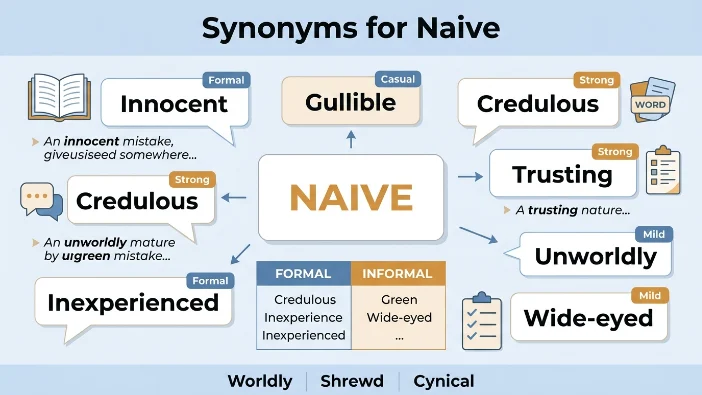
When you need another word for naive, the right choice depends on what you actually mean how innocent, how inexperienced, or how easily fooled someone is. The best synonyms for naive are innocent, gullible, unworldly, credulous, and inexperienced. Each word carries a slightly different shade of meaning, and picking the wrong one can shift your tone completely. This guide walks through all the major options, sorted by formality, strength, and context, so you always land on the word that fits.
Best Synonyms for Naive
The best synonyms for naive are innocent, gullible, credulous, unworldly, and inexperienced. The right choice depends on tone, context, and intensity. Use innocent when the focus is on purity or lack of wrongdoing. Use gullible when someone is easily fooled. Use credulous in formal writing. Use inexperienced when the emphasis is on lacking knowledge rather than lacking caution.
What Does Naive Mean?
Naive is an adjective that describes someone who lacks worldly experience, judgment, or the natural suspicion that comes from exposure to life’s harder realities. It often points to a kind of innocence sometimes endearing, sometimes risky.
A naive person tends to trust easily, accept things at face value, and miss the hidden motives or complications that a more experienced person would notice.
Part of speech: Adjective Common usage: Describing a person’s outlook, beliefs, or behavior
Example sentences:
- She gave a naive answer, not realizing the interviewer was testing her critical thinking.
- It was naive of him to think the contract had no hidden clauses.
The word comes from the French naïve, meaning natural or simple, and it entered English with that same dual quality sometimes positive (pure, fresh), sometimes negative (too trusting, easily misled).
Core Meaning of Naive
At its core, naive captures the idea of someone who hasn’t been shaped by enough experience to see the world clearly. It’s not about low intelligence naive people can be very smart. It’s about a gap between what they expect and how things actually work.
That gap can show up as:
- Trusting people or systems without question
- Believing good intentions are always behind others’ actions
- Missing social or professional cues that most people would catch
- Making decisions based on idealism rather than reality
The tone of naive floats between neutral and gently critical depending on context. Calling someone naive in a tender moment is different from calling them naive in an argument.
Grammar and Usage Notes
Part of speech: Adjective Also spelled: Naïve (with a diaeresis over the i, especially in British English)
Common sentence patterns:
- Subject + be + naive → She is naive about how the industry works.
- It + be + naive + infinitive → It was naive to assume everyone plays fair.
- Naive + noun → a naive assumption, a naive question, a naive approach
Common collocations:
- naive belief, naive optimism, naive question, naive view, naive assumption, naive approach, politically naive, dangerously naive
When naive sounds natural:
- Describing a beginner’s first take on a complex situation
- Talking about youthful or idealistic thinking
- Describing someone who underestimates risk or manipulation
When a synonym works better:
- If you want to sound more formal, swap naive for credulous or unworldly
- If the context is clearly about being fooled, gullible is more precise
- If the tone should be gentler, innocent or trusting fits better
Best Synonyms for Naive
| Synonym | Meaning | Tone | Best Use Case | Example Sentence |
|---|---|---|---|---|
| Innocent | Free from guilt or harmful knowledge | Warm, positive | Describing purity or childlike trust | She had an innocent faith in people that most adults had lost. |
| Gullible | Easily tricked or deceived | Slightly critical | Situations involving manipulation or scams | He was too gullible to question the salesperson’s claims. |
| Credulous | Quick to believe without evidence | Neutral to formal | Academic writing, persuasive analysis | The credulous audience accepted every statistic without question. |
| Unworldly | Unfamiliar with how the real world works | Gentle, thoughtful | Describing sheltered or idealistic people | Her unworldly outlook made city life a constant surprise. |
| Inexperienced | Lacking hands-on knowledge or exposure | Neutral | Professional or educational contexts | As an inexperienced negotiator, he agreed to unfair terms. |
| Trusting | Naturally inclined to believe others | Warm, positive | Emotional or personal contexts | She was a trusting soul who never expected betrayal. |
| Simple | Uncomplicated in thinking or manner | Neutral to dated | Describing plainness of mind | He gave a simple answer that missed the deeper issue. |
| Green | New, untrained, without experience | Informal | Workplace or casual conversation | The new hire was still green when it came to client management. |
| Unsophisticated | Lacking refinement or complex understanding | Neutral | Describing taste, judgment, or awareness | His unsophisticated view of politics surprised his colleagues. |
| Wide-eyed | Showing amazement or unrealistic optimism | Informal, vivid | Creative or descriptive writing | She arrived in the city with wide-eyed enthusiasm and no savings plan. |
Common Synonyms for Naive
These are the words you’ll reach for in everyday writing and conversation. They’re familiar, clear, and easy to understand.
Innocent Innocent overlaps with naive in the sense of purity and lack of cynicism, but it carries a more positive weight. Someone innocent isn’t just uninformed they’re clean of bad intent.
- Best context: Describing someone with genuine goodness, not just lack of experience
- Example: Her innocent take on the situation reminded everyone why they got into this work in the first place.
Trusting Trusting describes the behavior rather than the state. A trusting person chooses to believe it’s almost an active quality, sometimes a virtue, sometimes a weakness.
- Best context: Emotional relationships, personal stories
- Example: He was trusting by nature and rarely suspected people of lying.
Inexperienced This one focuses entirely on the lack of practice or exposure, without any judgment about character or intelligence.
- Best context: Jobs, learning situations, first-time events
- Example: The inexperienced driver wasn’t sure how to handle the merge lane.
Gullible Gullible is the most common everyday swap for naive when the situation involves being tricked. It has a slightly comic or critical edge.
- Best context: Describing someone who falls for tricks, scams, or jokes
- Example: Don’t tell him that story he’s gullible enough to believe it.
Formal Synonyms for Naive
Use these in academic papers, business reports, essays, and professional writing where plain language reads too casual.
Credulous Credulous means a tendency to believe claims without sufficient proof. It’s a precise academic word that sounds measured rather than dismissive.
- Best use: Analyzing audience behavior, media criticism, academic persuasion essays
- Example: A credulous readership rarely challenges the assumptions embedded in headlines.
Ingenuous Ingenuous describes someone who is openly honest, simple, and free from deceit sometimes so simple that they can’t imagine others being deceptive either.
- Best use: Literary analysis, formal character descriptions
- Example: The young diplomat’s ingenuous approach to negotiations left experienced envoys skeptical.
Unworldly Unworldly suggests someone disconnected from everyday practical realities, especially social or financial ones.
- Best use: Formal character analysis, literary criticism
- Example: Her unworldly perspective on wealth made her an unusual voice in the boardroom.
Unsophisticated This word describes a lack of complexity or refinement in thinking, taste, or judgment.
- Best use: Cultural criticism, formal analysis
- Example: The report was criticized for its unsophisticated approach to risk modeling.
Informal Synonyms for Naive
These work in conversation, text messages, social media, and casual writing where a natural voice matters more than precision.
Green Green is a relaxed, non-mean way to say someone is new and unformed. It’s common in workplaces and doesn’t carry much judgment.
- Tone: Casual, slightly affectionate
- Example: She’s still green, but she’s learning fast.
Wide-eyed Wide-eyed paints a picture someone looking at the world with wonder and no defenses.
- Tone: Vivid, slightly humorous
- Example: He moved to New York wide-eyed and convinced he’d make it in six months.
Wet behind the ears An idiom, but a useful one. It means someone is so new they haven’t even dried off yet.
- Tone: Playful, informal
- Example: She’s still wet behind the ears when it comes to managing a budget.
Starry-eyed Starry-eyed leans into the idealistic side of naive someone so dazzled by a dream that they can’t see practical problems.
- Tone: Informal, descriptive
- Example: He walked into his first job interview starry-eyed and completely unprepared.
Strong Synonyms for Naive
These carry more force. Use them when you want to emphasize vulnerability to deception or the danger of someone’s outlook.
Gullible At the strong end of the naive spectrum, gullible implies not just innocence but active susceptibility to being fooled. It’s direct and can sting.
- When to use: When someone is genuinely being taken advantage of
- When it’s too strong: If the person is simply new or idealistic without being deceived
Credulous (strong in formal writing) In academic contexts, calling someone credulous is a serious critique of their reasoning.
Susceptible Susceptible means open to influence or harm. It doesn’t always mean naive by itself, but in the right context, it captures the dangerous openness that naive implies.
- Example: Young investors can be susceptible to overconfident financial advice.
Exploitable This is the sharpest word in this space. It goes beyond describing a quality and implies real risk of harm. Use carefully.
- Example: The vague contract left the freelancer in an exploitable position.
Mild Synonyms for Naive
These are gentler options, useful when you want to describe innocence or limited experience without any critical edge.
Trusting As mentioned earlier, trusting can be a pure positive. It implies openness and warmth, not foolishness.
Simple In its mildest sense, simple describes someone who doesn’t complicate things genuine, straightforward, unguarded.
Open Open-hearted or simply open describes a person who hasn’t closed themselves off from the world. It’s barely critical at all.
- Example: Her open nature made her easy to talk to.
Fresh Fresh suggests newness without any negative judgment someone who hasn’t been worn down by experience yet.
- Example: The fresh perspective of a new employee is often more useful than you’d expect.
Synonyms for Naive by Context
Everyday Conversation
In casual talk, gullible, green, and trusting do most of the heavy lifting. They’re easy to understand and don’t sound stiff.
- “Don’t worry, she’s just a bit green she’ll figure it out.”
- “He’s way too trusting when it comes to strangers online.”
Professional Writing
Stick to inexperienced, unsophisticated, or credulous. These words carry weight without sounding dismissive.
- “The committee’s credulous acceptance of the initial projections led to a budget shortfall.”
Academic Writing
Credulous, ingenuous, and unworldly fit well here. They’re precise and carry the right level of formality.
- “The ingenuous assumptions embedded in the study undermine its conclusions.”
Creative Writing
Go descriptive wide-eyed, starry-eyed, innocent, and fresh give vivid texture to characters.
- “She was wide-eyed and recklessly hopeful, the way only a nineteen-year-old can be.”
Personal Communication
When talking to or about someone you care about, innocent, trusting, and fresh are kinder choices that honor the person’s goodness without calling them foolish.
Another Word for Naive in a Sentence
Here are 14 natural example sentences using different synonyms for naive:
- He was innocent enough to believe that the landlord would fix the heating without being asked.
- She felt gullible after falling for the same excuse twice.
- The young activist’s idealistic outlook inspired others even when it frustrated them.
- Everyone on the team was a little green at first that’s just how it goes.
- His credulous acceptance of unverified data weakened the entire argument.
- She was too trusting in professional settings, which people sometimes took advantage of.
- The ingenuous quality of his writing made it stand out among more calculated essays.
- Moving abroad was a shock for someone so unworldly about how different daily life could be.
- As a wide-eyed freshman, she had no idea how competitive the program would turn out to be.
- His unsophisticated view of the market led him to underestimate the risks.
- She was inexperienced with conflict and tended to avoid it rather than address it.
- The starry-eyed couple hadn’t thought through the actual cost of their plan.
- It was a bit simple of him to assume the other party had no agenda.
- The new recruit was wet behind the ears but eager to learn every process from scratch.
Naive Synonyms Compared
Some of the closest synonyms share a lot of territory but differ in key ways.
| Word | Focus | Tone | Intensity | Best Use |
|---|---|---|---|---|
| Naive | General lack of worldly experience | Neutral to mild criticism | Moderate | Most general contexts |
| Innocent | Purity, lack of harmful intent | Warm, positive | Low | When goodness is the main idea |
| Gullible | Susceptibility to being tricked | Critical | High | When deception is involved |
| Credulous | Tendency to believe without proof | Formal, analytical | Moderate to high | Academic, professional writing |
| Trusting | Openness to belief in others | Warm | Low | Emotional or personal contexts |
| Ingenuous | Honest simplicity, no guile | Formal, literary | Low | Literary or formal analysis |
| Green | New to something, untrained | Informal | Low | Casual workplace or life situations |
| Unworldly | Disconnected from practical reality | Thoughtful | Moderate | Describing sheltered worldviews |
The most common mix-up is treating gullible and naive as identical. They’re close but not the same naive is about general inexperience, while gullible specifically describes being easy to deceive. You can be naive without being gullible, and a seasoned but trusting person might be gullible without being naive.
Words Similar to Naive
These words belong to the same area of meaning but don’t always swap in directly for naive.
Idealistic Idealistic describes someone who holds high principles or unrealistic expectations about how things should be. It’s related to naive because both involve a gap between expectation and reality but idealism is often a conscious value system, not just inexperience.
- Why it’s related: Both describe a disconnect from harsh realities
- Why it differs: Idealistic implies belief in a better world; naive implies lack of knowledge about this one
Optimistic Optimism isn’t a flaw it’s a general positive outlook. It only edges toward naive when optimism ignores real evidence.
- Use carefully: Calling someone optimistic is usually a compliment; naive is more mixed
Sheltered Sheltered describes someone who was protected from difficult experiences, usually in childhood. It explains why someone is naive but isn’t quite the same thing.
- Example: Growing up sheltered, he found adult professional life deeply disorienting.
Childlike Childlike captures the innocence and wonder that naive sometimes implies, but it’s warmer and more positive. It’s never quite as critical as calling someone naive.
Impressionable Impressionable describes someone easily influenced by others a close cousin to naive, but more about the effect of outside forces than internal inexperience.
Antonyms of Naive
| Antonym | Meaning | Example Sentence |
|---|---|---|
| Worldly | Experienced with how the world works | Her worldly perspective helped the team avoid a common trap. |
| Cynical | Distrustful of others’ motives | He was too cynical to take the offer at face value. |
| Shrewd | Sharp, practical, hard to fool | A shrewd negotiator, she caught the misleading clause immediately. |
| Sophisticated | Refined in judgment and awareness | His sophisticated understanding of finance impressed the investors. |
| Skeptical | Questioning, not easily convinced | She remained skeptical even after three rounds of reassurance. |
| Experienced | Knowledgeable through past events | An experienced traveler knows never to flash cash in a crowd. |
| Astute | Quick to understand and assess | An astute observer, he spotted the inconsistency right away. |
| Savvy | Street-smart, practically aware | She was socially savvy and knew exactly how the room felt. |
How to Choose the Right Synonym for Naive
Match the context first. Ask: is this about inexperience, gullibility, idealism, or innocence? Each calls for a different word.
Check the tone. Gullible and credulous are more critical. Innocent and trusting are warmer. Green and wet behind the ears are light and casual.
Think about intensity. If you want to gently note someone’s limited experience, green or fresh is kinder than gullible. If the situation involves real manipulation, gullible or susceptible is more honest.
Know your reader. A formal report needs credulous or ingenuous, not wide-eyed or starry-eyed.
Test the sentence. Drop your chosen synonym in and read it aloud. If it sounds forced or off-key, try another. The goal is always natural, clear writing.
Don’t treat related words as exact synonyms. Idealistic and optimistic share ground with naive but aren’t interchangeable in all sentences.
Common Mistakes When Using Synonyms for Naive
Using gullible when you mean naive. Gullible specifically means someone can be fooled. If no deception is involved, naive or inexperienced fits better.
Using credulous in casual conversation. It will sound stiff and out of place. Save it for formal or academic writing.
Choosing simple carelessly. In older usage, simple was a near-insult. In modern US English, it can still read as condescending. Be deliberate.
Replacing naive with innocent when the context involves foolishness. Innocent focuses on goodness, not lack of wisdom. The words aren’t always swappable.
Piling on intensity by accident. Calling someone “dangerously gullible” or “hopelessly credulous” in a professional context can read as harsh or judgmental when your intent is descriptive.
Ignoring formality levels. Starry-eyed or wet behind the ears look wrong in a business report. Credulous and ingenuous look stiff in a personal blog post.
Treating all synonyms as gender-neutral equivalents. Some of these words carry historical baggage (like simple or ingenuous) that can read differently depending on who’s being described. Be aware of that when writing about people.
Quick Synonym List for Naive
Common synonyms: innocent, trusting, gullible, inexperienced, unsophisticated
Formal synonyms: credulous, ingenuous, unworldly, unsophisticated
Informal synonyms: green, wide-eyed, starry-eyed, wet behind the ears, fresh
Strong synonyms: gullible, credulous, susceptible, exploitable
Mild synonyms: trusting, innocent, open, fresh, simple
Related words (not exact synonyms): idealistic, optimistic, sheltered, childlike, impressionable
FAQs
What is the best synonym for naive?
The best synonym for naive depends on the situation. Innocent works when the focus is on purity and goodness. Gullible fits when someone is being deceived. Credulous is better in formal writing. For everyday use, inexperienced or trusting are safe, clear choices.
What is another word for naive?
Some of the most common alternatives include innocent, gullible, credulous, unworldly, trusting, inexperienced, green, and wide-eyed. Each one carries a different shade of meaning, so the best pick depends on context.
What is a formal synonym for naive?
The most common formal synonyms for naive are credulous (easily believing without evidence), ingenuous (openly simple and guileless), and unworldly (disconnected from practical experience). These work well in academic papers, reports, and professional writing.
What is an informal synonym for naive?
Green, wide-eyed, starry-eyed, and wet behind the ears are the most common casual alternatives. They’re conversational, easy to understand, and rarely sound harsh.
What is a stronger word for naive?
Gullible is the strongest everyday alternative it implies someone is actively easy to fool. In formal contexts, credulous carries a similar weight. Susceptible is strong when the emphasis is on vulnerability to harm or influence.
What is a milder word for naive?
Trusting, innocent, open, and fresh are all gentler alternatives that describe similar qualities without the critical edge. Use them when you want to honor the positive side of someone’s openness.
What words are similar to naive but not exact synonyms?
Idealistic, optimistic, sheltered, impressionable, and childlike all share ground with naive but point to slightly different things. They can work in the right context but shouldn’t be used interchangeably with naive without checking whether the meaning holds.
What is the opposite of naive?
Common antonyms include worldly, cynical, shrewd, sophisticated, skeptical, astute, and savvy. These all describe people who understand the world clearly and aren’t easily misled.
Conclusion
Naive is one of those words that carries more nuance than it first appears. It can describe someone dangerously easy to fool, or someone refreshingly untouched by the world’s harder edges and the difference matters when you’re choosing a synonym.
For formal writing, reach for credulous or ingenuous. For casual conversation, green, trusting, or gullible cover most situations. When you want warmth, innocent or fresh carry the feeling without the criticism. When precision matters, inexperienced is cleanly descriptive and rarely misread.
Whatever the context, the right synonym for naive is the one that fits the tone, the situation, and the reader not just the dictionary definition. Take a moment to think about what you’re actually trying to say, and the right word will follow.
Read More Related Articles:
- Synonyms for Thoughts | Enhance Clarity and Expression In Your Writing In 2026
- Synonyms for Trapped | Every English Learner and Writer Should Know In 2026
- Synonyms for Loving | Nuances, Examples, and Word Choice Tips In 2026

Evelyn Turner is a content creator at SynonymsAura.com who enjoys exploring the richness of the English language. Her work focuses on word meanings, synonyms, expressions and everyday language usage, helping readers communicate with greater clarity and confidence.