When you call something detrimental, you’re saying it causes harm or damage. But depending on your audience and purpose, a different word might work better. The best synonyms for detrimental are harmful, damaging, adverse, and injurious. Your choice depends on tone, context, and how strong you want the word to be. This guide covers everything from formal and informal alternatives to stronger and milder options, with real examples to help you choose wisely.
Best Synonyms for Detrimental
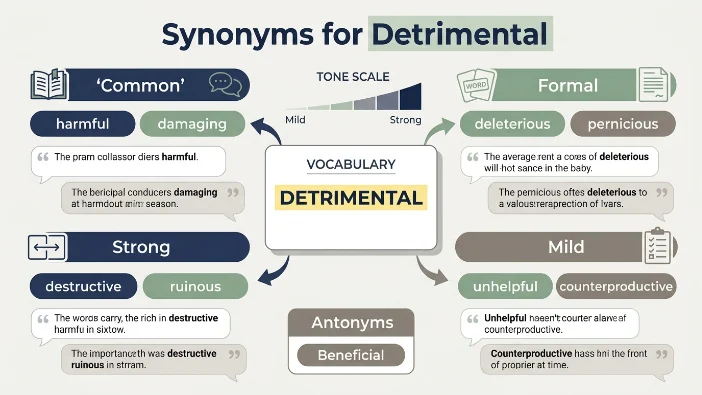
The best synonyms for detrimental are harmful, damaging, adverse, and injurious. For a more formal tone, use deleterious or pernicious. For a stronger effect, try destructive or ruinous. The right choice depends on whether you’re writing for business, academics, or casual conversation and how severe the harm is.
What Does Detrimental Mean?
Detrimental is an adjective that means causing harm, damage, or injury to someone or something. When something is detrimental, it makes a situation worse or produces negative results .
The word comes from the noun “detriment,” which means loss, damage, or injury. It’s a formal way of describing things that hurt, hinder, or put a damper on something .
Simple examples:
Core Meaning of Detrimental
At its heart, “detrimental” describes anything that does damage or causes problems. It’s not about minor inconveniences it’s about real harm. When you call something detrimental, you’re saying it has a noticeable, negative effect.
The word carries a formal tone. It appears often in health warnings, policy discussions, environmental reports, and academic writing . You probably wouldn’t use it to describe a bad haircut or a disappointing meal that would be too strong. Instead, it fits situations where the consequences matter.
Think of detrimental as sitting in the middle of the “harm” spectrum. It’s more formal than “bad,” more specific than “negative,” and stronger than “unhelpful.”
Grammar and Usage Notes
Part of Speech
- Adjective: “The decision was detrimental.”
- Often followed by “to”: “Stress is detrimental to your health.”
Common Sentence Patterns
- Something is detrimental to someone or something
- Something has a detrimental effect on someone or something
- Something proves detrimental to someone or something
Common Collocations
When Detrimental Sounds Natural
Use it when you need a formal, serious tone. It fits health warnings, business reports, academic papers, and policy discussions. If you’re writing for a professional audience or discussing serious issues, “detrimental” works well.
When a Synonym May Work Better
If you’re writing casually, “detrimental” can sound stiff or overly formal. “Bad,” “harmful,” or “damaging” are usually clearer and more natural. If the harm is mild, a softer word like “unhelpful” or “counterproductive” might fit better .
Best Synonyms for Detrimental
Common Synonyms for Detrimental
Harmful
The most direct, everyday synonym. It’s versatile and works in almost any context where something causes damage or injury.
Best context: General writing, health advice, everyday conversation.
Example: “Excessive alcohol consumption is harmful to your liver.”
Damaging
More concrete than “harmful.” It suggests specific, observable damage rather than general harm.
Best context: When you can see or measure the damage clearly.
Example: “The gossip was damaging to her reputation.”
Injurious
A formal synonym that often appears in medical or legal contexts. It suggests physical or legal harm.
Best context: Medical writing, safety warnings, legal documents.
Example: “The factory emissions were injurious to nearby residents.”
Adverse
Describes something that works against success or well-being. It often describes conditions, reactions, or effects.
Best context: Business, medicine, policy, and academic writing.
Example: “The medication had no adverse effects.”
Negative
A broad, common word that describes bad outcomes. It’s less specific than “detrimental” but widely understood.
Best context: General writing, business, daily conversation.
Example: “The restructuring had negative consequences for employees.”
Unfavorable
Describes conditions, opinions, or outcomes that are not helpful or positive.
Best context: Reviews, weather, business conditions, decisions.
Example: “The weather forecast is unfavorable for the outdoor event.”
Formal Synonyms for Detrimental
Deleterious
A highly formal word meaning harmful, often in subtle or unexpected ways. It appears in scientific and academic writing .
Example: “The deleterious effects of plastic waste on ocean ecosystems are well documented.”
Pernicious
This word suggests harm that is gradual, often unnoticed, and causes lasting damage. It’s used for social, moral, or systemic issues .
Example: “The pernicious influence of misinformation on democratic processes.”
Prejudicial
Legal and formal. It means causing prejudice or harming someone’s rights, reputation, or legal position .
Example: “The judge ruled the evidence was prejudicial to the defendant.”
Disadvantageous
Formal and business-friendly. It means creating a disadvantage or unfavorable position .
Example: “The company chose to avoid a disadvantageous merger.
Inimical
A rare, formal word meaning hostile or harmful, often to a particular interest or goal .
Example: “The new regulations were inimical to economic growth.”
Baneful
A literary and old-fashioned word meaning harmful or destructive, often suggesting poisoning or ruin .
Example: “The baneful effects of unchecked greed on society.”
When to use formal synonyms: Academic papers, legal documents, professional reports, scientific writing, policy briefs, and formal speeches. These words add precision and authority but can sound unnatural in everyday conversation.
Informal Synonyms for Detrimental
Bad
The simplest, most common word. It covers almost any negative situation but lacks precision.
Example: “Skipping breakfast is bad for your energy levels.”
Not Good
A softer, vaguer alternative to “bad.” It’s polite but not very specific.
Example: “Eating too much sugar is not good for your teeth.”
Counterproductive
Common in workplace and self-help contexts. It means something that works against the intended goal rather than helping .
Example: “Yelling at employees is counterproductive it lowers morale.”
Unhelpful
A mild and polite way to say something doesn’t help. It’s much softer than “detrimental.”
Example: “His advice was unhelpful and confusing.”
When to use informal synonyms: Everyday conversation, emails to friends, social media, personal messages, and casual blog posts. Use them when you want clarity and naturalness over formality.
Strong Synonyms for Detrimental
Destructive
A strong word meaning causing major physical or systemic damage. It implies serious, often irreversible harm.
Example: “The destructive power of the wildfire left nothing standing.”
Ruinous
This word means causing total destruction or financial collapse. It’s strong and dramatic.
Example: “The reckless investment strategy proved ruinous for the company.”
Noxious
Strong and often describes harmful substances or influences .
Example: “Noxious fumes from the factory sickened nearby residents.”
Calamitous
A dramatic word meaning causing disaster or great harm.
Example: “The calamitous decision led to a global recession.”
Deadly or Fatal
Strong words meaning causing death or complete failure. Use them only when literal or metaphorical death is involved .
Example: “The virus was deadly to the old population.”
When to use strong synonyms: When the harm is severe, when you need to emphasize urgency, or when a milder word would understate the seriousness. Be careful not to overuse them strong words lose impact if you use them for minor problems.
Mild Synonyms for Detrimental
Unhelpful
A mild, polite word that simply means not useful or not contributing.
Example: “The classroom layout was unhelpful for group work.”
Undesirable
A formal but not intense word meaning not wanted or not beneficial .
Example: “The arrangement had some undesirable side effects.”
Counterproductive
Mild but specific. It means something that wastes effort or works against your goal .
Example: “Micromanaging is counterproductive it makes people feel distrusted.”
Less Than Ideal
A polite, indirect way to say something isn’t good. It’s very mild and diplomatic.
Example: “The working conditions were less than ideal.”
When to use mild synonyms: When the harm is minor, when you need to be diplomatic, when you’re giving gentle feedback, or when a strong word would sound aggressive or alarmist.
Synonyms for Detrimental by Context
Everyday Conversation
For daily talk, stick with simple, common words: bad, harmful, damaging. These are clear and sound natural. Save the formal words for written contexts.
Example: “Staying up late all the time is harmful to your health.”
Professional Writing
In business and workplace writing, choose: adverse, disadvantageous, unfavorable, counterproductive. These sound professional and precise without being overly academic.
Example: “The merger would be disadvantageous to our current employees.”
Academic Writing
Use formal, precise words: deleterious, pernicious, injurious, inimical. These are common in scholarly journals and research papers.
Example: “The study examines the deleterious effects of microplastics on coral reef systems.”
Creative Writing
Choose evocative words that create emotion: destructive, ruinous, baleful, noxious. These add drama and vividness to creative works.
Example: “The baleful storm swept across the village, leaving ruin in its wake.”
Marketing Copy
For persuasive writing, use strong but believable words: damaging, harmful, counterproductive. Be careful not to exaggerate.
Example: “Ignoring customer feedback is counterproductive to building trust.”
Emotional Expression
When expressing strong feelings, choose words that match the intensity: destructive, hurtful, ruinous.
Example: “The cruel gossip was destructive to her self-esteem.”
Technical Writing
Scientific and technical writing demands precision: deleterious, adverse, injurious.
Example: “The chemical compound has no adverse effects on patient test results.”
Personal Communication
For personal messages, use clear, honest words: bad, harmful, damaging or the milder unhelpful, counterproductive.
Example: “Leaving things unsaid was damaging to our relationship.”
Another Word for Detrimental in a Sentence
Here are 15 natural examples using different synonyms for “detrimental.
- Harmful: “Excessive stress is harmful to your heart health.”
- Damaging: “The scandal was damaging to his political career.”
- Adverse: “The medication caused no adverse reactions in patients.”
- Injurious: “The workplace conditions were injurious to workers’ lungs.”
- Deleterious: “Excessive screen time has a deleterious effect on children’s sleep cycles.”
- Pernicious: “The pernicious belief that talent is fixed limits student potential.”
- Destructive: “Destructive criticism erodes an employee’s confidence.”
- Disadvantageous: “The timing of the announcement was disadvantageous for investors.”
- Unfavorable: “Unfavorable market conditions forced us to delay the launch.”
- Noxious: “Noxious fumes from the factory caused respiratory problems.”
- Ruinous: “The company’s ruinous spending habits led to bankruptcy.”
- Bad: “Eating processed food every day is bad for your skin.”
- Counterproductive: “Staying up all night to study is counterproductive you’ll forget more.”
- Unhelpful: “Blaming others is unhelpful when we need solutions.”
- Prejudicial: “The leaked information was prejudicial to the ongoing investigation.”
Detrimental Synonyms Compared
While many synonyms for “detrimental” mean “harmful,” subtle differences affect which word you should choose.
Harmful vs. Damaging
“Harmful” is broader it describes anything that can cause harm. “Damaging” is more concrete and suggests specific, observable damage. Something can be harmful without being immediately damaging, but damaging things are clearly harmful.
Adverse vs. Deleterious
“Adverse” describes conditions or effects that work against success it’s about opposition. “Deleterious” is more specific to slow, gradual harm, especially in scientific contexts. Adverse effects can be obvious; deleterious effects often take time to notice .
Pernicious vs. Destructive
“Pernicious” suggests harm that happens gradually, often in a hidden way, and causes lasting damage to systems or beliefs. “Destructive” is more physical and immediate think of a hurricane versus a toxic ideology .
Bad vs. Detrimental
“Bad” is the general, informal catch-all. “Detrimental” is more formal and specific. Use “bad” for everyday speech; use “detrimental” when you need a serious, formal tone.
| Synonym Pair | Difference | Best Choice |
|---|---|---|
| Harmful vs. Damaging | Harmful is broader; damaging implies visible damage | Use damaging for visible harm; harmful for general risk |
| Adverse vs. Deleterious | Adverse means opposing; deleterious means slowly harmful | Use adverse for conditions; deleterious for subtle biological harm |
| Pernicious vs. Destructive | Pernicious is insidious; destructive is violent | Use pernicious for ideas; destructive for physical force |
| Bad vs. Detrimental | Bad is general and informal; detrimental is formal | Use bad in conversation; detrimental in formal writing |
Words Similar to Detrimental
These words are related to “detrimental” but are not always exact synonyms. Understand the differences so you don’t misuse them.
Counterproductive
This means something that works against an intended goal. It’s harmful to success but not necessarily harmful to health or well-being. Many overuse “detrimental” when “counterproductive” is more accurate.
Example: “Micromanaging is counterproductive it slows everything down.” (Not “detrimental,” unless it’s causing serious psychological harm.)
Negative
A broad word that means undesirable or bad. “Negative” covers everything from emotions to numbers. It’s not always specific enough to replace “detrimental.”
Example: “The negative feedback was hard to hear.” (This is about opinion, not harm.)
Unhealthy
Specifically related to health or well-being. It’s a close synonym in health contexts but doesn’t fit non-health harm.
Example: “Smoking is unhealthy.” (Use “detrimental” if you want a more formal tone.)
Dangerous
This suggests risk or potential harm, while “detrimental” suggests actual harm. Something can be dangerous without being detrimental if the danger doesn’t materialize.
Example: “The procedure is dangerous but not necessarily detrimental if done carefully.”
Toxic
Often used for harmful substances or harmful environments. It’s stronger and more specific than “detrimental.”
Example: “The toxic work environment caused employee burnout.”
Antonyms of Detrimental
Beneficial
Producing good effects or helpful results.
Example: “Daily exercise is beneficial to your overall health.”
Helpful
Providing aid or assistance.
Example: “Her advice was helpful during the difficult project.”
Advantageous
Creating an advantage or favorable position.
Example: “The new location was advantageous for business growth.”
Favorable
Showing approval or creating good conditions.
Example: “Favorable weather conditions made the harvest successful.”
Harmless
Causing no harm or injury.
Example: “The spider was harmless despite its scary appearance.”
Safe
Not likely to cause harm or injury.
Example: “The playground equipment is safe for young children.”
How to Choose the Right Synonym for Detrimental
1. Match the context.
Formal writing calls for “deleterious,” “adverse,” or “prejudicial.” Everyday conversation works better with “harmful” or “bad.”
2. Match the tone.
If you want to sound polite or diplomatic, choose mild words like “unhelpful” or “counterproductive.” If you need to emphasize seriousness, use strong words like “destructive” or “ruinous.”
3. Check the intensity.
Ask yourself: How bad is the harm? Is it severe and obvious? Use “destructive.” Is it subtle and gradual? Try “deleterious” or “pernicious.” Is it just a minor inconvenience? Use a mild synonym.
4. Think about the reader.
If you’re writing for a general audience, simple words like “harmful” are best. For specialists, you can use formal terms.
5. Consider the type of harm.
Physical harm: “injurious,” “damaging.”
Reputational harm: “damaging,” “prejudicial.”
Systemic harm: “pernicious,” “deleterious.”
Strategic harm: “adverse,” “disadvantageous.”
6. Keep the sentence natural.
Read the sentence aloud with your chosen synonym. If it sounds forced or awkward, try a simpler word.
7. Use simple words when clarity matters.
When the main goal is understanding, “harmful” or “bad” are usually better than formal alternatives.
Common Mistakes When Using Synonyms for Detrimental
- Choosing a word with the wrong tone.
Using “deleterious” in an email to a friend sounds stiff and unnatural. Using “bad” in an academic paper sounds too casual. - Using a synonym that is too strong.
Calling a small inconvenience “ruinous” sounds exaggerated and weakens your credibility. - Using a formal word in casual writing.
“Deleterious,” “pernicious,” and “inimical” are great in papers but out of place in everyday speech. - Using a casual word in professional writing.
“Bad” is too vague for a business report. “Adverse” or “disadvantageous” would be more precise. - Replacing “detrimental” without checking meaning.
Not every negative word means “causes harm.” “Negative” can describe emotions or opinions. “Unhealthy” is only for health-related harm. Always check that the synonym fits your exact meaning. - Treating related words as exact synonyms.
“Counterproductive” means it works against a goal it doesn’t necessarily cause harm. “Dangerous” means risky, but the risk might not materialize. Understanding these distinctions avoids misuse. - Making the sentence sound unnatural.
Sometimes the simplest word is best. Don’t force formal synonyms into sentences where they don’t belong.
Quick Synonym List for Detrimental
Common Synonyms
- Harmful
- Damaging
- Injurious
- Negative
- Hurtful
Formal Synonyms
- Deleterious
- Pernicious
- Prejudicial
- Disadvantageous
- Inimical
- Baneful
Informal Synonyms
- Bad
- Not good
- Counterproductive
- Unhelpful
Strong Synonyms
- Destructive
- Ruinous
- Noxious
- Calamitous
- Deadly
- Fatal
Mild Synonyms
- Unhelpful
- Undesirable
- Counterproductive
- Less than ideal
Related Words
- Unhealthy
- Dangerous
- Toxic
- Unfavorable
- Adverse
FAQs
What is the best synonym for detrimental?
The best all-purpose synonym is harmful. It’s clear, common, and works in almost every situation. For formal writing, use adverse or deleterious.
What is another word for detrimental?
Common alternatives include harmful, damaging, injurious, adverse, and unfavorable. The best choice depends on your context and tone.
What is a formal synonym for detrimental?
Deleterious, pernicious, prejudicial, and inimical are formal synonyms. Use them in academic, legal, or scientific writing.
What is an informal synonym for detrimental?
Bad, not good, counterproductive, and unhelpful work well in casual conversation and informal writing.
What is a stronger word for detrimental?
For stronger emphasis, use destructive, ruinous, noxious, or calamitous. These words suggest severe, often irreversible harm.
What is a milder word for detrimental?
Unhelpful, undesirable, counterproductive, and less than ideal are milder alternatives.
What words are similar to detrimental?
Counterproductive, negative, unhealthy, dangerous, and toxic are related but not always exact synonyms. They share the idea of something undesirable or harmful but differ in intensity and specificity.
What is the opposite of detrimental?
Common antonyms include beneficial, helpful, advantageous, favorable, harmless, and safe.
How do I choose the right synonym for detrimental?
Consider your audience, context, tone, and the severity of the harm.
- For formal writing, choose formal synonyms.
- For everyday speech, use simpler words like “harmful.”
- For mild harm, choose mild alternatives like “unhelpful.”
Conclusion
Finding the right synonym for “detrimental” comes down to understanding your audience and the harm you’re describing. For most writing, “harmful” or “damaging” work just fine. When formality matters, turn to “deleterious” or “adverse.” To emphasize severity, use “destructive” or “ruinous.” For gentle criticism, “unhelpful” or “counterproductive” are better choices.
Keep your sentences natural, match the tone to the situation, and never force a formal word into casual writing or a casual word into a professional setting. The best synonym isn’t always the most impressive one; it’s the one that fits your context and helps your reader understand your meaning.
Read More Related Articles:
- Synonyms for Embarrassed | Smarter Word Choices for Every Context In 2026
- Synonyms For Felt | Make Your Writing More Descriptive In 2026
- Synonyms for Stress | Meaning, Examples, and Better Word Choices In 2026

Ethan Caldwell is a writer who enjoys exploring the nuances of language and how words shape everyday communication. His work focuses on making complex ideas easier to understand through clear, engaging and accessible writing.