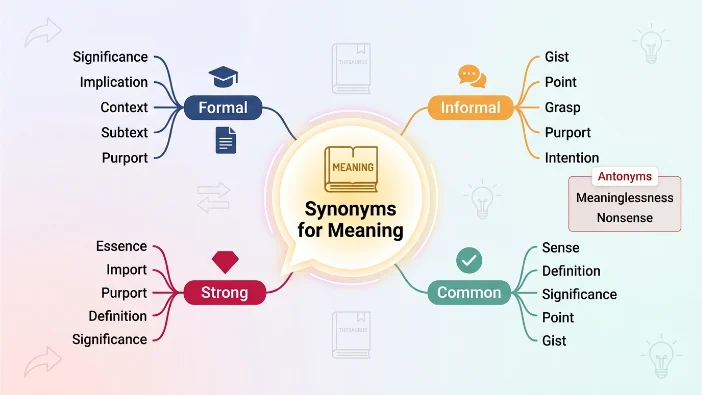
What is another word for “meaning”? The most common synonyms for meaning are significance, sense, definition, and import. However, the best alternative depends on whether you are talking about the definition of a word, the purpose of an action, or the deeper significance of an event. This guide will help you choose the right word by exploring over 30 synonyms for “meaning,” categorized by formality, intensity, and context.
Best Synonyms for Meaning
The best synonyms for meaning are significance, sense, definition, import, and gist. The right choice depends on tone, context, and intensity. For casual conversation, “gist” or “point” works well. For academic writing, “significance” or “implication” is more appropriate. For a stronger emphasis on worth, “importance” is a strong synonym.
What Does Meaning Mean?
At its core, “meaning” refers to the idea or concept that a word, action, symbol, or situation represents. It is the underlying message or purpose. It answers the question, “What is the point?” or “What does this stand for?”
For example:
- The meaning of the word is clear in this sentence.
- “She is searching for the meaning of life.”
Core Meaning of Meaning
The central idea behind “meaning” is the relationship between a signifier (a word, gesture, or symbol) and what it signifies (the idea or feeling it represents). It is the essence of something, the core message that can be derived from a communication or an event. It can be a literal translation (the denotation) or a deeper, more personal understanding (the connotation). “Meaning” is the thread that connects the surface of an action or word to its deeper purpose.
Grammar and Usage Notes
- Part of Speech: Meaning is primarily a noun (e.g., “The meaning is clear.”) but can also function as an adjective (“It was a meaningful experience”) or a verb in its present participle form (“What are you meaning to say?”).
- Common Sentence Patterns:
- “The [word/action/situation] holds meaning.”
- “What is the meaning of [X]?”
- “The meaning behind [Y] is [Z].”
- Common Phrases: “search for meaning,” “true meaning,” “deeper meaning,” “meaning of life,” “take [something] to mean.”
- When to Use: The word “meaning” is incredibly versatile and appropriate in almost any context. Its replacement depends on how specific you want to be.
- When a Synonym Works Better: Sometimes, “meaning” can feel vague. If you’re trying to be precise, choose a synonym like definition (for a strict explanation), significance (for importance), or gist (for the general idea).
Best Synonyms for Meaning
The table below provides a quick overview of the most effective synonyms for “meaning,” categorized by their tone and best use case.
| Synonym | Meaning | Tone | Best Use Case | Example Sentence |
|---|---|---|---|---|
| Significance | The quality of being important or noteworthy. | Formal | Academic writing, reports, discussing impact. | The discovery holds great significance for modern medicine. |
| Sense | The clear, logical, or intended meaning. | Neutral | Explaining understanding, clarifying a point. | The sense of his remark was not lost on the audience. |
| Definition | The exact statement of a word’s meaning. | Neutral | Technical writing, dictionaries, clarifying terms. | The dictionary gives a clear definition of the term. |
| Import | The quality of being significant or important. | Formal | Formal speeches, historical analysis. | The import of her message was that we must act now. |
| Gist | The main or essential part of a matter. | Informal | Everyday conversation, summarizing a story or point. | I can’t remember every detail, but I got the gist of what he said. |
Common Synonyms for Meaning
These are the everyday alternatives you can use in normal writing and conversation.
- Sense
- Meaning: The logical, practical, or intended idea.
- Best Context: When you want to explain that something is understandable or logical. “That makes sense.”
- Example: “The sense of the poem is quite straightforward once you read it a second time.”
- Definition
- Meaning: A formal and exact statement of what a word or concept represents.
- Best Context: When you are being literal or technical and need a precise explanation.
- Example: “We started the class by writing down the definition of each new term.”
- Content
- Meaning: The substance or material of a piece of writing or speech, as opposed to its form.
- Best Context: Used when referring to what is actually said or written, not the feeling around it.
- Example: “The content of his speech was powerful, though his delivery was a bit dull.”
Formal Synonyms for Meaning
For academic writing, business reports, and professional communication, these synonyms provide a more elevated and precise vocabulary.
- Significance
- Best Context: This is the go-to formal synonym for highlighting the importance, value, or far-reaching consequences of an event, idea, or discovery.
- Example: “The board of directors failed to grasp the full significance of the market shift.”
- Import
- Best Context: Very similar to “significance,” but it often emphasizes the gravity or seriousness of the matter.
- Example: “The CEO’s closing statement carried the weight and import of a final decree.”
- Implication
- Best Context: Use this when you are discussing the meaning that is suggested or inferred but not directly stated. It refers to the logical consequences of an action or idea.
- Example: “We need to consider the long-term financial implications of this merger.”
- Denotation
- Best Context: This is the technical term for the literal, dictionary definition of a word, as opposed to its associated feelings (connotation). Perfect for linguistic or academic contexts.
- Example: “Although they are often confused, the denotation of ‘home’ is simply a place of residence.”
Informal Synonyms for Meaning
In casual conversation, friendly writing, or on social media, these synonyms are more natural and relaxed.
- Gist
- Best Context: The perfect word for the main idea of a conversation, text, or story when you don’t want to get bogged down in details.
- Example: “I missed the start of the movie, but I quickly caught the gist of the plot.”
- Point
- Best Context: Use this when asking for the purpose or most important part of an argument or statement.
- Example: “That’s a great observation, but you’re missing my point.”
- Drift
- Best Context: Similar to “gist,” it suggests understanding the general direction or flow of a conversation.
- Example: “I didn’t catch every word she said, but I got her drift.
- Kernel
- Best Context: Used figuratively to mean the small, but essential, core idea at the heart of a larger matter.
- Example: “The kernel of his argument is that we need more funding.”
Strong Synonyms for Meaning
These words carry extra weight, emphasizing the profound importance, seriousness, or emotional depth of the “meaning.”
- Momentousness
- Best Context: Use this when the meaning or importance of something is so great that it will cause a historical shift or have a huge impact.
- Example: “The president’s speech was a moment of great momentousness for the nation.”
- Substance
- Best Context: This suggests that something has real, solid, and important meaning, as opposed to being empty or shallow.
- Example: “His writing lacks substance; it’s all style with no real meaning.”
- Magnitude
- Best Context: While often used for size, it is also a powerful synonym for the great significance or importance of a situation.
- Example: “We are only just beginning to comprehend the magnitude of the problem.”
Mild Synonyms for Meaning
For times when you want to soften the impact, these neutral or gentle alternatives work best.
- Sense
- Best Context: A safe and neutral way to refer to the meaning or logic of something without adding emotional weight.
- Example: “There is a sense of peace in this room.”
- Relevance
- Best Context: When the meaning is more about how something connects to or is important for a specific situation.
- Example: “His comments have no relevance to the current discussion.”
- Purport
- Best Context: To describe the intended or apparent meaning, often of a document or message, without committing to it being true.
- Example: “The purport of the memo is to streamline the process.”
Synonyms for Meaning by Context
The best synonym depends heavily on where and how you are using it.
Everyday Conversation
When talking with friends, stick with gist, point, or sense. These keep the flow natural and avoid sounding stiff.
Professional Writing
In emails, reports, and meetings, use significance and implication. These words demonstrate professional understanding and foresight.
Academic Writing
Academic papers require precision. Use denotation (for literal meaning), significance (for importance), and implication (for consequences).
Creative Writing
Creative writers have more freedom. You can use abstract and evocative words like essence, intent, or kernel to add depth and artistic flair.
Another Word for Meaning in a Sentence
Here are a variety of sentences using different synonyms to show them in a natural context.
- Significance: The discovery of a new planet has immense significance for the field of astronomy.
- Sense: Even without the introduction, the article makes perfect sense.
- Gist: I listened to the lecture for an hour, but I only grasped the gist at the end.
- Definition: In this class, we need a precise definition of the problem before we can solve it.
- Import: The ambassador’s speech was one of strategic import.
- Implication: The main implication of this new law is that we will have to update our software.
- Essence: The essence of good communication is clarity.
- Purport: The purport of the letter was to request a meeting.
- Relevance: The historical background has clear relevance to the current political situation.
- Substance: Her argument lacked substance and was mostly based on emotion.
- Momentousness: Few people understood the momentousness of the event as it was happening.
- Interpretation: His interpretation of the novel was unlike anyone else’s.
Meaning Synonyms Compared
Let’s look more closely at three groups of synonyms that are frequently confused.
Definition vs. Connotation
While “definition” refers to the literal, dictionary meaning of a word, “connotation” refers to the feeling or idea it invokes. For example, the definition of “cheap” is “low cost,” but its connotation is often negative, suggesting poor quality. They are related but not interchangeable.
Significance vs. Importance
Though very similar, “significance” often implies that something has a deeper, hidden, or symbolic meaning, while “importance” usually refers to its value or usefulness. An old family photograph can have great “significance” to a person, but it may not have much “importance” to a museum. Significance is a more precise synonym for meaning in an emotional or symbolic sense.
Gist vs. Point
Both are casual, but “gist” refers to the general overall idea of a speech or text. “Point” refers to the main argument or purpose of a specific statement. “I get the gist of the novel,” vs. “That’s a good idea, but you’re missing my point.”
Words Similar to Meaning
These words belong to the same semantic field but are not exact synonyms. They can, however, be useful in the right context.
- Interpretation: This is the specific meaning a person gives to something. It’s subjective.
- Why it’s not a perfect synonym: You interpret the meaning; you do not say “interpretation” is the same as meaning itself.
- Intention: This refers to the purpose or goal behind an action.
- Why it’s not a perfect synonym: “Intention” is about the goal; “meaning” is about the significance. They are related but distinct.
- Message: The moral, lesson, or main idea that is being communicated.
- Why it’s not a perfect synonym: It’s more specific to communication, whereas “meaning” can be inherent in a situation.
- Idea: A thought or concept.
- Why it’s not a perfect synonym: It’s broader. The “idea” of a story is its plot; the “meaning” is what it says about life.
Antonyms of Meaning
An antonym is a word with the opposite meaning. For “meaning,” the opposites refer to a lack of sense, importance, or purpose.
- Meaninglessness: The state of having no purpose or importance.
- Example: “He felt a deep sense of meaninglessness after quitting his job.”
- Nonsense: Spoken or written words that have no meaning or make no sense.
- Example: “His explanation was complete nonsense.”
- Irrelevance: The lack of a clear connection to or importance for a given subject.
- Example: “His comments were not offensive, but they were total irrelevance to the issue.”
How to Choose the Right Synonym for Meaning
Selecting the perfect word doesn’t have to be difficult. Follow these guidelines:
- Identify Your Context: Are you writing a business report or a text message? Formal or informal settings demand different vocabulary.
- Determine Your Tone: Are you aiming for a powerful, impactful statement or a neutral, informative one? This will guide you to strong or mild synonyms.
- Be Specific: Are you talking about the dictionary definition, the general idea, or the deep significance? Choose the word that is most precise.
- Read It Aloud: The best test is to see if the sentence sounds natural. If it feels forced or awkward, try another word.
- Use Simplicity: When in doubt, “meaning” is almost always perfectly correct and clear. Its synonyms are for refining, not replacing.
Common Mistakes When Using Synonyms for Meaning
Even skilled writers can stumble. Here are the most common pitfalls to avoid.
- Using a Formal Word Casually: Saying “What is the import of your text?” in a casual conversation sounds pretentious. Stick with “gist” or “point.”
- Using a Casual Word Formally: “Let’s discuss the gist of our quarterly report” is too informal for a professional context. Use “significance” or “implication.”
- Confusing “Meaning” and “Definition”: “Definition” is strict and literal. “Meaning” is broader. Don’t use “definition” to describe the purpose of an event.
- Overusing a Strong Word: If everything is “momentous,” nothing is. Save powerful synonyms for when they truly fit.
- Forgetting the Reader: Always consider whether your reader will understand the alternative you’ve chosen. Clarity is the ultimate goal.
Quick Synonym List for Meaning
- Common Synonyms: sense, definition, substance, gist, point.
- Formal Synonyms: significance, import, implication, denotation, relevance.
- Informal Synonyms: gist, point, drift, kernel.
- Strong Synonyms: momentousness, magnitude, essence, purpose.
- Mild Synonyms: sense, purport, relevance.
- Related Words: interpretation, intention, message, idea, connotation.
FAQs
What is the best synonym for meaning?
The best synonym depends on the context.
- For general use, significance is excellent.
- For everyday conversation, gist works well.
- For a literal dictionary sense, definition is best.
What is another word for meaning?
There are many. Some include significance, sense, import, definition, gist, and substance. The right one depends on how formal or precise you want to be.
What is a formal synonym for meaning?
Significance and import are the most common formal synonyms, used in academic, business, and professional writing.
What is an informal synonym for meaning?
Gist and point are the best informal synonyms, perfect for conversation and personal messages.
What is a stronger word for meaning?
Momentousness, magnitude, and essence are stronger words that emphasize a deeper or more important meaning.
What is a milder word for meaning?
Sense, purport, and relevance are milder, more neutral alternatives that are less intense.
What words are similar to meaning?
Similar words include interpretation, intention, and message. These are related but usually represent a specific aspect of meaning.
What is the opposite of meaning?
The most common antonyms are meaninglessness, nonsense, and irrelevance.
How do I choose the right synonym for meaning?
Consider your audience, the context, and the specific shade of meaning you want to convey. Read the sentence aloud to make sure it sounds natural.
Conclusion
Finding the right word for “meaning” is about more than just avoiding repetition. It’s about precision, tone, and clarity. Whether you choose the formal weight of “significance,” the casual ease of “gist,” or the literal precision of “definition,” your choice shapes how your reader understands you. By considering the context and your audience, you can move beyond simple synonyms and choose the perfect word to convey the true sense of your message.
Read More Related Articles:
- Synonyms for Suspicious | Clearer and More Precise Writing In 2026
- Synonyms for Harmful | Discover More Precise Word Choices In 2026
- Synonyms for Warrior | Synonyms That Make Your Writing Stand Out In 2026

Grace Phillips contributes content to SynonymsAura.com, where she writes about language, vocabulary and everyday communication. Her work is centered on helping readers find the right words and express themselves with greater clarity and confidence.