When you need another word for think, you have plenty of options but not all of them mean exactly the same thing. The best synonyms for think include consider, believe, ponder, reflect, suppose, and contemplate. Which one fits depends on what kind of thinking you mean: a quick guess, a careful decision, or a long period of deep reflection. This article walks through the most useful alternatives, with real examples, tone comparisons, and clear explanations so you can pick the right word every time.
Best Synonyms for Think
The best synonyms for think are consider, believe, ponder, reflect, suppose, and contemplate. The right choice depends on the depth of thought, the formality of your writing, and the tone you want to set.
What Does Think Mean?
Think is a common English verb. It covers a wide range of mental activity from forming a quick opinion to working through a complex problem slowly and carefully.
At its simplest, think means to use your mind to form an idea, hold a belief, or work through something mentally. It can refer to a passing thought or a sustained mental effort.
- Part of speech: Verb (also used as a noun in informal speech: “Give it a think.”)
- Common uses: Expressing opinions, forming beliefs, solving problems, imagining, recalling, and reflecting.
Example sentences:
- “I think we should leave early to avoid traffic.”
- “She sat by the window and thought about what he had said.”
Core Meaning of Think
The core idea behind think is mental engagement. It covers a huge range of cognitive activity from quick, surface-level reactions (“I think it’s going to rain”) to slow, careful deliberation (“I need to think through my options before deciding”).
That range is exactly why synonyms matter. The word think is so broad that it sometimes lacks precision.
- If you want to communicate that someone is carefully weighing options, deliberate or consider works better.
- If you want to show deep personal reflection, contemplate or muse captures that better.
- If someone simply holds an opinion, believe or feel may be the more natural fit.
Choosing the right synonym sharpens your writing and tells the reader exactly what kind of mental activity is happening.
Grammar and Usage Notes
Think follows standard verb patterns in English.
- Simple present: “I think he’s right.”
- Simple past: “She thought about it all night.”
- Present participle: “He’s thinking it over.”
- Infinitive: “I need to think before I respond.”
Common phrases and collocations:
- Think about to direct your attention mentally toward something
- Think over to consider something carefully before deciding
- Think through to reason through all the details
- Think up to invent or come up with something
- Think ahead to plan for future situations
When think sounds natural: It works well in everyday speech and informal writing for expressing opinions, beliefs, or casual reasoning. (“I think this is the best option.”)
When a synonym may work better: In formal, academic, or professional writing, think can sometimes feel vague or weak. Replacing it with consider, analyze, deliberate, or conclude gives the sentence more weight and precision.
Best Synonyms for Think
| Synonym | Meaning | Tone | Best Use Case | Example Sentence |
|---|---|---|---|---|
| Consider | To think about something carefully | Neutral / Formal | Decision-making, professional writing | “Please consider all the options before choosing.” |
| Believe | To hold something as true | Neutral | Expressing opinions and convictions | “I believe this approach will work.” |
| Ponder | To think deeply and at length | Slightly literary | Thoughtful writing, narrative | “She pondered the question for a long time.” |
| Reflect | To think seriously about past events or decisions | Neutral / Formal | Journaling, academic writing, advice | “He reflected on his mistakes.” |
| Suppose | To assume or guess | Informal / Mild | Casual speech, uncertain opinions | “I suppose we could try a different route.” |
| Contemplate | To think about something with great attention | Formal / Literary | Deep thought, serious topics | “He contemplated the meaning of the dream.” |
| Reason | To think logically to reach a conclusion | Formal | Academic, legal, analytical writing | “She reasoned that the evidence pointed to one answer.” |
| Imagine | To form a mental picture or idea | Neutral | Creative writing, speculation | “Imagine what life would look like in ten years.” |
| Muse | To think quietly and dreamily | Literary | Creative and poetic contexts | “He mused about his childhood summers.” |
| Deliberate | To think carefully and slowly before deciding | Formal | Legal, professional, and academic writing | “The committee deliberated for several hours.” |
Common Synonyms for Think
These are the everyday alternatives that feel natural in most writing and conversation.
Consider Means to think carefully about something, especially before making a decision. It implies more deliberate thought than a casual use of think.
- Best for: decision-making, recommendations, and professional writing.
- “I’ll need to consider your offer before giving you an answer.”
Believe Means to accept something as true or to hold a personal opinion. It has a slightly more confident tone than think when expressing views.
- Best for: stating opinions and personal convictions.
- “I believe the project will be finished on time.”
Suppose Means to assume or guess, often without full certainty. It softens a statement more than think does.
- Best for: expressing tentative opinions or uncertain assumptions.
- “I suppose she’ll be joining us later.”
Figure Casual and very common in American English. It means to think or conclude based on reasoning.
- Best for: informal speech and friendly conversation.
- “I figured we’d stop for lunch around noon.”
Reckon Informal, more common in Southern US or British English. Means to believe or think.
- Best for: casual conversation.
- “I reckon it’ll take about two hours to get there.”
Formal Synonyms for Think
These alternatives work well in academic papers, business reports, professional emails, and serious writing.
Contemplate Signals deep, sustained thought. It sounds more deliberate and serious than think. Use it when someone is weighing something significant.
- “The board contemplated the risks before approving the plan.”
Deliberate Often used when a group or individual thinks through options carefully and slowly before making a decision. It carries a sense of serious intent.
- “The jury deliberated for two days before reaching a verdict.”
Reflect Suggests thoughtful review of the past thinking back on an experience or decision to understand it better.
- “She reflected on the feedback she had received and made adjustments.”
Reason Implies logical, step-by-step thought. It is a strong choice in analytical or argumentative contexts.
- “He reasoned that cutting costs in one area would allow reinvestment in another.”
Analyze Goes beyond think it means to examine something in detail. Use it when the thinking is methodical and evidence-based.
- “The team analyzed the data before presenting their conclusions.”
Informal Synonyms for Think
These alternatives suit casual conversation, personal messages, and social media.
Figure Very natural in American English for casual reasoning.
- “I figure we’ll get there before dark.”
Reckon Common in regional American and British speech. Sounds relaxed and conversational.
- “I reckon he knows what he’s talking about.”
Feel Used when expressing an opinion or belief that is more emotional than logical. Very common in everyday conversation.
- “I feel like something is off about this plan.”
Guess Used when thinking leads to an uncertain conclusion. It signals low confidence and casual tone.
- “I guess we’ll have to wait and see.”
Bet Very informal. Used to express what someone believes will happen or is true.
- “I bet she’s already heard the news.”
Strong Synonyms for Think
These alternatives carry greater intensity, depth, or emphasis.
Contemplate Suggests long, serious, sometimes philosophical thought. It carries more weight than think and works well for major decisions or life questions.
- “She contemplated leaving her career to start something new.”
Deliberate Implies careful, thorough thought especially in formal settings. It signals that the thinker is weighing options seriously.
- “He deliberated over every detail before signing the agreement.”
Wrestle with A phrase rather than a single word, but it vividly captures a difficult, prolonged mental struggle.
- “She wrestled with the decision for weeks.”
Brood Means to think deeply but also in a dark, worried, or troubled way. It has a negative emotional undertone.
- “He brooded over the conversation long after it ended.”
Grapple with Means to struggle with a difficult idea or problem mentally. It implies the thinking is hard or exhausting.
- “Scientists continue to grapple with the cause of the phenomenon.”
Use these stronger words carefully. They add emotional and descriptive power, but they can easily sound too heavy for simple or everyday contexts.
Mild Synonyms for Think
These alternatives are softer, more tentative, or more polite.
Suppose Signals an uncertain or hesitant opinion. It softens the statement and avoids sounding too confident.
- “I suppose that could be one explanation.”
Guess Even softer than suppose. It signals very low certainty and a casual tone.
- “I guess it’s worth trying.”
Feel When used in place of think, it makes the opinion sound more personal and less assertive.
- “I feel like there might be a better way to handle this.”
Wonder Softer still it means to think about something with curiosity rather than reaching a conclusion.
- “I wonder if the meeting has already started.”
Mild synonyms are useful when you want to sound open-minded, polite, or uncertain rather than forceful. They work especially well in conversations where you don’t want to come across as pushy or overconfident.
Synonyms for Think by Context
Everyday Conversation
In casual talk, figure, guess, reckon, feel, and suppose all feel natural. They match the relaxed tone of everyday speech without sounding stiff.
- “I figure we can sort this out pretty quickly.”
- “I guess that’s one way to look at it.”
Professional Writing
In emails, reports, and business documents, use consider, believe, conclude, or determine. These words carry appropriate weight and precision for workplace communication.
- “We believe this proposal meets all the stated requirements.”
- “After reviewing the data, the team concluded that costs could be reduced.”
Academic Writing
Analyze, reason, deliberate, reflect, and hypothesize work well when writing papers, essays, or research reports. They signal structured, evidence-based thinking.
- “The researchers hypothesized that the results would differ across age groups.”
Creative Writing
Muse, ponder, contemplate, brood, and wonder add texture and depth to fiction, poetry, and narrative nonfiction. They help show character depth and emotional complexity.
- He mused quietly as the train carried him farther from home.”
Emotional Expression
When capturing personal feelings and inner thoughts, feel, sense, wonder, and wrestle with communicate emotion alongside thought.
- “She wrestled with whether to tell him the truth.”
Another Word for Think in a Sentence
Here are 14 natural example sentences using different synonyms for think:
- “She considered every possible outcome before making her decision.”
- “I believe the new policy will make a real difference.”
- “He pondered the question for nearly ten minutes before answering.”
- “They reflected on what had gone wrong during the project.”
- “I suppose we could reschedule if that works better for you.”
- “The committee deliberated carefully before issuing its recommendation.”
- “She contemplated the offer for several days.”
- “I figured we’d catch up over lunch sometime next week.”
- “He reasoned that the shorter route would save time.”
- “I guess we’ll find out the results tomorrow.”
- She mused over what her life might have been like had she taken a different path.
- “I reckon the match will go into extra time.”
- “He grappled with the idea for a long time before reaching a conclusion.”
- “I wonder whether anyone else noticed what happened during the meeting.”
Think Synonyms Compared
Some synonyms for think are very close in meaning but differ in tone, intensity, or context. Here is a quick comparison of the most commonly confused pairs:
| Word Pair | Key Difference | When to Use Each |
|---|---|---|
| Think vs. Consider | Think is broader; consider implies deliberate attention | Use consider when careful evaluation is happening |
| Ponder vs. Contemplate | Ponder often involves uncertainty; contemplate can suggest intent or planning | Use ponder for open reflection; contemplate for focused thought |
| Believe vs. Suppose | Believe sounds more confident; suppose signals uncertainty | Use believe for convictions; suppose for tentative guesses |
| Reflect vs. Muse | Reflect is more serious and intentional; muse is dreamier and more passive | Use reflect in professional writing; muse in creative writing |
| Reason vs. Analyze | Reason emphasizes logic; analyze emphasizes structured examination of evidence | Use reason in arguments; analyze in research and reports |
| Brood vs. Ponder | Brood has a negative, troubled tone; ponder is neutral | Use brood to show worry or darkness; ponder for calm reflection |
Words Similar to Think
These words belong to the same mental or cognitive world as think but are not always direct replacements. Understanding the difference helps you use them correctly.
Imagine Related to think because it involves forming mental images or ideas, but it specifically refers to creative or hypothetical thinking things that may not be real or certain.
- You think about a problem; you imagine a solution that doesn’t exist yet.
Remember Involves the mind, but specifically refers to recalling past information rather than forming new thoughts or opinions.
- “She remembered what he had told her” is not the same as “She thought about what he had told her.”
Know Know implies certainty you have the information. Think implies less certainty you believe or assume something.
- “I know the answer” vs. “I think the answer is…”
Decide The result of thinking, not the process itself. You can think for a long time before you finally decide.
- These words often appear together, but they are not synonyms.
Understand Means to grasp the meaning of something, which is related to thinking but more specific. You can think about something without understanding it.
Antonyms of Think
| Antonym | Short Meaning | Example Sentence |
|---|---|---|
| Ignore | To deliberately not give attention or thought to something | “He chose to ignore the warning signs.” |
| Dismiss | To reject or push away without careful thought | “She dismissed the idea before hearing the full explanation.” |
| React | To respond without thinking first | “He reacted before giving himself time to think.” |
| Act impulsively | To do something without consideration | “She acted impulsively and later regretted it.” |
| Overlook | To fail to notice or consider something | “They overlooked an important detail in the report.” |
| Disregard | To pay no attention to | “He disregarded the feedback he had been given.” |
How to Choose the Right Synonym for Think
Match the type of thinking. Ask yourself what kind of mental activity is happening. A quick assumption calls for suppose or guess. Deep, sustained thought calls for contemplate or deliberate. Logical reasoning calls for reason or analyze.
Match the formality of your writing. Casual writing and conversation: figure, reckon, feel, or guess. Professional and business writing: consider, believe, or conclude. Academic writing: analyze, reason, hypothesize, or reflect.
Match the emotional tone.
- If the thinking is troubled or dark, brood or wrestle with fits well. I
- f the thinking is calm and dreamy, muse works better.
- If it is neutral and objective, consider or deliberate is the safest choice.
Check the intensity. Stronger synonyms like deliberate, grapple with, and contemplate carry more weight. Do not use them for small or trivial thoughts. Save them for significant decisions and weighty topics.
Check whether the synonym changes your meaning. Think can express a quick personal opinion (“I think it’s fine”) or deep reasoning. Some synonyms only work for one of those uses. Deliberate would sound odd replacing a casual opinion statement.
Keep the sentence natural. Read the sentence out loud after replacing think with your chosen synonym. If it sounds stiff, unnatural, or over-formal for the context, try a different word.
Common Mistakes When Using Synonyms for Think
Using a formal synonym in casual writing. Writing “I contemplated whether to have pizza” instead of “I thought about having pizza” sounds stilted. Save formal synonyms for formal contexts.
Using a casual synonym in professional writing. “I reckon the budget needs revision” sounds out of place in a business report. Replace it with “I believe” or “I would suggest.”
Treating related words as exact synonyms. Remember, know, and decide are related to think but are not interchangeable with it. Swapping them in without checking meaning leads to sentences that say something different from what you intended.
Choosing a word that is too strong. Using brood or wrestle with for small, everyday thoughts makes them sound unnecessarily dramatic. Reserve these for genuinely heavy or difficult subjects.
Using think when the sentence needs more precision. In formal writing, think can come across as vague. Push yourself to use a more specific synonym that tells the reader exactly what kind of mental process is happening.
Ignoring connotation. Brood has a dark, heavy connotation. Muse has a gentle, dreamy one. Even if two words share a similar basic meaning, their emotional coloring can be very different. Always check connotation before making a swap.
Quick Synonym List for Think
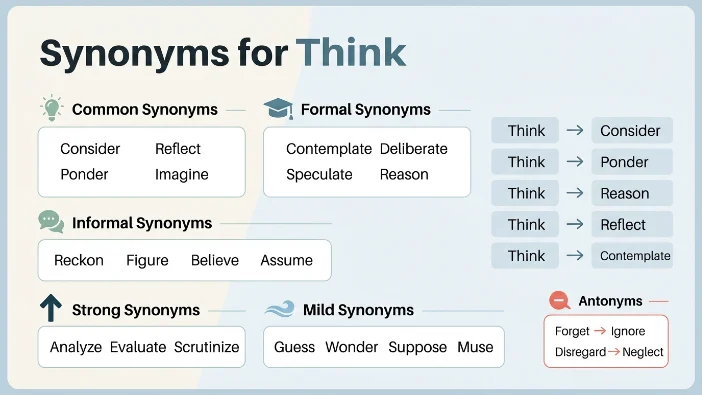
Common synonyms: consider, believe, suppose, figure, reckon, feel, guess, think over
Formal synonyms: contemplate, deliberate, reflect, reason, analyze, conclude, hypothesize, determine
Informal synonyms: figure, reckon, feel, bet, guess, suppose
Strong synonyms: deliberate, contemplate, brood, wrestle with, grapple with
Mild synonyms: suppose, guess, feel, wonder, imagine
Related words (not always direct replacements): remember, know, decide, understand, imagine, perceive
FAQs About Synonyms for Think
What is the best synonym for think?
The best all-around synonym is consider. It fits most contexts formal, informal, and neutral and carries a sense of genuine mental attention without being too heavy or too casual.
What is another word for think?
Other words for think include believe, suppose, ponder, reflect, contemplate, reason, and figure. Each fits a slightly different context and tone, so the best choice depends on your sentence.
What is a formal synonym for think?
Formal synonyms for think include contemplate, deliberate, reflect, reason, and analyze. These work well in academic papers, professional reports, and business writing.
What is an informal synonym for think?
In casual conversation and informal writing, figure, reckon, guess, feel, and bet are natural replacements for think.
What is a stronger word for think?
Stronger alternatives include deliberate, contemplate, grapple with, brood, and wrestle with. These suggest deeper, more intense, or more troubled mental engagement.
What is a milder word for think?
Milder alternatives include suppose, guess, wonder, and feel. These soften the statement and signal less certainty or a more tentative opinion.
What words are similar to think?
Words in the same semantic area include imagine, remember, understand, decide, know, and perceive. These are related to mental activity but are not always interchangeable with think each carries its own specific meaning.
What is the opposite of think?
The clearest antonyms of think are ignore, dismiss, disregard, and react (impulsively). These describe responding or acting without engaging mentally.
How do I choose the right synonym for think?
Identify the type of thinking (quick guess, deep reflection, logical reasoning), match the tone of your writing (formal, casual, emotional), and check that the synonym fits the sentence naturally. When in doubt, read the sentence aloud awkward phrasing is a clear sign the synonym is not quite right.
Conclusion
The word think covers a vast range of mental activity, which is exactly why having the right synonym matters. A word like consider adds precision when you are making decisions. Contemplate signals depth and seriousness. Suppose softens an uncertain opinion. Brood adds an emotional weight that plain think cannot.
No single synonym works for every situation. The right choice always depends on what kind of thinking you mean, the tone of your writing, the formality of the setting, and how much intensity the moment calls for. Use this article as a reference whenever you want to move beyond the word think and find the word that says exactly what you mean.
Read More Related Articles:
- Synonyms for Helping | Easy Words with Clear Meanings In 2026
- Synonyms for Smile | Say It Better with Style In 2026
- Synonyms for Perform | Choose the Right Word Every Time In 2026

Grace Phillips contributes content to SynonymsAura.com, where she writes about language, vocabulary and everyday communication. Her work is centered on helping readers find the right words and express themselves with greater clarity and confidence.