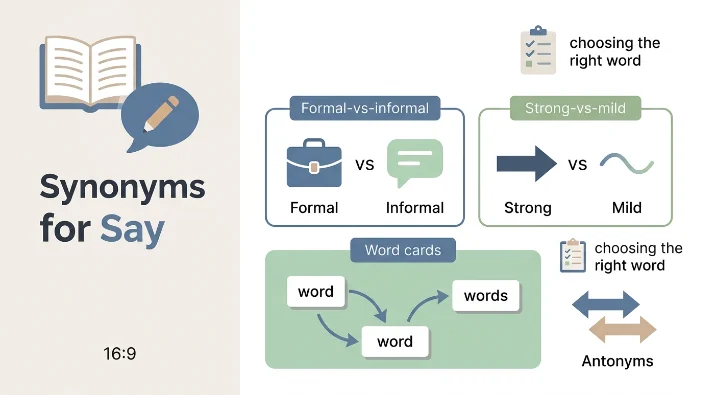
“Say” is one of the most common verbs in English, which is exactly why it gets overused. If you write, speak, or edit often, you’ve probably searched for synonyms for say to avoid repeating it in the same paragraph or to match a more specific tone. The good news is that English offers dozens of alternatives but not all of them mean exactly the same thing. The right synonym depends on the context, the formality of your writing, and how strong or gentle you want the statement to sound.
This guide breaks down the most accurate synonyms for say, grouped by tone and use case, with example sentences and clear explanations of when each word fits best.
Quick Answer: Best Synonyms for Say
The best synonyms for say are state, mention, remark, and tell. The right choice depends on tone, context, and intensity “state” works for formal writing, “mention” fits casual references, “remark” suits observations, and “tell” is common in everyday conversation.
What Does Say Mean?
At its core, “say” means to express something using words, whether spoken or written. It’s a verb, and it’s one of the most flexible words in English because it works in almost any situation casual conversation, formal reports, storytelling, and quotations.
Common usage examples:
- “She said she would call later.”
- “What did the report say about sales?”
“Say” doesn’t carry strong emotion or formality on its own. That neutrality is part of why it’s so widely used and also why writers often look for more specific alternatives.
Core Meaning of Say
The central idea behind “say” is communication through words. It covers spoken statements, written statements, opinions, facts, and quoted speech. Unlike words like “shout” or “whisper,” “say” doesn’t tell you how something was expressed only that it was expressed.
This is important because many synonyms for say add extra meaning. “Announce” implies a formal or public statement. “Mutter” implies a quiet, unclear tone. “Say” itself stays neutral, which makes it useful as a default but also easy to overuse.
Grammar and Usage Notes
“Say” is an irregular verb: say, said, said. It commonly appears in these patterns:
- Say + that clause: “He said that he was tired.”
- Say + direct quote: “She said, ‘I’ll be there soon.'”
- Say + to someone: “I said to him, ‘Wait here.'”
Common collocations include “say so,” “say a word,” “say goodbye,” and “needless to say.
Say” sounds natural in almost any context, which is why it’s a safe default. But in formal writing, using it repeatedly can make your work feel flat. In creative writing, dialogue tags like “said” are often preferred over fancier synonyms because they stay invisible to the reader but when you want variety or precision, a synonym can add color.
Best Synonyms for Say
| Synonym | Meaning | Tone | Best Use Case | Example Sentence |
|---|---|---|---|---|
| State | To express clearly and formally | Formal | Reports, legal writing | “The witness stated her account of the accident.” |
| Mention | To refer to briefly | Neutral | Casual reference | “She mentioned the meeting was moved to Friday.” |
| Remark | To comment, often with observation | Neutral-formal | Sharing an opinion | “He remarked that the weather had changed.” |
| Tell | To inform someone directly | Neutral | Everyday conversation | “Tell me what happened at work.” |
| Declare | To announce firmly and officially | Strong, formal | Official statements | “The mayor declared a state of emergency.” |
| Whisper | To speak very quietly | Mild | Secretive or gentle speech | “She whispered the answer so no one else heard.” |
| Claim | To assert something as true, often disputed | Strong | Arguments, debates | “He claims he was never at the scene.” |
| Note | To point out or record briefly | Formal, neutral | Reports, documentation | “The doctor noted the patient’s improvement.” |
Common Synonyms for Say
These everyday alternatives show up in normal writing and conversation without sounding overly formal or dramatic.
Tell to communicate information directly to someone. Works well in casual and instructional contexts.
“Can you tell me the directions again?”
Mention to bring something up briefly, often in passing.
“He mentioned he might be late tonight.”
Remark to make a comment, usually based on observation.
“She remarked that the price had gone up again.”
State to express something clearly, often used in slightly more formal everyday contexts too.
“He stated his opinion during the meeting.”
Add to say something further, usually after another point.
“She agreed, then added that she’d help out too.”
Formal Synonyms for Say
Formal alternatives work well in academic writing, business communication, reports, and professional emails.
State clear and objective, ideal for facts or findings.
“The report states that revenue increased by 12 percent.”
Declare carries authority and certainty, often used for official or public statements.
“The company declared its new policy effective immediately.”
Indicate suggests something without being overly direct, common in data or research writing.
“The results indicate a strong correlation between the two variables.”
Assert used when someone confidently puts forward a claim or opinion.
“The author asserts that the theory needs further testing.”
Note useful for pointing out a detail in formal documentation.
“The auditor noted several discrepancies in the accounts.”
Informal Synonyms for Say
These casual alternatives fit conversation, texting, social media, and relaxed writing.
Tell simple and direct, used constantly in daily speech.
“She told me the whole story last night.”
Go (as in reported speech) very casual, common in spoken storytelling.
“And then he goes, ‘No way that’s true.'”
Mention light and easygoing, good for casual references.
“I mentioned it to her, but she forgot.”
Blurt out casual and implies something said suddenly, without thinking.
“He just blurted out the secret before anyone could stop him.”
Chime in used when someone adds a comment during a conversation.
“My sister chimed in with her own opinion.”
Strong Synonyms for Say
These words carry more emotional weight, force, or emphasis. Use them when you want the statement to feel powerful, urgent, or intense.
Declare bold and official, best for formal announcements.
“The team declared victory after the final match.”
Proclaim public and confident, often used for important announcements.
“The king proclaimed a national holiday.”
Insist implies firmness, often in disagreement.
“She insisted that the plan wouldn’t work.”
Exclaim used when something is said suddenly with excitement or surprise.
“He exclaimed that he had finally finished the project.”
Assert confident and firm, common in arguments or debates.
“The lawyer asserted that the evidence was incomplete.”
Be careful with strong synonyms they can sound dramatic or out of place in neutral writing. “She asserted that dinner was ready” sounds odd because the situation doesn’t call for that level of intensity.
Mild Synonyms for Say
Mild alternatives soften the tone and work well when the statement is casual, gentle, or uncertain.
Mention light and low-key.
“He mentioned that he might join us later.”
Note calm and observational.
“She noted that the door was left open.”
Remark mild but still specific.
“He remarked that the coffee tasted different today.”
Whisper soft and quiet in tone.
“She whispered goodnight before leaving the room.”
Murmur quiet and gentle, often unclear.
“He murmured something under his breath.”
Mild synonyms work best when the situation doesn’t call for emphasis casual chats, soft-spoken moments, or understated observations.
Synonyms for Say by Context
Everyday Conversation
“Tell,” “mention,” and “say” itself work naturally here. These words don’t draw attention to themselves, which fits relaxed, spoken English.
Professional Writing
“State,” “note,” “indicate,” and “assert” fit business reports, emails, and presentations because they sound precise and objective.
Academic Writing
“Assert,” “state,” and “indicate” are common in essays and research papers, especially when referencing claims, data, or arguments.
Creative Writing
“Whisper,” “murmur,” “exclaim,” and “declare” add tone and personality to dialogue, helping readers picture how a character speaks.
Marketing Copy
“Announce” and “reveal” work well for product launches or promotions because they create excitement and draw attention.
Emotional Expression
“Exclaim,” “insist,” and “cry out” convey emotion more clearly than a plain “say.”
Another Word for Say in a Sentence
- She stated her reasons clearly during the interview.
- He mentioned the deadline had been moved up.
- The teacher remarked on how much the class had improved.
- Please tell me what you decided.
- The company declared record profits this quarter.
- She whispered the secret so no one else could hear.
- He claims the story isn’t true.
- The report notes a decline in customer satisfaction.
- The officer announced the road closure.
- She insisted that everyone stay calm.
- He exclaimed that the news was incredible.
- The scientist asserted that more research was needed.
- My friend added that she’d bring dessert.
- He murmured an apology before walking away.
- The CEO proclaimed a new era for the company.
Say Synonyms Compared
| Word Pair | Key Difference |
|---|---|
| State vs. Mention | “State” is formal and definite; “mention” is casual and brief. |
| Declare vs. Announce | “Declare” often implies authority or firmness; “announce” implies sharing news publicly. |
| Whisper vs. Mutter | “Whisper” is quiet and intentional; “mutter” is quiet, often unclear or irritated. |
| Claim vs. Assert | “Claim” suggests the statement may be disputed; “assert” implies confidence in the statement’s truth. |
| Remark vs. Comment | “Remark” often reflects a spontaneous observation; “comment” can be more structured or planned. |
Choosing between close synonyms comes down to tone and certainty. “Claim” hints at doubt, while “assert” sounds confident even if the claim is debatable.
Words Similar to Say
These words share meaning with “say” but aren’t always direct replacements.
Communicate broader than “say”; includes non-verbal communication too, like body language or writing without direct speech.
They communicated their concerns through a written letter.” This works, but replacing “say” directly with “communicate” can sound overly formal in casual speech.
Express focuses on conveying feelings or ideas, not necessarily spoken words.
“She expressed her gratitude.” This fits emotional or abstract statements better than plain reporting.
Utter technically means to produce sound with the voice, often used in literary or slightly old-fashioned writing.
He didn’t utter a single word.” Works well for emphasis on silence or minimal speech, but sounds unnatural in everyday conversation.
Voice used specifically for opinions or concerns.
“They voiced their concerns about the new policy.” Doesn’t work for neutral statements or quotes.
Antonyms of Say
| Antonym | Meaning | Example Sentence |
|---|---|---|
| Conceal | To keep something hidden or unspoken | “She chose to conceal her true feelings.” |
| Withhold | To hold back information deliberately | “He withheld his opinion during the meeting.” |
| Silence | To stop speech or expression | “The judge called for silence in the courtroom.” |
| Suppress | To hold back an emotion or statement | “He suppressed his anger and said nothing.” |
How to Choose the Right Synonym for Say
- Match the context. Formal writing calls for “state” or “indicate,” while casual writing suits “tell” or “mention.”
- Match the tone. Emotional scenes benefit from “exclaim” or “insist,” while calm moments fit “remark” or “note.”
- Check the intensity. Words like “declare” and “proclaim” carry weight don’t use them for minor statements.
- Think about the reader. Academic and professional audiences expect precise, formal word choices.
- Check whether the synonym is exact or only related. Words like “express” or “communicate” shift meaning slightly, so make sure they still fit your sentence.
- Keep the sentence natural. If a synonym feels forced, it’s usually better to use plain “say” or “said.
- Use simple words when clarity matters. In instructions or technical writing, clarity beats variety.
Common Mistakes When Using Synonyms for Say
- Choosing a word with the wrong tone, like using “proclaim” for a casual text message.
- Using a synonym that’s too strong for the situation, such as “insist” when someone simply agreed.
- Using a formal word like “assert” in casual conversation, which can sound stiff.
- Using a casual word like “mention” in a legal or academic document where precision matters.
- Replacing “say” without checking meaning, which can distort the sentence’s intent.
- Treating related words like “express” or “communicate” as exact synonyms when they carry broader meaning.
- Forcing a fancy word into a sentence where it doesn’t fit naturally, making the writing sound awkward.
Quick Synonym List for Say
Common synonyms: tell, mention, remark, state, add
Formal synonyms: state, declare, indicate, assert, note
Informal synonyms: tell, mention, blurt out, chime in, go (reported speech)
Strong synonyms: declare, proclaim, insist, exclaim, assert
Mild synonyms: mention, note, remark, whisper, murmur
Related words: communicate, express, utter, voice
FAQs
What is the best synonym for say?
The best overall synonym is “state,” since it’s neutral, clear, and works in both formal and everyday writing. It communicates the same core meaning as “say” without adding extra tone or emotion.
What is another word for say?
Common alternatives include “tell,” “mention,” “state,” and “remark.” The right one depends on how formal or casual your sentence needs to be.
What is a formal synonym for say?
“State,” “declare,” and “assert” are strong formal choices. They fit reports, essays, and professional communication where precision matters.
What is an informal synonym for say?
“Tell,” “mention,” and “chime in” work well in casual conversation, texting, and relaxed writing.
What is a stronger word for say?
Declare,” “proclaim,” and “insist” carry more force and confidence than a plain “say.” Use them when the statement needs emphasis or authority.
What is a milder word for say?
“Mention,” “remark,” and “whisper” soften the tone, making them useful for gentle or understated statements.
What words are similar to say?
“Communicate,” “express,” “voice,” and “utter” are related but carry slightly different meanings, often focused on emotion or broader communication rather than a simple spoken statement.
What is the opposite of say?
Common antonyms include “conceal,” “withhold,” and “suppress,” all of which involve holding something back instead of expressing it.
Conclusion
“Say” is a flexible, everyday verb, but it’s not your only option. Whether you need something formal like “state,” something casual like “tell,” or something with more punch like “declare,” the right synonym depends on meaning, tone, context, and intensity. Once you understand these small differences, choosing the perfect word becomes second nature and your writing will feel more precise and less repetitive.
Read More Related Articles:
- Synonyms For Role | Expand Your Vocabulary Easily In 2026
- Synonyms For Nose | Fresh Words to Describe This Feature In 2026
- Synonyms For Issue | Speak More Precisely in Any Context In 2026

Ethan Caldwell is a writer who enjoys exploring the nuances of language and how words shape everyday communication. His work focuses on making complex ideas easier to understand through clear, engaging and accessible writing.