“Are” is one of the most common words in English, but that doesn’t mean it’s always the best word. If you’re rewriting a sentence, tightening your writing, or just tired of seeing “are” on every line, there are natural alternatives depending on what the sentence is actually doing. The right synonym for “are” depends on context whether you’re describing existence, identity, appearance, or a state that’s changing.
Best Synonyms for “Are”
The best synonyms for “are” are exist, seem, remain, and appear. The right choice depends on whether the sentence describes existence, identity, a temporary state, or an impression.
What Does “Are” Mean?
“Are” is the present-tense, plural (and second-person singular) form of the verb “to be.” It links a subject to a description, identity, location, or state.
- Part of speech: linking verb (auxiliary or copular verb)
- Common usage: connecting a subject to an adjective, noun, or location (“They are tired,” “We are teachers,” “You are here”)
- Example sentences:
- “The kids are outside.”
- “You are right about that.”
Because “are” is a grammatical linking verb rather than a word with a single fixed meaning, it doesn’t have direct one-to-one synonyms the way a noun or adjective would. Instead, each alternative works only in certain sentence structures.
Core Meaning of “Are”
At its core, “are” expresses a state of being existence, identity, condition, or location. It answers the question “what is true about the subject right now?” Depending on the sentence, that truth might be permanent (“Dogs are mammals”), temporary (“The streets are wet”), or a matter of perception (“They are convincing”).
Grammar and Usage Notes
- Part of speech: Linking verb, present tense plural
- Common sentence pattern: Subject + are + adjective/noun/location (“The results are clear”)
- Common phrases: “there are,” “you are,” “we are,” “they are,” “how are you”
- When “are” sounds natural: In nearly every plural or second-person present-tense sentence it’s the default, unmarked choice
- When a synonym works better: When you want to emphasize existence (“exist”), impression (“seem” or “appear”), or continuation (“remain”) rather than a flat statement of fact
Best Synonyms for “Are”
| Synonym | Meaning | Tone | Best Use Case | Example Sentence |
|---|---|---|---|---|
| Exist | To be real or present | Neutral, factual | Emphasizing presence or reality | “Few solutions exist for this problem.” |
| Seem | To give an impression | Neutral, cautious | Softening a claim | “They seem ready for the trip.” |
| Appear | To look or present as | Neutral, slightly formal | Describing outward impression | “The numbers appear accurate.” |
| Remain | To continue being | Neutral to formal | Describing an unchanged state | “Prices remain high this year.” |
| Stay | To continue in a state | Casual | Everyday descriptions of ongoing condition | “The doors stay open until nine.” |
| Constitute | To make up or form | Formal | Academic or legal writing | “These items constitute the full order.” |
| Represent | To stand for or embody | Formal | Business or analytical writing | “These figures represent last quarter’s growth.” |
| Prove to be | To turn out as | Neutral | Describing an outcome | “The plan proved to be effective.” |
Common Synonyms for “Are”
These are everyday alternatives you’ll hear in normal speech and casual writing.
Seem a soft way to describe an impression rather than a certainty. Best context: everyday conversation, opinions. Example: “You seem tired today.”
Appear similar to “seem,” but slightly more observational. Best context: descriptions based on what you can see or read. Example: “The instructions appear straightforward.”
Stay used for a condition that continues over time. Best context: routines, habits, ongoing situations. Example: “The shops stay busy on weekends.”
Remain a step up in formality from “stay,” used for conditions that persist. Best context: reports, updates, general statements. Example: “Tensions remain high between the two teams.”
Formal Synonyms for “Are”
These work well in academic writing, business writing, essays, reports, and professional communication.
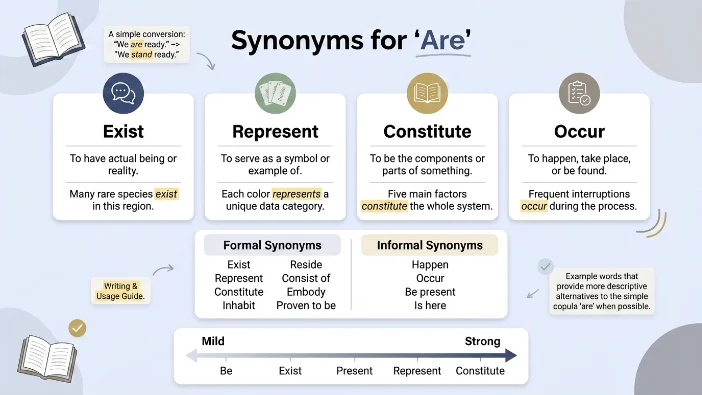
- Constitute best for defining what makes up a group or total. Example: “These three factors constitute the main risk.”
- Represent best for describing what something stands for or reflects. Example: “These figures represent a 12% increase.”
- Exist best for stating that something is present or real, often in analytical writing. Example: “Significant gaps exist in the current policy.”
- Prove to be best for summarizing an outcome after analysis. Example: “The strategy proved to be successful.”
Informal Synonyms for “Are”
These fit casual conversation, texting, social media, and friendly writing.
- Seem light, conversational, good for opinions. Example: “You seem pretty happy today.”
- Look casual way to describe appearance. Example: “You look great in that photo.”
- Stay casual and common in everyday talk. Example: “We stay pretty busy on weekdays.”
- Turn out to be casual way to describe a surprising result. Example: “That movie turned out to be really good.”
Strong Synonyms for “Are”
These carry more emphasis or certainty than a plain “are.”
- Constitute sounds more definitive and formal, useful when making a firm claim. Example: “These emails constitute clear evidence.”
- Represent carries weight when describing significance. Example: “These results represent a major breakthrough.”
- Prove to be implies a confirmed, tested outcome rather than a guess. Example: “The new method proved to be far more efficient.”
Use these when you want the sentence to sound confident and conclusive. They can sound overly formal or heavy in casual conversation, so save them for writing that needs authority.
Mild Synonyms for “Are”
These soften a statement instead of asserting it flatly.
- Seem introduces gentle uncertainty. Example: “The results seem promising so far.”
- Appear similarly cautious, good for hedging a claim. Example: “The team appears confident heading into the match.”
Mild wording works well when you’re not 100% certain, when you want to sound diplomatic, or when you’re presenting an early impression rather than a confirmed fact.
Synonyms for “Are” by Context
Everyday Conversation
“Seem,” “look,” and “stay” fit naturally here because they sound relaxed and familiar. “The kids seem happy” reads more like normal speech than “The kids are happy,” though both are correct.
Professional Writing
“Remain,” “represent,” and “constitute” suit reports, memos, and emails where precision and a measured tone matter.
Academic Writing
“Constitute” and “exist” work well when defining categories or describing findings, since they sound analytical rather than casual.
Creative Writing
“Seem,” “appear,” and “prove to be” add variety and mood to descriptive sentences, helping avoid repetitive “are” constructions in narrative prose.
Marketing Copy
“Represent” can add polish when describing what a product or brand stands for, though many marketing sentences keep “are” because it reads clean and direct.
Emotional Expression
Seem” and “appear” are useful for describing feelings without overstating them, which can sound more genuine in personal writing.
Another Word for “Are” in a Sentence
- Two solutions exist for this issue.
- They seem confident about the results.
- The photos appear blurry on this screen.
- Prices remain steady this month.
- The stores stay open until midnight on Fridays.
- These three points constitute the main argument.
- The charts represent our total sales for the year.
- The plan proved to be more complicated than expected.
- You look exhausted after that shift.
- The rules stay the same every season.
- Several risks exist that we haven’t addressed yet.
- The claims appear accurate based on the data.
- Her instructions remain unclear to the new staff.
- The two teams turned out to be evenly matched.
- These documents constitute sufficient proof of ownership.
“Are” Synonyms Compared
| Synonym | Meaning | Tone | Intensity | Formality | Best Use Case |
|---|---|---|---|---|---|
| Exist | Be real or present | Neutral | Medium | Neutral | Stating presence or reality |
| Seem | Give an impression | Cautious | Low | Casual to neutral | Softening a claim |
| Appear | Look or present as | Cautious | Low | Neutral | Describing observation |
| Remain | Continue being | Steady | Medium | Neutral to formal | Describing unchanged states |
| Stay | Continue in a state | Relaxed | Low | Casual | Everyday ongoing conditions |
| Constitute | Make up or form | Assertive | High | Formal | Defining or listing components |
| Represent | Stand for or embody | Assertive | Medium-high | Formal | Describing significance |
The main difference between “seem” and “appear” is subtlety: “seem” is based more on overall impression, while “appear” often implies a visual or observable basis. “Remain” and “stay” both describe continuation, but “stay” sounds more casual and “remain” sounds more composed or formal.
Words Similar to “Are”
These words relate to the idea of “being” but don’t function as direct grammatical replacements in every sentence.
- Become describes a change into a new state, not a current state. “They became teachers” is different from “They are teachers,” since “become” implies a transition happened.
- Feel describes a subjective internal state rather than an objective fact. “They feel tired” isn’t identical to “They are tired,” since “feel” centers on perception.
- Live as / act as describe a role or behavior rather than a simple identity. “She acts as the manager” isn’t the same as “She is the manager.”
These words are useful when the sentence is really about change, perception, or role rather than plain existence, but they shouldn’t be swapped in for “are” without checking the meaning shift.
Antonyms of “Are”
| Antonym | Meaning | Example Sentence |
|---|---|---|
| Aren’t | Negative present state | “They aren’t ready yet.” |
| Lack | To be without something | “The report lacks detail.” |
| Cease to be | Stop existing or being true | “Old habits cease to be useful over time.” |
Because “are” is a linking verb rather than a word with a clear opposite meaning, its true antonym is usually its negative form (“are not” / “aren’t”) rather than a separate word.
How to Choose the Right Synonym for “Are”
- Match the context. Formal writing calls for words like “constitute” or “represent”; casual writing calls for “seem” or “stay.
- Match the tone. If the sentence needs confidence, use “prove to be” or “constitute.” If it needs caution, use “seem” or “appear.”
- Check the intensity. Some alternatives, like “constitute,” sound heavier than a plain “are,” so use them only when that weight fits.
- Think about the reader. Business readers expect measured language; casual readers respond better to simple, direct wording.
- Check whether the synonym is exact or only related. Words like “become” or “feel” shift the meaning, so use them only when that shift is intended.
- Keep the sentence natural. Not every “are” needs replacing sometimes it’s simply the clearest choice.
- Use simple words when clarity matters. In instructions or technical writing, “are” is often better than a fancier alternative.
Common Mistakes When Using Synonyms for “Are”
- Choosing a word with the wrong tone using “constitute” in a casual text message sounds stiff and out of place.
- Using a synonym that is too strong “prove to be” can overstate a simple, ordinary fact.
- Using a formal word in casual writing “represent” in a text to a friend feels unnatural.
- Using a casual word in professional writing “seem” repeated throughout a formal report can weaken its authority.
- Replacing “are” without checking meaning swapping in “become” changes a static fact into a process, which isn’t always intended.
- Treating related words as exact synonyms “feel” and “are” describe different things (perception vs. fact), so they aren’t interchangeable.
- Making the sentence sound unnatural over-editing every “are” out of a paragraph can make writing sound forced instead of polished.
Quick Synonym List for “Are”
Common synonyms: seem, appear, stay, remain
Formal synonyms: constitute, represent, exist, prove to be
Informal synonyms: seem, look, stay, turn out to be
Strong synonyms: constitute, represent, prove to be
Mild synonyms: seem, appear
Related words: become, feel, act as, live as
FAQs
What is the best synonym for “are”?
The best synonym depends on context, but “exist,” “seem,” and “remain” are the most versatile options. Choose “exist” for factual statements, “seem” for impressions, and “remain” for ongoing states.
What is another word for “are”?
Common alternatives include “seem,” “appear,” “stay,” and “remain,” depending on whether you’re describing an impression, a location, or a continuing state.
What is a formal synonym for “are”?
“Constitute” and “represent” are strong formal choices, often used in academic, legal, or business writing to describe composition or significance.
What is an informal synonym for “are”?
“Seem,” “look,” and “stay” work well in casual conversation and everyday writing because they sound relaxed and familiar.
What is a stronger word for “are”?
“Constitute” and “prove to be” carry more weight and certainty, making a statement sound more definitive.
What is a milder word for “are”?
“Seem” and “appear” soften a claim, making it sound like an impression rather than an absolute fact.
What words are similar to “are”?
“Become,” “feel,” and “act as” relate to the idea of being but describe change, perception, or role rather than a direct, current state.
What is the opposite of “are”?
The most direct opposite is the negative form, “aren’t” or “are not,” since “are” doesn’t have a true antonym in the traditional sense.
Conclusion
“Are” is a small word that does a lot of work in English, but it isn’t always the most precise choice. Whether you reach for “exist,” “seem,” “remain,” or something more formal like “constitute,” the best synonym always comes down to meaning, tone, context, and intensity. Pay attention to what the sentence is really saying, and the right word will usually stand out on its own.
Read More Related Articles:
- Synonyms for Hopeful | Which Word Fits Your Situation Best In 2026
- Synonyms for Blessed | Improve Your Word Choice Naturally In 2026
- Synonyms for Multifaceted | From Basic to Brilliant Vocabulary In 2026

Evelyn Turner is a content creator at SynonymsAura.com who enjoys exploring the richness of the English language. Her work focuses on word meanings, synonyms, expressions and everyday language usage, helping readers communicate with greater clarity and confidence.