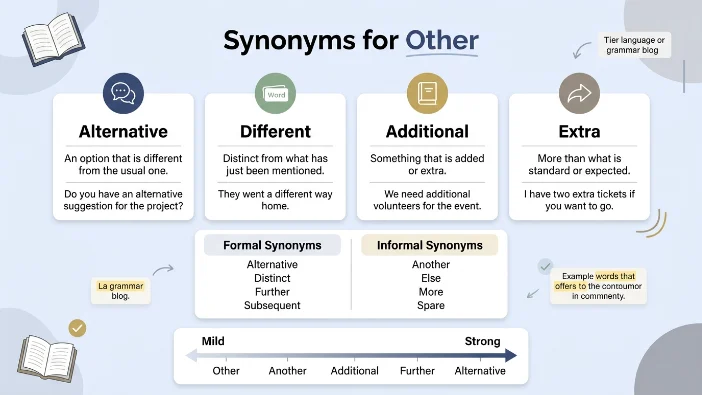
Finding the right words can sometimes feel tricky, especially when you find yourself using the same word repeatedly. If you’re looking for Synonyms for Other, you’ve come to the right place. The best alternative depends on your meaning, tone, context, and what you’re trying to say. Whether you need a formal word, a casual option, or something in between, this guide covers everything you need to know. The most common and useful synonyms for other are alternative, different, additional, another, and extra. Keep reading to learn which one fits your situation perfectly.
Best Synonyms for Other
The best synonyms for “other” are alternative, different, additional, another, and extra. The right choice depends on tone, context, and intensity. For formal writing, consider “alternative” or “additional.” For casual conversation, “different” or “extra” work well. If you’re comparing two things, “another” often fits best.
What Does Other Mean?
Other” is a versatile word that serves as an adjective, pronoun, or noun in English. At its core, it refers to something that is not the one already mentioned, or something that is different, additional, or remaining.
Simple definition: “Other” means not the same as the one previously mentioned, or an additional person or thing beyond what has already been named.
Part of speech: Adjective, pronoun, or noun
Example sentences:
- She chose the other dress from the rack.
- We need to consider other options before deciding.
- Some people prefer coffee, while others prefer tea.
Core Meaning of Other
The word “other” carries the fundamental idea of distinction, difference, or addition. When you use “other,” you’re drawing a line between one thing and everything else that doesn’t fit that category. It helps you differentiate, compare, or expand on what you’ve already mentioned.
Think of “other” as your way of saying, “Not this one but something else.” It can point to an alternative choice, a remaining item, or an additional possibility. The beauty of “other” lies in its flexibility it works in almost any context where you need to talk about what’s left, what’s different, or what’s extra.
Grammar and Usage Notes
“Other” can function in several grammatical roles:
- As an adjective: Usually before a noun (the other book, other people)
- As a pronoun: Replacing a noun (one is red, the other is blue)
- As a noun: Referring to a person or thing (helping others)
Common phrases with “other”:
- The other day (recently)
- Each other (reciprocally)
- Every other (alternate)
- Other than (except for)
- On the other hand (from a different perspective)
When “other” sounds natural:
- Comparing two or more things
- Offering alternatives
- Referring to additional items
- Speaking about differences
- Talking about remaining choices
When a synonym might work better:
- When you need more precision (alternative vs. additional)
- When you want to sound more formal
- When you want to vary your vocabulary
- When “other” feels too vague
Best Synonyms for Other
| Synonym | Meaning | Tone | Best Use Case | Example Sentence |
|---|---|---|---|---|
| Alternative | Another possibility or choice | Neutral to formal | When offering options or choices | We should explore alternative solutions to this problem. |
| Different | Not the same; distinct | Neutral | When emphasizing distinction | The two proposals are completely different in approach. |
| Additional | Extra; more than what exists | Formal | When adding to an existing set | We need additional resources to complete the project. |
| Another | One more; a different one | Neutral | When referring to a singular additional thing | Could I have another cup of coffee, please? |
| Extra | More than usual or necessary | Informal | When emphasizing excess or addition | I brought extra snacks just in case. |
| Remaining | Left over; still there | Neutral | When referring to what’s left | The remaining tickets will be sold at the door. |
| Contrary | Opposite in nature | Formal | When emphasizing opposition | His views are contrary to what we expected. |
| Further | Additional or more advanced | Formal | When adding more detail or extension | We’ll need further evidence to support the claim. |
Common Synonyms for Other
These everyday synonyms work well in most writing and conversation. They’re versatile, widely understood, and won’t sound out of place in normal communication.
Another
Meaning: One more; a different person or thing of the same type
Best context: When you want one more of something, or a different one of the same category
Example sentence: “I finished my book and started another.”
Different
Meaning: Not the same; distinct or separate
Best context: When emphasizing how two or more things are not alike
Example sentence: “Their approach to the project was different from ours.”
Additional
Meaning: Added to what already exists; extra
Best context: When something is being added to an existing group or amount
Example sentence: “The teacher provided additional materials for the students.”
Extra
Meaning: More than is usual, expected, or necessary
Best context: When describing something in excess of what’s needed
Example sentence: “We should bring extra water on the hike.”
Remaining
Meaning: Left over after others have been used, taken, or dealt with
Best context: When referring to what is still available or undone
**Example sentence”: “The remaining cookies are in the jar.”
Formal Synonyms for Other
When writing for academic, professional, or business contexts, these formal alternatives to “other” can elevate your language and add precision.
Alternative
Meaning: Available as another possibility or choice
Best context: Business proposals, decision-making contexts, academic writing
Why it works: “Alternative” suggests thoughtful consideration of options, making it ideal for professional settings.
Example sentence: “The committee will consider alternative funding sources.”
Further
Meaning: Additional to what already exists, or more distant
Best context: Reports, official communications, academic research
Why it works: “Further” adds a sense of progression or continuation beyond the current point.
Example sentence: “Further investigation revealed important details about the case.”
Contrary
Meaning: Opposite in nature, direction, or meaning
Best context: Legal writing, academic debates, formal arguments
Why it works: “Contrary” is precise and strong, useful for emphasizing opposition.
Example sentence: “The evidence presented was contrary to the defendant’s claims.”
Supplemental
Meaning: Added to complete or enhance something
Best context: Official documents, academic papers, professional reports
Why it works: “Supplemental” suggests that something is being added to make the original more complete.
Example sentence: “The report includes supplemental data from the second phase of research.”
Divergent
Meaning: Different or moving in different directions
Best context: Academic writing, analytical reports, formal discussions
Why it works: “Divergent” describes differences that are significant or growing.
**Example sentence”: “The two researchers reached divergent conclusions.”
Distinct
Meaning: Clearly different from something else
Best context: Professional analysis, academic descriptions, formal comparisons
Why it works: “Distinct” emphasizes clear, identifiable differences.
Example sentence: “Each department has distinct responsibilities.”
Informal Synonyms for Other
For everyday conversation, friendly writing, social media, and personal messages, these casual alternatives feel natural and approachable.
Extra
Meaning: More than usual; surplus
Best context: Casual conversation, friendly advice, everyday situations
Tone: Relaxed, straightforward
Example sentence: “I grabbed an extra slice of pizza if you want it.”
Different
Meaning: Not the same
Best context: Daily conversation, personal observations, informal writing
Tone: Natural, easygoing
**Example sentence”: “That movie was so different from the book.”
Another
Meaning: One more; a different one
Best context: Casual requests, everyday situations
Tone: Simple, direct
**Example sentence”: “Let’s try another restaurant this weekend.”
More
Meaning: Additional; a greater amount
Best context: Informal requests, daily communication
Tone: Simple, practical
**Example sentence”: “Do we need more chairs for the party?”
Fresh
Meaning: New or different from before
Best context: Creative contexts, personal growth conversations
Tone: Positive, dynamic
Example sentence: “I’m looking for a fresh approach to this project.”
Strong Synonyms for Other
Sometimes you need a word that carries more weight, emphasis, or intensity than the standard “other.” These synonyms add strength and clarity to your writing.
Opposing
Meaning: In conflict with; against
When to use: When emphasizing direct conflict or opposition
Example sentence: “The two teams took opposing positions on the issue.”
Divergent
Meaning: Moving in different directions; very different
When to use: When differences are widening or significant
**Example sentence”: “Their paths were becoming increasingly divergent.”
Contradictory
Meaning: Saying or implying the opposite; in direct opposition
When to use: When two things can’t both be true
Example sentence: “The witness gave contradictory statements.”
Separate
Meaning: Different and not connected
When to use: When emphasizing lack of connection
**Example sentence”: “The two matters are completely separate.”
Distinct
Meaning: Clearly different; unmistakably separate
When to use: When differences are obvious and clear
Example sentence: “The two flavors are delicious but distinctly different.”
Varied
Meaning: Having many different elements or types
When to use: When describing a range of differences
Example sentence: “The students came from varied backgrounds.”
Mild Synonyms for Other
For softer, more neutral expression, these milder synonyms work well when you want to avoid strong emphasis.
Further
Meaning: Additional; more distant
When to use: When adding to something without strong contrast
Example sentence: “We’ll need further details before deciding.”
Alternate
Meaning: Different from what is usual; in addition
When to use: When offering a gentle alternative
Example sentence: “We could take the alternate route if you prefer.”
Diverse
Meaning: Showing a variety; not all the same
When to use: When describing variety without strong comparison
Example sentence: “The city has a diverse population.”
Various
Meaning: Different kinds or types
When to use: When referring to multiple different things
Example sentence: “She has various interests and hobbies.”
Some
Meaning: An unspecified amount or number
When to use: When you don’t need to specify exact differences
Example sentence: “Some people prefer to work in the morning.”
Added
Meaning: Put with something else
When to use: When something is simply being included
**Example sentence”: “The added features made the product better.”
Synonyms for Other by Context
Everyday Conversation
In daily talk, you’ll most often use another, different, and extra. These words are simple, clear, and don’t sound stiff.
- Another: “Can I have another cookie?”
- Different: “This cake tastes different from your usual recipe.”
- Extra: “I’ll bring extra napkins just in case.”
Professional Writing
In business and professional contexts, formality matters. Alternative, additional, and further sound polished and professional.
- Alternative: “We should consider alternative strategies.”
- Additional: “The report contains additional findings.”
- Further: “Further consultation will be needed.”
Academic Writing
Academic writing often requires precision and sophistication. Divergent, distinct, and supplemental add the right tone.
- Divergent: “The researchers found divergent outcomes.”
- Distinct: “The two theories are distinct but complementary.”
- Supplemental: “Supplemental data is available in the appendix.”
Creative Writing
In fiction and creative writing, word choice affects mood and imagery. Alternative, contrary, and fresh can add interest.
- Alternative: “She glimpsed a possible alternative future.”
- Contrary: “His ideas were contrary to the community’s values.”
- Fresh: “A fresh perspective transformed the project.”
Marketing Copy
Marketing requires clear, persuasive language. Extra, alternative, and additional help sell the idea.
- Extra: “You get extra features at no additional cost.”
- Alternative: “There’s an alternative solution you haven’t considered.”
- Additional: “Additional benefits come with every purchase.”
Another Word for Other in a Sentence
Here are fifteen natural examples using various synonyms for “other”:
- Alternative: “The committee proposed an alternative plan that saved money.”
- Different: “Her style of leadership is different from her predecessor’s.”
- Additional: “We received additional support from the community.”
- Another: “She decided to try another approach after the first failed.”
- Extra: “Please bring extra chairs for the guests.”
- Remaining: “The remaining work will take about two hours.”
- Contrary: “The results were contrary to what we predicted.”
- Further: “We need further evidence before proceeding.”
- Separate: “The two matters are completely separate.”
- Divergent: “Their opinions were too divergent to reach a compromise.”
- Various: “We considered various options before deciding.”
- Opposing: “The two sides held opposing views on the proposal.”
- Distinct: “Each region has distinct cultural traditions.”
- Supplemental: “The package includes supplemental materials.”
- Fresh: “The new manager brought a fresh vision to the team.”
Other Synonyms Compared
Some synonyms are close in meaning but not identical. Understanding the subtle differences helps you choose the right word.
| Synonym | When It’s Better | What’s Different |
|---|---|---|
| Alternative vs. Another | Use “alternative” when presenting choices; “another” for a simple additional item | “Alternative” implies options; “another” just means one more |
| Different vs. Distinct | “Different” for general differences; “distinct” when differences are clear and obvious | “Distinct” emphasizes noticeable, identifiable differences |
| Additional vs. Extra | “Additional” for formal writing; “extra” for casual use | “Extra” often implies more than needed; “additional” is neutral |
| Remaining vs. Further | “Remaining” for what’s left; “further” for more that continues | “Remaining” suggests leftover; “further” suggests progression |
| Contrary vs. Opposing | “Contrary” for different in nature; “opposing” for active conflict | “Opposing” suggests direct opposition; “contrary” is more general |
Words Similar to Other
These words belong to the same semantic family as “other” but may not work as direct replacements in every situation. Understanding when they can (and can’t) be used helps you avoid mistakes.
Alternate
Why it’s related: “Alternate” suggests another option, often in a sequence or rotation.
When it works: When describing choices or things that happen in turns.
When it doesn’t replace “other”: “Alternate” implies a pattern or rotation, while “other” can be more general.
Example: “We meet on alternate Wednesdays.”
Varied
Why it’s related: “Varied” describes a group with many different elements.
When it works: When describing diversity or a range of differences.
When it doesn’t replace “other”: “Varied” describes a collection, not a single other thing.
Example: “The menu has varied options.”
Diverse
Why it’s related: “Diverse” refers to a wide range of different things or people.
When it works: When emphasizing variety or inclusion.
When it doesn’t replace “other”: “Diverse” describes a group, not a single alternative.
Example: “A diverse group attended the event.”
Separate
Why it’s related: “Separate” implies that things are not connected.
When it works: When emphasizing that things are apart or distinct.
When it doesn’t replace “other”: “Separate” suggests more distance than “other” usually implies.
Example: “They live in separate houses.”
Antonyms of Other
| Antonym | Meaning | Example Sentence |
|---|---|---|
| Same | Identical; not different | “We both ordered the same dish.” |
| Similar | Like something else; not different in important ways | “The two designs are remarkably similar.” |
| Alike | Almost identical; very similar | “The twins are alike in many ways.” |
| Identical | Exactly the same; no differences | “The two copies are identical.” |
| Corresponding | Matching; related in a consistent way | “Each problem has a corresponding solution.” |
| Equivalent | Equal in value, meaning, or effect | “Her contribution was equivalent to his.” |
How to Choose the Right Synonym for Other
Follow these practical guidelines to pick the best word every time.
- Match the context
- Formal writing: Use “additional,” “further,” or “alternative”
- Informal writing: Use “extra,” “different,” or “another”
- Match the tone
- Professional: Choose “supplemental” or “divergent”
- Friendly: Choose “extra” or “different”
- Check the intensity
- Strong: “Opposing,” “contradictory”
- Mild: “Further,” “various”
- Think about the reader
- General audience: Stick to common synonyms
- Specialized readers: Use precise formal terms
- Check whether the synonym is exact or only related
- Alternative” is an exact replacement for “other” when offering choices
- “Varied” is related but not an exact replacement in all contexts
- Keep the sentence natural
- If the synonym sounds forced, choose a simpler word
- Read the sentence aloud to check flow
- Use simple words when clarity matters
- When communicating clearly is most important, choose widely understood synonyms like “different” or “another
Common Mistakes When Using Synonyms for Other
Avoid these typical errors to keep your writing precise and natural.
Using a Word with the Wrong Tone
- Mistake: “We need supplementary chairs for the party” (too formal)
- Better: “We need extra chairs for the party”
Using a Synonym That’s Too Strong
- Mistake: “I’d like a contradictory flavor of ice cream” (too strong)
- Better: “I’d like a different flavor of ice cream”
Using a Formal Word in Casual Writing
- Mistake: “I bought supplemental milk at the store” (sounds unnatural)
- Better: “I bought extra milk at the store”
Using a Casual Word in Professional Writing
- Mistake: “We need extra evidence to support the claim” (too informal)
- Better: “We need additional evidence to support the claim”
Replacing “Other” Without Checking Meaning
- Mistake: “The divergent guests arrived early” (wrong meaning)
- Better: “The other guests arrived early”
Treating Related Words as Exact Synonyms
- Mistake: “The varied side effects were unexpected” (using “varied” where “other” would be better)
- Better: “The other side effects were unexpected”
Making the Sentence Sound Unnatural
- Mistake: “I need a further book to read” (awkward)
- Better: “I need another book to read”
Quick Synonym List for Other
Common Synonyms
- Another
- Different
- Additional
- Extra
- Remaining
Formal Synonyms
- Alternative
- Further
- Contrary
- Supplemental
- Divergent
- Distinct
Informal Synonyms
- Extra
- Different
- Another
- More
- Fresh
Strong Synonyms
- Opposing
- Divergent
- Contradictory
- Separate
- Distinct
- Varied
Mild Synonyms
- Further
- Alternate
- Diverse
- Various
- Some
- Added
Related Words
- Alternate
- Varied
- Diverse
- Separate
- Several
FAQs
What is the best synonym for other?
The best synonym depends on your context. For most everyday situations, “different” and “another” work well. For formal writing, “alternative” and “additional” are excellent choices. The most versatile synonym is “different,” as it works in almost any context.
What is another word for other?
Common alternatives include “different,” “additional,” “another,” “extra,” “alternative,” and “further.” The right choice depends on whether you’re offering choices, adding to something, or emphasizing contrast.
What is a formal synonym for other?
Formal synonyms include “alternative,” “further,” “contrary,” “supplemental,” “divergent,” and “distinct.” These words are suitable for academic, business, and professional writing contexts.
What is an informal synonym for other?
Informal synonyms include “extra,” “different,” “another,” “more,” and “fresh.” These words work well in conversation, friendly writing, social media, and personal communication.
What is a stronger word for other?
Stronger words include “opposing,” “divergent,” “contradictory,” “separate,” and “distinct.” These words add more emphasis and are useful when you need to highlight differences or contrast.
What is a milder word for other?
Milder options include “further,” “alternate,” “diverse,” “various,” “some,” and “added.” These are useful when you want to soften your language or avoid strong comparisons.
What words are similar to other?
Words similar to “other” include “alternate,” “varied,” “diverse,” “separate,” and “several.” These share the general idea of difference or addition but may not work as direct replacements in every context.
What is the opposite of other?
The most direct opposites are “same” and “similar.” Other antonyms include “identical,” “alike,” “corresponding,” and “equivalent.” These words describe things that are not different from each other.
How do I choose the right synonym for other?
Consider your context, tone, and what you’re trying to communicate. Formal writing calls for words like “additional” or “alternative.” Casual writing works with “extra” or “different.” Always read your sentence aloud to make sure the synonym fits naturally.
Conclusion
Finding the right synonym for “other” doesn’t have to be complicated. The best word depends on your meaning, tone, context, and how much emphasis you need. For most everyday writing, “different,” “another,” and “extra” are solid choices. When you need more formality, reach for “alternative,” “additional,” or “further.” And when you want stronger emphasis, “opposing,” “divergent,” or “contradictory” can add impact.
Remember that no single synonym works perfectly in every situation. The key is understanding the subtle differences between similar words and choosing the one that best fits your specific need. With the guidance in this article, you can confidently choose the right word every time.
Read More Related Articles:
- Synonyms for Suspicious | Clearer and More Precise Writing In 2026
- Synonyms for Multifaceted | From Basic to Brilliant Vocabulary In 2026
- Synonyms for Hopeful | Which Word Fits Your Situation Best In 2026

Ethan Caldwell is a writer who enjoys exploring the nuances of language and how words shape everyday communication. His work focuses on making complex ideas easier to understand through clear, engaging and accessible writing.