The word “for” is one of the most common words in English and one of the trickiest to replace. The best synonyms for “for” include in favor of, on behalf of, due to, in order to, during, and in exchange for, depending on how “for” is being used. The right choice always depends on context, tone, and the specific meaning you need. This article breaks down the word by usage, then matches the right synonym to each one.
Best Synonyms for For
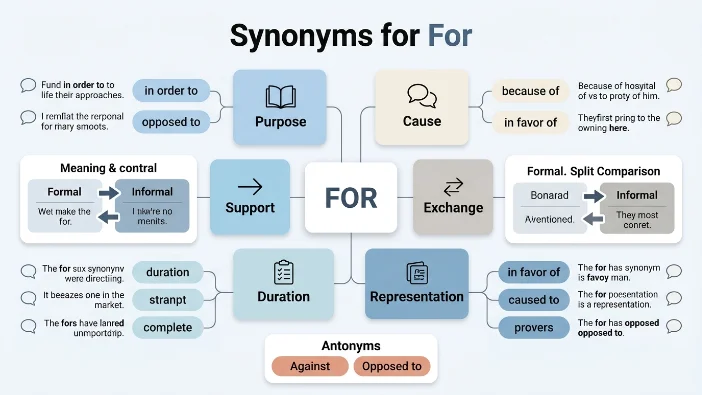
The best synonyms for “for” are in favor of, because of, on behalf of, in order to, and in exchange for. However, “for” carries several distinct meanings, and no single synonym replaces it in every situation. Match the synonym to the meaning, not just the word.
What Does “For” Mean?
“For” is primarily a preposition, though it can also act as a conjunction in some constructions. It connects a noun, pronoun, or clause to the rest of a sentence and expresses a wide range of relationships.
Here are the most common meanings:
- Purpose or intention: She bought flowers for the table.
- Benefit or recipient: This gift is for you.
- Support or favor: Are you for or against the proposal?
- Reason or cause: He was punished for lying.
- Duration: They talked for hours.
- Representation or substitution: She spoke for the entire team.
- Exchange: I paid twenty dollars for that book.
Because “for” carries so many meanings, finding a synonym requires identifying which meaning is active in the sentence before you swap it out.
Simple example sentences:
- I made this cake for my sister. (beneficiary)
- He left early for work. (purpose)
Core Meaning of For
At its core, “for” signals a connection a link between one thing and another. It tells the reader why something is happening, who benefits, what it cost, how long it lasted, or whose side someone is on. That makes it one of the most versatile prepositions in English.
Because of this versatility, “for” often acts as a grammatical bridge. It shows relationships that other prepositions can’t quite handle. When you look for synonyms, you’re really looking for phrases that rebuild that bridge in a more specific or stylistically different way.
Grammar and Usage Notes
Part of speech: Preposition (most common); occasionally a conjunction.
Common sentence patterns:
- Verb + for + noun: She asked for help.
- Noun + for + noun: a recipe for soup
- Adjective + for + noun: ready for action
- For + noun/pronoun + infinitive: It’s time for us to leave.
Common collocations:
- famous for, known for, ready for, responsible for, grateful for, sorry for, apply for, wait for, pay for, care for, look for, stand for
When “for” sounds natural:
- In everyday speech and writing, “for” rarely needs to be replaced. It flows naturally in almost all registers.
When a synonym may work better:
- In formal writing where precision matters, a more specific phrase can clarify meaning.
- In creative writing, replacing “for” with a longer phrase can add rhythm or emphasis.
- When editing for variety, swapping “for” avoids accidental repetition in dense text.
Best Synonyms for For
| Synonym | Meaning | Tone | Best Use Case | Example Sentence |
|---|---|---|---|---|
| In favor of | Supporting something | Neutral–Formal | Opinions, proposals, votes | She voted in favor of the new policy. |
| On behalf of | Representing someone | Formal | Legal, professional, public speech | He signed the document on behalf of the board. |
| Because of | Expressing cause | Neutral | Explaining reasons | She missed class because of a family emergency. |
| Due to | Attributing cause | Slightly formal | Reports, emails, explanations | The delay was due to bad weather. |
| In order to | Expressing purpose | Neutral–Formal | Formal writing, instructions | She studied in order to pass the exam. |
| In exchange for | Denoting trade | Neutral | Transactions, negotiations | He agreed to help in exchange for a small fee. |
| During | Expressing time/duration | Neutral | Narrative, reports | She worked overtime during the holiday season. |
| Throughout | Covering an entire period | Neutral–Formal | Descriptions, narratives | He stayed calm throughout the entire ordeal. |
| To support | Showing aid or backing | Informal–Neutral | Everyday writing | We rallied to support the local shelter. |
| Pro | Strongly in favor of | Informal | Casual speech, debates | She’s always been pro change in the organization. |
Common Synonyms for For
These are the alternatives you’ll reach for most often in normal writing and conversation.
In favor of Means supporting or preferring something. Works when “for” expresses backing or approval. Example: Most employees are in favor of the new schedule.
Because of Signals a reason or cause. Works when “for” introduces why something happened. Example: He was late because of traffic.
In order to Shows purpose, especially in a more deliberate or structured sense. Example: They trained hard in order to compete at the national level.
On behalf of Used when someone acts or speaks as a representative. Example: I’m writing on behalf of our entire department.
During Replaces “for” when describing a span of time. Example: He lived abroad during his twenties.
Formal Synonyms for For
These alternatives work well in academic writing, business reports, official documents, and professional communication.
On behalf of – Use in legal, official, or professional contexts when someone represents a group or individual. Example: The attorney signed on behalf of her client.
In favor of – A strong, clear substitute in formal opinion or policy writing. Example: The committee voted in favor of the amendment.
Due to – Preferred in formal writing over “because of” when citing a cause. Example: The meeting was rescheduled due to scheduling conflicts.
In order to – More precise than “for” when expressing purpose formally. Example: Applicants must register in order to attend the event.
In exchange for – Suitable for contracts, agreements, and formal transactions. Example: The company agreed to provide training in exchange for a two-year commitment.
Representing – A clean, professional synonym when “for” means speaking or acting for someone. Example: She appeared representing the board of directors.
Informal Synonyms for For
These casual alternatives fit everyday conversation, social media, and friendly messages.
Pro – A breezy, speech-like way to express being in favor of something. Example: I’m totally pro this idea.
Into – Informal substitute when “for” expresses interest or preference. Example: She’s really into cooking lately. (Note: subtle meaning shift check context.)
Behind – Casual way to say “in support of.” Example: The whole team was behind the new strategy.
Backing – Works when “for” implies support, especially in informal discussions. Example: Are you backing the local candidate?
Strong Synonyms for For
These carry more intensity, emotion, or emphasis than a plain “for.”
Advocating for – Suggests active, passionate support. Example: She spent years advocating for better housing standards.
Championing – Conveys strong, sustained support for a cause or person. Example: He championed the rights of workers throughout his career.
In defense of – Used when “for” implies protection or justification. Example: She wrote a powerful essay in defense of free speech.
Devoted to – Strong emotional commitment. Example: The foundation is devoted to eradicating childhood poverty.
Be careful with these. They intensify the relationship beyond what a neutral “for” conveys. Use them when you want emphasis, not as casual substitutions.
Mild Synonyms for For
These are softer, more neutral choices that reduce the weight of the original word.
Toward – Suggests movement or orientation in the direction of a goal. Example: Her efforts were directed toward improving student outcomes.
Concerning – Mild substitute when “for” relates to a topic or subject. Example: I have some suggestions concerning the new workflow.
Regarding – Slightly more formal but still understated. Example: He had no concerns regarding the timeline.
About – The most casual and understated of the replacements when “for” signals a topic. Example: She had a lot to say about the proposal.
Mild synonyms are best when you want to soften a message, lower urgency, or keep the tone light.
Synonyms for For by Context
Everyday Conversation
In casual speech, “for” usually sounds most natural as-is. When you do replace it, because of, behind, and about work smoothly. “I’m behind this plan completely.” “He left early because of the rain.”
Professional Writing
Precision matters in professional contexts. Use in favor of, on behalf of, due to, and in order to. “The director signed on behalf of the organization.” “Costs rose due to supply chain disruptions.”
Academic Writing
Academic style demands formality and clarity. Use in order to, due to, in support of, and representing. “This study was conducted in order to identify key risk factors.”
Creative Writing
In creative prose, longer phrase substitutes can add texture. In search of, driven by, and in hopes of replace “for” while adding narrative color. “She wandered the market in search of the perfect gift.” “Driven by ambition, he pushed through every obstacle.”
Emotional Expression
When “for” carries emotional weight, try out of, driven by, or in love with. “She cried out of relief.” “He did it all out of loyalty.”
Another Word for For in a Sentence
Here are 14 natural examples showing how different synonyms work in real sentences.
- She volunteered on behalf of the entire community.
- The project was delayed due to unexpected costs.
- They raised money in support of the local shelter.
- He trained every morning in order to qualify for the race.
- She traded her old laptop in exchange for a newer model.
- The council voted in favor of the zoning change.
- He was penalized because of a procedural error.
- She stayed at the office throughout the evening.
- The team rallied behind their coach.
- He was recognized for his work or recognized owing to his contributions.
- She moved abroad in pursuit of a new opportunity.
- The memo was sent concerning the upcoming audit.
- He defended the policy in the interest of public safety.
- The funds were set aside toward rebuilding the school.
For Synonyms Compared
Some of the closest synonyms for “for” overlap in meaning but diverge in tone or specificity.
| Pair | Difference |
|---|---|
| Because of vs. due to | Both signal cause, but “due to” is slightly more formal. In strict grammar, “due to” follows a noun, while “because of” follows a verb. |
| In favor of vs. pro | Same core meaning (support), but “pro” is informal and casual; “in favor of” fits formal writing. |
| On behalf of vs. representing | Near-identical meaning; “representing” reads as slightly more active and direct. |
| In order to vs. to | “In order to” is more emphatic and formal; a plain infinitive “to” is often sufficient in casual writing. |
| During vs. throughout | “During” specifies a window of time within a larger period; “throughout” means across the entire duration without gaps. |
Words Similar to For
These words share semantic territory with “for” but don’t directly replace it in most sentences.
Toward / Towards – Suggests direction or orientation. Related to “for” in purpose contexts but adds a sense of movement or progression. She worked toward a resolution. Cannot replace “for” when “for” marks a beneficiary.
About – Overlaps with “for” in topic or subject contexts but is less precise. He had concerns about the plan versus He had concerns for the plan (slightly different nuance).
Over – Can replace “for” in time expressions in informal speech (We talked over lunch), but it’s not always interchangeable.
Per – Used in formal or technical writing when “for” signals rate or proportion. Paid fifty dollars per hour. More precise than “for” in numerical or rate contexts.
With – Occasionally overlaps in emotional cause sentences (shaking with fear vs. shaking for fear), but not a general synonym.
These words belong to the same usage territory but require careful handling. Substituting them carelessly can shift meaning or register in ways that confuse readers.
Antonyms of For
Since “for” often expresses support or purpose, its most natural antonyms relate to opposition.
| Antonym | Meaning | Example Sentence |
|---|---|---|
| Against | Opposed to | She voted against the motion. |
| Opposed to | In strong disagreement | He is openly opposed to the new rules. |
| Anti | Informal, contrary to | She’s been anti this idea from the start. |
| Contrary to | In disagreement with | Contrary to expectations, sales fell. |
| Despite | Regardless of, in opposition to a force | He succeeded despite the obstacles. |
| Without | Lacking, in the absence of | She managed without any assistance. |
How to Choose the Right Synonym for For
Finding the right word isn’t about picking any synonym it’s about picking the accurate one.
Match the meaning first. Identify which of “for’s” core uses is active: purpose, cause, support, exchange, time, or representation. Then choose from synonyms that serve that exact meaning.
Match the tone. “Pro” works in casual conversation. “In favor of” works in a policy document. Using the wrong register creates friction for the reader.
Check the intensity. “Championing” implies deep commitment. “Behind” implies light support. “In favor of” sits in the middle. Calibrate accordingly.
Think about your reader. If you’re writing for a general audience, simpler phrases land better. If you’re writing for a technical or academic audience, precision matters more than brevity.
Test the sentence. After swapping in the synonym, read the full sentence aloud. If it sounds stiff, awkward, or off it probably is.
Don’t replace “for” out of habit. In most cases, the original word is already the best choice. Replace it only when clarity, variety, or tone requires it.
Common Mistakes When Using Synonyms for For
Replacing “for” without identifying the meaning. “For” has at least six distinct uses. A synonym that works in one context fails in another. Don’t swap blindly.
Using “due to” after a verb. “Due to” should follow a noun. The cancellation was due to rain (correct). We cancelled due to rain (debated in formal grammar). In careful writing, use “because of” after verbs.
Using “in order to” when “to” is enough. She left in order to catch the bus can usually be simplified to She left to catch the bus. The longer phrase isn’t wrong, but it can feel heavy in casual writing.
Using “pro” in professional writing. “Pro” is a casual shorthand. In a report or formal email, it reads as unprofessional. Stick with “in favor of” or “in support of” in those contexts.
Treating “about” and “for” as interchangeable. I feel sorry for her and I feel sorry about her carry different meanings. “For” focuses on the person; “about” can imply uncertainty or the situation. They are not always equivalent.
Overusing “in order to.” This phrase is useful but heavy. Sprinkling it through a document adds unnecessary length and slows the reader down.
Ignoring the grammatical role. If “for” is introducing a clause or acting as part of a fixed phrase (for all intents and purposes, for good, for granted), no synonym will replace it cleanly. Leave idiomatic uses alone.
Quick Synonym List for For
Common synonyms:
- because of, in favor of, on behalf of, in order to, during, in exchange for
Formal synonyms:
- due to, representing, in support of, in the interest of, on account of, throughout
Informal synonyms:
- pro, behind, backing, about, into
Strong synonyms:
- advocating for, championing, devoted to, in defense of, in pursuit of
Mild synonyms:
- toward, concerning, regarding, about
Related words:
- toward, about, over, per, with, despite
FAQs About Synonyms for For
What is the best synonym for “for”?
There’s no single best synonym because “for” has multiple meanings. In favor of works for support and backing. Because of works for cause and reason. In order to works for purpose. Match the synonym to the specific meaning of “for” in your sentence.
What is another word for “for” in formal writing?
In formal writing, the best alternatives are in favor of, on behalf of, due to, in order to, and in exchange for. The right choice depends on whether “for” is expressing purpose, cause, representation, or exchange.
What is a stronger word for “for”?
Stronger alternatives include championing, advocating for, devoted to, and in defense of. These add emotional intensity and commitment beyond what a neutral “for” conveys. Use them when emphasis matters.
What is a milder alternative to “for”?
Milder options include toward, concerning, regarding, and about. These soften the connection between ideas and are useful when you want a less direct or lower-stakes tone.
What is the opposite of “for”?
The most direct antonyms of “for” are against and opposed to, particularly when “for” expresses support or favor. In other contexts, without and despite can serve as functional opposites.
Can I always replace “for” with “because of”?
No. “Because of” only replaces “for” when “for” expresses a reason or cause. In other uses such as expressing purpose, duration, exchange, or a recipient “because of” would not make sense. Always check the meaning of “for” in context first.
How do I know which synonym is right for my sentence?
Ask yourself: what is “for” doing in this sentence? If it shows purpose, use “in order to.” If it shows cause, use “because of” or “due to.” If it shows support, use “in favor of.” If it shows representation, use “on behalf of.” Matching the synonym to the function always beats guessing.
Are “due to” and “because of” the same thing?
They are close, but not identical in formal grammar. “Due to” traditionally modifies a noun (The delay was due to weather). “Because of” modifies a verb (She left because of the weather). In everyday writing many people use them interchangeably, but in formal or academic contexts, the distinction is worth observing.
Conclusion
“For” is a small word that does big work. Because it carries so many meanings purpose, cause, support, duration, exchange, and representation there’s no single synonym that replaces it in every situation.
The best approach is to start with meaning. Identify exactly what “for” is doing in your sentence, then choose a synonym that fits that function precisely. Keep the tone of your writing in mind, whether formal, casual, or somewhere in between, and test the sentence after the swap to make sure it still flows naturally.
Used well, these alternatives can add clarity, precision, and variety to your writing. Used carelessly, they can confuse readers or shift your meaning in unintended ways. When in doubt, the original word is often the right call.
Read More Related Articles:
- Synonyms for Superior | Instantly Improve Your Writing In 2026
- Synonyms For Felt | Make Your Writing More Descriptive In 2026
- Synonyms for Embarrassed | Smarter Word Choices for Every Context In 2026

Evelyn Turner is a content creator at SynonymsAura.com who enjoys exploring the richness of the English language. Her work focuses on word meanings, synonyms, expressions and everyday language usage, helping readers communicate with greater clarity and confidence.