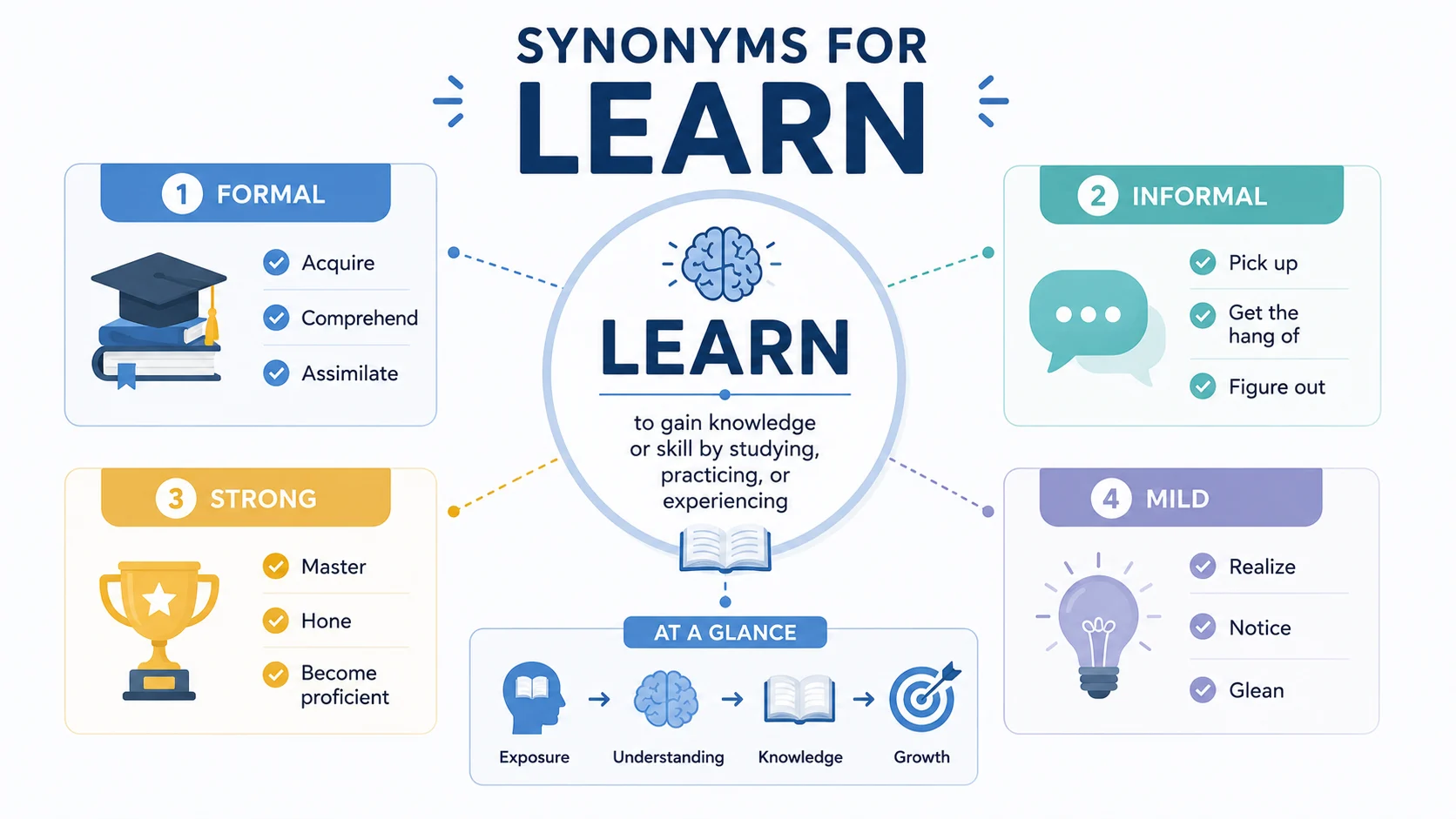
Want to move beyond the word “learn” but aren’t sure which alternative fits best? The best synonyms for learn are acquire, master, pick up, and comprehend but the right choice depends entirely on your context, tone, and what you’re actually trying to say. This guide breaks down over 50 synonyms for “learn,” grouped by formality, intensity, and use case, so you can choose the perfect word every time.
Best Synonyms for Learn
The best synonyms for “learn” are acquire, master, pick up, comprehend, grasp, and study. Choose “acquire” for professional contexts, “pick up” for casual learning, “master” for achieving expertise, and “comprehend” or “grasp” for understanding concepts.
What Does Learn Mean?
To learn means to gain knowledge, understanding, or skill through experience, study, or being taught. It’s a verb that describes the process of taking in new information or developing ability .
Simple examples:
- “I want to learn Spanish before my trip.”
- “She learned a lot from her internship.”
Core Meaning of Learn
At its heart, “learn” is about transformation. When you learn, you move from not knowing something to knowing it. This can happen through formal education, hands-on practice, watching others, reading, or even making mistakes. The word covers everything from memorizing facts to developing complex skills and changing how you think .
Learning can be intentional (studying for an exam) or accidental (picking up slang from coworkers). It can be quick (realizing the answer to a riddle) or take years (becoming a concert pianist). That’s why there are so many different synonyms for “learn” each one captures a different shade of this broad process .
Grammar and Usage Notes
Part of speech: Verb (transitive and intransitive)
Common sentence patterns:
- Learn + noun: “She is learning French.”
- Learn + to + verb: “He learned to cook.”
- Learn + that + clause: “I learned that the store was closing.”
- Learn + about + noun: “We learned about ancient Rome.”
- Learn + from + noun: “You can learn from your mistakes.”
Common collocations:
- Learn a lesson
- Learn the ropes
- Learn by heart
- Learn from experience
- Learn the hard way
When “learn” sounds natural: In everyday conversation, general writing, and when the method of learning isn’t important.
When a synonym may work better: When you need to be more specific about how you learned (studied vs. picked up), how well you learned (mastered vs. familiarized), or the tone of the context (formal reports vs. casual chats).
Best Synonyms for Learn
Common Synonyms for Learn
These are everyday alternatives you can use in normal writing and conversation.
1. Pick Up
Meaning: To learn something casually, usually by being around it rather than studying it formally .
Best context: Languages, skills, habits, and cultural knowledge.
Example: “She picked up some Spanish just from watching TV shows.”
2. Grasp
Meaning: To understand something, often after some difficulty .
Best context: Abstract concepts, ideas, or instructions.
Example: “I finally grasped the difference between the two accounting methods.”
3. Study
Meaning: To apply yourself to learning, often in a structured way .
Best context: Formal education, exams, or intentional learning sessions.
Example: “She studied for three hours every night before the test.”
4. Absorb
Meaning: To take in information, often quickly or without much effort .
Best context: Learning through immersion or natural exposure.
Example: “He absorbed the company culture during his first month.”
5. Familiarize Yourself With
Meaning: To get to know or learn about something .
Best context: New tools, places, processes, or information you need to know.
Example: “Please familiarize yourself with the new software before Monday.”
6. Discover
Meaning: To find out something that wasn’t known before .
Best context: Finding new information, research, or surprising facts.
Example: “I discovered that my great-grandfather was a painter.”
Formal Synonyms for Learn
Use these in academic writing, business communication, reports, and professional contexts. They sound more sophisticated and precise.
1. Acquire
This suggests gaining knowledge or a skill, often through effort or experience. It’s a strong, professional choice for resumes and formal documents . “The internship allowed her to acquire valuable project management skills.”
2. Assimilate
This goes beyond just learning it means incorporating new knowledge into your existing understanding . “New employees need time to assimilate the company’s complex procedures.”
3. Comprehend
This focuses on full and clear understanding rather than just surface-level knowledge . “The professor expected students to comprehend the material, not just memorize it.”
4. Attain
This is used when reaching a certain level of knowledge or skill through effort . “After years of practice, she attained mastery of the instrument.”
5. Cultivate
This suggests careful and deliberate development of knowledge or ability . “The program is designed to cultivate critical thinking skills.”
6. Internalize
This means making knowledge or beliefs a part of yourself . “He internalized the safety procedures until they became second nature.”
Informal Synonyms for Learn
Use these in conversations, social media, texts, friendly emails, and casual writing.
1. Get the Hang Of
Meaning: To learn how to do something, usually a skill or activity .
Context: Learning physical skills, using new tools, or understanding processes.
Example: “I’m starting to get the hang of this new video editor.”
2. Figure Out
Meaning: To solve or understand something through thought .
Context: Problems, puzzles, mysteries, or confusing situations.
Example: “It took me a while, but I figured out how to fix the sink.”
3. Catch On
Meaning: To begin to understand, often after some initial confusion .
Context: Understanding trends, jokes, or how things work.
Example: “The students quickly caught on to the game’s rules.”
4. Soak Up
Meaning: To learn a lot of information, often in a short time .
Context: New environments, cultures, and immersive experiences.
Example: “She soaked up everything the tour guide said.”
5. Bone Up On
Meaning: To study a topic quickly and intensively .
Context: Last-minute studying, refreshing knowledge.
Example: “I need to bone up on my history before the trivia night.”
6. Brush Up On
Meaning: To refresh or improve existing knowledge or skills .
Context: Skills you haven’t used in a while.
Example: “I’m brushing up on my French before the Paris trip.”
Strong Synonyms for Learn
These carry more intensity and should be used when you want to emphasize effort, achievement, or depth.
1. Master
Achieving complete skill or knowledge in a subject . This is for when you’ve reached a high level of proficiency. “He mastered the violin after fifteen years of practice.”
2. Hone
Refining and perfecting a skill . This suggests you already know the basics but are getting better. “The workshop helped her hone her leadership skills.”
3. Become Proficient In
Reaching a competent, skilled level in something . “He became proficient in Python after the coding bootcamp.”
4. Specialize In
Focusing on a specific area and gaining deep knowledge in it . “She specializes in early childhood education.”
Mild Synonyms for Learn
These are softer, more neutral alternatives that describe lighter forms of learning.
1. Realize
To suddenly become aware of something . “I realized that I had been doing it wrong all along.”
2. Notice
To become aware of something through observation . “She noticed that the technique wasn’t working as well as before.”
3. Become Aware Of
To discover or learn about something, often gradually. “He became aware of the company’s financial problems.”
4. Glean
To gather information bit by bit, often from various sources . “I gleaned some useful tips from the conference.”
5. Be Informed
To receive information from someone else . “We were informed that the meeting had been postponed.”
Synonyms for Learn by Context
Everyday Conversation
Best choices: Pick up, get the hang of, figure out, catch on, brush up on.
In casual conversation, you want to sound natural and relaxed. These words feel conversational and easy to use.
Example: “I picked up a few tricks from the YouTube tutorial.”
Professional Writing
Best choices: Acquire, develop, hone, become proficient in, familiarize yourself with.
On resumes and in workplace emails, you want to sound capable and professional. These words show effort and competence.
Example: “He developed strong leadership skills during his tenure as team lead.”
Academic Writing
Best choices: Comprehend, assimilate, internalize, study, engage with.
In essays and scholarly work, you need precision and formality. These words show deep engagement with material.
Example: “Students must engage with primary sources to comprehend the historical context fully.”
Creative Writing
Best choices: Discover, realize, absorb, glean, immerse yourself.
In stories and creative pieces, you want vivid, evocative language. These words paint a picture of the learning process.
Example: “She immersed herself in the city’s culture, absorbing every detail of its streets and people.”
Emotional Expression
Best choices: Discover, realize, come to understand, grow in, uncover.
When learning is tied to personal growth or emotional development, these words carry more weight.
Example: “Through therapy, he came to understand the root of his anxiety.”
Another Word for Learn in a Sentence
Here are 15 natural example sentences using different synonyms for “learn.”
- She acquired her knowledge of furniture-making from her grandfather.
- He mastered the art of negotiation after years of practice.
- I picked up some Italian during my semester in Rome.
- It took a moment, but she finally grasped the concept.
- He studied engineering at the state university.
- Young children absorb language at an incredible speed.
- It was difficult to assimilate so much new information.
- She familiarized herself with the new system before the launch.
- We discovered that the problem was caused by a software bug.
- He honed his writing skills through daily practice.
- They attained a working knowledge of the software in just two weeks.
- She internalized the values of the organization.
- I need to brush up on my Excel skills before the new project.
- The team gleaned valuable insights from the user data.
- He got the hang of the new interface after a few tries.
Learn Synonyms Compared
Acquire vs. Pick Up: Both mean gaining knowledge, but “acquire” is more formal and suggests deliberate effort. “Pick up” is casual and often implies learning passively through exposure. You pick up a language by living in a country; you acquire it through formal study .
Master vs. Study: “Study” is about the process of learning; “master” is about the result. You can study something for years without mastering it. “She studied biology in college, but it took years of lab work to master it” .
Comprehend vs. Grasp: Both mean understanding, but “comprehend” is more formal and implies complete understanding. “Grasp” can mean a basic understanding or a breakthrough “getting it” moment. You can grasp the general idea without fully comprehending all the details .
Learn vs. Study: “Learn” focuses on the outcome gaining knowledge. “Study” focuses on the activity applying yourself to learning . You can study for hours and learn nothing, or learn something without ever studying it.
Words Similar to Learn
These are related words that aren’t exact synonyms but are connected to the same semantic field.
- Teach: To impart knowledge to someone else. The opposite side of the learning process .
- Train: To learn or teach skills through practice and instruction.
- Educate: To provide systematic instruction .
- Investigate: To examine or look into something to discover facts .
- Examine: To inspect or analyze carefully .
- Explore: To investigate or examine something to learn more .
- Memorize: To commit information to memory .
- Read: To look at and understand written material .
Antonyms of Learn
How to Choose the Right Synonym for Learn
Picking the perfect word isn’t hard if you follow these guidelines:
Match the context. Are you writing a resume or texting a friend? Formal documents need words like “acquire” and “comprehend,” while conversations call for “pick up” or “get the hang of.”
Match the tone. Is your writing serious, academic, casual, or emotional? The tone of your synonyms should align with the mood of your piece.
Check the intensity. How deep was the learning? If you just picked up a few facts, use “discover” or “glean.” If you’ve reached expert level, “master” or “become proficient in” fits better .
Think about your reader. Will they understand the word? Don’t use overly formal synonyms in casual writing just to sound smart. Clear communication wins every time.
Check if the synonym is exact or only related. “Study” means learning through effort, not learning in general. Use it when the method matters.
Keep the sentence natural. Does the synonym flow in your sentence? If it feels forced or awkward, choose another one.
Use simple words when clarity matters. When you need everyone to understand, “learn” itself is a perfectly good word.
Common Mistakes When Using Synonyms for Learn
- Choosing a word with the wrong tone: Using “acquire” in a text message sounds pretentious. Using “pick up” in a formal report sounds too casual .
- Using a synonym that is too strong: Saying you “mastered” a topic when you just have basic knowledge sounds like exaggeration.
- Using a formal word in casual writing: “I comprehend your point” sounds stiff and unnatural compared to “I get your point.”
- Using a casual word in professional writing: “I picked up the skills” on a resume sounds less impressive than “I acquired the skills.
- Replacing “learn” without checking meaning: “Study” means learning through effort it’s not a direct replacement for “learn” if the method isn’t important .
- Treating related words as exact synonyms: “Memorize” means committing to memory, not understanding. You can memorize facts without learning them.
- Making the sentence sound unnatural: “He acquired to play guitar” is grammatically wrong. The pattern is “learn to” but “acquire” is used differently “he acquired guitar skills.” Always check the grammar.
Quick Synonym List for Learn
Common Synonyms:
Pick up, grasp, study, absorb, familiarize yourself with, discover
Formal Synonyms:
Acquire, assimilate, comprehend, attain, cultivate, internalize
Informal Synonyms:
Get the hang of, figure out, catch on, soak up, bone up on, brush up on
Strong Synonyms:
Master, hone, become proficient in, specialize in
Mild Synonyms:
Realize, notice, become aware of, glean, be informed
Related Words:
Teach, train, educate, investigate, examine, explore, memorize, read
FAQs
What is the best synonym for learn?
The best synonym depends on context.
- For casual learning, use pick up.
- For professional or formal writing, use acquire.
- For reaching a high level of skill, use master.
- For understanding concepts, use grasp or comprehend .
What is another word for learn?
Another word for “learn” is acquire (formal), pick up (informal), master (strong), study (for formal learning), or comprehend (for understanding). Choose based on tone and context .
What is a formal synonym for learn?
Formal synonyms for “learn” include acquire, assimilate, comprehend, attain, and cultivate. Use these in academic papers, business writing, and professional documents .
What is an informal synonym for learn?
Informal synonyms for “learn” include pick up, get the hang of, figure out, catch on, and soak up. Use these in conversation, social media, and casual writing .
What is a stronger word for learn?
Stronger words for “learn” include master, hone, become proficient in, and specialize in. These emphasize skill, effort, and expertise .
What is a milder word for learn?
Milder words for “learn” include realize, notice, become aware of, glean, and be informed. These describe gentler or more passive learning .
What words are similar to learn?
Words similar to “learn” include teach, train, educate, investigate, examine, explore, memorize, and read. These are related but not always exact synonyms .
What is the opposite of learn?
The opposite of “learn” is forget. Other opposites include ignore, misunderstand, overlook, neglect, and unlearn .
How do I choose the right synonym for learn?
Match the context (formal or casual), match the tone, check the intensity of the learning, think about your reader, and make sure the sentence sounds natural .
Conclusion
The word “learn” is simple and effective, but the English language is full of more precise alternatives. Whether you need a formal word for a business report, a casual option for a text message, a strong word for a resume, or a mild one for personal reflection, there’s a synonym that fits. The best choice always depends on your context, tone, and what you’re trying to say. So next time you write, skip “learn” and pick the word that captures exactly what you mean .
Read More Related Articles
- Synonyms for Suspicious | Clearer and More Precise Writing In 2026
- Synonyms for Harmful | Discover More Precise Word Choices In 2026
- Synonyms for Warrior | Synonyms That Make Your Writing Stand Out In 2026

Evelyn Turner is a content creator at SynonymsAura.com who enjoys exploring the richness of the English language. Her work focuses on word meanings, synonyms, expressions and everyday language usage, helping readers communicate with greater clarity and confidence.