Finding the right synonym for “pay” isn’t always as simple as swapping one word for another. The best alternative depends on your meaning, tone, context, and the audience you’re writing for. The most common synonyms for “pay” are compensate, reimburse, remunerate, and settle when referring to giving money for goods or services, and spend, shell out, or fork over in more casual contexts. This guide gives you a complete picture of your options.
Best Synonyms for Pay
The best synonyms for “pay” depend on context. For formal contexts, use compensate, remunerate, reimburse, or settle. For everyday use, try spend, reward, or give. In casual situations, shell out or cough up work well. The right choice depends on your audience, tone, and the specific action you mean.
What Does Pay Mean?
At its most basic level, “pay” means to give money or something of value in exchange for goods, services, or to settle a debt. It can also mean to be profitable or worthwhile, as in “it pays to be honest,” or to give attention, as in “pay attention.”
Part of speech: Verb and Noun
Common usage:
Core Meaning of Pay
The core idea of “pay” revolves around exchange you give something of value (usually money) to receive something in return. But the word has layered meanings:
- Financial transaction: Exchanging money for goods, services, or settling a debt. This is the most common use.
- Compensation: Giving money to someone for their work or to cover a loss.
- Consequences: Suffering a penalty or price for an action (you’ll pay for that mistake).
- Attention or respect: Giving attention, regard, or a compliment.
- Profitability: Being worthwhile or profitable (hard work pays off).
Grammar and Usage Notes
- Part of Speech: Verb (regular: pay, paid, paid) and noun.
- Common sentence patterns: “Pay someone something,” “pay for something,” “pay someone for something,” “pay a debt/bill.”
- Common collocations: Pay attention, pay a visit, pay the price, pay your dues, pay respect, pay for itself, pay off.
- When “pay” sounds natural: In almost any context involving money, exchange, or giving attention.
- When a synonym may work better: When you need to be more formal (remunerate), casual (shell out), or specific (reimburse for expenses).
Best Synonyms for Pay
Common Synonyms for Pay
Everyday words you can use in normal conversation and writing:
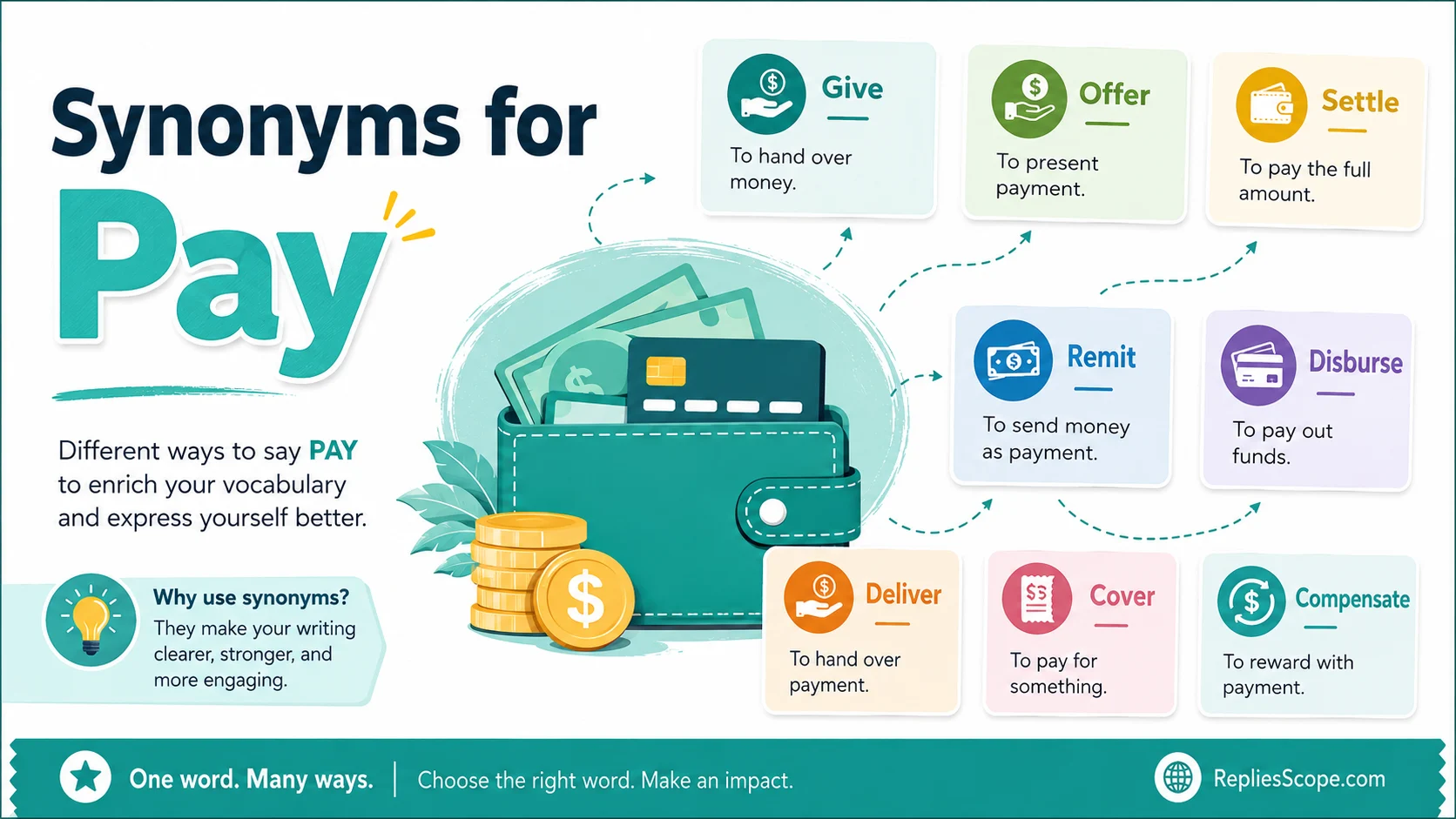
Give
- Meaning: To hand over money or something of value.
- Best Context: General exchange. You might say “I gave him twenty bucks” instead of “I paid him twenty bucks.”
- Example: “She gave the cashier a fifty-dollar bill.”
Spend
- Meaning: To use money to pay for things.
- Best Context: When focusing on the person paying rather than the receiver.
- Example: “We spent all our money on travel.”
Reward
- Meaning: To give money or something valuable for effort.
- Best Context: When recognizing someone’s hard work.
- Example: “The team was rewarded for finishing early.”
Settle
- Meaning: To pay a bill or debt completely.
- Best Context: Accounts, invoices, and financial obligations.
- Example: “Please settle the invoice within 30 days.”
Cover
- Meaning: To have enough money to pay for something.
- Best Context: Paying for a shared expense or paying for someone else.
- Example: “My grant will cover the tuition costs.”
Formal Synonyms for Pay
When you’re writing academic papers, business reports, contracts, or professional emails, these formal alternatives add polish and precision.
Compensate
Used when paying someone for work or to make up for a loss or damage.
- Example: “The insurance policy will compensate you for the stolen items.”
Remunerate
A very formal word for paying someone for services or work.
- Example: “All freelancers will be remunerated at the standard hourly rate.”
Reimburse
Used specifically when paying someone back for money they’ve already spent.
- Example: “The company will reimburse all travel expenses.”
Remit
To send payment, especially by mail or electronic transfer.
- Example: “Please remit payment to the address below.”
Disburse
To pay out money, typically from a fund. Often used for organizations.
- Example: “The foundation disburses grants twice a year.”
Defray
- Example: “The donation helped defray the cost of new equipment.”
Informal Synonyms for Pay
In everyday conversation, social media, or personal messages, these casual terms are more natural and conversational.
Shell out
To pay money, especially when it seems like a lot or you don’t want to.
Fork over (Fork out)
To hand over money, usually unwillingly or with some resistance.
Cough up
To reluctantly pay money you owe.
Pony up
To pay money that is due, especially when you’ve been avoiding it.
- Example: “It’s time for the shareholders to pony up more capital.”
Foot the bill
To pay for a large expense, often for a group.
- Example: “The company will foot the bill for everyone’s dinner.”
Chip in
To contribute money with other people.
- Example: “We all chipped in to buy a nice gift for the boss.”
Strong Synonyms for Pay
Use these words when you want more emotional weight or power. They often imply consequence, significance, or substantial compensation.
Pay off
To result in success after effort, or to pay a debt in full.
- Stronger Meaning: Implies a hard-won result. “All that studying paid off when she passed the exam with flying colors.”
Atone
To make amends or pay for a wrongdoing.
- Stronger Meaning: Carries a moral or serious weight. “He felt the need to atone for his mistakes.”
Suffer
To experience something unpleasant as a result of an action to “pay” in a non-monetary way.
Indemnify
To compensate someone for damage or loss.
- Stronger Meaning: Very formal and often legal; implies serious protection. “The contract indemnifies the client against any losses.”
Mild Synonyms for Pay
When you need a softer or more neutral alternative.
Offer
Provide
To supply money. Mild and neutral.
- Example: “The scholarship provides funding for tuition.”
Grant
To give money for a specific purpose, usually a sum.
- Example: “The university granted her a research allowance.”
Extend
To give or offer something, like credit or a loan. Formal and mild.
- Example: “The bank extended credit to the new business.”
Synonyms for Pay by Context
H2: Professional & Business Writing
In business, use compensate, reimburse, and remunerate. These show professionalism and clarity, especially in contracts. Settle is good for invoices and accounts.
H2: Academic Writing
Remunerate, disburse, and defray are appropriate. Compensate works when discussing economic policies or employee treatment. Reimburse is common in research contexts with travel expenses.
H2: Casual Conversation
Shell out, fork over, and cough up feel natural. Use these with friends or when complaining about a large expense. Spend and give are always safe in casual speech.
H2: Creative Writing
Writers can choose based on tone. A character could settle a score (not just a debt), suffer for their choices, or be rewarded. Metaphorical uses of pay work well here.
H2: Financial & Legal Documents
Discharge, indemnify, liquidate, and remit are essential. These terms have specific legal and financial definitions that add precision.
H2: Everyday Purchases
Spend and give are your go-to words. If you want to add emotion, use shell out or fork over to express that you spent more than you wanted.
Another Word for Pay in a Sentence
Here are 15 examples showing different synonyms in context.
- The company will compensate you for any overtime hours.
- Please settle your outstanding balance before the end of the month.
- I will reimburse you for the travel expenses once I see the receipts.
- The consultant was generously remunerated for her time and expertise.
- We spent over a thousand dollars on hotel rooms for the conference.
- He was rewarded for his honesty with a promotion and a bonus.
- The government will disburse the funds at the beginning of the quarter.
- Could you cover the taxi and I’ll get dinner?
- I cannot believe we had to shell out $200 just for the tickets.
- The new equipment will pay for itself within the first six months.
- She finally forked over the money she owed her brother.
- The lawyers will discharge the remaining debt on her behalf.
- Let’s all chip in to get a nice gift for the teacher.
- The client will remit payment upon completion of the project.
- Hard work in college pays off when you land a good job.
Pay Synonyms Compared
Compensate vs. Remunerate
Compensate is broader; it can mean paying for loss, damage, or services. Remunerate is specifically for paying for services or work and is more formal. You can compensate someone for a lost pet; you don’t remunerate them for it.
Reimburse vs. Repay
Reimburse is about restoring money someone spent on your behalf. Repay is broader, meaning to pay back any kind of debt, financial or moral. You reimburse an employee for a business lunch; you repay a bank loan.
Spend vs. Pay
Spend focuses on the person paying and the act of parting with money. Pay focuses on the transaction and the recipient. You pay the cashier, but you spend money at the store.
Shell out vs. Fork over
Both are informal. Shell out often expresses that something was expensive. Fork over adds a feeling of reluctance. “I had to shell out $500,” vs. “He was forced to fork over his wallet.”
Words Similar to Pay
Remuneration
- Meaning: Payment for work or services.
- Why it’s related: It’s the noun form of “remunerate” and directly relates to pay.
- When it’s useful: When you need a more formal word for “pay” as a noun.
Emolument
- Meaning: Payment for employment, including salary and benefits.
- Why it’s related: A formal term for the benefits and pay from a job.
- When it’s useful: In legal or official employment documents.
Honorarium
- Meaning: A payment for services for which a fee is not customarily required.
- Why it’s related: A type of payment, often for a guest speaker.
- When it’s useful: Distinguishing a token payment from regular wages.
Commission
- Meaning: A payment based on a percentage of a sale.
- Why it’s related: A specific type of “pay.”
- When it’s useful: In sales and business contexts.
Antonyms of Pay
How to Choose the Right Synonym for Pay
Choosing the right word doesn’t need to be difficult. Follow these practical steps:
- Match the context: Are you writing a contract, a text message, or a novel? Use remunerate for contracts, shell out for texts, and reward for a character’s arc.
- Match the tone: Formal writing needs formal words. Casual conversations need casual words. Mixing them up can sound strange (and unprofessional).
- Check the intensity: Are you paying a small bill or suffering a major consequence? Suffer is much stronger than pay.
- Think about the reader: Who is going to read this? A boss, a friend, or a professor? Tailor your word choice to them.
- Is it exact or related? Sometimes you need to “remunerate” someone, but other times you just need to “settle” a debt. Know the difference.
- Keep it natural: If the synonym makes the sentence sound forced, it’s the wrong choice. A simple “pay” is better than a clunky “remunerate.”
Common Mistakes When Using Synonyms for Pay
Choosing the Wrong Tone
Don’t use cough up in a formal proposal. Don’t use remunerate when talking to your buddy. Tone is everything.
Using a Synonym Too Strong
“You will suffer for this” is a threat. If you mean a simple transaction, stick with pay or settle. It can make you sound overly dramatic or accusatory.
Using a Formal Word Casually
Remunerate sounds out of place in normal conversation. You wouldn’t say “I need to remunerate you for that coffee.”
Treating Related Words as Exact Synonyms
Reward is not the same as reimburse. You reimburse someone for an expense. You reward someone for a job well done.
Making the Sentence Unnatural
Sometimes the simplest word is the best. Don’t try to find a fancy synonym for “pay” when the word “pay” works perfectly and naturally.
Quick Synonym List for Pay
Common Synonyms: Give, Spend, Reward, Settle, Cover
Formal Synonyms: Compensate, Remunerate, Reimburse, Disburse, Remit, Defray
Informal Synonyms: Shell out, Fork over, Cough up, Pony up, Chip in, Foot the bill
Strong Synonyms: Atone, Suffer, Pay off, Indemnify
Mild Synonyms: Offer, Provide, Grant, Extend
Related Words: Salary, Wages, Remuneration, Emolument, Honorarium, Commission, Earnings, Stipend
FAQs
What is the best synonym for pay?
The best synonym depends on the context. Compensate is a strong, formal all-purpose choice. For everyday situations, spend or give are excellent. For paying a debt, use settle.
What is another word for pay in a formal setting?
In formal settings, use remunerate, compensate, reimburse, disburse, or remit. These are appropriate for business, academic, and legal writing.
What is an informal synonym for pay?
Great informal synonyms include shell out, fork over, cough up, and foot the bill. These are perfect for conversation and casual writing.
What is a stronger word for pay?
Atone and suffer are stronger when referring to consequences. Indemnify is stronger in legal contexts. Pay off is stronger when referring to success after effort.
What is a milder word for pay?
Offer, provide, and grant are milder words. They suggest the possibility of payment without the directness of “pay.”
What words are similar to pay?
Remuneration, emolument, honorarium, commission, wages, and salary are similar. They are usually synonyms for the noun “pay” rather than the verb.
What is the opposite of pay?
The most direct opposite in a financial transaction is receive or owe. Default is an antonym for the act of paying a debt. Earn is the opposite perspective on a transaction.
How do I choose the right synonym for pay?
Consider your context, audience, and tone. Ask yourself: Is this formal or casual? Am I paying a debt, purchasing an item, or giving attention? The right word will fit the situation naturally.
Conclusion
Finding the right synonym for “pay” means moving beyond the first word that comes to mind. The best choice depends on who you’re talking to, what you’re writing, and the specific meaning you want to convey. Use this guide to pick the perfect word for any situation, whether you need a formal remunerate for a business contract, a casual shell out for a conversation, or a strong atone for creative writing.
Read More Related Articles:
- Synonyms for Embarrassed | Smarter Word Choices for Every Context In 2026
- Synonyms For Felt | Make Your Writing More Descriptive In 2026
- Synonyms for Stress | Meaning, Examples, and Better Word Choices In 2026

Grace Phillips contributes content to SynonymsAura.com, where she writes about language, vocabulary and everyday communication. Her work is centered on helping readers find the right words and express themselves with greater clarity and confidence.