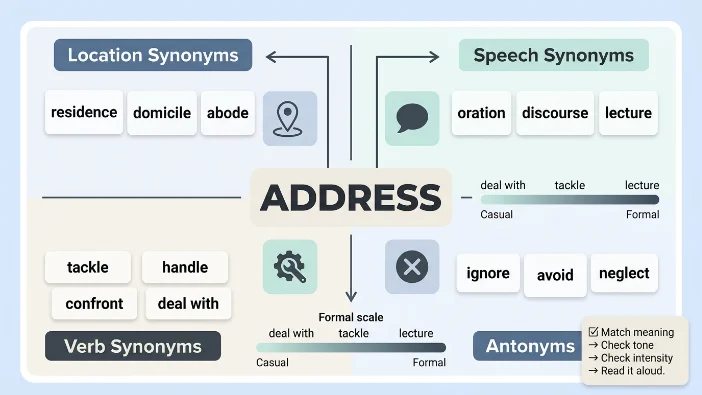
If you’re looking for synonyms for address, the right choice depends on which meaning you’re working with. “Address” can mean a physical location, a formal speech, or the act of dealing with something. The best synonyms for address such as location, tackle, speech, and residence each fit a different situation. This guide walks through all the key meanings, organized by tone, formality, and context, so you can swap in the right word every time.
Best Synonyms for Address
The best synonyms for address are location, residence, tackle, speech, handle, and oration. The right choice depends on which meaning of “address” you need location, a formal talk, or the act of dealing with something and whether your tone is formal, casual, or somewhere in between.
What Does Address Mean?
Address” is one of those words that carries more than one job. As a noun, it can mean:
- A specific location the place where someone lives or works (a street address, mailing address).
- A formal speech or public talk delivered to an audience.
As a verb, it can mean:
- To speak directly to someone or a group.
- To deal with, handle, or respond to a problem, question, or situation.
- To write a destination on an envelope or package.
This range of meanings makes finding the perfect substitute important. Using the wrong synonym say, swapping “address” for “speech” when you mean “handle a problem” can leave your reader confused.
Example sentences:
- She updated her address after moving to Chicago. (noun location)
- The president delivered a national address on the economy. (noun speech)
- We need to address this issue before the deadline. (verb deal with)
Core Meaning of Address
At its heart, “address” connects the idea of directed attention. Whether you’re pointing someone to a physical place, turning your words toward an audience, or turning your focus toward a problem, the common thread is direction attention aimed at something specific.
That directness is what makes “address” such a useful word. It implies intentional engagement rather than passive acknowledgment. When you “address” a problem, you’re not just noticing it you’re actively turning toward it. That nuance is worth keeping in mind when you pick a synonym.
Grammar and Usage Notes
As a noun:
- “Address” follows standard noun patterns: my address, a mailing address, her keynote address, an address to the nation.
- Common collocations: home address, email address, IP address, deliver an address, opening address, formal address.
As a verb:
- Follows standard verb patterns: address the issue, address the crowd, address concerns, address someone directly.
- Common collocations: address a problem, address the audience, address the letter, address questions, fail to address.
When “address” sounds natural:
- Professional writing and formal emails (“We will address your concerns promptly.”)
- Political or academic contexts (“She delivered an address to the assembly.”)
- Official documents and records (“Please confirm your current address.”)
When a synonym may work better:
- In casual writing, “address” as a verb can sound stiff. “Handle it” or “deal with it” often flows more naturally in conversation.
- In creative writing, “abode” or “dwelling” can replace the location meaning with more texture.
Best Synonyms for Address
| Synonym | Meaning | Tone | Best Use Case | Example Sentence |
|---|---|---|---|---|
| Location | A specific place | Neutral | General, everyday writing | Share your location so we can send it over. |
| Residence | Where someone lives | Formal | Legal, official, academic | Please provide your current residence. |
| Tackle | To actively deal with | Informal-moderate | Conversation, workplace | We need to tackle this before Friday. |
| Handle | To manage or deal with | Neutral | Business, everyday writing | She knows how to handle difficult situations. |
| Speech | A formal talk | Neutral-formal | Referring to a planned talk | He rehearsed his speech for an hour. |
| Oration | A formal public speech | Very formal | Academic, political, historical | The senator’s oration moved the crowd. |
| Domicile | Legal place of residence | Very formal | Legal documents, contracts | His domicile was listed in the filing. |
| Confront | To face something directly | Moderate-strong | Emotional or difficult issues | She had to confront the problem head-on. |
| Discourse | A formal discussion or speech | Formal | Academic, literary | His discourse on ethics lasted an hour. |
| Engage with | To deal with or interact with | Neutral | Professional, academic | The team needs to engage with these findings. |
Common Synonyms for Address
These are the everyday alternatives most writers and speakers reach for naturally.
Handle Means to manage or deal with something. Works across most contexts without sounding too stiff or too casual. Best for business writing and general conversation. Example: “Can you handle the complaints that came in this morning?”
Deal with A two-word verb that closely mirrors the “tackle a problem” meaning. Feels natural in both spoken and written English. Example: “We’ll deal with the delay as soon as the team is back.”
Location The most common substitute for the “place” meaning of address. Feels more general it covers any spot, not just a home or office. Example: “Drop a pin and share your location.”
Speak to A mild, natural alternative to the “address an audience” or “address someone” sense of the verb. Example: “The manager will speak to the whole department at noon.”
Home Works for informal references to where someone lives. Example: “I’ll send the package to your home.”
Formal Synonyms for Address
These alternatives fit academic papers, official documents, business reports, and professional correspondence.
Domicile Used in legal and government contexts to mean a person’s permanent legal home. Not interchangeable with “address” in casual writing. Best for: Contracts, legal filings, formal registration forms. Example: “The applicant’s domicile must be in the state of registration.”
Residence More polished than “home” but less technical than “domicile.” Works well in formal letters, applications, and professional writing. Best for: Applications, formal letters, HR documents. Example: “Kindly provide your current residence for our records.”
Oration A formal, often eloquent public speech. Carries a sense of rehearsed, elevated delivery. Best for: Academic writing, historical references, political contexts. Example: “Lincoln’s oration at Gettysburg is still studied in schools today.”
Discourse A formal treatment of a subject through speech or writing. Implies length and seriousness. Best for: Academic and philosophical writing. Example: “Her discourse on climate policy covered three hours of testimony.”
Attend to Means to give careful attention or take action on something. Slightly softer and more formal than “deal with.” Best for: Formal emails, professional settings. Example: “The committee will attend to the outstanding complaints by Thursday.”
Abode A formal or literary term for where someone lives. Rarely used in modern documents but still appears in legal and poetic writing. Best for: Literary, legal, or historical contexts. Example: “He had no fixed abode at the time of the incident.”
Informal Synonyms for Address
These work in conversation, text messages, casual emails, and social media writing.
Place The most casual substitute for someone’s address or home. Example: “I’ll swing by your place after work.”
Spot Even more casual. Refers to a general location rather than a formal address. Example: “What’s your spot? I’ll come to you.”
Pad (slang) Refers to someone’s home or apartment. Very informal, common in spoken American English. Example: “We’re all heading to Jake’s pad tonight.”
Sort out A casual way to say “deal with” or “address a problem.” Common in both American and British informal speech. Example: “Let’s sort out this scheduling mess before the week ends.”
Talk about / Bring up Casual substitutes when “address” is used in the sense of raising an issue or topic in conversation. Example: “Can we bring up the budget issue at today’s meeting?”
Strong Synonyms for Address
Use these when you want to convey urgency, direct confrontation, or forceful engagement.
Confront Implies facing something difficult head-on a conflict, a hard truth, or a serious problem. Stronger and more emotionally charged than “address.” Example: “The company was forced to confront years of mismanagement.
Tackle Suggests active, energetic effort to deal with a problem. More vivid than “handle” or “address.” Example: “We need to tackle this growing backlog before it spirals.”
Take on Implies accepting and engaging with a challenge directly. Carries a slight sense of courage or willingness. Example: “She decided to take on the corruption case herself.”
Combat Best for problems or challenges that require active resistance. Much stronger than “address.” Example: “The new policy is designed to combat rising misinformation.”
These are vivid and useful, but they can sound excessive when applied to minor issues. Use them when the situation genuinely calls for force or urgency.
Mild Synonyms for Address
These carry less weight and are better when you want to sound measured, diplomatic, or understated.
Consider Suggests thinking about something rather than acting on it. Very soft use only when the action is still exploratory. Example: “We should consider the feedback before moving forward.”
Look at Even softer. Implies review rather than action. Example: “Can we look at this issue together?”
Refer to Works when “address” means mentioning or directing attention to something in speech or writing. Example: “The report refers to several unresolved points.”
Acknowledge Implies recognizing something without necessarily solving it. Even milder than “address.” Example: “The CEO acknowledged the concerns raised by employees.”
Mild alternatives are useful in diplomatic writing, sensitive conversations, or when you want to avoid sounding aggressive.
Synonyms for Address by Context
Everyday Conversation
In casual speech, “address” in the problem-solving sense is usually replaced by deal with, sort out, handle, or figure out. For the location meaning, people almost always say place, home, or just ask “where do you live?”
Professional Writing
In emails, memos, and reports, handle, attend to, respond to, and engage with all work well. For location, residence fits formal documents; address itself is still perfectly appropriate here.
Academic Writing
Discourse, examine, engage with, and explore can replace the verb sense. Domicile works for the location sense in legal scholarship. For speech, oration, lecture, and keynote all serve well.
Creative Writing
- For the location meaning, abode, dwelling, haunt, or quarters add texture.
- For the speech meaning, monologue, proclamation, or address itself is often the right choice.
- For tackling a problem, more vivid verbs like wrestle with, grapple with, or confront give your writing more energy.
Marketing Copy
Tackle and solve tend to outperform “address” in headlines and calls to action. “We tackle your toughest billing problems” is more active than “We address billing challenges.”
Another Word for Address in a Sentence
Here are 14 natural example sentences using a range of substitutes:
- She finally confronted the anxiety she’d been avoiding for months.
- Please confirm your current residence on the application form.
- The CEO will speak to all employees about the restructuring plan.
- They need to tackle the supply chain issue before the next quarter.
- The coach delivered an inspiring oration before the championship game.
- Drop me your location and I’ll meet you there.
- He couldn’t find her home because she’d moved without leaving a forwarding note.
- The committee agreed to attend to the outstanding safety concerns this week.
- The professor’s discourse on postcolonial theory spanned two semesters.
- Let’s sort out the billing issue before the client calls again.
- The organization is working to combat housing inequality across three counties.
- She acknowledged the complaints but didn’t commit to any changes.
- His legal domicile remained in Texas even after years of living abroad.
- We’ll handle the staffing problem as soon as the director is back.
Address Synonyms Compared
Some of the closest substitutes for “address” (in the verb sense) look interchangeable but carry real differences.
| Word | Tone | Intensity | Best For | Key Difference |
|---|---|---|---|---|
| Address | Neutral-formal | Moderate | Professional writing | Broad; can sound vague in casual use |
| Handle | Neutral | Moderate | Business, everyday | Implies practical management |
| Tackle | Informal-moderate | Strong | Urgent problems, sports metaphors | More energetic and active |
| Confront | Serious | Strong | Difficult truths, conflicts | Implies resistance or emotional weight |
| Deal with | Informal | Moderate | Conversation, emails | Very natural, slightly informal |
| Attend to | Formal | Mild | Formal letters, professional emails | Suggests careful, methodical action |
| Engage with | Neutral-formal | Mild-moderate | Academic, professional | Implies ongoing interaction, not one-time fix |
Words Similar to Address
These words share a connection with “address” but aren’t always direct replacements.
Communicate Related to the “speak to” meaning but broader it covers all forms of sharing information, not just directed speech. Why it’s not always a substitute: “Address” implies a specific audience or issue. “Communicate” is more general.
Approach Shares the idea of turning toward something intentionally a problem, a person, a topic. But it emphasizes method more than action. Example: “Her approach to the conflict was calm and methodical.”
Lecture Overlaps with the “speech” meaning but implies a teaching context rather than a public or official address.
Post In the context of mailing, “post” shares some ground with “address” (sending something to a destination) but refers to the act of mailing, not the destination itself.
Identify Sometimes used in academic writing in place of “address” as in “this paper identifies three key challenges” but it doesn’t carry the sense of actively dealing with them.
Antonyms of Address
| Antonym | Meaning | Example Sentence |
|---|---|---|
| Ignore | To deliberately pay no attention to | The team chose to ignore the early warning signs. |
| Avoid | To keep away from or sidestep | He avoided the question entirely. |
| Neglect | To fail to give proper attention | Years of neglect left the building in poor condition. |
| Overlook | To miss or fail to notice | They overlooked several key complaints in the report. |
| Evade | To escape or dodge deliberately | She evaded every question the interviewer asked. |
| Dodge | Informal for evading or avoiding | He dodged responsibility by blaming the system. |
How to Choose the Right Synonym for Address
Match the meaning first. “Address” has at least three distinct senses. Before swapping it out, decide which one you’re using location, speech, or dealing with something and only look at synonyms that match that sense.
Match the tone. “Tackle” fits a team meeting. “Domicile” fits a legal document. “Pad” fits a text message to a friend. The same meaning can call for very different words depending on how formal or casual the context is.
Check the intensity. “Confront” hits harder than “address.” “Acknowledge” hits softer. Ask yourself whether you want to convey urgency, neutrality, or diplomacy and choose accordingly.
Think about your reader. A general audience usually responds better to “handle” or “deal with” than “attend to” or “engage with.” A legal or academic reader will expect more precise terminology.
Test the sentence. After substituting, read the sentence out loud. If it sounds stiff, over-formal, or slightly off, try a different option. Natural flow is always a good sign you’ve chosen well.
Common Mistakes When Using Synonyms for Address
Using the wrong sense of the word. The single most common mistake. Replacing “address” with “oration” works fine when it means a public speech. It’s completely wrong when it means “deal with a problem” or “list a location.
Using “confront” for mild situations. “Confront” implies confrontation conflict, resistance, or emotional difficulty. Using it to mean “we’ll address your request” sounds unnecessarily tense.
Treating “domicile” as a casual substitute for “address.” “Domicile” is a legal term. Dropping it into a casual email or social media post sounds awkward and out of place.
Swapping “acknowledge” for “address” when action is expected. “Acknowledge” means you noticed something. “Address” implies you’re taking action. In professional settings, using “acknowledge” when your reader expects a response can come across as evasive.
Using “tackle” in very formal writing. “Tackle” is vivid and effective in business and everyday contexts. In academic papers or legal documents, it can sound too casual.
Ignoring formality levels altogether. “Sort out” and “attend to” mean roughly the same thing, but one fits a text message and the other fits a formal complaint letter. Always check formality before substituting.
Quick Synonym List for Address
Common synonyms: handle, deal with, location, speak to, home, place
Formal synonyms: residence, domicile, oration, discourse, abode, attend to
Informal synonyms: sort out, pad, spot, place, bring up, talk about
Strong synonyms: tackle, confront, take on, combat
Mild synonyms: consider, acknowledge, look at, refer to
Related words: communicate, approach, lecture, post, identify, engage with
FAQs
What is the best synonym for address?
It depends on the meaning.
- For the location sense, residence or location works best in most contexts.
- For the speech sense, speech or oration are the closest alternatives.
- For the verb sense dealing with something handle, tackle, and deal with are the most natural substitutes.
What is another word for address a problem?
Tackle, handle, deal with, confront, and attend to are all strong alternatives. “Tackle” and “confront” add urgency; “handle” and “deal with” stay neutral; “attend to” sounds more formal and deliberate.
What is a formal synonym for address?
- For the location meaning, residence or domicile are the most formal alternatives.
- For a speech, oration or discourse work well.
- For the verb sense, attend to or engage with are the most formal options.
What is an informal synonym for address?
For a home or location, place, spot, or pad are all casual alternatives. For dealing with a problem, sort out, deal with, or figure out are all natural in everyday speech.
What is a stronger word for address?
Confront and tackle are both more forceful than “address.” Combat is even stronger and works when the situation involves active resistance to something. Use these when the situation genuinely calls for emphasis or urgency.
What is a milder word for address?
Acknowledge, consider, and look at are all softer alternatives. They suggest awareness or review rather than committed action, which makes them useful in diplomatic or exploratory contexts.
What is the opposite of address?
The clearest antonyms are ignore, avoid, and neglect. Evade and dodge work when the avoidance is deliberate. These all capture the idea of failing to deal with something the opposite of what “address” implies.
How do I choose the right synonym for address?
Start by identifying which meaning of “address” you’re using location, speech, or action. Then match the tone to your context (formal vs. casual) and check the intensity level (mild, neutral, or strong). Read the sentence out loud after substituting to make sure it flows naturally.
Conclusion
Address” is a flexible word, and finding the right synonym means knowing exactly which version of it you’re working with.
- If you mean a place, choose from location, residence, or abode based on how formal you need to sound.
- If you mean a speech, oration, speech, or discourse each carry slightly different weight.
- If you mean the act of dealing with something, tackle, handle, deal with, and confront all work but each brings a different level of energy and formality to the sentence.
The best synonym isn’t always the most impressive one. It’s the one that fits the meaning, matches the tone, and reads naturally to your audience. Use the comparisons, examples, and tips in this guide to make that call with confidence.
Read More Related Articles:
- Synonyms for Humble | Try These Better and More Expressive Synonyms In 2026
- Synonyms for Wisdom| From Basic to Brilliant Words In 2026
- Synonyms for Skilled | Avoid Repetition Like an Expert In 2026

Evelyn Turner is a content creator at SynonymsAura.com who enjoys exploring the richness of the English language. Her work focuses on word meanings, synonyms, expressions and everyday language usage, helping readers communicate with greater clarity and confidence.