When you need to show that something is true, you prove it. But sometimes the word “prove” feels overused or not quite right for the situation. The best synonyms for prove are demonstrate, verify, confirm, and substantiate. The right choice depends on your context, tone, and how strong your evidence is. This guide covers everything you need to know about synonyms for prove from formal and informal options to powerful alternatives and common mistakes to avoid.
Best Synonyms for Prove
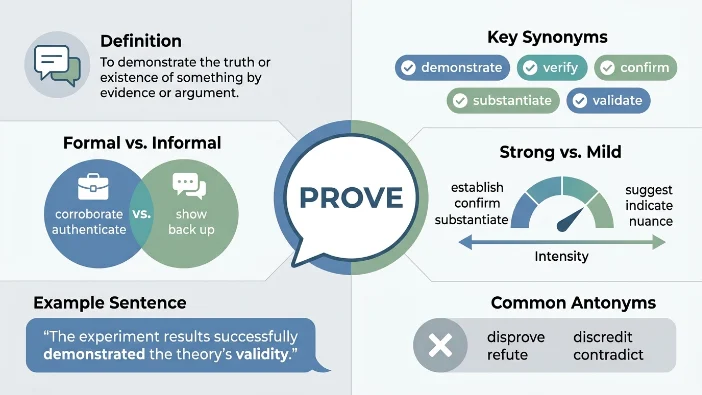
The best synonyms for prove are demonstrate, verify, confirm, substantiate, and validate. Choose “demonstrate” for showing through action or evidence, “verify” for checking accuracy, “confirm” for strengthening an existing belief, and “substantiate” for supporting a claim with solid evidence. The right word depends on your tone, context, and the strength of your proof.
What Does Prove Mean?
Prove is a verb that means to establish the truth or existence of something by presenting evidence, logic, or argument . When you prove something, you provide the proof that convinces others it’s real or correct.
The word comes from the Latin root probare, meaning “to test or prove worthy” . This origin hints at the word’s connection to testing and validation.
Part of speech: Verb (transitive and intransitive)
Common usage: You can prove a claim, prove a theory, prove your abilities, or prove someone wrong. The word appears frequently in academic writing, legal contexts, scientific discussion, and everyday conversation.
Example sentences:
- The new evidence helped prove his innocence.
- This experiment will prove whether the theory is correct.
- The rumor proved to be false after the investigation.
Core Meaning of Prove
The core meaning of prove involves three elements: a claim or assertion, evidence or logic that supports it, and a conclusion that the claim is true. When you prove something, you move from uncertainty to certainty by providing convincing support.
This action can happen in several ways:
- Through argument: You present a logical case that convinces others .
- Through evidence: You show physical, documentary, or testimonial proof .
- Through action: You demonstrate a quality or ability by what you do .
- Through outcome: Something turns out to be a certain way .
The word carries a strong sense of finality. Once something is proven, it’s accepted as true at least until new evidence appears.
Grammar and Usage Notes
Part of speech: Verb
Forms: prove, proves, proved, proving, proven
Common sentence patterns:
- Prove + noun: “She proved her theory.”
- Prove + that clause: “The data proves that the policy works.”
- Prove + object + to be/complement: “Events proved him right.”
- Prove + adjective (intransitive): “The plan proved successful.”
Usage note on proved vs. proven: Both are standard past participles. “Proved” is more common in spoken English, while “proven” appears more often as an adjective before a noun (e.g., “a proven method”). The phrase “not proven” is also common in legal contexts .
When prove sounds natural:
- Presenting evidence in a debate or argument
- Demonstrating a scientific or mathematical conclusion
- Showing your abilities in a new situation
- Describing how something turned out
When a synonym works better:
- When “prove” sounds too strong for the situation
- When you need a more formal or academic tone
- When you want to soften your language
- When you need a more specific word for the type of proof
Best Synonyms for Prove
Common Synonyms for Prove
Demonstrate
Meaning: Show or make something clear through evidence, reasoning, or action.
Best context: General use when you want to show something clearly. Works in both professional and everyday settings.
Example: The teacher demonstrated the principle with a simple experiment.
Verify
Meaning: Check or test the truth or accuracy of something.
Best context: Fact-checking, quality assurance, situations where accuracy matters.
Example: The bank called to verify the transaction before approving it.
Confirm
Meaning: Strengthen or establish the truth of something that was already suspected.
Best context: News, reports, personal situations, professional updates.
Example: The test results confirmed what the doctor suspected.
Show
Meaning: Allow something to be seen or understood.
Best context: Informal situations, daily conversation.
Example: The figures show that sales increased this quarter.
Establish
Meaning: Set up or prove something so that it’s accepted as fact.
Best context: Formal writing, legal contexts, setting precedents.
Example: The study establishes the benefits of regular exercise.
Formal Synonyms for Prove
When writing academic papers, business reports, or legal documents, choose formal alternatives that add precision and sophistication to your writing.
Substantiate
This formal word means to provide strong evidence that supports a claim or statement. Use it when you want to emphasize the weight of your evidence .
Example: The defense lawyer was unable to substantiate his client’s alibi.
Corroborate
Corroborate means to support or confirm something with additional evidence. It’s particularly useful in legal and journalistic contexts where multiple sources matter.
Example: The security footage corroborates the witness’s statement.
Validate
Validate suggests confirming something’s value, accuracy, or truth. It appears often in research, data analysis, and professional contexts.
Example: We need to validate these findings before publishing the report.
Authenticate
This formal word focuses on proving that something is genuine, original, or what it claims to be. Use it for documents, artifacts, digital information, and identities.
Example: The historian authenticated the newly discovered manuscript.
Attest
To attest is to provide evidence or bear witness to something. It often appears in legal, academic, and historical writing.
Example: Her years of service attest to her dedication and skill.
Determine
Determine can mean to establish or find out something through investigation. It’s a strong formal choice when showing the results of analysis.
Example: Scientists worked to determine the cause of the outbreak.
Informal Synonyms for Prove
Casual situations call for relaxed language. These synonyms are perfect for conversation, social media, friendly writing, and personal messages.
Show
“Show” is the most natural informal alternative to prove. Use it when you’re pointing out evidence in everyday conversation .
Example: His grades show that he worked hard this semester.
Back up
This phrasal verb means to support a claim with evidence. It’s commonly used in casual conversation .
Example: Do you have any evidence to back up your accusation?
Bear out
To bear out means to confirm or support something. It sounds slightly more formal than “back up” but still works in informal contexts.
Example: The test results bear out what we suspected all along.
Pan out
When you find out that something is true or works out as expected, you can say it “pans out.”
Example: His theory didn’t pan out when we tested it.
Strong Synonyms for Prove
Some situations require powerful language that leaves no room for doubt. These strong synonyms add emphasis and certainty to your writing.
Establish
To establish something is to prove it so thoroughly that it becomes an accepted fact. This is a powerful choice for scientific, legal, and professional contexts.
Example: The DNA evidence establishes his presence at the crime scene.
Confirm
When you confirm something, you remove all doubt. It works well in professional and personal contexts where certainty matters .
Example: The board confirmed his appointment as CEO.
Substantiate
This strong word implies a high standard of proof. Use it when you’re supporting claims that need serious evidence .
Example: The historian’s findings substantiate the controversial theory.
Corroborate
When you corroborate evidence, you strengthen it by adding more proof. This is a powerful word in legal and historical writing.
Example: Multiple independent studies corroborate these results.
Mild Synonyms for Prove
Sometimes you need to soften your language or avoid sounding overly certain. These mild synonyms express similar ideas with less intensity.
Suggest
To suggest is to imply or indicate something without declaring it as proven fact.
Example: The evidence suggests a connection, but more research is needed.
Indicate
Indicate points toward something without proving it definitively. Use it for preliminary findings or patterns.
Example: Early results indicate that the treatment may be effective.
Point to
This informal phrase directs attention toward evidence without making strong claims.
Example: All the evidence points to his involvement.
Hint at
When you hint at something, you suggest it indirectly without proof.
Example: His comments hint at a larger problem.
Synonyms for Prove by Context
Everyday Conversation
In casual conversation, simple words work best. “Show,” “prove,” and “back up” are clear and direct. Most people want straightforward communication, not fancy vocabulary.
Best choices: show, prove, back up
Professional Writing
Business documents, reports, and professional correspondence need precise, clear language. Demonstrate,” “confirm,” and “establish” add professionalism without sounding overly academic.
Best choices: demonstrate, confirm, establish, verify
Academic Writing
Academics value precision and formality. “Substantiate,” “corroborate,” “validate,” and “demonstrate” appear frequently in research papers and scholarly articles .
Best choices: substantiate, corroborate, validate, demonstrate, verify
Creative Writing
Writers should vary their language to keep prose engaging. Choose vivid, specific alternatives that fit the tone of the piece.
Best choices: show, reveal, attest to, demonstrate
Legal Writing
Legal contexts demand the highest standards of proof. “Corroborate,” “substantiate,” and “establish” are essential legal terms.
Best choices: corroborate, substantiate, establish, attest
Emotional Expression
When describing personal growth or character, use words that emphasize showing worth through action.
Best choices: demonstrate, show, prove oneself
Another Word for Prove in a Sentence
Here are fifteen natural examples showing different synonyms in context:
- The DNA evidence demonstrated his guilt beyond any doubt.
- Please verify your email address before continuing.
- The doctor’s findings confirmed the patient’s diagnosis.
- The prosecution could not substantiate its claims against the defendant.
- Multiple sources corroborated the reporter’s story.
- The museum will authenticate the painting before purchasing it.
- The study establishes a link between smoking and heart disease.
- The witness’s testimony bore out the defendant’s account.
- Can you back up your argument with some evidence?
- His success proved that hard work pays off.
- The experiment demonstrates how the chemical reaction occurs.
- The records attest to his long history of community service.
- The data validates our original hypothesis.
- The software will verify the user’s identity.
- Her career shows that women can succeed in engineering.
Prove Synonyms Compared
While these words all relate to proving something, each carries subtle differences in meaning and use.
| Synonym | Core Meaning | Tone | Best For |
|---|---|---|---|
| Demonstrate | Show clearly through evidence or action | Neutral | General use, explanations |
| Verify | Check for accuracy | Formal | Quality control, fact-checking |
| Confirm | Strengthen existing belief | Neutral | Reports, personal situations |
| Substantiate | Support with strong evidence | Very formal | Legal, academic, serious claims |
| Corroborate | Support with additional evidence | Very formal | Legal, journalism, historical |
| Validate | Confirm value or truth | Formal | Research, professional contexts |
| Authenticate | Prove genuineness | Formal | Documents, artifacts, identity |
| Establish | Prove and make accepted | Formal | Legal, scientific, precedents |
Words Similar to Prove
These words belong to the same semantic family as prove but are not always direct replacements.
Confirm vs. Corroborate
“Confirm” strengthens what you already suspect. “Corroborate” adds independent evidence that supports an existing claim. Both are strong choices, but “corroborate” implies you’re adding to existing proof rather than proving something from scratch.
Substantiate vs. Validate
“Substantiate” means providing strong evidence to support a claim. “Validate” means confirming that something is valuable, accurate, or legitimate. Both involve proving, but “validate” often has an extra layer of professional or expert judgment.
Demonstrate vs. Prove
“Demonstrate” shows how something works or proves it’s true. “Prove” is more absolute. You can demonstrate a principle without definitively proving the underlying theory.
Antonyms of Prove
Sometimes you need words that express the opposite of proving. Here are the most common antonyms:
How to Choose the Right Synonym for Prove
Follow these guidelines to select the best synonym every time:
Match the context. Academic papers need more formal language than personal emails. “Substantiate” fits research papers; “show” fits conversations.
Match the tone. Formal synonyms like “corroborate” sound out of place in casual writing. Save them for professional contexts.
Check the intensity. Strong words like “establish” and “substantiate” carry more weight than mild words like “suggest.” Choose based on how certain you want to sound.
Think about your reader. Who is reading your writing? Use words they’ll understand. Consider a non-technical audience might not know “corroborate” .
Check whether the synonym is exact or only related. Many words relate to proving but aren’t perfect replacements. “Suggest” is weaker; “corroborate” is stronger and more specialized.
Keep sentences natural. If a synonym makes your sentence awkward, choose a different word. Clarity matters more than vocabulary.
Use simple words when clarity matters. When proving something important, especially to a general audience, plain language wins.
Common Mistakes When Using Synonyms for Prove
Choosing a word with the wrong tone. Using “substantiate” in a text message sounds pretentious. Using “show” in a legal document might seem too casual.
Using a synonym that is too strong. “Prove” and “confirm” are absolute. “Suggest” and “indicate” are weaker. Don’t claim to have proved something when you only have weak evidence.
Using a formal word in casual writing. Words like “corroborate” and “substantiate” belong in formal contexts. Reserve them for appropriate situations.
Using a casual word in professional writing. “Back up” works in conversation but looks informal in business reports.
Replacing prove without checking meaning. Not all synonyms are interchangeable. “Demonstrate” shows the process; “verify” checks accuracy; “authenticate” confirms genuineness.
Treating related words as exact synonyms. “Show” is related to “prove” but weaker. “Suggest” points toward proof but doesn’t provide it.
Making the sentence sound unnatural. Forcing a synonym into a sentence where it doesn’t belong creates awkward phrasing. Choose the word that fits your sentence structure and meaning .
Quick Synonym List for Prove
Common synonyms: demonstrate, verify, confirm, show, establish
Formal synonyms: substantiate, corroborate, validate, authenticate, attest
Informal synonyms: show, back up, bear out, pan out
Strong synonyms: establish, confirm, substantiate, corroborate
Mild synonyms: suggest, indicate, point to, hint at
Related words: attest, evince, manifest, determine, ascertain
FAQs
What is the best synonym for prove?
The best synonym depends on your context. “Demonstrate” works for general use. “Substantiate” is best for formal writing. “Show” is natural in conversation. Choose the word that fits your tone and the strength of your proof.
What is another word for prove in academic writing?
Academic writing often uses “substantiate,” “corroborate,” “validate,” and “demonstrate.” These formal alternatives add precision and credibility .
What is a formal synonym for prove?
Formal synonyms include “substantiate,” “corroborate,” “validate,” “authenticate,” and “attest.” Use these in legal, academic, and professional contexts .
What is an informal synonym for prove?
Informal alternatives include “show,” “back up,” and “bear out.” Use these in conversation, personal messages, and casual writing.
What is a stronger word for prove?
Strong alternatives include “establish,” “confirm,” and “substantiate.” These words carry more weight and certainty than “prove” .
What is a milder word for prove?
Milder alternatives include “suggest,” “indicate,” and “point to.” These words imply probability without absolute certainty.
What words are similar to prove but not exact synonyms?
“Demonstrate,” “verify,” and “confirm” are related but have distinct meanings. “Demonstrate” shows through action, “verify” checks accuracy, and “confirm” strengthens existing belief. Choose based on context .
What is the opposite of prove?
Common antonyms include “disprove,” “refute,” “contradict,” “deny,” and “falsify” .
Conclusion
Choosing the right synonym for prove depends on your context, tone, and audience. Formal writing benefits from “substantiate” and “corroborate.” Conversation calls for simpler choices like “show” and “back up.” Strong contexts need powerful options like “establish” and “confirm.” Mild situations suggest “indicate” or “suggest.”
The best writers vary their vocabulary intentionally. They choose the word that exactly fits their meaning, their reader, and their purpose. By understanding the full range of synonyms for prove, you can write with more precision and impact. Use this guide to select the perfect word every time.
Read More Related Articles:
- Synonyms for Embarrassed | Smarter Word Choices for Every Context In 2026
- Synonyms For Felt | Make Your Writing More Descriptive In 2026
- Synonyms for Stress | Meaning, Examples, and Better Word Choices In 2026

Grace Phillips contributes content to SynonymsAura.com, where she writes about language, vocabulary and everyday communication. Her work is centered on helping readers find the right words and express themselves with greater clarity and confidence.