When you’re looking for synonyms for “people,” you might be surprised how many options exist. The best synonym for “people” depends entirely on your context, tone, and what you’re trying to say. Are you writing a formal report? A casual email? Describing a crowd at a concert? Or talking about humanity as a whole?
The most common synonyms for “people” are individuals, folks, citizens, and the public. But choosing the right one requires understanding subtle differences in meaning, formality, and usage.
This guide gives you everything you need: clear definitions, synonym lists by tone and context, example sentences, and practical advice for choosing the perfect word every time.
Best Synonyms for People
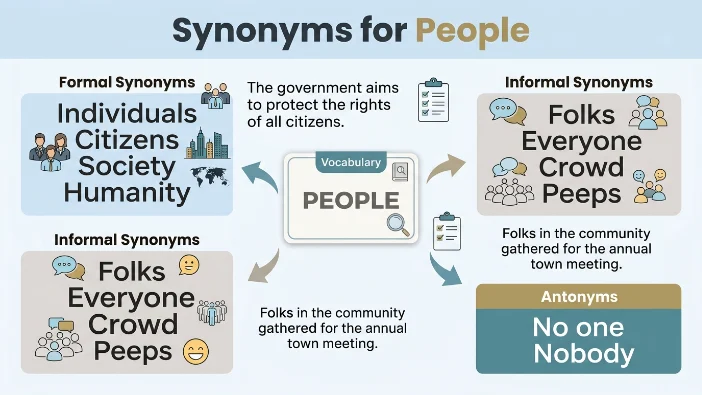
The best synonyms for “people” are individuals, folks, citizens, society, and the public. For formal writing, choose individuals or citizens. For casual conversation, choose folks or everyone. For collective reference, choose society, the public, or humanity. The right choice depends on your audience, tone, and what aspect of “people” you want to emphasize.
What Does “People” Mean?
“People” is a plural noun that refers to human beings in general or a specific group of humans.
At its core, the word carries three main meanings:
- Human beings collectively – all humans as a group
- A specific group – a particular set of humans (e.g., “the people of Texas”)
- The general public – ordinary citizens as opposed to leaders or officials
Part of speech: Plural noun (can also be a verb meaning “to populate,” but that’s less common)
Common usage examples:
- “Many people attended the festival.”
- “The people have the power to vote.”
- “She’s a people person.” (meaning someone who enjoys socializing)
Core Meaning of “People”
The word “people” captures the idea of humans as social, collective beings. It’s not just about individual humans it’s about humans in relationship to each other, as groups, communities, and societies.
Unlike “person,” which focuses on the individual, “people” emphasizes the collective. When you say “people,” you’re talking about humans as part of something larger: a population, a community, a nation, or humanity itself.
This collective quality makes “people” one of the most versatile words in English. It can be formal (“the people of this nation”), casual (“what do people think?”), deeply philosophical (“all people are created equal”), or everyday (“people say it’s going to rain”).
Grammar and Usage Notes
Plural noun: “People” is always plural when referring to humans. You say “people are,” not “people is.”
Collective noun: “People” can function as a collective noun when referring to a specific group: “the British people,” “the people of France.”
Common collocations and phrases:
- “People person” – someone who enjoys and is good with others
- “People of color” – a term for POC individuals
- “The people” – the general public or ordinary citizens
- “People power” – political action by ordinary citizens
- “People skills” – social abilities
When “people” sounds natural: Use it for general references, everyday conversation, and when you don’t need to be specific about the group.
When a synonym may work better: Use “individuals” for formal, precise writing.
- Use “folks” for casual, friendly communication.
- Use “citizens” when discussing legal or political contexts.
- Use “humanity” when talking about the entire human race in a philosophical sense.
Best Synonyms for People
| Synonym | Meaning | Tone | Best Use Case | Example Sentence |
|---|---|---|---|---|
| Individuals | Separate human beings | Formal | Academic, professional writing; emphasizing distinctness | “Each individual has unique strengths to contribute.” |
| Folks | People in a friendly, informal way | Informal | Casual conversation, friendly writing, direct address | “What do folks in your neighborhood think?” |
| Citizens | Members of a country or city | Formal | Political, legal, and civic contexts | “Citizens have the right to free speech.” |
| Society | People organized into a community | Formal | Sociological, philosophical, and political writing | “Society expects certain behaviors from its members.” |
| The public | Ordinary people as a whole | Neutral | News, journalism, formal announcements | “The public deserves to know the truth.” |
| Humanity | All human beings collectively | Formal, philosophical | Grand, sweeping statements about human nature | “Humanity has made remarkable progress.” |
| Community | People sharing a location or identity | Neutral | Social, local, and group contexts | “The community rallied to support the family.” |
| Population | All people in a specific area | Formal | Statistics, demography, data-focused writing | “The population of the city has grown rapidly.” |
| People group | A distinct cultural or ethnic group | Neutral | Anthropology, cultural studies | “The region is home to many indigenous people groups.” |
| Crowd | A large group of people together | Neutral | Events, gatherings, public spaces | “The crowd cheered as the band took the stage.” |
Common Synonyms for People
Folks
Short meaning: People in a casual, friendly way.
Best context: Everyday conversation, social media, personal messages.
Example sentence: “Some folks prefer coffee over tea in the morning.”
Everyone
Short meaning: All people.
Best context: General statements, everyday speech.
Example sentence: “Everyone wants to feel appreciated.”
The public
Short meaning: Ordinary people as a whole.
Best context: News reports, announcements, formal statements.
Example sentence: “The public is concerned about rising costs.”
Society
Short meaning: People living together in communities with shared rules.
Best context: Sociology, politics, commentary.
Example sentence: “Society shapes how we view success.”
Individuals
Short meaning: Single people considered separately.
Best context: Formal writing, business, legal contexts.
Example sentence: “Individuals should take responsibility for their actions.”
Citizens
Short meaning: Legally recognized members of a country.
Best context: Politics, law, civic discussions.
Example sentence: “Citizens have a duty to vote.”
Community
Short meaning: People with shared characteristics or location.
Best context: Local issues, social groups, identity-based discussions.
Example sentence: “The community came together to clean up the park.”
Formal Synonyms for People
When writing for academic, business, or professional audiences, use these formal alternatives:
Individuals
This word emphasizes each person as separate and distinct. It’s perfect when you want to highlight personal responsibility, uniqueness, or specific cases.
Best use: Academic writing, HR documents, legal contexts.
Example: “Individuals with prior experience will be given preference.”
Citizens
Use this when discussing political or legal rights and responsibilities.
Best use: Government documents, political writing, legal contexts.
Example: “Citizens have the right to petition the government.”
Society
This word captures people as a structured, organized collective with shared institutions and norms.
Best use: Sociological writing, political commentary, philosophy.
Example: “Society benefits when education is accessible to all.”
Population
Use this for statistical or demographic discussions about specific areas.
Best use: Research, reports, data analysis.
Example: “The population of the region has declined over the past decade.”
Humanity
This word makes broad, philosophical statements about the entire human race.
Best use: Philosophy, grand conclusions, inspirational writing.
Example: “Humanity’s greatest achievements stem from collaboration.”
The populace
A slightly old-fashioned but formal word for the general population.
Best use: Historical writing, political commentary, formal analyses.
Example: “The populace grew restless under the new policies.”
Informal Synonyms for People
For casual conversation, social media, and friendly writing, these alternatives work well:
Folks
This is the go-to informal synonym. It’s friendly, warm, and approachable.
Best use: Personal conversations, social media, customer service interactions.
Example: “Hey folks, thanks for coming today!”
Everyone
Short, direct, and universally understood.
Best use: General statements in everyday speech.
Example: “Everyone loved the new restaurant.”
Everybody
Slightly more casual than “everyone,” though they’re mostly interchangeable.
Best use: Very casual speech and writing.
Example: “Everybody knows that.”
Crowd
Used specifically when people are gathered together physically.
Best use: Events, concerts, public gatherings.
Example: “The crowd was really energetic tonight.”
Guys
Very informal and sometimes considered gendered, but often used as a neutral collective in casual speech.
Best use: Very casual conversation among friends.
Example: “Hey guys, let’s get going.”
Peeps
Slang for “people” or “friends,” popular in casual online communication.
Best use: Social media, texting, very informal contexts.
Example: “Going out with my peeps tonight.”
Strong Synonyms for People
These words carry more emotional weight, power, or intensity:
Humanity
This isn’t just a synonym it’s a statement about the entire human race and what connects us.
When to use: Writing about human nature, global issues, or philosophical topics.
When it’s too strong: Everyday conversation, casual references.
Example: “Humanity faces a critical choice about climate change.”
Mankind / Humankind
Large-scale words that encompass all people across time.
When to use: Sweeping historical or philosophical statements.
When it’s too strong: Casual conversation, specific contexts.
Example: “Humankind has always been curious about the stars.”
Society
Strong when used to discuss collective norms, rules, and expectations.
When to use: Social critique, political writing.
When it’s too strong: Simple references to people in everyday contexts.
Example: “Society often judges people by their appearances.”
The masses
Emphasizes large numbers of ordinary people, often in contrast to elites.
When to use: Political or social commentary.
When it’s too strong: Neutral or everyday situations.
Example: “The masses demanded change.”
The people
- When capitalized or emphasized, “the People” carries political weight.
- When to use: Political speeches, democracy discussions.
- When it’s too strong: Ordinary conversation.
- Example: “The people have spoken.”
Mild Synonyms for People
Sometimes you need softer, more neutral alternatives:
Individuals
This is neutral and mild, focusing on separate persons without strong emotion.
When to use: Formal writing, professional contexts.
Example: “Individuals may choose their own paths.”
Everyone
Mild and inclusive, without strong emotion.
When to use: Everyday statements, general observations.
Example: “Everyone needs a break sometimes.”
The public
Neutral and detached, suitable for objective reporting.
When to use: News, journalism, formal statements.
Example: “The public is generally supportive of the measure.”
Community
A warm but mild word that emphasizes connection and shared identity.
When to use: Social contexts, local issues.
Example: “The community responded with generosity.”
Society
Neutral enough for academic use, not overly emotional.
When to use: Objective social commentary.
Example: “Society has changed dramatically over the last century.”
Synonyms for People by Context
Everyday Conversation
For daily speech, stick with folks, everyone, or simply people. These sound natural and unforced.
- “Folks around here are pretty friendly.”
- “Everyone I know agrees.”
Professional Writing
In business contexts, prefer individuals, team members, or employees.
- “All individuals involved in the project will be recognized.”
- “The team members delivered excellent results.”
Academic Writing
Academics favor precise, formal words like individuals, subjects, participants, population, or society.
- “The subjects reported significant improvement.”
- “The population sampled was diverse.”
Creative Writing
Writers have more freedom. Choose words that match your tone and setting:
- Folks for a friendly, down-home tone
- Citizens for political or epic stories
- Crowd for scenes with gatherings
- Humanity for grand themes
- Souls for poetic or emotional passages
- “The souls gathered at the ancient site.”
- “Citizens filled the square, demanding answers.”
Marketing Copy
Marketers should choose words that resonate with their audience:
- Customers for buying audiences
- Users for product contexts
- Community for brand loyalty
- Folks for friendly, approachable brands
- Professionals for B2B marketing
- “Our customers love this feature.”
- “Join our growing community of satisfied users.”
Emotional Expression
When writing about feelings or human experiences, choose words with warmth:
- Souls for depth and spirituality
- Hearts for emotional resonance
- Humanity for compassion and connection
- “The hearts of the people were touched by the gesture.”
Technical Writing
For data, stats, and technical reports, use:
- Population for demographics
- Subjects for research
- Users for software or products
- Individuals for precise references
- “The user base grew by 20%.”
Personal Communication
In messages to friends and family, stay casual:
- Folks for friendly warmth
- Everyone for inclusivity
- Guys (in very casual contexts)
- Peeps for close friends
- “Just wanted to check in with you folks.”
Another Word for People in a Sentence
Here are 15 natural example sentences using different synonyms for “people”:
- Individuals “Individuals must complete the form by Friday.”
- Folks “I told folks at work about the new policy.”
- Citizens “Citizens are encouraged to vote in the upcoming election.”
- Society “Society tends to value productivity above all else.”
- The public “The public has the right to access government records.”
- Humanity “Humanity thrives when we work together.”
- Community “Our community raised enough money for the new playground.”
- Population “The population of the city has reached one million.”
- Crowd “The crowd went wild when the band started playing.”
- Everyone “Everyone deserves a second chance.”
- The masses “The masses often follow trends without questioning them.”
- Souls “Over a thousand souls attended the ceremony.”
- Mankind “Mankind has always been fascinated by the stars.”
- People group “The region protects the rights of every people group.”
- Folks “Some folks prefer the quiet life in the country.”
People Synonyms Compared
Understanding the subtle differences between near-synonyms helps you choose the perfect word:
| Synonyms | Difference | Best Use |
|---|---|---|
| Folks vs. People | “Folks” is casual and friendly; “people” is neutral | Use “folks” for warmth, “people” for general reference |
| Individuals vs. People | “Individuals” emphasizes separateness; “people” emphasizes collectiveness | Use “individuals” for precision, “people” for general reference |
| Citizens vs. People | “Citizens” has legal/political meaning; “people” is broader | Use “citizens” for political/legal contexts |
| Society vs. People | “Society” is about systems and organization; “people” is about individuals | Use “society” for institutional contexts |
| Humanity vs. People | “Humanity” is philosophical and global; “people” is more practical | Use “humanity” for broad, philosophical statements |
| The public vs. People | “The public” emphasizes ordinary citizens; “people” can be any group | Use “the public” for news and official contexts |
Words Similar to People
These words belong to the same semantic field but aren’t exact synonyms:
Population
Why related: Both refer to groups of humans.
Why not a direct replacement: “Population” is more specific it implies a defined group in a specific area, usually with statistical or demographic implications. “People” can refer to any group in any context.
When useful: When discussing demographics, statistics, or specific geographic areas.
Community
Why related: Both refer to groups of humans with shared bonds.
Why not a direct replacement: “Community” implies connection, shared identity, or shared location. “People” can refer to a group without any bond at all.
When useful: When emphasizing shared identity, support, or local connection.
Society
Why related: Both refer to humans in groups.
Why not a direct replacement: “Society” emphasizes the systems, institutions, and norms that organize people. “People” is about the humans themselves, not the structures.
When useful: When discussing social structures, norms, or institutions.
Crowd
Why related: Both can refer to groups of humans.
Why not a direct replacement: “Crowd” implies a physical gathering in one place. “People” can refer to groups anywhere, at any time.
When useful: When describing events, gatherings, or physical spaces.
Antonyms of People
| Antonym | Short Meaning | Example Sentence |
|---|---|---|
| No one | Not a single person | “No one showed up to the meeting.” |
| Nobody | No person | “Nobody knows the answer.” |
| One | A single person | “One can only hope for the best.” |
| Person | A single individual (used in singular contrast) | “Not a single person disagreed.” |
| Individual | A single person (used in singular contrast) | “The individual stands alone in that opinion.” |
How to Choose the Right Synonym for People
Follow these practical steps to pick the perfect word:
1. Match the context
Are you writing a formal business report? A casual email? An academic paper? Each setting calls for different words. Choose “individuals” for formal, “folks” for casual.
2. Match the tone
Warm and friendly? Go with “folks” or “community.” Objective and neutral? Use “the public” or “society.” Philosophical and grand? “Humanity” or “mankind.”
3. Check the intensity
Do you want strong emotional resonance (“humanity,” “souls”) or mild, neutral language (“individuals,” “the public”)? Choose accordingly.
4. Think about your reader
Who is your audience? What words will they understand best? What tone will resonate with them? Always write with your reader in mind.
5. Check whether the synonym is exact or only related
Some words on this list are exact synonyms in certain contexts, while others are only related. “Folks” is a direct replacement in casual contexts. “Society” is not always a direct replacement it has a specific meaning about organization and institutions.
6. Keep the sentence natural
Read your sentence aloud. Does the new word fit naturally? If it sounds forced or awkward, try a different word.
7. Use simple words when clarity matters
If you’re writing for a general audience, stick with familiar words like “people,” “folks,” or “everyone.” Save “populace” and “masses” for specific, appropriate contexts.
Common Mistakes When Using Synonyms for People
Choosing a word with the wrong tone
Using “citizens” in a casual setting sounds overly formal. Using “folks” in an academic paper sounds too casual. Match the tone to the context.
Using a synonym that is too strong
“Humanity” carries weight. Don’t use it when you just mean “a group of people at a meeting.” Overusing strong words weakens their impact.
Using a formal word in casual writing
“I chatted with several individuals at the party” sounds stiff. “I chatted with several people at the party” sounds natural.
Using a casual word in professional writing
“Our customers are good folks” works for a friendly brand but sounds unprofessional in a formal business report.
Replacing “people” without checking meaning
“People” is versatile. Some synonyms are more specific. “Population” means a group in a specific area. “Society” means an organized community. Don’t just swap words check if they truly fit.
Treating related words as exact synonyms
“Community” and “people” are related, but “community” implies shared identity or location. “People” does not always imply that. Know the difference.
Making the sentence sound unnatural
Overly formal or obscure words can make your writing feel forced. If a synonym sounds unnatural, stick with the simpler word.
Quick Synonym List for People
Common synonyms:
folks, everyone, everybody, the public, community, citizens, individuals
Formal synonyms:
individuals, citizens, society, population, humanity, the populace, persons
Informal synonyms:
folks, everyone, everybody, crowd, guys, peeps
Strong synonyms:
humanity, mankind, humankind, society, the masses, the people
Mild synonyms:
individuals, everyone, the public, community, society
Related words:
population, community, society, crowd, public, citizens, humanity
FAQs
What is the best synonym for “people”?
The best synonym depends on your context.
- For formal writing, use individuals or citizens.
- For casual conversation, use folks or everyone.
- For collective reference, use society or the public.
What is another word for “people” in formal writing?
In formal writing, the best alternatives are individuals, citizens, society, population, and humanity. These words maintain professionalism while varying your language.
What is an informal synonym for “people”?
The most common informal synonyms are folks, everyone, crowd, guys (very casual), and peeps (slang). These work well in conversation, social media, and friendly writing.
What is a stronger word for “people”?
Stronger words include humanity, mankind, humankind, the masses, and society. These carry more emotional weight and are suitable for philosophical, political, or grand statements.
What is a milder word for “people”?
Milder, more neutral alternatives include individuals, the public, and everyone. These are less emotional and work well in objective, factual writing.
What words are similar to “people”?
Related words include population, community, society, crowd, public, and citizens. These belong to the same semantic field but have more specific meanings.
What is the opposite of “people”?
The most common antonyms are no one, nobody, and one (as in a single person). These emphasize the absence of people or the singular.
How do I choose the right synonym for “people”?
Consider your audience, context, tone, and the specific meaning you want to convey. Formal contexts call for formal words; casual contexts call for casual words. Always prioritize clarity and naturalness.
Conclusion
Finding the right synonym for “people” doesn’t have to be difficult. The key is understanding that “people” has multiple meanings and uses, and the best alternative depends on your specific context, tone, and audience.
- For formal writing, reach for individuals or citizens.
- For casual conversation, folks or everyone works perfectly.
- For philosophical statements, humanity or mankind adds depth and resonance.
- And for neutral, everyday use, sometimes “people” is simply the best word.
The most important rule? Keep your reader in mind. Choose the word that fits your context, sounds natural, and communicates clearly. That’s the mark of a thoughtful writer.
Read More Related Articles:
- Synonyms For History | Transform Your Writing Overnight In 2026
- Synonyms For Task | Choose the Perfect Word For Work and Responsibilities In 2026
- Synonyms For Detrimental | Add Depth to Your Writing In 2026

Evelyn Turner is a content creator at SynonymsAura.com who enjoys exploring the richness of the English language. Her work focuses on word meanings, synonyms, expressions and everyday language usage, helping readers communicate with greater clarity and confidence.