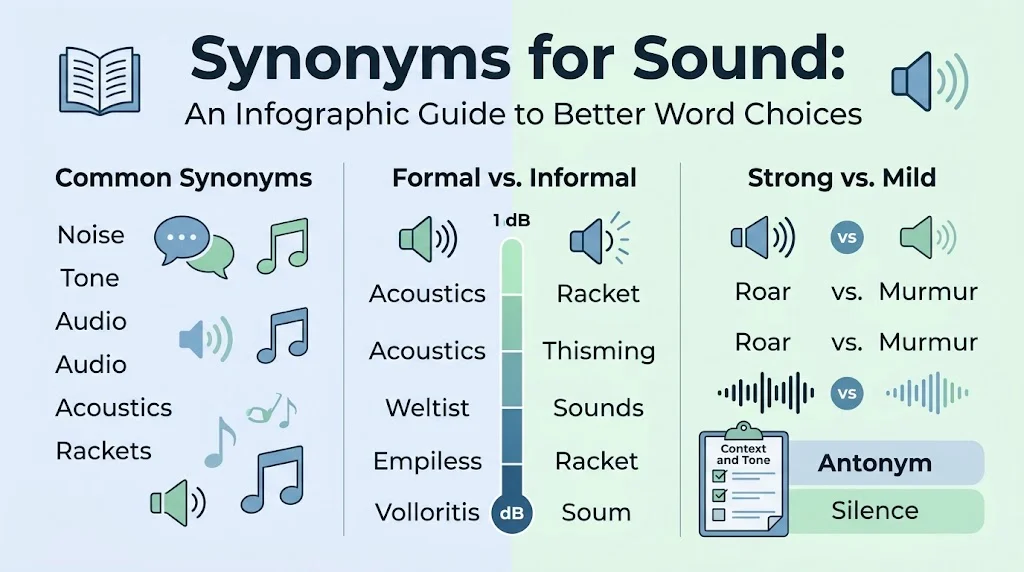
When searching for synonyms for sound, it’s important to understand context—whether you’re referring to audio, noise, or a general sensory experience. A strong sound synonym can elevate your writing, helping you replace repetitive terms with precise and engaging language. From everyday communication to professional content, finding another word for sound ensures clarity and impact.
This guide covers everything from a simple noise synonym to advanced synonyms of audio, giving you a wide range of words for sound that fit different tones and situations. Whether you’re a student, writer, or content creator, mastering these synonyms of sound will help you express ideas more effectively and naturally.
Best Synonyms for Sound
The best synonyms for sound are noise, tone, audio, and acoustics. The right choice depends on the context and the specific meaning you want to convey.
What Does “Sound” Mean?
In its most basic sense, “sound” is a noun that refers to something you can hear. It is the vibration of air, water, or other materials that travels to your ears and is interpreted by your brain.
- Part of Speech: Noun, verb, adjective, and adverb.
- Simple Definition: A vibration that travels through a medium, stimulating the sense of hearing.
- Example Sentences:
- The sound of rain on the roof was very relaxing.
- I could hear the sound of a car engine in the distance.
Core Meaning of Sound
The core idea behind “sound” is the auditory experience. It’s the quality of something that is heard. It can refer to any audible vibration, from the faintest whisper to the loudest explosion. It’s the medium through which we experience music, speech, and the ambiance of our environment. Think of it as the audible sensation that fills our world.
Grammar and Usage Notes
- Noun: “I heard a strange sound.” (The most common usage).
- Verb: “Please sound the alarm.” (To cause a device to make a noise). “That sounds like a good idea.” (To seem or appear based on what is heard or inferred).
- Adjective: “She is of sound mind.” (Meaning healthy, in good condition, or sensible).
- Adverb: “He was sound asleep.” (Meaning deeply).
When using “sound,” it’s incredibly versatile. It fits naturally into almost any context. However, when you need to be more precise, a synonym is often better. For example, “audio” is better in a technical context, while “racket” is a stronger, more informal choice.
Best Synonyms for Sound
This table provides a quick overview of the most accurate synonyms for “sound.
| Synonym | Meaning | Tone | Best Use Case | Example Sentence |
|---|---|---|---|---|
| Noise | Unwanted, unpleasant, or loud sound. | Informal, Negative | Describing disturbances or things that irritate. | The construction noise outside was unbearable. |
| Tone | The quality or character of a sound. | Formal, Neutral | Describing the pitch, timbre, or mood of a voice or instrument. | The doctor’s stern tone worried the patient. |
| Audio | Sound, especially when recorded, transmitted, or reproduced. | Formal, Technical | Technical contexts, media production, and electronics. | The audio quality in the podcast was excellent. |
| Acoustics | The properties or qualities of a room or building that determine how sound is heard. | Formal, Technical | Architecture, music, and sound engineering. | The acoustics in the concert hall were fantastic. |
| Volume | The loudness or quietness of a sound. | Neutral | Describing the intensity of a sound. | Could you turn up the volume on the TV? |
| Resonance | A deep, full, and reverberating sound. | Formal, Literary | Creative writing and describing impactful sounds. | The resonance of the cello filled the room. |
| Cadence | A rhythmic flow of sound. | Formal, Literary | Describing speech patterns, poetry, or music. | The gentle cadence of her voice was soothing. |
Common Synonyms for Sound
These are everyday synonyms you can use in normal writing and conversation.
Noise
Short Meaning: An unpleasant or loud sound.
Best Context: Use this when you want to imply that the sound is annoying, distracting, or unwanted.
Example Sentence: We couldn’t hear ourselves think over the noise of the traffic.
Tone
Short Meaning: The quality or character of a sound, often relating to pitch or emotional quality.
Best Context: Great for describing voices, musical instruments, or the general feeling of a sound.
Example Sentence: The apologetic tone in his voice made me feel better.
Audio
Short Meaning: Sound, particularly when it’s recorded, transmitted, or broadcast.
Best Context: Best used in technical, media, or professional production environments.
Example Sentence: The audio on this video is much clearer than on the last one.
Volume
Short Meaning: The degree of loudness or softness of a sound.
Best Context: Use when the main point is about how loud or quiet something is.
Example Sentence: Please check the volume on your microphone before the call.
Echo
Short Meaning: A sound that is repeated as it bounces off a surface.
Best Context: Describing sounds in large, empty spaces like canyons or caverns.
Example Sentence: We heard the echo of our footsteps in the empty hall.
Formal Synonyms for Sound
When writing reports, academic papers, or business communications, these are your best options.
Acoustics
Explanation: This is the scientific term for the study of sound, but it’s also used to describe the overall quality of sound in a physical space.
Best Use: Architecture, music, and physics. It conveys a high level of precision.
Example Sentence: The architect consulted a specialist to improve the building’s acoustics.
Auditory
Explanation: This word means relating to the sense of hearing. It’s often used as an adjective.
Best Use: Medical, scientific, or psychological contexts.
Example Sentence: The patient’s auditory processing abilities were normal.
Sonance
Explanation: A more technical word for the quality or state of sounding. It’s a synonym for resonance and audibility.
Best Use: Formal writing or analysis of sound in literature or music theory.
Example Sentence: The poet’s choice of words created a harsh and jarring sonance.
Audio
Explanation: As a formal term, “audio” is standard in professional media, communications, and technology.
Best Use: Technical reports, engineering, and digital media.
Example Sentence: The audio interface connects the microphone to the computer for recording.
Informal Synonyms for Sound
For social media, texts, and casual chats, these synonyms fit right in.
Noise
Explanation: This is one of the most common informal words for sound, especially when it’s unwanted.
Best Use: Talking about everyday disturbances or complaints.
Example Sentence: My neighbor’s dog is making so much noise tonight.
Racket
Explanation: A very informal word for a loud, clattering, and unpleasant noise.
Best Use: Describing a chaotic and irritating disturbance.
Example Sentence: Stop making that racket! I’m trying to read.
Clamor
Explanation: A loud and confused noise, often made by a group of people.
Best Use: Describing protests, crowds, or other situations with many simultaneous voices.
Example Sentence: The clamor from the fans outside the stadium was deafening.
Buzz
Explanation: A low, continuous humming or murmuring sound.
Best Use: Describing the sound of an electronic device, insects, or a room full of people talking quietly.
Example Sentence: I could hear the buzz of the refrigerator from the other room.
Din
Explanation: A loud, unpleasant, and prolonged noise.
Best Use: Similar to “racket,” it describes a long-lasting, irritating sound.
Example Sentence: The din of the crowded marketplace was overwhelming.
Strong Synonyms for Sound
These synonyms pack a punch, conveying power, intensity, or overwhelming volume.
Roar
Explanation: A deep, loud, and resonant sound.
Best Use: This is perfect for describing large animals, crowds, thunder, or powerful engines.
Example Sentence: We could hear the roar of the waterfall from miles away.
Thunder
Explanation: A loud, deep, rumbling sound, like thunder.
Best Use: Use to describe the sound of a massive explosion, a large crowd, or a forceful voice.
Example Sentence: The politician’s speech was met with the thunder of applause.
Din
Explanation: A loud, continuous, and jarring noise.
Best Use: Describing a chaotic environment where different sounds blend together unpleasantly.
Example Sentence: The din of the city streets made it hard to sleep.
Uproar
Explanation: A loud and impassioned noise, usually from a crowd protesting or expressing strong feeling.
Best Use: Describing a public outcry or a tumultuous event.
Example Sentence: The senator’s comment caused an uproar in the chamber.
Mild Synonyms for Sound
If you need a softer, quieter, or more neutral word, these are a great choice.
Murmur
Explanation: A soft, low, or indistinct sound.
Best Use: To describe quiet voices, the rustling of leaves, or the gentle flow of water.
Example Sentence: We could only hear the murmur of distant conversation.
Whisper
Explanation: A soft, quiet sound made by speaking without vibration of the vocal cords.
Best Use: This is the ultimate word for quiet, intimate communication.
Example Sentence: I spoke in a whisper so I wouldn’t wake the baby.
Hiss
Explanation: A soft, sharp, sibilant sound.
Best Use: Describing the sound of steam, a snake, or someone speaking in a menacing undertone.
Example Sentence: I heard the hiss of steam escaping from the kettle.
Rustle
Explanation: A soft, muffled, crackling sound, like that of dry leaves or paper.
Best Use: This is perfect for describing nature or quiet physical movements.
Example Sentence: The rustle of leaves in the breeze was the only sound.
Hum
Explanation: A low, steady, continuous sound.
Best Use: Describing the sound of machinery, insects, or a person singing with closed lips.
Example Sentence: The hum of the air conditioner provided a peaceful background noise.
Synonyms for Sound by Context
The perfect synonym depends entirely on the situation. Here’s how to choose.
Everyday Conversation
In casual talk, keep it simple. Use noise to complain, volume to ask for something louder or quieter, or just stick with sound for general use.
- “The noise from the party next door is driving me wild.”
- “Can you turn the volume up on the radio?”
Professional Writing
In a business or professional setting, aim for precision. Audio is excellent for technical topics, while tone is crucial for communication and marketing.
- “We need to improve the audio quality of our product videos.”
- “The tone of this email is too aggressive for a client.”
Academic Writing
Academics and scientists will use words like acoustics, auditory, and sonance. The goal here is to be as precise and clinical as possible.
- “The study measured participants’ auditory responses to different frequencies.”
- “The auditorium was designed with state-of-the-art acoustics.”
Creative Writing
Creative writers have the most freedom. Use evocative words like resonance, murmur, roar, or cadence to create mood and atmosphere.
- “The resonance of his voice settled in the silent room.”
- “The gentle cadence of the waves was hypnotic.”
Emotional Expression
When feelings are involved, word choice is critical. A racket implies annoyance, a roar suggests power, and a whisper implies intimacy.
- “The baby’s cry was a heartbreaking wail.” (Strong, emotional).
- “Her voice was a soothing murmur that calmed my anxiety.” (Soothing, mild).
Another Word for Sound in a Sentence
Seeing synonyms in action is the best way to understand their nuance. Here are many examples using different alternatives.
- The noise from the street construction made it impossible to sleep in.
- I recognized the confident tone in her voice immediately.
- The audio on this recording is a bit too low.
- The acoustics in the chapel made the choir sound angelic.
- The din of the cafeteria was overwhelming on the first day of school.
- A sudden racket from the kitchen made everyone jump.
- The roar of the engine signaled the start of the race.
- I could only hear a faint murmur of conversation upstairs.
- The rustle of the paper gave away his hiding spot.
- The hiss of the snake warned us to keep our distance.
- The resonance of the cello was deep and moving.
- We heard the echo of our laughter in the empty canyon.
- The clamor of the fans reached a fever pitch when the team scored.
- There was a rhythmic cadence to the poet’s speech that was unforgettable.
- The buzz of the bee was the only sound in the garden.
Sound Synonyms Compared
Some words are often confused. Here’s how to tell the difference between the most closely related synonyms.
| Synonym | Meaning & Tone | Why Not Just Use “Sound”? | Best Use Case |
|---|---|---|---|
| Sound | General, neutral, all-purpose. | It’s often too vague. | For general hearing events. |
| Noise | Unwanted, unpleasant sound. | “Sound” is neutral; “noise” is negative. | Complaints or disturbances. |
| Tone | The character or quality of the sound. | “Tone” is more specific about mood. | Describing voices or instruments. |
| Audio | Technical or recorded sound. | “Audio” implies a technological component. | Media, electronics, and technical work. |
| Acoustics | The science or properties of sound in a space. | This is a niche term; “sound” is broader. | Architecture and sound engineering. |
| Volume | The loudness or softness. | This is only one aspect of “sound.” | Describing or adjusting loudness. |
Words Similar to Sound
These words belong to the same family as “sound” but aren’t exact synonyms. They relate to the idea of hearing or making a sound.
- Cacophony: A harsh, discordant mixture of sounds. It’s a great, advanced word for a chaotic and unpleasant noise.
- Why it’s related: It’s a specific type of sound (a bad one).
- Why it’s not a direct replacement: You can’t just say “I heard a cacophony” for any sound; it must be loud and chaotic.
- Symphony: An elaborate musical composition or a harmonious combination of sounds.
- Why it’s related: It describes a beautiful and complex arrangement of sounds.
- Why it’s not a direct replacement: It’s almost always used metaphorically for pleasant, organized sounds, whereas “sound” is neutral.
- Timbre: The distinct character or quality of a sound, separate from its pitch and volume.
- Why it’s related: It’s a specific characteristic of a sound.
- Why it’s not a direct replacement: It’s a technical term; you wouldn’t say “I heard a timbre.”
Antonyms of Sound
While “sound” is a noun for something you hear, its antonyms relate to silence or the absence of hearing.
| Antonym | Short Meaning | Example Sentence |
|---|---|---|
| Silence | The complete absence of sound. | An uncomfortable silence fell over the room. |
| Quiet | The state of being still or without much noise. | I love the peace and quiet of the countryside. |
| Stillness | The absence of movement or sound. | The stillness of the night was broken by a single bird’s call. |
How to Choose the Right Synonym for Sound
Here are seven practical steps to ensure you always pick the best word.
- Identify the Context: Are you writing a science paper, a text to a friend, or a novel? This is your starting point.
- Define the Tone: Do you want to be formal, informal, literary, or neutral? Your word choice dictates the tone.
- Consider the Intensity: Is the sound a gentle murmur or a deafening roar? Choose a word that matches the volume.
- Think About the Reader: Who is your audience? Use vocabulary they will easily understand.
- Check for Exact Meaning: Does the synonym directly replace “sound,” or is it only related? For example, “acoustics” is related but not a direct replacement in many contexts.
- Read It Aloud: Does the sentence sound natural with your chosen synonym? If not, try another.
- Keep It Simple: Unless you need a fancy word for a specific reason, the simplest option is often the best.
Common Mistakes When Using Synonyms for Sound
Using a thesaurus without understanding context is a recipe for awkward writing. Here are some common errors to avoid.
- Using “Noise” as a Neutral Word: Remember, “noise” almost always has a negative connotation. Don’t say “The noise of the birds was pleasant.” Use “sound” or “song.”
- Using “Audio” Casually: Unless you’re talking about a recording or broadcast, “sound” is better. It sounds strange to say “I heard the audio of her voice” when you can just say “I heard her voice.”
- Confusing “Tone” and “Volume”: “Tone” is the quality of the sound; “volume” is the loudness. “Her harsh tone” is different from “Her high volume.”
- Using Fancy Words Incorrectly: Don’t use “cacophony” to describe a quiet conversation. Using a big word incorrectly is worse than using a simple one correctly.
- Treating Related Words as Exact Synonyms: Words like “cacophony” and “symphony” are related but are not interchangeable with the neutral “sound.
Quick Synonym List for Sound
Here is a clean, scannable list for quick reference.
- Common: Noise, Tone, Audio, Volume, Echo.
- Formal: Acoustics, Auditory, Sonance.
- Informal: Racket, Clamor, Buzz, Din, Hiss.
- Strong: Roar, Thunder, Uproar.
- Mild: Murmur, Whisper, Rustle, Hum.
FAQs
What is the best synonym for sound?
The best synonym for sound depends on the context. For general use, noise and tone are excellent. For technical contexts, audio and acoustics are better choices. Consider what you are trying to convey before selecting a word.
What is another word for sound in writing?
In creative writing, popular synonyms for sound include resonance, din, murmur, roar, and cadence. These words provide more imagery and emotional depth than the simple word “sound.”
What is a formal synonym for sound?
Audio and acoustics are two of the most common formal synonyms for sound. “Acoustics” is often used in a scientific or architectural context, while “audio” is used in professional media and technology. Another formal term is “auditory,” which relates to the sense of hearing.
What is an informal synonym for sound?
Noise is a very common informal synonym for sound, especially for unwanted sounds. Other informal terms include racket, clamor, buzz, and din. These are perfect for casual conversations and social media.
What is a stronger word for sound?
Stronger words for sound convey more intensity, volume, or power. Good examples include roar, thunder, and uproar. Use these words to describe sounds that are overwhelming, loud, or emotionally charged.
What is a milder word for sound?
Milder words are used to describe softer, quieter, or more gentle sounds. Excellent examples include murmur, whisper, rustle, and hum. These are perfect for creating a peaceful or quiet atmosphere in your writing.
What words are similar to sound?
Words that are related to sound but are not always exact synonyms include cacophony, symphony, and timbre. These are all specific types of sounds or specific characteristics of sound.
What is the opposite of sound?
The most direct antonym of sound is silence. Other antonyms include quiet and stillness. These words all describe the absence of sound.
Conclusion
Understanding the many synonyms for sound is an essential skill for any writer or speaker. It allows you to move beyond vague language and choose the perfect word for every situation. Whether you need the technical precision of “audio,” the emotional weight of “roar,” or the soft calm of a “murmur,” your choice of synonym directly shapes how your audience experiences your words. Remember to always consider context, tone, and intensity, and you’ll communicate with greater clarity and impact.
Read More Related Articles:
- Synonyms for Humble | Try These Better and More Expressive Synonyms In 2026
- Synonyms For Felt | Make Your Writing More Descriptive In 2026
- Synonyms for Stress | Meaning, Examples, and Better Word Choices In 2026

Grace Phillips contributes content to SynonymsAura.com, where she writes about language, vocabulary and everyday communication. Her work is centered on helping readers find the right words and express themselves with greater clarity and confidence.