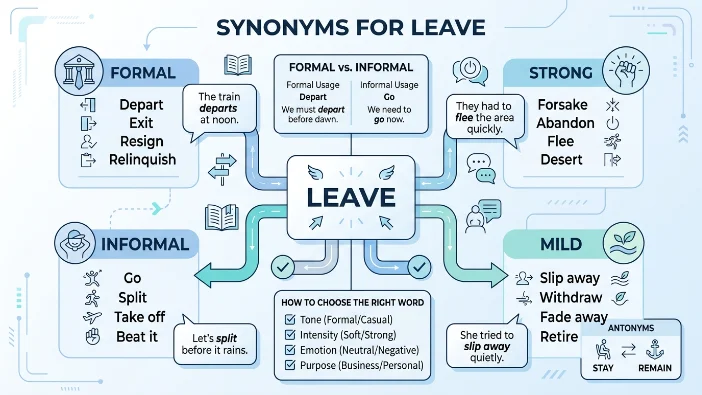
If you’ve ever paused mid-sentence wondering whether to use “depart,” “quit,” or “abandon,” you’re not alone. The best synonyms for leave depend entirely on what you’re trying to say because “leave” has more meanings than most people realize. You can leave a room, leave a job, leave someone behind, or take leave from work. Each situation calls for a different word.
This guide covers every angle: formal and informal alternatives, strong and mild options, context-specific choices, and common mistakes to avoid. By the end, you’ll know exactly which synonym fits your sentence.
Best Synonyms for Leave
The best synonyms for leave are depart, withdraw, quit, exit, abandon, forsake, and vacation. The right choice depends on tone, context, and intensity. For leaving a place, use “depart” or “exit.” For leaving a job, use “quit” or “resign.” For leaving someone, use “abandon” or “forsake.” For time off work, use “vacation” or “leave of absence.”
What Does Leave Mean?
Leave” is a versatile word that functions as both a verb and a noun. As a verb, it means to go away from a place or person, to cause something to remain, or to stop doing something. As a noun, it means permission to be absent from work or duty, or the act of departing.
Here are two simple examples:
- I need to leave for the airport by 6 AM. (verb)
- She took a month of leave after her surgery. (noun)
Core Meaning of Leave
At its heart, “leave” carries the idea of separation, departure, or letting something remain behind.
- When you leave a room, you physically remove yourself from that space.
- When you leave a job, you end your association with that employer.
- When you leave a message, you’re letting something stay behind for someone else.
The word also conveys intentionality or sometimes forgetfulness. You might leave your keys on the counter by accident, or you might leave a relationship on purpose. This dual nature makes “leave” incredibly useful but also tricky to replace with a single synonym.
Grammar and Usage Notes
Part of speech: Verb (transitive and intransitive) and noun
Common sentence patterns:
- Leave + place: I left the office early.
- Leave + person/thing: She left her husband.
- Leave + object + complement: The news left him speechless.
- Take + leave + of + person: He took leave of his colleagues.
Common collocations:
- leave behind
- leave out
- leave off
- leave of absence
- annual leave
- maternity leave
- sick leave
When “leave” sounds natural: “Leave” works well in everyday conversation, professional settings, and writing. It’s neutral enough for most situations.
When a synonym works better: If you need more precision, formality, or emotional weight, a synonym often serves better. For example, “abandon” carries stronger emotion than “leave,” and “depart” sounds more formal.
Best Synonyms for Leave
| Synonym | Meaning | Tone | Best Use Case | Example Sentence |
|---|---|---|---|---|
| Depart | To go away from a place | Formal | Travel, scheduled leaving | The train departs at noon. |
| Withdraw | To remove oneself from a situation | Formal | Military, politics, formal settings | The troops withdrew from the region. |
| Quit | To stop doing something or leave a job | Neutral | Jobs, habits | She quit her job last week. |
| Exit | To go out of a place | Neutral | Buildings, rooms, stages | The actor exited the stage. |
| Abandon | To leave someone or something permanently | Strong | Relationships, responsibilities | He abandoned his family. |
| Forsake | To give up or renounce | Strong | Beliefs, people, commitments | She forsook her former friends. |
| Resign | To formally leave a position | Formal | Jobs, offices | The CEO resigned from the board. |
| Desert | To leave someone without help | Strong | Military, relationships | The soldier deserted his post. |
| Relinquish | To give up control or possession | Formal | Power, rights, control | He relinquished his claim to the throne. |
| Mislay | To leave something by forgetting where it is | Neutral | Objects, personal items | I mislaid my glasses again. |
Common Synonyms for Leave
These everyday alternatives work well in both writing and conversation.
Go away
- Meaning: To leave a place
- Best context: Casual conversation, telling someone to leave
- Example: The kids need to go away and let me work in peace.
Head out
- Meaning: To begin a journey or leave a place
- Best context: Casual, friendly situations
- Example: We should head out soon if we want to make the movie.
Pull out
- Meaning: To withdraw from a situation or place
- Best context: Military, business, commitments
- Example: The company pulled out of the deal at the last minute.
Take off
- Meaning: To leave suddenly or begin a journey
- Best context: Informal, describing quick departures
- Example: He took off before anyone could say goodbye.
Move out
- Meaning: To leave a residence or remove oneself
- Best context: Changing homes, leaving a place permanently
- Example: She’s moving out of her apartment next month.
Walk out
- Meaning: To leave abruptly, often in protest
- Best context: Workplaces, negotiations, relationships
- Example: The employees walked out after the pay cut announcement.
Formal Synonyms for Leave
For academic writing, business reports, or professional communication, these formal alternatives add precision and authority.
Depart
Use “depart” when you need a direct, formal replacement for leaving a place. It’s common in travel writing, official announcements, and polite conversation.
- The flight departs from Terminal A at 6 PM.
Withdraw
Choose “withdraw” when someone removes themselves from a situation, especially in political, military, or organizational contexts. It suggests a deliberate, often strategic exit.
- The country withdrew its ambassador after the diplomatic dispute.
Resign
Use “resign” specifically for leaving a job, position, or office. It implies a formal, often written notification.
- The board accepted her resignation as the finance director.
Relinquish
Select “relinquish” when giving up control, power, or possession. It’s often used in legal or formal writing about rights or authority.
- He relinquished his inheritance to his younger brother.
Bequeath
Use “bequeath” in legal contexts when referring to leaving property or money to someone after death.
- The philanthropist bequeathed his entire fortune to the university.
Forsake
“Forsake” appears in formal and literary writing. It means to give up something valued, often a belief, habit, or relationship.
- The politician forsook his earlier principles.
Delegation
Use this when referring to the act of leaving tasks or responsibilities to others.
- Effective management requires delegation of routine tasks.
Renounce
“Renounce” is formal and carries weight. It means to formally give up a claim, right, or belief.
- The king renounced his throne.
Informal Synonyms for Leave
For casual conversation, texts, and friendly writing, these alternatives sound natural and relaxed.
Skedaddle
Meaning: To leave quickly
Best context: Playful, lighthearted situations
Example: It’s getting late time to skedaddle.
Make tracks
Meaning: To leave or depart
Best context: Casual speech, telling someone it’s time to go
Example: We should make tracks before the traffic gets worse.
Bounce
Meaning: To leave casually
Best context: Social situations, hanging out with friends
Example: I’m going to bounce see you tomorrow.
Hit the road
Meaning: To begin a journey or leave
Best context: Road trips, travel, casual goodbyes
Example: We need to hit the road by 8 AM.
Clear off
Meaning: To leave a place (often used as a command)
Best context: Informal, sometimes annoyed tone
Example: Clear off before I call security.
Decamp
Meaning: To leave suddenly or secretly
Best context: Playful or dramatic informal situations
Example: The whole team decamped to the pub after work.
Ditch
Meaning: To leave someone or something behind
Best context: Casual, often used about relationships or events
Example: She ditched her friends to go to the party.
Hook it
Meaning: To leave quickly
Best context: British slang, very informal
Example: We hooked it before the rain started.
Chuck
Meaning: To leave or throw away
Best context: Very informal, often about discarding things or people
Example: She chucked her old job and started a new career.
Strong Synonyms for Leave
These alternatives carry more emotional weight or intensity. Use them when you want to emphasize the gravity of a departure.
Abandon
“Abandon” means to leave someone or something completely and permanently, often in a way that feels irresponsible or heartless.
- She abandoned her childhood home after the fire.
Desert
“Desert” implies leaving someone without help or support, especially in a difficult situation. It’s stronger than “leave” and suggests betrayal.
- The soldier was court-martialed for deserting his unit.
Forsake
“Forsake” carries a sense of renunciation or giving up something cherished.
- Despite the pressure, he refused to forsake his faith.
Dump
“Dump” is informal and strong, often used when ending a romantic relationship.
- She dumped her boyfriend after discovering the truth.
Jilt
“Jilt” is specifically used for leaving a romantic partner suddenly, especially at the altar or in a committed relationship.
- He jilted his fiancée three days before the wedding.
Ditch
“Ditch” means to leave someone or something behind, often with a sense of relief or carelessness.
- The team ditched their underperforming coach.
Walk out on
This phrase adds emotional weight to leaving someone, especially in a relationship context.
- He walked out on his family without any explanation.
Leave in the lurch
Meaning: To leave someone in a difficult situation
Abstain from
Meaning: To deliberately avoid or leave alone
- She abstained from voting on the controversial issue.
Mild Synonyms for Leave
When you need a softer or more neutral way to say “leave,” these alternatives work well.
Step away
Meaning: To move away, often temporarily
Best context: Taking a break or giving space
Example: Let’s step away from the project for a day and look at it fresh.
Back off
Meaning: To move away or withdraw
Best context: Giving someone physical or emotional space
Example: The manager backed off once he saw the data.
Ease out
Meaning: To leave gradually or gently
Best context: Transitioning, changing roles
Example: She eased out of the company after 30 years.
Phase out
Meaning: To gradually stop or leave
Best context: Long-term changes, ending practices
Example: The company phased out the old policy over six months.
Move on
Meaning: To leave behind and continue
Best context: Emotional contexts, letting go
Example: It’s time to move on from the past.
Take a break
Meaning: To temporarily leave or pause
Best context: Work, study, stressful situations
Example: Let’s take a break and come back to this later.
Drift away
Meaning: To leave slowly or subtly
Best context: Relationships that end gradually
Example: They drifted away over the years.
Slip away
Meaning: To leave quietly or unnoticed
Best context: Subtle departures
Example: She slipped away from the party without anyone noticing.
Synonyms for Leave by Context
Everyday Conversation
For daily chats, “go,” “head out,” “take off,” and “bounce” sound natural and easy. You can also use “get going” when you’re in a hurry: I should get going before the stores close.
Professional Writing
In workplace communication, use “depart,” “resign,” “withdraw,” or “step down.” For emails, “I need to leave early” works fine, but “I need to depart at 4 PM” sounds more professional. “Resign” and “step down” are appropriate for leaving positions formally.
Academic Writing
Formal alternatives like “withdraw,” “depart,” “relinquish,” and “abstain” fit well in essays and research papers. Use “depart” when discussing travel or migration: Participants were asked to depart the study area. “Relinquish” works for discussions of power or control.
Creative Writing
“Forsake,” “abandon,” “desert,” and “relinquish” add emotional weight to fiction and poetry. Use “depart” for a formal, measured exit: The king departed the chamber in silence. Use “abandon” for dramatic moments: She abandoned her possessions and fled. Use “slip away” for subtle exits: He slipped away into the night.
Marketing Copy
“Step away,” “move on,” and “phase out” work well when talking about leaving behind old habits or products. “Phase out” suggests gradual, positive change: We’re phasing out our old software to focus on innovation. “Move on” suggests fresh starts: Ready to move on from outdated business practices?
Emotional Expression
For deep emotional writing, “abandon,” “desert,” “forsake,” and “jilt” carry significant weight. “Abandon” conveys loss and betrayal: The feeling of being abandoned haunted her. “Forsake” suggests personal sacrifice or renunciation: She forsook all comfort for her ideals. “Jilted” carries romantic hurt: He felt jilted and humiliated.
Technical Writing
“Withdraw,” “exit,” “depart,” and “remove” appear in technical documentation. “Withdraw” is common in finance: Withdraw funds from the account. “Exit” works for computer programs: Click the button to exit the application.
Personal Communication
“Head out,” “take off,” “get going,” and “bounce” feel natural with friends and family: We’re heading out for dinner want to join? “Get going” works as a gentle reminder: We should get going soon.
Another Word for Leave in a Sentence
Here are real-world examples showing different synonyms in action:
- Depart: The next bus departs from the station in ten minutes.
- Withdraw: I decided to withdraw my application for the job.
- Quit: He quit smoking last year and hasn’t touched a cigarette since.
- Exit: Please exit the building through the side doors.
- Abandon: The storm forced them to abandon their vacation plans.
- Forsake: The old man forsook all worldly pleasures for a life of simplicity.
- Resign: The senator resigned her seat after the scandal broke.
- Desert: The captain refused to desert his sinking ship.
- Relinquish: The company relinquished control of its foreign subsidiaries.
- Bequeath: My aunt bequeathed her antique china collection to the museum.
- Skedaddle: We skedaddled out of there before the music stopped.
- Move on: After a long pause, she knew it was time to move on.
- Ditch: I ditched my old car and bought a bike for city commuting.
- Farewell: He said a heartfelt farewell to his colleagues.
- Adieu: They bade adieu to the village that had been their home.
Leave Synonyms Compared
| Synonyms | Core Difference | Tone | Best Use |
|---|---|---|---|
| Leave vs. Depart | “Leave” is general; “depart” is more formal and often scheduled | Neutral vs. Formal | “Leave” for everyday; “depart” for schedules |
| Leave vs. Abandon | “Abandon” implies permanence and often irresponsibility | Neutral vs. Strong | “Abandon” when the act matters emotionally |
| Leave vs. Forsake | “Forsake” has a moral or emotional component | Neutral vs. Strong | “Forsake” for beliefs or people |
| Leave vs. Quit | “Quit” is more abrupt and final | Neutral | “Quit” for jobs, habits, and activities |
| Leave vs. Withdraw | “Withdraw” suggests removal from a situation | Formal | Political, financial, or tactical exits |
| Leave vs. Exit | “Exit” focuses on leaving an enclosed space | Neutral | Buildings, rooms, stages, programs |
| Leave vs. Resign | “Resign” is specific to positions and is formal | Formal | Jobs, offices, professional roles |
| Leave vs. Desert | “Desert” suggests betrayal or abandonment of duty | Strong | Military, relationships, obligations |
| Leave vs. Relinquish | “Relinquish” is about giving up control or possession | Formal | Power, rights, property |
Words Similar to Leave
These words belong to the same semantic field but aren’t exact synonyms. Use them carefully.
Abstain
Related because it involves not doing something, like leaving a habit untouched. But “abstain” means to deliberately avoid, not to go away.
- She abstained from alcohol during her pregnancy.
- Not exact: You don’t “abstain from the room.”
Forbear
Related to restraint. “Forbear” means to refrain or hold back, sometimes from leaving or acting.
- He forbore from commenting on the decision.
- Not exact: It’s about holding back, not departing.
Pass on
Related to leaving behind information or possessions. Often used informally for death or transmission.
- The teacher passed on her knowledge to the next generation.
- Not exact: It’s about transferring, not moving away.
Abscond
Similar to leaving but carries a negative connotation leaving secretly to avoid trouble.
Decamp
Related to leaving suddenly, often with all belongings or as a group.
- The entire company decamped from the office before the storm.
- Not exact: Implies a sudden, often complete departure.
Flee
Similar to leaving but implies escaping from danger or threat.
- The refugees fled their war-torn country.
- Not exact: Always implies urgency and fear.
Part
Related to leaving in the sense of saying goodbye or separating.
- We parted ways after graduation.
- Not exact: Usually implies mutual separation or a romantic breakup.
Antonyms of Leave
Stay
To remain in one place rather than leaving.
- Instead of leaving early, she decided to stay until the end.
Remain
To continue existing or being in the same state.
- Only a few students remained after the class ended.
Arrive
To reach a destination, the opposite of departing.
Join
To become part of a group, the opposite of leaving one.
- He joined the company after leaving his previous job.
Retain
To keep possession, the opposite of leaving behind.
- She retained her position despite the restructuring.
Stay with
To continue being associated with someone or something.
Persist with
To continue doing something rather than leaving it.
How to Choose the Right Synonym for Leave
Match the context. Are you leaving a room? Use “exit” or “depart.” Leaving a job? Use “resign” or “quit.” Leaving someone forever? Use “abandon” or “forsake.” Context is the most important factor.
Match the tone. Formal writing calls for “depart,” “withdraw,” or “resign.” Casual conversation welcomes “head out,” “take off,” or “bounce.” Academic work prefers “relinquish” or “withdraw.”
Check the intensity. “Abandon” and “desert” are much stronger than “leave.” If you don’t want to sound harsh, choose a milder alternative like “step away” or “move on.”
Think about the reader. Will your audience understand the nuance? A British reader knows “bog off” means leave; an American reader might not. A formal audience expects “depart,” not “skedaddle.”
Check if the synonym is exact. “Abstain” doesn’t mean leave it means not do. “Forbear” doesn’t mean go away it means hold back. Test the synonym in the sentence before committing.
Keep it natural. If the synonym sounds awkward in your sentence, it probably is. Your reader will notice a forced word choice. When in doubt, “leave” works fine in most contexts.
Use simple words when clarity matters. If you’re giving directions (“Leave the building”), stick with clear words like “exit” or “depart.” Avoid “bounce” or “skedaddle” in important instructions.
Common Mistakes When Using Synonyms for Leave
Choosing the wrong tone. “Abandon” sounds serious and permanent. Using it for leaving a meeting feels odd. Keep the tone consistent with your situation.
Using a synonym that is too strong. “She abandoned her coffee” sounds overly dramatic. “She left her coffee” sounds normal. Unless you’re writing fiction or trying to make a point, tone down the intensity.
Using a formal word in casual writing. “The team relinquished the project” sounds stiff in everyday conversation. “The team stepped away from the project” sounds more natural.
Using a casual word in professional writing. “I bounced from the meeting” doesn’t work in a business email. “I left the meeting” or “I departed” works fine.
Replacing “leave” without checking the meaning. “Relinquish” means give up control, not go away. “Bequeath” means leave something after death, not leave a room. Always verify the meaning.
Treating related words as exact synonyms. “Abscond” and “decamp” imply secrecy and suddenness. “Flee” implies danger. They can’t replace “leave” in most sentences because they carry extra meaning.
Making the sentence sound unnatural. Forcing a fancy synonym into a simple sentence makes the writing feel forced. Use the word that fits naturally, even if it’s the simple “leave.
Quick Synonym List for Leave
Common synonyms:
go away, depart, exit, quit, withdraw, head out, take off, move out, walk out, pull out
Formal synonyms:
depart, withdraw, resign, relinquish, bequeath, renounce, delegate, forsake
Informal synonyms:
skedaddle, make tracks, bounce, hit the road, clear off, decamp, ditch, hook it
Strong synonyms:
abandon, desert, forsake, dump, jilt, leave in the lurch, walk out on
Mild synonyms:
step away, back off, ease out, phase out, move on, take a break, drift away
Related words:
abscond, decamp, flee, abstain, forbear, pass on, part, defect, transfer, entrust, commit
FAQs
What is the best synonym for leave?
The best synonym depends on your meaning.
- For leaving a place, use “depart” or “exit.”
- For leaving a job, use “quit” or “resign.”
- For leaving a person, use “abandon” or “forsake.”
- For taking time off, use “vacation” or “leave of absence.”
What is another word for leave?
Another word for leave depends on context. Common alternatives include depart, exit, quit, withdraw, abandon, and resign. For casual situations, try head out, take off, or bounce. For formal writing, use depart, withdraw, or relinquish.
What is a formal synonym for leave?
Formal synonyms for leave include depart (go away from a place), withdraw (remove oneself from a situation), resign (leave a job formally), relinquish (give up control or possession), and bequeath (leave property after death). These work well in academic, business, and legal contexts.
What is an informal synonym for leave?
Informal synonyms for leave include skedaddle, make tracks, bounce, hit the road, clear off, decamp, and ditch. Use these in casual conversation, texts, and friendly writing not in professional or academic settings.
What is a stronger word for leave?
Stronger words for leave include abandon, desert, forsake, dump, and jilt. These carry more emotional weight and imply permanence, betrayal, or serious consequences. Use them when the departure matters deeply.
What is a milder word for leave?
Milder words for leave include step away, back off, move on, take a break, and phase out. These sound gentler and often imply a temporary or gradual departure.
What words are similar to leave?
Words similar to leave include abscond, decamp, flee, abstain, forbear, pass on, and part. These are related but not always interchangeable. For example, “flee” implies escaping danger, while “abstain” means refusing to do something.
What is the opposite of leave?
The opposite of leave includes stay, remain, arrive, join, retain, stay with, and persist with. “Stay” and “remain” are the most direct opposites.
How do I choose the right synonym for leave?
Choose the right synonym by matching the context, tone, and intensity of your situation.
- Use formal synonyms like “depart” for professional writing.
- Use informal ones like “head out” for casual conversation.
- Use strong ones like “abandon” for emotional weight.
- Use mild ones like “step away” for gentleness.
Conclusion
“Leave” is a word with many faces. It can be a simple departure or a permanent abandonment. It can be a formal resignation or a casual “bounce.” The best synonym depends entirely on what you’re trying to say and who you’re saying it to.
- If you’re leaving a room, “exit” or “depart” works.
- If you’re leaving a job, “resign” or “quit” fits.
- If you’re leaving a relationship, “abandon” or “forsake” carries the weight.
- If you’re leaving work for vacation, “leave of absence” or simply “leave” does the job.
The English language gives you options. Use the right one, and your writing becomes more precise, more powerful, and more polished. Next time you write about leaving, you’ll have every word you need.
Read More Related Articles:
- Synonyms for Corrupt | Meaning, Examples, and Better Word Choices
- Synonyms For Destiny | Fresh Ways to Describe Life’s Path In 2026
- Synonyms For Sexual | From scientific to subtle In 2026

Grace Phillips contributes content to SynonymsAura.com, where she writes about language, vocabulary and everyday communication. Her work is centered on helping readers find the right words and express themselves with greater clarity and confidence.