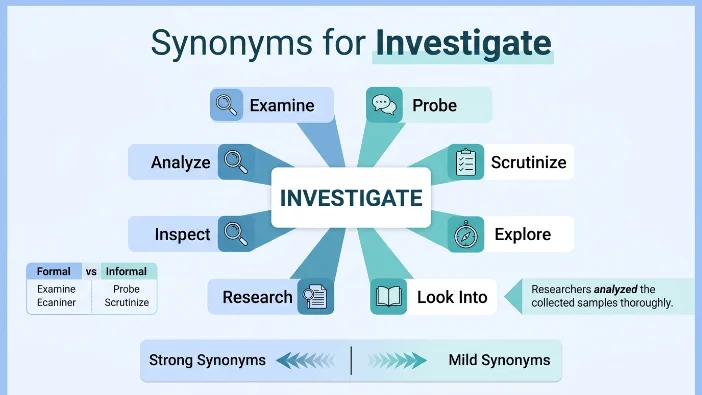
Understanding synonyms for investigate can significantly improve the clarity and impact of your writing. Whether you’re searching for an investigate synonym in research or simply need another word for investigate, choosing the right term helps convey precision. Words like probe and scrutinize are often used when you want to investigate or probe or scrutinize deeply, especially in academic or professional contexts.
If you’re looking for a reliable synonym for investigate, it’s important to match the word with your purpose. In research, terms such as examine, analyze, or explore may serve as a strong investigate synonym, while in general use, words like inspect or look into work well. Expanding your vocabulary with the right alternatives ensures your message remains engaging, accurate, and easy to understand.
Best Synonyms for Investigate
The best synonyms for investigate are examine, probe, scrutinize, explore, and look into. The right choice depends on tone, context, and intensity. Use examine for careful analysis, probe for deep questioning, scrutinize for close inspection, explore for open-ended discovery, and look into for casual or everyday situations.
What Does Investigate Mean?
Investigate is a verb. It means to study, examine, or inquire into something carefully especially to find facts, uncover the truth, or understand a situation more fully.
It’s most commonly used when someone is trying to gather information about something uncertain, suspicious, or unknown. Journalists investigate stories. Police investigate crimes. Scientists investigate phenomena. Companies investigate complaints.
Example sentences:
- The detective was asked to investigate the disappearance.
- We need to investigate the cause of the system failure before fixing it.
The word comes from the Latin investigare, meaning to track or trace. That original idea of following a trail is still at the heart of its modern meaning.
Core Meaning of Investigate
At its core, investigate means to go looking for information you don’t yet have and to do so in a systematic, purposeful way. It’s not the same as a casual glance or a quick Google search. Investigation implies effort, method, and intention.
The word carries a sense of seriousness. When someone is investigating something, there’s often something at stake a crime, a problem, a controversy, a question that needs a real answer. That sense of purpose is what separates investigate from lighter synonyms like look at or check out.
It also implies some degree of doubt or uncertainty. You don’t investigate something you already understand. You investigate because something isn’t yet clear.
Grammar and Usage Notes
Part of speech: Verb (transitive it takes a direct object)
Common sentence patterns:
- investigate + noun: “They investigated the incident.”
- investigate + how/why/what: “She investigated how the leak started.”
- investigate + whether: “The board investigated whether fraud had occurred.”
Common collocations:
- investigate a claim / complaint / case / crime / matter / incident
- thoroughly / fully / independently investigate
- investigate on behalf of
When investigate sounds natural:
- In formal, professional, or serious writing
- When describing police, legal, journalistic, or scientific inquiry
- When the process is thorough and deliberate
When a synonym may work better:
- In casual conversation, look into or check out sounds more natural
- In academic writing, examine or analyze may fit better
- In creative writing, probe or dig into can feel more vivid
Best Synonyms for Investigate
| Synonym | Meaning | Tone | Best Use Case | Example Sentence |
|---|---|---|---|---|
| Examine | To look at carefully and in detail | Neutral to formal | Academic, medical, professional writing | She examined the evidence before drawing conclusions. |
| Probe | To question or explore deeply, often persistently | Formal to neutral | Journalism, law, interviews | Reporters probed the official’s past financial records. |
| Scrutinize | To inspect very closely, looking for flaws or details | Formal | Critical analysis, audits, research | Auditors scrutinized every transaction in the account. |
| Explore | To look into something open-endedly | Neutral | Research, discovery, casual contexts | The team explored possible causes of the data error. |
| Look into | To make an inquiry; to begin checking | Informal | Conversation, emails, everyday writing | Can you look into why the delivery was delayed? |
| Inquire into | To seek information formally | Formal | Legal, official reports, formal letters | The committee will inquire into the matter next week. |
| Study | To examine carefully over time | Neutral | Academic, scientific, research contexts | Scientists studied the effects of the drug over six months. |
| Research | To gather facts through systematic inquiry | Neutral | Academic, professional, journalistic | She researched the company before the interview. |
| Delve into | To go deep into a subject or issue | Neutral to informal | Writing, conversation, analysis | He delved into the history of the organization. |
| Inspect | To look at something closely and officially | Neutral to formal | Official reviews, physical checks | An inspector was sent to inspect the building. |
Common Synonyms for Investigate
These are the most widely used alternatives words you’ll find in everyday writing and normal conversation without sounding stiff or out of place.
Look into A relaxed, everyday phrase. It signals that someone is going to check on something or follow up. It works well in emails, text messages, and spoken language.
- I’ll look into the issue and get back to you by Friday.
Examine One of the most flexible synonyms. It suggests careful, thoughtful attention but doesn’t carry the same sense of suspicion that investigate sometimes does.
- The engineer examined the data logs to find the error.
Explore This word has an open, curious feel. It’s best when the inquiry doesn’t have a fixed destination when someone is genuinely discovering rather than looking for something specific.
- The researchers explored the relationship between sleep and memory.
Research Implies a structured process of gathering facts from sources. Works well in academic, journalistic, and professional contexts.
- She researched the new policy before writing her report.
Study Similar to research, but often implies longer, more sustained attention.
- The professor had studied this topic for over a decade.
Formal Synonyms for Investigate
These words work well in academic writing, legal documents, business reports, and professional communication.
Scrutinize Suggests extremely close inspection often with a critical eye. Use it when the examination is intense and detail-focused.
- The committee will scrutinize every clause of the proposed contract.
Inquire into A formal phrase used in official or legal contexts. It signals a structured process of asking questions and gathering information.
- The board voted to formally inquire into the CEO’s conduct.
Probe In formal writing, probe carries a sense of determined, persistent questioning. It’s common in journalism and law.
- The prosecutor probed the witness about the timeline of events.
Audit Specifically formal and often financial or organizational. Use only when the investigation involves checking records, accounts, or procedures.
- The firm hired an independent accountant to audit its financial statements.
Analyze Works well in academic and scientific writing when the focus is on breaking something down to understand its parts.
- The data scientist analyzed the results from three separate trials.
Review A softer formal option. Suggests looking something over carefully but not necessarily with suspicion.
- The legal team will review all documents before the hearing.
Informal Synonyms for Investigate
These alternatives fit casual conversations, social media, personal messages, and informal writing.
Check out Very casual. Works in conversation or informal writing when someone wants to take a quick look at something.
- Hey, can you check out why the app keeps crashing?
Dig into Suggests going deep with more energy and curiosity than a casual look. Common in spoken language and informal writing.
- She really dug into the backstory before writing her blog post.
Snoop around Has a slightly playful or negative connotation implies looking for information in a nosy or unofficial way.
- He was snooping around the old files and found something interesting.
Nose around Similar to snoop around informal, slightly cheeky. Suggests looking where you may or may not be welcome.
- She nosed around the department to see who was behind the rumor.
Look around Casual, low-pressure. Suggests a general look without a specific goal.
- I looked around online to see what people were saying about the product.
Strong Synonyms for Investigate
These words carry more intensity, urgency, or force than investigate in its neutral form.
Probe In its strongest use, probe suggests relentless, penetrating questioning. It’s used when the investigation is aggressive or deep.
- The senate committee probed the agency’s misuse of federal funds.
Scrutinize Suggests the most intense form of examination leaving no detail unchecked.
- Every line of the agreement was scrutinized before the deal was signed.
Interrogate Much stronger than investigate. This word is specifically about questioning people, often in a confrontational or formal way. Use carefully it carries a sense of pressure.
- The suspect was interrogated for three hours.
Dissect Implies breaking something apart to examine every single piece. Strong in analytical contexts.
- The investigative journalist dissected the politician’s financial disclosures.
Uncover / Expose These words focus on revealing something hidden the result of investigation rather than the process itself.
- The reporter’s work uncovered a pattern of corporate fraud.
When to be careful: Words like interrogate, dissect, and expose carry strong connotations. Using them in neutral or professional writing can make tone feel harsher than intended.
Mild Synonyms for Investigate
When you want a softer, less charged alternative especially in neutral or positive contexts these words work well.
Review Gentle and professional. Suggests looking something over carefully without implying suspicion.
- The supervisor will review the employee’s work at the end of the quarter.
Look at The most neutral option. Very simple, very light.
- Can we look at the numbers again before we decide?
Consider Even lighter implies thinking about something rather than actively gathering information.
- The team considered several explanations for the drop in sales.
Survey Suggests a broad, general look rather than a deep dive.
- She surveyed the available literature on the subject.
Assess Slightly more structured than look at, but still gentler than investigate. Implies forming a judgment after looking.
- The technician assessed the situation before recommending a fix.
When to use mild synonyms: Choose them when the subject doesn’t involve suspicion, wrongdoing, or urgency or when you want to sound collaborative rather than accusatory.
Synonyms for Investigate by Context
Everyday Conversation
In normal conversation, look into, check out, and dig into all work naturally. They feel direct without sounding overly serious.
- I’ll look into it and let you know.
- Can you dig into what’s going on with that account?
Professional Writing
In emails, reports, and business communications, examine, review, assess, and look into all fit well. They’re clear without being dramatic.
- We will examine the feedback received and provide a formal response.
Academic Writing
Examine, analyze, study, and scrutinize are the strongest choices here. Academic writing values precision and depth, and these words reflect that.
- This paper examines the long-term effects of urban heat islands on public health.
Creative Writing
Probe, delve into, dig into, and uncover add texture and energy. They work well in fiction, narrative journalism, and personal essays.
- She delved into her family’s past, following every thread until the whole story came apart.
Marketing Copy
In marketing, explore and discover feel inviting rather than clinical. They suggest curiosity without the weight of formal investigation.
- Explore how our platform can streamline your workflow.
Emotional Expression
When someone is working through something personal, reflect on, think through, or explore can replace investigate without sounding cold.
- She spent a long time exploring what had gone wrong in the relationship.
Legal and Journalistic Writing
Probe, scrutinize, inquire into, and examine are strong, credible choices in these fields.
- The attorney probed the financial records for any sign of misrepresentation.
Another Word for Investigate in a Sentence
Here are 14 natural example sentences using different synonyms:
- The journalist probed the company’s hiring practices for months before publishing the story.
- Can you look into why the customer’s order hasn’t shipped yet?
- A team of scientists studied the glacier’s behavior over a ten-year period.
- The school board reviewed the incident report before making any decisions.
- She examined the contract carefully and found two conflicting clauses.
- Detectives scrutinized the security footage from every angle.
- He decided to dig into the history of the building after finding old documents in the basement.
- The auditors will inspect all financial records from the past three years.
- The committee was formed to inquire into allegations of misconduct.
- They explored different theories about why the experiment produced unexpected results.
- The consultant assessed the team’s workflow before recommending changes.
- She researched the topic thoroughly before presenting her findings to the board.
- The reporter uncovered a series of emails that contradicted the official statement.
- He analyzed customer feedback to identify patterns in the complaints.
Investigate Synonyms Compared
Some synonyms look interchangeable at first but carry real differences in tone and use. Here’s a side-by-side comparison of the most commonly confused alternatives:
| Word | Intensity | Formality | Best Context | Key Difference |
|---|---|---|---|---|
| Investigate | Medium–High | Neutral to formal | Crime, law, journalism, research | General-purpose; implies method and seriousness |
| Examine | Medium | Neutral to formal | Academic, medical, analytical | Focus on close attention; less suspicion-driven |
| Probe | High | Formal to neutral | Law, journalism, interviews | Implies persistence and deep questioning |
| Scrutinize | High | Formal | Audits, critical review | Most intense form of examination; implies looking for flaws |
| Look into | Low | Informal | Everyday conversation, emails | Casual starting point; less depth implied |
| Explore | Low–Medium | Neutral | Research, discovery, creative | Open-ended; curious rather than suspicious |
| Inspect | Medium | Neutral to formal | Physical or official checks | Usually refers to checking something concrete |
| Research | Medium | Neutral | Academic, professional | Broader and more source-driven than examine |
Key takeaway: If suspicion or wrongdoing is involved, probe or scrutinize work better than explore or look at. If you want something neutral and professional, examine or review are the safest choices. If the context is casual, look into almost always sounds right.
Words Similar to Investigate
These words belong to the same general area of meaning but aren’t always direct replacements for investigate.
Monitor Monitoring is ongoing observation over time. Investigating is a more targeted, time-bound process. You monitor a patient’s vitals; you investigate a diagnosis.
- The agency monitors air quality across the region not the same as investigating a specific pollution event.
Observe Observation is passive you watch what’s happening without necessarily asking questions. Investigation is active and purposeful.
- The researcher observed the group’s behavior this may be a step within an investigation, but it’s not the same thing.
Interview Interviewing is one tool used during an investigation. It’s not a synonym but a method.
- The detective interviewed three witnesses this is part of how you investigate, not what investigating means.
Follow up This phrase implies checking on something already started. It’s related but much lighter than investigate.
- I’ll follow up with the supplier about the delay a light action, not a full investigation.
Test Testing is often part of an investigation, especially in science, but it refers to a specific act of verifying a hypothesis not the broader process.
- The chemist tested the sample for contaminants.
These words all orbit the same general idea, but they each describe one part of the investigative process rather than the whole thing. Use them as supporting words, not straight replacements.
Antonyms of Investigate
| Antonym | Meaning | Example Sentence |
|---|---|---|
| Ignore | To pay no attention to something | The manager ignored the complaints and moved on. |
| Overlook | To fail to notice or choose not to deal with | The auditors overlooked several discrepancies in the report. |
| Neglect | To fail to give proper attention or care | The agency neglected to investigate the initial warning signs. |
| Dismiss | To reject something without considering it | The committee dismissed the allegations without review. |
| Disregard | To treat something as unworthy of attention | She disregarded the tip and closed the file. |
| Abandon | To leave or give up on something | Investigators were forced to abandon the case after losing key evidence. |
Understanding antonyms helps sharpen your grasp of what investigate really means it’s the opposite of ignoring, dismissing, or walking away from a question.
How to Choose the Right Synonym for Investigate
Picking the right word takes a few seconds of thought but makes a real difference in how your writing comes across. Here’s a simple decision process:
Match the context first. Is this a legal report? A casual email? An academic paper? A social media caption? Context usually tells you most of what you need. Formal contexts need formal words; casual contexts need simple, easy language.
Check the tone. Does your word sound accusatory, neutral, curious, or suspicious? Probe sounds more aggressive than examine. Look into sounds lighter than scrutinize. Make sure the tone matches what you actually mean.
Think about intensity. How serious is the situation you’re describing? A company reviewing a complaint is different from a regulator scrutinizing its practices. Match the intensity of the word to the weight of the subject.
Consider the reader. Are you writing for experts, the general public, or a specific professional audience? Use language your reader is comfortable with. Academic readers expect precise vocabulary; general readers often prefer plain language.
Check whether the synonym is exact or only related. Some words are close but not perfect replacements. Monitor is related to investigate but isn’t the same thing. Interview is part of an investigation, not a synonym for it. Only use a synonym if it genuinely substitutes for the full meaning.
Read the sentence aloud. If a substituted word feels awkward when you say the sentence out loud, it probably isn’t the right fit. Trust that instinct and try another option.
Common Mistakes When Using Synonyms for Investigate
Choosing a word with the wrong tone Using scrutinize in a friendly email sounds stiff and accusatory. Using look at in a legal brief sounds careless. Always match tone to setting.
Going too strong too fast Words like interrogate and expose carry real weight. Dropping them into a neutral context creates unintended drama. Save strong synonyms for situations that actually call for intensity.
Using formal words in casual writing Writing the committee shall inquire into the matter in a casual workplace message sounds oddly official. Use look into or check out instead.
Using informal words in professional writing I’ll dig around and see what I can find might work in a chat message, but it would look out of place in a formal report or legal letter.
Treating related words as exact synonyms Monitor, observe, and interview are often confused with investigate. They describe actions that may happen during an investigation, but they don’t mean the same thing as the full process.
Swapping words without checking meaning Some words are so close that it’s tempting to swap them freely but examine and scrutinize aren’t identical. Scrutinize implies a more critical, fault-finding type of inspection. Using it in the wrong context shifts the meaning of your sentence.
Making the sentence sound unnatural If you’ve replaced investigate with a synonym just for the sake of variety, but the result reads awkwardly, that’s a signal to go back to the original word. Variety is good; forced variety isn’t.
Quick Synonym List for Investigate
Common synonyms
- Examine
- Explore
- Study
- Research
- Look into
- Inspect
Formal synonyms
- Scrutinize
- Probe
- Inquire into
- Analyze
- Review
- Audit
Informal synonyms
- Check out
- Dig into
- Look around
- Snoop around
- Nose around
Strong synonyms
- Probe
- Scrutinize
- Dissect
- Interrogate
- Uncover
Mild synonyms
- Review
- Look at
- Consider
- Assess
- Survey
Related words
- Monitor
- Observe
- Interview
- Follow up
- Test
FAQs
What is the best synonym for investigate?
The best all-around synonym is examine. It’s neutral, widely understood, fits both formal and general writing, and doesn’t carry the same sense of suspicion that investigate sometimes does. For more intense contexts, probe or scrutinize are stronger choices.
What is another word for investigate?
Common alternatives include examine, probe, scrutinize, explore, look into, study, inspect, and research. The best choice depends on tone and context.
What is a formal synonym for investigate?
Strong formal synonyms include scrutinize, probe, inquire into, analyze, and audit. These work well in academic writing, legal documents, and official reports.
What is an informal synonym for investigate?
In casual conversation and everyday writing, look into, check out, dig into, and look around all work naturally. They’re approachable and easy to understand without sounding stiff.
What is a stronger word for investigate?
Scrutinize, probe, interrogate, and dissect all carry more intensity than investigate in its standard use. Scrutinize implies the sharpest, most critical form of examination. Interrogate specifically means questioning people under pressure.
What is a milder word for investigate?
Review, assess, look at, consider, and survey are all softer alternatives. They suggest careful attention without the weight of a formal investigation.
What words are similar to investigate but not exact synonyms?
Monitor, observe, interview, test, and follow up all relate to investigation but describe only parts of the process not the full act of investigating something. They can complement your writing but shouldn’t replace investigate directly.
What is the opposite of investigate?
Common antonyms of investigate include ignore, overlook, neglect, dismiss, and disregard. These words describe the failure to look into something rather than the act of examining it.
How do I choose the right synonym for investigate?
Start with context formal or casual? Then check tone and intensity. Use look into for casual writing, examine for neutral or professional writing, and probe or scrutinize when the situation calls for depth and seriousness. Always read the sentence aloud to make sure it sounds natural.
Conclusion
Investigate is a versatile, purposeful word and so are its synonyms. Whether you reach for examine in a business report, probe in a legal brief, look into in an email, or dig into in casual conversation, the right choice always comes back to tone, formality, intensity, and context.
The best synonym isn’t always the most impressive-sounding one. It’s the one that fits the sentence so naturally that the reader doesn’t even notice the word choice they just understand exactly what you mean.
Use this guide as a reference whenever you need to sharpen your word choice, and remember: when in doubt, read the sentence out loud. Your ear is often the best editor you have.
Read More Related Articles:
- Synonyms for Okay | When to Use Each Alternative In 2026
- Synonyms for Feeling | Meaning, Examples & Alternatives In 2026
- Synonyms for Blessed | Improve Your Word Choice Naturally In 2026

Ethan Caldwell is a writer who enjoys exploring the nuances of language and how words shape everyday communication. His work focuses on making complex ideas easier to understand through clear, engaging and accessible writing.



1 thought on “Synonyms for Investigate | Express Ideas with More Precision In 2026”