When you need another word for avoid, the best choice depends on what you actually mean. Are you dodging something unpleasant? Steering clear of a person? Deliberately refraining from a behavior? The synonyms for avoid include evade, dodge, sidestep, shun, circumvent, refrain from, eschew, and bypass but each one carries a different tone, intensity, and best use case. Pick the wrong one, and your sentence can sound too formal, too harsh, or just awkward.
This article breaks every synonym down so you can choose the right one every time.
Best Synonyms for Avoid
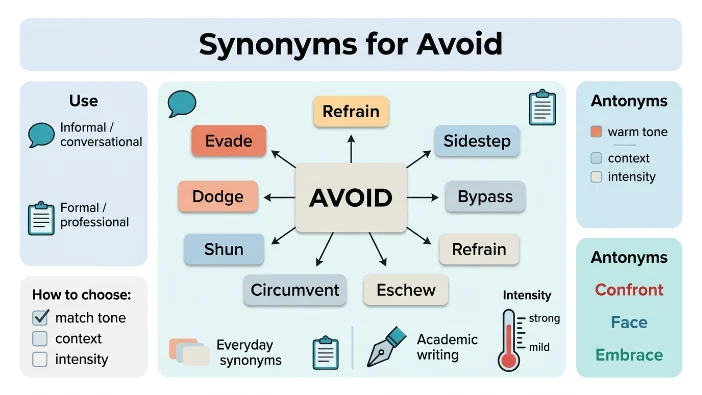
The best synonyms for avoid are evade, dodge, sidestep, shun, circumvent, and refrain from. The right choice depends on the tone, context, and intensity you need. Evade and dodge suggest active effort. Shun implies rejection of a person. Circumvent sounds formal and strategic. Refrain from works well when self-control is involved.
What Does Avoid Mean?
Avoid is a verb. It means to keep away from something or someone, or to prevent something from happening. You avoid things on purpose it’s a deliberate act, not an accident.
Part of speech: Verb
Core use: Describes the action of staying away from, escaping, or preventing something
Example sentences:
- She tried to avoid the crowded hallway between classes.
- He avoided making eye contact during the meeting.
The word works in almost any setting casual conversation, professional writing, academic essays, and everyday speech. That flexibility is exactly why it needs so many synonyms. Depending on your meaning, avoid can sound too neutral, too bland, or not quite precise enough.
Core Meaning of Avoid
At its heart, avoid is about keeping distance either physical, emotional, or behavioral. You can avoid a place, a person, a situation, a topic, or a habit. The word is neutral by nature. It doesn’t tell you why someone is staying away, how strongly they feel about it, or whether the avoidance is justified.
That neutrality is useful in everyday writing. But when you want to show that someone is desperately fleeing something, quietly brushing past an issue, or deliberately cutting a person out of their life, a more specific synonym does the job better.
Grammar and Usage Notes
Avoid is a transitive verb, which means it takes a direct object. You always avoid something or someone.
Common sentence patterns:
- Avoid + noun: Avoid conflict.
- Avoid + gerund (verb + -ing): Avoid making promises you can’t keep.
- Try to avoid + noun or gerund: Try to avoid direct sunlight.
Note that avoid is not followed by an infinitive. You would not say avoid to do something that’s a common grammar mistake. The correct form is always avoid doing something.
Common collocations:
- avoid conflict, avoid eye contact, avoid the issue, avoid detection, avoid mistakes, avoid responsibility
A synonym often works better than avoid when you want to show intent, emotion, or intensity. For example, evade suggests cleverness or evasion of something serious, while sidestep is lighter and often used for awkward situations.
Best Synonyms for Avoid
| Synonym | Meaning | Tone | Best Use Case | Example Sentence |
|---|---|---|---|---|
| Evade | Escape or avoid cleverly | Neutral to negative | When someone avoids with effort or skill | She evaded every question the reporter asked. |
| Dodge | Move quickly to avoid, or avoid cleverly | Informal | Casual writing, quick evasion | He dodged the topic every time it came up. |
| Sidestep | Avoid without directly confronting | Neutral | Diplomatic or careful avoidance | The politician sidestepped the controversy. |
| Shun | Deliberately avoid and reject | Strong, negative | Personal rejection or social avoidance | He was shunned by his former colleagues. |
| Circumvent | Go around a rule or obstacle | Formal | Legal, business, or strategic writing | They found a way to circumvent the regulation. |
| Refrain from | Stop yourself from doing something | Neutral to formal | Self-restraint, advice, instructions | Please refrain from using your phone during class. |
| Eschew | Deliberately avoid something, often for moral reasons | Formal, literary | Academic or formal writing | She eschewed processed food entirely. |
| Bypass | Go around something | Neutral | Systems, processes, physical routes | The update bypassed the usual approval process. |
| Elude | Escape from or be missed by | Neutral to literary | When something escapes notice or pursuit | The answer continued to elude him. |
| Steer clear of | Stay well away from | Informal | Everyday speech and advice | Steer clear of that neighborhood at night. |
Common Synonyms for Avoid
These are the everyday alternatives you’ll reach for in most writing and conversation.
Evade
Means to avoid something with skill or effort, often something that requires an active response. Best for situations involving questions, responsibilities, or pursuit.
Example: She evaded the question without technically lying.
Dodge
Suggests a quick, clever move either physical or verbal. It has a slightly sneaky feel to it, which makes it useful for casual, informal contexts.
Example: He dodged every difficult topic in the interview.
Sidestep
Works well when someone avoids something without making a big deal of it smooth, subtle avoidance. It’s often used in political or professional contexts.
Example: The CEO sidestepped questions about the merger.
Skip
A lighter, more casual option. Works when someone simply chooses not to do or attend something.
Example: I decided to skip the meeting and catch up later.
Steer clear of
A phrasal verb that means to deliberately stay away from something or someone. Very natural in speech and everyday writing.
Example: Steer clear of high-fat meals before a workout.
Formal Synonyms for Avoid
Use these in academic papers, professional reports, formal letters, or essays where you need a more polished vocabulary.
Eschew
A strong, formal word meaning to deliberately stay away from something, often for personal or moral reasons. It’s most at home in literary or academic writing.
Example: The author chose to eschew conventional narrative structures.
Circumvent
Means to find a way around a rule, problem, or obstacle. It implies cleverness and strategy. Use it in legal, business, or policy writing.
Example: The company circumvented safety protocols to cut costs.
Abstain from
Means to voluntarily hold yourself back, especially from food, drink, or actions. Often used in health, ethics, and religious contexts.
Example: Members were asked to abstain from voting on the issue.
Refrain from
More general than abstain from and works in many formal contexts, especially instructions and polite requests.
Example: Please refrain from discussing this matter publicly.
Avert
Means to prevent something from happening, especially something bad. It has a slightly urgent quality and works well in formal or journalistic writing.
Example: Quick action averted a potential disaster.
Forgo
Means to choose not to do or have something you could otherwise enjoy. It implies a conscious decision to give something up.
Example: She decided to forgo the annual bonus in exchange for extra leave.
Informal Synonyms for Avoid
These work in casual conversation, social media, text messages, and relaxed writing.
Ditch
Means to leave or drop something a plan, a person, or a habit often abruptly. It has a slightly dismissive feel.
Example: He ditched the gym plan after two weeks.
Give a miss
A common informal phrase, especially in British English, meaning to skip or not bother with something.
Example: I’ll give the party a miss this time I’m exhausted.
Blow off
Very casual American English. Means to ignore or skip something, often carelessly.
Example: She blew off the study session and regretted it.
Pass on
Means to decline or choose not to take part. Polite enough for most contexts but still informal.
Example: I’ll pass on dessert tonight, thanks.
Wriggle out of
Means to cleverly escape a responsibility or obligation. It suggests cunning.
Example: He always manages to wriggle out of doing the dishes.
Strong Synonyms for Avoid
These carry more intensity use them when the avoidance is deliberate, emotional, or extreme.
Shun
The strongest word in this list. It means to actively reject or exclude someone. Shun implies a permanent, often public form of avoidance. Use it carefully it’s powerful.
Example: After the scandal, he was shunned by the entire community.
Flee
Means to run away from something in fear or urgency. It goes beyond avoidance into active escape.
Example: Thousands fled the city as the storm approached.
Recoil from
Describes pulling back sharply, often in disgust or fear. It suggests an emotional or physical reaction.
Example: She recoiled from the idea of returning to her old job.
Ostracize
Specifically means to exclude someone from a group. It’s a social form of avoidance on a collective level.
Example: The new employee felt ostracized within weeks of starting.
Boycott
Means to collectively refuse to use, support, or engage with something, usually as a form of protest.
Example: Consumers boycotted the brand after the controversy.
These words go beyond simple avoidance and carry strong social, emotional, or political weight. Be sure the context justifies that intensity.
Mild Synonyms for Avoid
These carry a softer or more neutral feeling useful when avoidance is gentle, passive, or subtle.
Bypass
Means to go around something without directly engaging with it. It’s practical and non-judgmental.
Example: The new road bypasses the town center.
Overlook
Often means to miss or not notice, but can also mean to choose not to deal with something.
Example: They decided to overlook the minor discrepancy.
Omit
Means to leave something out. It’s neutral and works well in writing or editorial contexts.
Example: She omitted the most sensitive details from her report.
Gloss over
Means to treat something briefly or superficially instead of confronting it.
Example: The teacher glossed over the more difficult sections of the chapter.
Skirt
Means to stay on the edge of something without going directly through or into it.
Example: The documentary skirted the most controversial aspects of the story.
Mild alternatives like these are ideal when you want to describe avoidance without implying judgment, fear, or hostility.
Synonyms for Avoid by Context
Everyday Conversation
In casual speech, dodge, skip, steer clear of, and pass on sound the most natural. These are short, simple, and don’t call attention to themselves.
“I’d steer clear of that restaurant the service is terrible.”
Professional Writing
In work emails, reports, and business communication, refrain from, bypass, circumvent, and avert are the strongest choices. They sound measured and appropriate for a formal tone.
“Please refrain from sharing this information externally.”
Academic Writing
For essays, research papers, and formal arguments, use eschew, abstain from, forgo, or circumvent. These show sophisticated vocabulary without overreaching.
“The researcher chose to eschew quantitative methods in favor of qualitative analysis.”
Creative Writing
Evade, elude, flee, recoil from, and shun offer the most vivid options for fiction and narrative nonfiction. They create atmosphere and show character motivation.
“He had been eluding capture for three weeks.”
Emotional Expression
When describing how someone feels about avoiding something or avoiding someone shun, recoil from, flee, and ditch carry emotional weight.
“She shunned every reminder of the relationship.”
Personal Communication
In messages and personal writing, give a miss, blow off, wriggle out of, and pass on work naturally.
“I’m going to give the gym a miss this morning.”
Another Word for Avoid in a Sentence
Here are 14 natural example sentences using different synonyms for avoid:
- She managed to evade the question without giving anything away.
- He always finds a way to dodge his responsibilities at work.
- The manager sidestepped every direct question about the budget.
- He was shunned after the incident became public knowledge.
- They circumvented the process by filing under a different category.
- Please refrain from speaking during the performance.
- She eschewed the typical career path and started her own business.
- The new road bypasses the congested city center entirely.
- The solution continued to elude even the most experienced engineers.
- Just steer clear of the second floor they’re filming up there.
- I decided to skip the conference call and read the notes later.
- He ditched his diet after the first stressful week.
- They boycotted the company’s products in protest.
- She glossed over the most difficult parts of the assignment.
Avoid Synonyms Compared
Some synonyms for avoid are very close to each other. Here’s how to tell them apart:
| Word Pair | Key Difference | Use This When… |
|---|---|---|
| Evade vs. Dodge | Evade suggests sustained, skillful avoidance. Dodge is quicker and more casual. | Use evade for questions, taxes, responsibility; dodge for quick deflection |
| Shun vs. Ostracize | Shun is one person avoiding another. Ostracize is a group excluding someone. | Use shun for individual behavior; ostracize for group dynamics |
| Circumvent vs. Bypass | Circumvent usually applies to rules or obstacles (implies cleverness). Bypass is more neutral and physical. | Use circumvent in formal/strategic contexts; bypass for systems or routes |
| Refrain from vs. Abstain from | Both involve holding back, but abstain from is more formal and specific often used for food, drink, or voting. | Use refrain from for general restraint; abstain from for deliberate, principled restraint |
| Eschew vs. Forgo | Eschew implies strong personal conviction. Forgo simply means choosing not to have or do something. | Use eschew for principled rejection; forgo for practical choice |
| Sidestep vs. Skirt | Both mean to avoid something indirectly. Sidestep is more active and deliberate. Skirt is more passive, staying near the edge. | Use sidestep for active avoidance of an issue; skirt for treating something lightly |
Words Similar to Avoid
These words are related to avoid but aren’t always direct replacements. Understanding the difference helps you use them correctly.
Prevent
Prevent means to stop something from happening it’s about blocking an outcome, not just staying away from it. You avoid a problem; you prevent one.
Avoid: She avoided the argument. / Prevent: She prevented the argument by changing the subject.
Neglect
Neglect means to fail to care for something it’s often unintentional. You can avoid something on purpose; you neglect it by not paying enough attention.
Example: He neglected his health for years, which is different from intentionally avoiding the doctor.
Escape
Escape means to get free from something, often something you were already caught in. Avoid means you stay out of it in the first place.
Avoid: She avoided the trap. / Escape: She escaped the trap.
Ignore
Ignore means to be aware of something and choose not to respond to it. Avoid means to stay away. You can ignore something while still being near it.
Example: He ignored her texts, but he didn’t avoid her in person.
Decline
Decline means to politely refuse an offer or invitation. It’s a specific action, not a general pattern of avoidance.
Example: She declined the invitation, not “she avoided the invitation.”
Antonyms of Avoid
| Antonym | Meaning | Example Sentence |
|---|---|---|
| Confront | To face something directly and head-on | He confronted the problem instead of running from it. |
| Seek | To actively look for or pursue | She sought opportunities, not reasons to back away. |
| Embrace | To accept or welcome something fully | He embraced the change rather than resisting it. |
| Engage | To become involved with or interact with | She engaged the critics rather than avoiding them. |
| Pursue | To actively follow or go after | He pursued the goal despite the obstacles. |
| Face | To deal with something directly | You have to face the situation sooner or later. |
| Welcome | To receive or accept with openness | She welcomed the challenge instead of dreading it. |
How to Choose the Right Synonym for Avoid
Picking the best synonym comes down to a few simple questions:
Match the context. Formal writing needs circumvent or refrain from, not dodge or ditch. Casual conversation needs the opposite.
Match the tone. Shun is harsh and carries judgment. Skip is light and neutral. If your sentence is about a serious social exclusion, skip is the wrong word. If you’re just talking about skipping dessert, shun is absurdly dramatic.
Check the intensity. Strong synonyms like shun, boycott, and flee carry real emotional weight. Use them only when the situation justifies that level of force.
Consider the subject. Some words only work with people (shun, ostracize). Others work better with situations or things (circumvent, bypass, sidestep). Mixing these up can create awkward sentences.
Check for exact match. Words like neglect, escape, and ignore are related to avoid but don’t mean the same thing. Double-check the meaning before using them as direct replacements.
Read the sentence out loud. If it sounds unnatural, try a different synonym. A technically correct word choice that sounds forced is still the wrong choice.
Common Mistakes When Using Synonyms for Avoid
Using a word that’s too strong for the situation. Writing that someone shunned a coworker when they simply didn’t say hello reads as dramatic and inaccurate. Match intensity to reality.
Replacing avoid without checking the meaning. Neglect and escape are related, but they don’t always replace avoid directly. Always check the full meaning.
Using formal words in casual contexts. Writing eschew in a text message or social media post sounds stiff and out of place. Save formal words for formal situations.
Using casual words in professional writing. Ditched and blew off don’t belong in a business report, even if they feel natural in everyday speech.
Treating all synonyms as interchangeable. Evade and sidestep are both ways of avoiding something, but evade suggests active effort while sidestep implies calm finesse. These aren’t the same.
Ignoring the subject of the sentence. Some synonyms only work with people. Writing that someone ostracized a rule, or shunned a task, doesn’t quite make sense. Check what the word is typically used with before applying it.
Using a synonym that changes the grammar. Avoid takes a gerund: avoid doing. Some synonyms take different structures. Refrain from doing works. Refrain doing doesn’t.
Quick Synonym List for Avoid
Common synonyms:
Evade, dodge, sidestep, skip, steer clear of, bypass
Formal synonyms:
Circumvent, eschew, refrain from, abstain from, forgo, avert
Informal synonyms:
Ditch, give a miss, pass on, blow off, wriggle out of
Strong synonyms:
Shun, flee, recoil from, ostracize, boycott
Mild synonyms:
Bypass, overlook, omit, gloss over, skirt
Related words (not always exact synonyms):
Prevent, neglect, escape, ignore, decline
FAQs
What is the best synonym for avoid?
The best synonym for avoid depends on context. In formal writing, circumvent or refrain from are strong choices. In casual writing, dodge or steer clear of work well. For emotional or social avoidance, shun or evade are more precise.
What is another word for avoid?
Common alternatives include evade, dodge, sidestep, shun, bypass, circumvent, and refrain from. Each one has a slightly different meaning and tone, so the right choice depends on what you’re trying to say.
What is a formal synonym for avoid?
Eschew, circumvent, refrain from, abstain from, and forgo are the most suitable formal synonyms for avoid. They work well in academic papers, legal writing, professional emails, and reports.
What is an informal synonym for avoid?
Ditch, skip, blow off, pass on, and give a miss are casual alternatives to avoid. These work naturally in conversation, text messages, and relaxed writing.
What is a stronger word for avoid?
Shun is the most intense synonym for avoid it implies deliberate rejection. Flee suggests escaping in fear. Recoil from shows a strong emotional response. Boycott implies collective, principled avoidance.
What is a milder word for avoid?
Bypass, overlook, omit, skirt, and gloss over are softer alternatives to avoid. They’re useful when avoidance is subtle, accidental, or not strongly intended.
What words are similar to avoid?
Words in the same general area as avoid include prevent, neglect, escape, ignore, and decline. These aren’t always exact synonyms they each carry their own specific meaning but they belong to the same semantic space.
What is the opposite of avoid?
The main antonyms of avoid are confront, face, seek, engage, embrace, pursue, and welcome. These describe actively turning toward something rather than staying away from it.
How do I choose the right synonym for avoid?
Start by identifying the tone and context of your sentence. Ask whether the avoidance is casual or deliberate, personal or professional, light or intense. Then pick the word that matches the meaning, not just the general idea.
Conclusion
Avoid is one of those words that does its job well but rarely does it with personality. The right synonym gives your writing precision, tone, and clarity. Whether you need the formal restraint of refrain from, the social sharpness of shun, the casual ease of skip, or the strategic feel of circumvent, there’s a word that fits your exact meaning.
The best synonym for avoid is always the one that matches the context, suits the reader, and feels natural in the sentence. When in doubt, say the sentence out loud with your chosen word. If it sounds right, it probably is.
Read More Related Articles:
- Synonyms for Loving | Nuances, Examples, and Word Choice Tips In 2026
- Synonyms for Feeling | Meaning, Examples & Alternatives In 2026
- Synonyms for excited and happy | Complete Guide to Stronger Emotional Vocabulary In 2026

Grace Phillips contributes content to SynonymsAura.com, where she writes about language, vocabulary and everyday communication. Her work is centered on helping readers find the right words and express themselves with greater clarity and confidence.