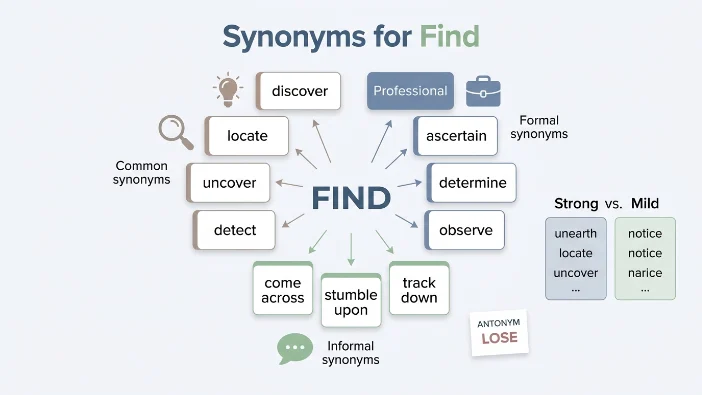
The best synonyms for find depend on how you’re using the word. If you mean discovering something by chance, use discover, come across, or stumble upon. If you’re searching for something specific, use locate, track down, or unearth. For realizing or determining something, use ascertain, detect, or determine. For recovering something lost, use recover or retrieve. Here’s everything you need to know to choose the right synonym for every situation.
Quick Answer: Best Synonyms for Find
The best synonyms for find are discover, locate, uncover, detect, and come across. The right choice depends on the context: discover works for something previously unknown, locate for finding a specific position, uncover for revealing something hidden, detect for noticing subtle things, and come across for accidental discovery.
What Does “Find” Mean?
To find means to discover, locate, or become aware of something either by chance, by searching, or through reasoning. It can also mean to recover something lost, to judge something after consideration, or to experience a particular feeling.
Part of speech: Verb (transitive and intransitive) and Noun
Example sentences:
- She found a dollar on the sidewalk. (discovered by chance)
- I need to find my keys before I leave. (locate by searching)
- The jury found him guilty. (judged or determined)
Core Meaning of Find
At its heart, “find” is about gaining awareness of or access to something that wasn’t in your possession or knowledge before. This can happen in several ways:
- Accidental discovery: You weren’t looking, but you found it anyway (a dollar on the ground, a great restaurant).
- Deliberate search: You were actively looking and succeeded (finding your phone, finding a job).
- Mental realization: You came to understand something or determined a truth (finding the answer, finding that someone is trustworthy).
- Recovery: You got back something you’d lost (finding your voice, finding your confidence).
- Judgment: You formed an opinion or made a decision (finding someone guilty).
As a noun, a find is something valuable or interesting that you’ve discovered like a treasure or a talented new employee.
Grammar and Usage Notes
“Find” is an irregular verb: find (base) → found (past) → found (past participle).
Common sentence patterns:
- Find + object: “I found a great book.”
- Find + object + adjective: “I find this movie boring.”
- Find + object + to be + adjective/noun: “I found him (to be) a good listener.”
- Find + that clause: “We found that the restaurant was closed.”
- Find + object + -ing: “She found him waiting outside.”
- Find + yourself + place/state: “I found myself agreeing with her.”
Common phrases and collocations:
- find a way
- find time
- find courage
- find fault with
- find one’s feet
- find oneself
- find out
- find meaning
Find” sounds natural in almost any context, but a synonym may be better when you need a specific shade of meaning (like unearth for archaeological discoveries or ascertain for formal research).
Best Synonyms for Find
This table compares the most useful synonyms for “find” across different situations.
Common Synonyms for Find
These are the everyday synonyms you’ll hear and read most often.
Discover
Short meaning: To find something that existed but wasn’t known before.
Best context: Scientific findings, new information, learning truths.
Example: “Archaeologists discovered ancient ruins beneath the city.”
Locate
Short meaning: To find the exact position of something.
Best context: Searching for lost items, finding people or places, GPS navigation.
Example: “I cannot locate my keys anywhere in the house.”
Come across
Short meaning: To find by accident without searching.
Best context: Everyday accidental discoveries.
Example: “I came across an interesting article about space exploration.”
Uncover
Short meaning: To reveal something hidden or secret.
Best context: Investigations, exposing secrets, revealing truths.
Example: “Auditors uncovered evidence of fraud in the company.”
Detect
Short meaning: To notice something subtle or difficult to see.
Best context: Technical, sensory, or subtle discoveries.
Example: “He could detect a note of sadness in her voice.”
Formal Synonyms for Find
These alternatives are ideal for academic writing, business reports, professional communication, and legal documents.
Ascertain
Meaning: To find out something with certainty through investigation.
Best context: Formal research, legal proceedings, official inquiries.
Example: “The committee aims to ascertain the facts surrounding the incident.”
Determine
Meaning: To find out or establish something precisely after study or investigation.
Best context: Scientific reports, legal decisions, formal analysis.
Example: “The study was designed to determine the effectiveness of the new drug.”
Observe
Meaning: To notice or perceive something carefully, often scientifically.
Best context: Research, scientific writing, formal reporting.
Example: “Researchers observed significant changes in the participants’ behavior.”
Perceive
Meaning: To become aware of something through the senses.
Best context: Formal descriptions, philosophical writing, analysis.
Example: “She perceived a change in the atmosphere of the room.”
Locate
Meaning: To discover the exact position of something.
Best context: Reports, formal correspondence, professional writing.
Example: “The search team successfully located the missing hikers.”
Identify
Meaning: To establish or recognize who or what someone or something is.
Best context: Professional reports, legal documents, technical writing.
Example: “The experts identified the painting as a genuine Rembrandt.”
Establish
Meaning: To find out or confirm something with certainty.
Best context: Legal proceedings, formal investigations, research.
Example: “The investigation established his whereabouts on the night of the crime.”
Attain
Meaning: To achieve or reach something through effort.
Best context: Academic achievements, business goals, formal writing.
Example: “He attained his goal of becoming a partner at the firm.”
Informal Synonyms for Find
These synonyms work well in conversation, friendly writing, social media, and personal messages.
Come across
Meaning: To find something by chance.
Best context: Everyday conversation, informal writing.
Example: “I came across a great new coffee shop downtown.”
Stumble upon
Meaning: To find something or someone by accident.
Best context: Casual stories, personal anecdotes.
Example: “We stumbled upon the most amazing little bookstore.”
Dig up
Meaning: To find something by searching or investigating.
Best context: Informal research, gossip, casual detective work.
Example: “The reporter dug up some interesting details about the candidate.”
Track down
Meaning: To find someone or something after a long search.
Best context: Finding people, information, or hard-to-find items.
Example: “I managed to track down a first edition of the book.”
Run into
Meaning: To meet or find someone or something unexpectedly.
Best context: Social encounters, casual discovery.
Example: “I ran into an old friend at the grocery store.”
Turn up
Meaning: To be found after being lost or missing.
Best context: Finding lost items, casual conversation.
Example: “Don’t worry, your wallet will turn up somewhere.”
Ferret out
Meaning: To find something by persistent searching.
Best context: Research, investigation, casual problem-solving.
Example: “He managed to ferret out the information we needed.”
Strong Synonyms for Find
These words carry more force, intensity, or emphasis. They’re useful when you want to stress the effort behind the finding or the importance of the discovery.
Unearth
Meaning: To discover something that was hidden, buried, or forgotten often with significant effort.
Best context: Archaeological discoveries, revealing secrets, major finds.
Example: “Historians unearthed documents that changed how we understand the period.”
Expose
Meaning: To reveal something hidden, especially something that should be known or is scandalous.
Best context: Investigations, journalism, revealing wrongdoing.
Example: “The documentary exposed the truth about the factory’s safety violations.”
Dig up
Meaning: To find something through persistent searching or investigation.
Best context: Research, investigative work, uncovering secrets.
Example: “The defense lawyer dug up new evidence that helped the case.”
Breakthrough (as a noun)
Meaning: A major discovery or achievement after persistent effort.
Best context: Scientific achievements, important advances.
Example: “The researchers made a significant breakthrough in cancer treatment.”
Hunt down / Track down
Meaning: To find someone or something after a thorough and determined search.
Best context: Finding fugitives, rare items, information.
Example: “He was determined to track down the original owner of the watch.”
Mild Synonyms for Find
These words are softer, more neutral, or gentler ways to express finding. Use them when you want to avoid sounding dramatic or assertive.
Notice
Meaning: To become aware of something through observation.
Best context: Everyday observations, gentle realization.
Example: “I noticed that she seemed tired.”
Spot
Meaning: To see or notice something, often briefly.
Best context: Casual observations, everyday discoveries.
Example: “Can you spot the differences between these two pictures?”
Observe
Meaning: To see or notice something carefully.
Best context: Watching, noticing without interference.
Example: “The teacher observed that the students were struggling.”
Sense
Meaning: To become aware of something without being told or shown it directly.
Best context: Intuition, emotional awareness, subtle perceptions.
Example: “I sense that something is wrong.”
Perceive
Meaning: To become aware of something through the senses.
Best context: Careful, subtle noticing.
Example: “The system perceives changes in temperature and adjusts accordingly.”
Be aware of
Meaning: To know about something or notice it.
Best context: Gentle or subtle realization.
Example: “I am aware of the challenges we face.”
Synonyms for Find by Context
The best synonym changes based on the situation. Here’s what works in different contexts.
Everyday Conversation
In daily life, people use casual and natural synonyms. Come across, stumble upon, and run into are perfect for accidental discoveries. Locate and find are straightforward for active searching. Track down works for something you’ve been hunting for.
Example: “I came across an old yearbook while cleaning out the garage.”
Professional Writing
Business and professional settings call for precise, formal alternatives. Use locate for finding objects, identify for naming or recognizing, determine for finding out facts, and ascertain for discovering information through formal processes.
Example: “After a thorough search, we identified the source of the error.”
Academic Writing
In academic contexts, precision is key. Use ascertain or determine for research findings, observe for scientific noticing, and establish for conclusive findings. Detect is perfect for subtle or technical discoveries.
Example: “The researchers determined that the treatment had a statistically significant effect.”
Creative Writing
Creative writing allows for expressive, varied vocabulary. Use unearth for dramatic discoveries, stumble upon for chance encounters, uncover for secrets, and discover for emotional or poetic revelations.
Example: “She stumbled upon a hidden garden that transformed her life.”
Marketing Copy
Marketing uses words that resonate with emotion and action. Use discover for new products, uncover for revealing hidden benefits, track down for finding solutions, and pinpoint for precision.
Example: “Discover the secret to radiant skin with our revolutionary new product.”
Emotional Expression
When describing feelings, personal discoveries, or inner experiences, use find oneself, perceive, or sense. These verbs fit moments of realization or self-awareness.
Example: “He found himself drawn to the quiet countryside.”
Technical Writing
Technical contexts call for words that are specific and precise. Use detect for signals or anomalies, locate for positions, pinpoint for exact identification, and determine for calculations.
Example: “The sensor can detect movement within a fifty-foot radius.”
Personal Communication
For emails, messages, and personal updates, the most natural words are come across, stumble upon, find out, and run into. They feel genuine and conversational.
Example: “I just found out that I got the job!”
Another Word for “Find” in a Sentence
Here are real-world examples showing how different synonyms replace “find” in context.
- Discover: “Scientists discovered a new species of fish in the deep ocean.”
- Locate: “The rescue team will locate the survivors using thermal imaging.”
- Uncover: “The investigation will uncover the truth.”
- Detect: “The system can detect unusual patterns in the data.”
- Come across: “I came across a wonderful recipe for chocolate cake.”
- Stumble upon: “They stumbled upon the solution while working on something else.”
- Track down: “I finally tracked down the rare album I’ve been looking for.”
- Pinpoint: “We need to pinpoint the exact cause of the problem.”
- Ascertain: “The survey was designed to ascertain public opinion.”
- Determine: “Tests will determine whether the drug is effective.”
- Recover: “The police recovered the stolen jewelry.”
- Retrieve: “She retrieved the documents from the safe.”
- Observe: “He observed a change in the patient’s condition.”
- Encounter: “The team encountered unexpected difficulties.”
“Find” Synonyms Compared
While many synonyms for “find” are related, they’re not always interchangeable. Here’s a closer look at the differences between some common options.
Discover vs. Locate
Discover is about finding something that existed but wasn’t known often by chance or through research. Locate is about pinpointing the exact position of something specific you’re looking for. You discover a new species; you locate your keys.
Uncover vs. Detect
Uncover means to reveal something that was hidden or secret. Detect means to notice something subtle or difficult to perceive. You uncover a conspiracy; you detect a faint smell of gas.
Come across vs. Stumble upon
These are very similar, but come across is slightly more neutral while stumble upon often implies a more surprising or fortunate accidental discovery. Both work in casual conversation.
Ascertain vs. Determine
Both are formal and mean “find out,” but ascertain often focuses on confirming a fact or truth, while determine often focuses on making a decision or concluding after analysis. Ascertain the facts; determine the outcome.
Recover vs. Retrieve
Recover means to get something back that was lost or stolen. Retrieve means to find and bring something back, often after searching. You recover a stolen painting; you retrieve files from a computer.
Words Similar to “Find”
These words belong to the same general semantic field as “find” but aren’t always perfect synonyms. Use them when “find” doesn’t quite capture the exact meaning.
Seek
Related because finding often follows seeking. Seek means to look for something, while find means to succeed in locating it. You seek answers; you find them.
Look for
Related in a similar way to seek. This is the active process before finding. You look for something before you find it.
Search
Related as the method, not the result. Search is the action; find is the outcome. You search the house, then you find the keys.
Obtain
Similar when “find” means acquiring something. Obtain is more formal and often suggests intentional acquisition rather than accidental discovery. You obtain a permit; you find a dollar on the street.
Procure
Similar to obtain but even more formal, focusing on acquiring with effort. You procure supplies; you find a solution.
Encounter
Related when “find” means meeting something unexpectedly. Encounter often applies to people, situations, or experiences. You encounter a problem; you find a new restaurant.
Identify
Related when “find” means recognizing or determining what something is. Identify is about naming and classification, while find is broader. You identify the culprit; you find the truth.
Antonyms of “Find”
Knowing the opposite of “find” helps clarify its meaning.
| Antonym | Short Meaning | Example Sentence |
|---|---|---|
| Lose | To misplace something and no longer know where it is. | “I always lose my keys when I’m in a hurry.” |
| Miss | To fail to notice, see, or find something. | “I completely missed the sign and drove past the exit.” |
| Overlook | To fail to notice or consider something. | “The investigator overlooked an important piece of evidence.” |
| Conceal | To hide something deliberately. | “The suspect tried to conceal the weapon.” |
| Hide | To put something in a place where it cannot be found. | “She hid the birthday present in the closet.” |
| Ignore | To deliberately pay no attention to something. | “He decided to ignore the warning signs.” |
How to Choose the Right Synonym for “Find”
Choosing the best synonym is about matching the word to the situation, tone, and your audience. Here’s a practical process.
Match the context. Are you writing an academic paper or chatting with a friend? Formal contexts call for ascertain, determine, or locate. Casual contexts call for come across, stumble upon, or track down.
Match the tone. Consider how you want the sentence to sound. Unearth and expose sound dramatic and intense. Notice and sense sound gentle and subtle.
Check the intensity. Is the discovery casual or significant? Use spot or notice for everyday observations. Use unearth or breakthrough for major discoveries.
Think about your reader. Will they understand the word? Clarity matters more than complexity in most cases.
Consider whether the synonym is exact or only related. If you’re writing about revealing a secret, uncover or expose are exact. Locate is related but doesn’t capture the “revealing hidden” aspect.
Keep the sentence natural. Read your sentence aloud. Does it sound like something a real person would say or write? If it sounds forced, try a different word.
When in doubt, choose the simpler word. Discover, locate, and come across work in almost every situation and feel natural in most contexts.
Common Mistakes When Using Synonyms for “Find”
Even confident writers sometimes fall into these traps when choosing synonyms.
Choosing a word with the wrong tone. Using ascertain in a text message sounds out of place. Using stumble upon in a formal report sounds unprofessional. Always match the tone to the context.
Using a synonym that’s too strong. Unearth and expose are dramatic. Using them for everyday discoveries like finding your lost sock sounds like overkill. Save them for significant revelations.
Using a formal word in casual writing. Formal words like ascertain, determine, and obtain can make casual writing sound stiff and unnatural. Stick with simpler options unless the context demands formality.
Using a casual word in professional writing. Using dig up or turn up in a business report makes the writing feel unprofessional. Choose formal alternatives instead.
Treating related words as exact synonyms. Seek and search aren’t exact replacements for find. They describe the process, not the result. Use them when that distinction matters.
Making the sentence sound unnatural. If you’re forcing a synonym into a sentence just to avoid repetition, the result often sounds awkward. Natural writing is more important than variety.
Misunderstanding the synonym’s meaning. Perceive means “become aware of through the senses,” while discern can mean “perceive with difficulty.” Make sure you understand the nuance before substituting.
Quick Synonym List for “Find”
A fast reference list of synonyms for find grouped by category.
Common Synonyms
discover, locate, come across, uncover, detect, identify, spot, notice
Formal Synonyms
ascertain, determine, observe, perceive, locate, identify, establish, attain, procure
Informal Synonyms
come across, stumble upon, dig up, track down, run into, turn up, ferret out
Strong Synonyms
unearth, expose, dig up, track down, hunt down
Mild Synonyms
notice, spot, observe, sense, perceive
Related Words
seek, look for, search, obtain, encounter, identify, recover, retrieve
FAQs
What is the best synonym for “find”?
Discover is the most versatile and natural synonym for most situations. Locate is best when you’re talking about finding a specific position or place. Come across is the most natural choice for accidental discoveries in conversation.
What is another word for “find” in a professional context?
In professional writing, use locate, identify, determine, or ascertain depending on what you’re finding. Locate works for objects and people. Determine works for facts and conclusions. Identify works for recognition and naming.
What is a formal synonym for “find”?
The most formal synonyms are ascertain (to find out with certainty), determine (to establish after investigation), and observe (to notice carefully). These are suitable for academic writing, legal documents, and business reports.
What is an informal synonym for “find”?
Come across, stumble upon, and turn up are the most common informal synonyms. They sound natural in conversation and friendly writing. Run into is also a good choice for unexpectedly finding someone.
What is a stronger word for “find”?
Unearth, expose, and track down are stronger alternatives. They suggest significant effort or importance. Use them when the discovery matters or took persistence. Breakthrough is a stronger noun form.
What is a milder word for “find”?
Notice, spot, and observe are milder alternatives. They suggest careful attention rather than active searching. Sense is even softer and suggests intuition.
What words are similar to “find” but not exact synonyms?
Seek and look for describe the process of trying to find something. Obtain and procure mean to get something. They’re related but not direct replacements in every sentence.
What is the opposite of “find”?
The most direct antonym is lose. Other opposites include miss, overlook, conceal, and hide.
How do I choose the right synonym for “find”?
Match the synonym to your context, tone, and audience. Use formal words like ascertain in academic writing. Use informal words like come across in conversation. Consider whether the discovery is accidental or intentional, and how strong the word needs to be.
Conclusion
Finding the right synonym for “find” is about understanding your meaning, matching your audience, and choosing a word that fits the tone. Discover, locate, and come across work well in most situations. Formal contexts call for ascertain or determine. Casual contexts favor stumble upon or track down.
Remember that no two synonyms are exactly the same. Unearth suggests digging up something hidden. Detect suggests noticing something subtle. Recover suggests getting something back. Choosing the right word makes your writing clearer, more precise, and more engaging.
The best synonym is always the one that fits your sentence naturally and communicates your exact meaning. When in doubt, go with discover it’s clear, versatile, and works in almost every context.
Read More Related Articles:
- Synonyms for Embarrassed | Smarter Word Choices for Every Context In 2026
- Synonyms For Felt | Make Your Writing More Descriptive In 2026
- Synonyms for Stress | Meaning, Examples, and Better Word Choices In 2026

Evelyn Turner is a content creator at SynonymsAura.com who enjoys exploring the richness of the English language. Her work focuses on word meanings, synonyms, expressions and everyday language usage, helping readers communicate with greater clarity and confidence.