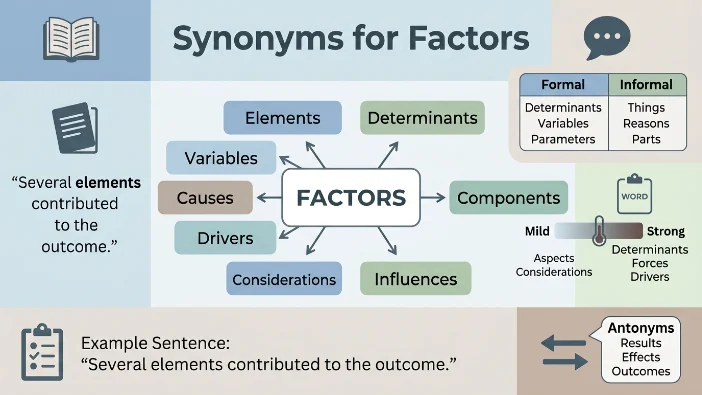
The word factors is everywhere in essays, reports, news articles, and everyday conversations. If you’re looking for synonyms for factors, the most common alternatives are elements, determinants, components, variables, and influences. But the best choice depends on what you’re writing, who you’re writing for, and how formal or specific you need to be.
This article walks you through the meaning of factors, its best synonyms, usage differences, example sentences, and tips to help you pick the right word every time.
Best Synonyms for Factors
The best synonyms for factors are elements, determinants, variables, components, and influences. The right choice depends on the tone, context, and level of formality your writing requires.
What Does Factors Mean?
Factors is a plural noun. The singular form is factor. At its core, a factor is something that contributes to a result, decision, or outcome. When multiple things work together to cause or shape something, each one is called a factor.
Simple definition: A factor is a cause, condition, or element that plays a role in producing a result.
Part of speech: Noun (plural)
Common usage: Factors appears in academic writing, business reports, scientific analysis, journalism, and everyday speech.
Example sentences:
- Several factors led to the project’s failure.
- Price is one of the key factors customers consider before buying.
Core Meaning of Factors
At the heart of the word factors is the idea of contribution. Something is a factor when it has an effect on an outcome, even if it isn’t the only cause.
Factors don’t always work alone. In most real-world situations, multiple factors interact some playing a bigger role than others. That’s why you’ll often see phrases like key factors, contributing factors, or risk factors, where the word describes not just what matters but how much it matters.
This plural quality the sense that multiple things are at work is what makes factors such a common word in analysis, research, decision-making, and problem-solving contexts.
Grammar and Usage Notes
Part of speech: Noun (plural of factor)
Common sentence patterns:
- “Several factors contributed to…”
- “One of the main factors is…”
- “Economic, social, and environmental factors all played a role…”
- “We must consider all relevant factors before…”
Common collocations:
- contributing factors
- risk factors
- key factors
- external factors
- internal factors
- determining factors
- environmental factors
- socioeconomic factors
When factors sounds natural: Use factors when you want to describe multiple causes or conditions that shape an outcome. It works in both formal and general writing and rarely sounds out of place.
When a synonym may work better:
- Use variables when the context is scientific or mathematical.
- Use elements when you’re discussing parts of a broader whole.
- Use drivers in business or strategy contexts where causes lead to growth or change.
- Use considerations when you’re listing things someone must think about before making a decision.
Best Synonyms for Factors
| Synonym | Meaning | Tone | Best Use Case | Example Sentence |
|---|---|---|---|---|
| Elements | Individual parts that make up a whole | Neutral | Academic, general writing | Several elements contributed to the team’s success. |
| Determinants | Things that decide or determine an outcome | Formal | Research, analysis, reports | Socioeconomic determinants affect health outcomes. |
| Variables | Conditions that can change and affect results | Technical | Science, math, research | The study controlled for several key variables. |
| Components | Parts that form a larger system or whole | Neutral–Formal | Technical, professional | The components of a strong strategy include planning and execution. |
| Influences | Things that shape or affect something indirectly | General | Everyday writing, social science | Family influences play a role in career choices. |
| Drivers | Forces that cause something to move forward | Business | Strategy, marketing, economics | Cost and demand are the main drivers of pricing decisions. |
| Considerations | Things worth thinking about before deciding | Neutral–Formal | Decision-making, advice writing | Safety and comfort are major considerations for buyers. |
| Causes | Direct reasons something happens | General | News, reports, everyday use | Researchers identified three causes of the outbreak. |
| Contributors | Things or people that add to a result | General | Analysis, journalism | Stress and diet are major contributors to heart disease. |
| Parameters | Defined conditions that set limits or scope | Technical | Science, engineering, programming | The model ran within these parameters. |
| Aspects | Features or sides of something being considered | General | Essays, reviews, discussions | Multiple aspects of the issue deserve attention. |
| Agents | Forces or entities that cause an effect | Formal | Science, philosophy, law | Environmental agents can trigger allergic reactions. |
Common Synonyms for Factors
These are the everyday alternatives you’ll reach for most often.
Elements
Elements means individual parts that together make up a whole. It’s slightly broader than factors because it can describe structural parts, not just causes.
- Best context: General writing, essays, explanations
- Example: Several elements shaped the outcome of the election.
Components
Components refers to parts that combine to form a system. It’s a bit more structural than factors.
- Best context: Technical writing, professional reports, systems thinking
- Example: The components of a successful proposal include clear goals and a realistic budget.
Aspects
Aspects describes the different sides or features of something. Use it when you’re exploring a topic from multiple angles rather than identifying causes.
- Best context: Essays, articles, discussions
- Example: We need to consider all aspects of the situation before moving forward.
Causes
Causes is the most direct synonym for factors when the focus is on what made something happen.
- Best context: Journalism, reports, everyday speech
- Example: Researchers are studying the causes of rising inflation.
Contributors
Contributors works well when something adds to a result, especially in the context of health, environment, or analysis.
- Best context: Medical writing, social analysis, news
- Example: Poor sleep is one of the biggest contributors to low productivity.
Formal Synonyms for Factors
These alternatives suit academic papers, business reports, professional communication, and essays.
Determinants
Determinants is the go-to formal synonym when something actively decides or shapes an outcome. It’s common in sociology, medicine, economics, and public health.
- Example: The social determinants of health include education level, income, and access to care.
Parameters
Parameters fits scientific and technical writing where conditions define the scope or limits of something.
- Example: The experiment was conducted within carefully defined parameters.
Variables
Variables is the standard word in research and scientific writing when discussing factors that can change and affect results.
- Example: The researchers accounted for multiple variables in their analysis.
Agents
Agents carries a sense of active force or cause, making it useful in science, law, and formal analysis.
- Example: Chemical agents in the environment can affect soil quality over time.
Drivers
Drivers is formal enough for business writing and specific enough to suggest directional force what’s pushing an outcome forward.
- Example: The key drivers of customer satisfaction include price, service quality, and speed of delivery.
Informal Synonyms for Factors
These casual alternatives work in conversations, personal writing, social media, and informal emails.
Things
Simple and natural in everyday speech. Not suitable for formal writing.
- Example: A few things led me to make this decision.
Reasons
Common in spoken and informal written language.
- Example: There are a few good reasons why prices went up.
Parts
Works when you’re talking about what makes something up.
- Example: Hard work and timing are big parts of success.
Bits
Very informal and conversational. Use in friendly messages or casual content only.
- Example: A few bits came together to make the project work.
Strong Synonyms for Factors
Use these when you want to emphasize power, significance, or decisive influence.
Determinants
Carries a sense of finality these don’t just play a role; they decide the outcome.
- Example: Price is often the single greatest determinant of purchasing behavior.
Forces
Suggests something powerful and often unstoppable pushing a result.
- Example: Social and economic forces drove the rapid change in policy.
Drivers
Implies something actively pushing a result, especially in business or strategy.
- Example: Innovation and cost reduction are the primary drivers of growth in this sector.
Catalysts
Use when a factor doesn’t just contribute but actively speeds up or triggers a change.
- Example: The new regulation served as a catalyst for industry-wide reform.
Use these strong synonyms when you want to convey importance and impact. Avoid them when you need neutral, descriptive language they can sound overstated in mild contexts.
Mild Synonyms for Factors
Sometimes a softer, less loaded word fits better especially in exploratory, advisory, or balanced writing.
Considerations
Suggests things worth thinking about, without implying they caused anything.
- Example: Budget and timing are key considerations in this decision.
Aspects
Gentle and descriptive, useful when analyzing without making causal claims.
- Example: There are many aspects to explore before reaching a conclusion.
Elements
Neutral and broad, works when you want to list parts without assigning weight to any single one.
- Example: Several elements came together to make the campaign a success.
Mild synonyms work well in persuasive writing, advice articles, and any context where you don’t want to overstate how much one thing caused or determined another.
Synonyms for Factors by Context
Everyday Conversation
In casual speech, swap factors for reasons, things, or parts. These feel natural without sounding stiff.
- “There were a few reasons the plan didn’t work.”
- “A lot of things came into play.”
Professional Writing
In business emails, reports, and presentations, use drivers, considerations, or determinants. These sound precise and confident.
- “Several drivers are affecting our Q3 performance.”
Academic Writing
In research papers and essays, variables, determinants, and parameters carry more scholarly weight.
- “The study examined the key variables influencing student performance.”
Creative Writing
Opt for forces, currents, or elements when writing fiction, personal essays, or narrative nonfiction.
- “Dark forces were already at work beneath the surface of the city.”
Marketing Copy
Drivers and considerations work well in marketing. They imply direction and decision-making.
- “Three key considerations shape every buying decision.”
Emotional Expression
When writing about personal experiences or feelings, influences and forces feel more human than factors.
- “A lot of influences from my childhood shaped who I am today.”
Another Word for Factors in a Sentence
Here are 14 natural example sentences using different synonyms for factors:
- Several elements contributed to the campaign’s unexpected success.
- Price and quality are the main drivers in the consumer electronics market.
- The study identified three key variables that predicted student achievement.
- Health experts have outlined the determinants of chronic illness in urban areas.
- Many considerations go into choosing the right career path.
- Environmental agents can damage the structural integrity of buildings over time.
- The team listed several components of a strong leadership strategy.
- Budget constraints and timelines are the main parameters of the project.
- Childhood influences can shape a person’s confidence well into adulthood.
- Multiple causes were found behind the sudden drop in sales.
- She identified the key contributors to the increase in customer complaints.
- The researchers controlled for external forces that might skew the results.
- There are many aspects of this policy worth discussing before implementation.
- Cost reduction served as the primary catalyst for restructuring the team.
Factors Synonyms Compared
Some synonyms for factors are close but not interchangeable. Here’s how the main ones differ:
| Word | Core Idea | Formality | Causal Strength | Best Fits |
|---|---|---|---|---|
| Elements | Parts of a whole | Neutral | Weak–Moderate | Essays, general writing |
| Determinants | Things that decide outcomes | Formal | Strong | Research, health, economics |
| Variables | Changeable conditions | Technical | Moderate | Science, math, research |
| Components | Structural parts | Neutral–Formal | Moderate | Technical, systems writing |
| Influences | Indirect shaping forces | General | Mild | Social science, personal writing |
| Drivers | Active causes pushing change | Business | Strong | Marketing, strategy, business |
| Considerations | Things to think about | Neutral | Weak | Advice, decision-making |
| Causes | Direct reasons | General | Strong | Journalism, everyday use |
Key takeaway: Determinants and drivers carry more weight and imply decisive or powerful impact. Elements, aspects, and considerations are gentler and more descriptive. Variables is the right word in scientific writing. Causes is the most direct everyday alternative.
Words Similar to Factors
These words are related to factors and belong to the same semantic space, but they don’t always work as direct replacements.
Circumstances
Circumstances refers to the broader conditions surrounding a situation. Unlike factors, it doesn’t necessarily imply that those conditions caused anything just that they exist.
- When it works: “Given the circumstances, the decision made sense.”
- Why it’s not always a synonym: It describes a setting or situation, not a contributing cause.
Conditions
Conditions describes the state of things at a given moment. It overlaps with factors in research writing but tends to describe what exists rather than what causes.
- When it works: “The conditions were ideal for growth.”
- Why it’s not always a synonym: It describes a state, not an active contributor.
Criteria
Criteria refers to standards used to judge or evaluate. It’s related to factors in decision-making contexts but implies a measuring stick, not a cause.
- When it works: “The criteria for selection include experience and reliability.”
Inputs
Inputs is close in engineering, economics, and systems writing, but it specifically refers to what goes into a process, not what contributes to an outcome.
Forces
Forces can work as a synonym in some contexts, especially when discussing social, economic, or natural phenomena, but it implies more power and inevitability than factors usually does.
Antonyms of Factors
| Antonym | Meaning | Example Sentence |
|---|---|---|
| Results | The outcomes that factors produce | The results showed a clear improvement. |
| Effects | What happens because of causes | The effects of stress on sleep are well documented. |
| Outcomes | End states following a process | The outcomes of the policy were mixed. |
| Consequences | What follows from an action or cause | The consequences of that decision lasted for years. |
| Products | What is created by causes or processes | Innovation is often the product of many influences. |
These words sit on the output side of the cause-and-effect relationship. Factors belong on the input or cause side; antonyms generally belong on the result or effect side.
How to Choose the Right Synonym for Factors
Here’s a quick decision guide:
- Match the context. Scientific writing calls for variables or parameters. Business writing calls for drivers or determinants. Everyday writing uses reasons, things, or elements.
- Match the tone. Formal documents need formal words. Casual writing needs casual alternatives.
- Check the intensity. If you want to suggest decisive power, use determinants or drivers. If you want a neutral description, use elements or aspects.
- Think about the reader. A general audience understands causes and reasons more easily than determinants or parameters.
- Check whether the synonym is exact. Aspects and considerations don’t carry the causal weight that factors does. Use them only when you’re describing or listing, not explaining causes.
- Keep the sentence natural. Read the sentence aloud after swapping the word. If it sounds odd, try a different synonym.
- Simple is often better. When in doubt, use the clearest word. A plain word that your reader understands beats a technical word that confuses them.
Common Mistakes When Using Synonyms for Factors
Using aspects when you mean causes
Aspects describes features, not causes. If you’re explaining why something happened, stick with factors, causes, or determinants not aspects.
Replacing factors with variables in non-scientific writing
Variables belongs in research and scientific contexts. Using it in casual or business writing can sound out of place.
Using drivers in academic essays
Drivers is business language. In a formal essay or research paper, determinants or factors will sound more appropriate.
Treating conditions as a direct synonym
Conditions describes the state of things, not what causes an outcome. Swapping factors for conditions can change your sentence’s meaning.
Picking a word that’s too strong
Words like forces or catalysts carry more intensity than factors. Overusing them can make writing sound dramatic when you just need to describe contributing causes.
Ignoring formality differences
Using things or bits in a formal business report instead of factors or determinants will undermine the professional tone.
Assuming all synonyms are interchangeable
No two synonyms mean exactly the same thing in every context. Always check that the replacement word fits both the meaning and the tone of your sentence.
Quick Synonym List for Factors
Common synonyms: Elements, components, aspects, causes, contributors, influences
Formal synonyms: Determinants, variables, parameters, agents, drivers
Informal synonyms: Things, reasons, parts, bits
Strong synonyms: Determinants, forces, drivers, catalysts
Mild synonyms: Considerations, aspects, elements, influences
Related words: Circumstances, conditions, criteria, inputs, forces
FAQs
What is the best synonym for factors?
The best synonym for factors depends on context. Elements and determinants are the most versatile. Use elements in general writing and determinants in formal or research-based writing. For business contexts, drivers works well.
What is another word for factors?
Common alternatives include elements, components, causes, influences, determinants, and variables. Each carries a slightly different shade of meaning, so the right choice depends on your context and audience.
What is a formal synonym for factors?
The most widely used formal synonyms are determinants, variables, and parameters. Determinants works well in social science, economics, and medicine. Variables suits scientific and research writing. Parameters fits technical and engineering contexts.
What is an informal synonym for factors?
In casual writing or conversation, factors is often replaced with reasons, things, or parts. These feel natural and are easy for any reader to understand.
What is a stronger word for factors?
If you want more power or emphasis, use determinants, drivers, or forces. These suggest that the contributing elements have significant or decisive impact, not just a mild role.
What is a milder word for factors?
Considerations and aspects are softer alternatives. They describe what’s worth thinking about or examining without implying strong causal force.
What words are similar to factors but not exact synonyms?
Circumstances, conditions, and criteria are related to factors but serve different functions. Circumstances describes a setting, conditions describes a state, and criteria describes a standard for judgment none of them carry the direct causal weight that factors does.
What is the opposite of factors?
The natural antonyms are results, effects, outcomes, and consequences the things that factors produce or cause, rather than the causes themselves.
Conclusion
The word factors is one of the most widely used nouns in English, and it has a rich set of alternatives worth knowing. Whether you need something formal like determinants or variables, something straightforward like causes or elements, or something business-specific like drivers, there’s a better word for every context.
The key is to match your word choice to your audience, tone, and level of formality. A scientific paper calls for variables. A business strategy document calls for drivers. A casual article or conversation? Reasons or things will do just fine.
Always read your sentence aloud after swapping the word. If it sounds natural and the meaning holds, you’ve made the right choice.
Read More Related Articles:
- Synonyms for Suspicious | Clearer and More Precise Writing In 2026
- Synonyms for Harmful | Discover More Precise Word Choices In 2026
- Synonyms for Warrior | Synonyms That Make Your Writing Stand Out In 2026

Evelyn Turner is a content creator at SynonymsAura.com who enjoys exploring the richness of the English language. Her work focuses on word meanings, synonyms, expressions and everyday language usage, helping readers communicate with greater clarity and confidence.