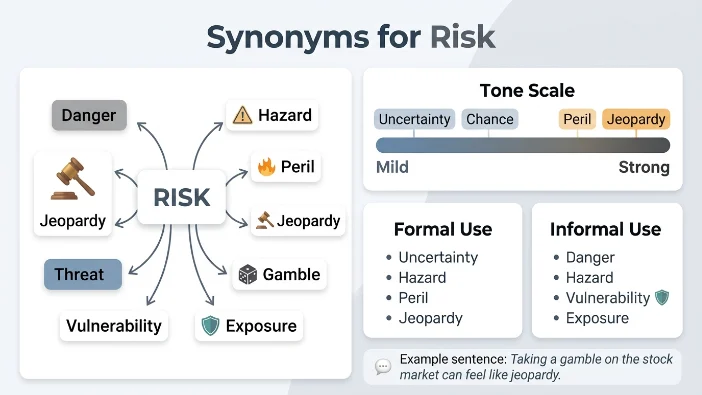
When you need a synonym for risk, the best choice depends on what you’re trying to say. Are you describing a physical danger, a financial gamble, or an emotional vulnerability? The word “risk” covers a lot of ground, and different synonyms carry different weight.
The most commonly used synonyms for risk are danger, hazard, threat, peril, and jeopardy. But using the right one in the right context makes your writing clearer and more precise. This guide walks you through all the best options, grouped by tone, formality, and intensity, with example sentences to show them in action.
Best Synonyms for Risk
The best synonyms for risk are danger, hazard, peril, threat, and jeopardy. The right choice depends on tone, context, and intensity. Danger and hazard work well in everyday writing; peril and jeopardy are more dramatic; threat focuses on something that may cause harm. For formal writing, exposure, liability, and vulnerability are strong alternatives.
What Does Risk Mean?
Risk is a noun and a verb. As a noun, it refers to the possibility that something harmful or undesirable will happen. As a verb, it means to expose something or someone including yourself to a chance of loss, harm, or failure.
Part of speech: Noun and verb Core idea: The chance that something bad might happen, or the act of willingly entering a situation where that chance exists.
Example sentences:
- “There is a real risk of injury if you skip the safety briefing.”
- “She decided to risk everything on the new business idea.”
The word is used across almost every field medicine, finance, engineering, psychology, sports, and everyday conversation.
Core Meaning of Risk
At its heart, risk is about uncertainty with a downside. It’s not just any uncertainty it’s the kind where something could go wrong. That’s what separates risk from words like chance or opportunity, which can lean positive.
When someone talks about risk, they usually mean:
- A situation where harm, loss, or failure is possible
- The degree to which someone or something is exposed to that possibility
- A deliberate choice to enter a situation despite that possibility
This nuance matters when you choose a synonym. Some alternatives focus on the danger itself (peril, hazard). Others focus on the exposure (vulnerability, liability). And some focus on the deliberate choice (gamble, wager).
Grammar and Usage Notes
As a noun: Risk appears after verbs like pose, carry, face, reduce, manage, and assess.
- “The project carries significant risk.”
- “We need to assess the risk before moving forward.”
As a verb: Risk is followed by a noun or gerund.
- “Don’t risk your health for a deadline.”
- “He risked losing everything.”
Common collocations:
- at risk, risk factor, risk management, health risk, financial risk, calculated risk, risk assessment, risk tolerance
A synonym may not work in all of these phrases. For example, you can say danger zone but not easily danger management that role belongs to risk specifically. Keep this in mind when substituting.
Best Synonyms for Risk
| Synonym | Meaning | Tone | Best Use Case | Example Sentence |
|---|---|---|---|---|
| Danger | Active threat of harm | Neutral–serious | Everyday and professional writing | “The construction site poses a real danger to pedestrians.” |
| Hazard | Source of potential harm | Neutral–technical | Safety, health, workplace contexts | “Black ice is a serious road hazard in winter.” |
| Peril | Serious and immediate danger | Formal–dramatic | Literature, speeches, strong emphasis | “The sailors understood the peril of crossing during a storm.” |
| Threat | Something likely to cause harm | Neutral–serious | Security, health, politics | “Climate change remains a growing threat to coastal cities.” |
| Jeopardy | A state of serious danger | Formal | Legal writing, serious situations | “His careless actions put the entire team in jeopardy.” |
| Vulnerability | Susceptibility to harm | Clinical–formal | Psychology, security, medicine | “The study assessed emotional vulnerability in teenagers.” |
| Exposure | Degree of contact with a hazard | Technical–formal | Finance, medicine, law | “The company’s exposure to currency fluctuation is significant.” |
| Gamble | A risky choice with uncertain outcome | Informal | Conversation, casual writing | “Quitting without another job lined up is a serious gamble.” |
| Liability | Legal or financial risk | Formal | Business, legal writing | “Leaving the sidewalk icy is a liability for the property owner.” |
| Chance | Possibility, which may involve risk | Neutral | Casual, narrative | “There’s a slim chance the plan could backfire.” |
Common Synonyms for Risk
These are the synonyms most people reach for in everyday writing and speech. They’re widely understood and work well across most contexts.
Danger Danger refers to an active or present threat of harm. It’s probably the most natural everyday substitute for risk. Best for: General conversation, journalism, informal reports. Example: “Driving without a seatbelt puts you in real danger.”
Hazard A hazard is a specific source of potential harm often used in safety, health, or environmental contexts. It implies the risk comes from a concrete thing or condition. Best for: Workplace safety, health communication, official warnings. Example: “The storage room has several chemical hazards that need to be labeled.”
Threat A threat suggests something or someone that is likely to cause harm. It’s slightly more directional than risk pointing to a source rather than just a probability. Best for: Security, geopolitics, health, competitive analysis. Example: “A rising interest rate is a threat to the housing market.”
Chance Chance is the mildest option here. It can refer to risk but also carries positive meaning, so use it only when context makes the negative possibility clear. Best for: Casual writing, narrative, when the risk is low or uncertain. Example: “There’s a chance the weather could turn bad during the hike.”
Formal Synonyms for Risk
When you’re writing for a professional, academic, or legal audience, these alternatives fit better than casual words like gamble or chance.
Jeopardy Implies serious danger to something of value often used in legal or high-stakes contexts. Best for: Legal writing, journalism, business writing when stakes are high. Example: “The merger could put thousands of jobs in jeopardy.”
Liability Refers to the legal or financial risk an entity faces. It’s narrow in scope but precise when that scope fits. Best for: Contract language, business communication, legal documents. Example: “Operating without insurance creates a significant liability.”
Exposure Used in finance, medicine, and law to describe how much a person or organization is open to a potential harm or loss. Best for: Financial reports, clinical writing, regulatory documents. Example: “The portfolio’s exposure to tech stocks increased after the rebalancing.”
Vulnerability Describes a condition of being open to harm often used in cybersecurity, psychology, and public health. Best for: Academic papers, clinical reports, technical writing. Example: “The software audit identified a critical vulnerability in the authentication system.”
Informal Synonyms for Risk
These alternatives suit casual speech, social media, personal messages, and friendly writing.
Gamble A gamble is a risky action with an uncertain outcome. It implies the person is choosing to take the risk despite knowing it might not pay off. Tone: Casual, slightly negative. Example: “Taking out a loan to invest in crypto right now is a serious gamble.”
Chance As an informal substitute, chance softens the word risk considerably. Tone: Light, conversational. Example: “I took a chance on that new restaurant and it was totally worth it.”
Leap (of faith) Not a direct synonym, but often used informally to describe a risky decision made despite uncertainty. Tone: Casual, optimistic. Example: “Moving to a new city without a job lined up is a real leap.”
Dare Used mainly as a verb, dare captures the brave aspect of taking a risk. Tone: Conversational, energetic. Example: “Not many people dare to start a business in their sixties.”
Strong Synonyms for Risk
When you want to express that the risk is serious, extreme, or life-altering, these words carry more weight.
Peril One of the strongest synonyms for risk. It suggests danger that is immediate and potentially severe. When to use it: Literature, speeches, dramatic writing, or situations where the stakes are genuinely life-threatening. When it’s too strong: Don’t use peril to describe minor inconveniences or everyday uncertainties. Example: “The crew faced great peril as the storm closed in around the vessel.”
Jeopardy Strong but slightly more controlled than peril. Works well in high-stakes professional or legal writing. Example: “His reckless behavior put the entire investigation in jeopardy.”
Menace A menace is something that actively threatens harm it emphasizes the source rather than just the probability. Example: “Unchecked inflation is a menace to working families.”
Danger At its strongest usage, danger is direct and urgent. Example: “Residents near the volcano were in immediate danger.”
Mild Synonyms for Risk
Sometimes you want to acknowledge that something carries risk without alarming the reader. These softer alternatives work well in those situations.
Uncertainty Focuses on the unknown rather than the harmful. It acknowledges that things might not go as planned without implying serious harm. Best for: Business planning, investment communication, forecasting. Example: “The economic uncertainty makes it hard to plan for next quarter.”
Chance As discussed above, chance is the most neutral option when the risk is small or context-dependent. Example: “There’s a chance the project might run a bit over budget.”
Possibility Similar to chance, but slightly more neutral. Doesn’t assume the outcome is negative. Example: “We should plan for the possibility of delays.”
Concern When a risk is worth noting but not alarming, concern keeps the tone measured. Example: “Data privacy is a growing concern for online users.”
Synonyms for Risk by Context
Everyday Conversation
In normal speech, danger, chance, and gamble feel the most natural. People say “there’s a real danger of rain” or “it’s a gamble” without thinking twice. Avoid peril or jeopardy here they sound out of place in casual settings.
Professional Writing
Threat, liability, and exposure work well in business reports, memos, and strategy documents. They’re specific and carry the right level of seriousness without sounding dramatic.
Academic Writing
Vulnerability, exposure, and uncertainty appear frequently in research papers and clinical writing. These words align with how academics measure and discuss risk in quantitative or qualitative terms.
Creative Writing
Peril, danger, and menace add tension and drama. In fiction, strong synonyms help raise the emotional stakes and keep readers engaged. Jeopardy also works well in thriller or mystery contexts.
Marketing Copy
In marketing, chance and opportunity (when framing risk as manageable) help soften the message. The goal is usually to acknowledge risk while reassuring the audience, so mild synonyms often serve better than intense ones.
Technical Writing (Cybersecurity, Engineering, Medicine)
Vulnerability, exposure, hazard, and threat are the standard vocabulary. They’re precise, widely understood by specialists, and carry the right technical connotation.
Another Word for Risk in a Sentence
Here are 14 natural example sentences using different synonyms for risk:
- “The avalanche posed a serious danger to hikers on the north slope.”
- “Wet floors are a common hazard in grocery stores during rainy seasons.”
- “The company’s exposure to rising oil prices is a concern for investors.”
- “She knew starting over in a new career was a gamble, but she took it anyway.”
- “The patient’s vulnerability to infection increased after surgery.”
- “Poor communication puts any team’s performance in jeopardy.”
- “There’s always a chance that a startup won’t survive its first year.”
- “Driving without brakes is a peril no one should face.”
- “Unverified suppliers represent a major liability for the supply chain.”
- “Market uncertainty has slowed investment activity across the sector.”
- “The software team discovered a critical security vulnerability in the latest update.”
- “The factory’s carbon emissions are a growing threat to local air quality.”
- “Leaving the gas stove on is more than just a minor concern it’s dangerous.”
- “Taking that route in icy conditions is a risk the driver was not willing to take.”
Risk Synonyms Compared
Some synonyms for risk are close enough that people use them interchangeably but they’re not identical. Here’s how the most common ones differ:
| Word | Intensity | Focus | Best When… |
|---|---|---|---|
| Risk | Moderate | Probability of harm | General use; the baseline word |
| Danger | Moderate–High | Active threat | Harm is present or close |
| Hazard | Moderate | Source of harm | A specific thing causes the risk |
| Threat | Moderate–High | Origin of harm | Something is pointing toward causing harm |
| Peril | High | Immediate, serious danger | Stakes are very high |
| Jeopardy | High | Valuable thing at stake | Something important could be lost |
| Gamble | Moderate | Chosen risk | The person is voluntarily taking a chance |
| Vulnerability | Moderate | Openness to harm | Focus is on the exposed party |
| Exposure | Moderate | Degree of risk | Measuring how much risk exists |
| Uncertainty | Low | Unknown outcome | Outcome is unclear, harm not certain |
Risk vs. Danger: Risk is about probability the chance something could go wrong. Danger implies the threat is already present or very close.
Hazard vs. Threat: A hazard is a condition or object that causes risk. A threat comes from something that intends or is likely to cause harm.
Peril vs. Jeopardy: Both are intense, but peril focuses on the danger itself while jeopardy focuses on what’s at stake something valuable being threatened.
Words Similar to Risk
These words share the same general territory as risk but don’t always work as direct substitutes.
Probability Related because risk is partly about probability, but probability is neutral it can be high or low, positive or negative. Not a synonym for risk on its own.
Consequence Refers to what happens after a risk plays out. You can’t substitute it directly, but it often appears alongside risk in the same context.
Stakes Describes what’s on the line what you could lose or gain. High stakes often imply high risk, but the words aren’t interchangeable. Example: “The stakes were high, and everyone felt the weight of the decision.”
Uncertainty Related to risk but broader. Uncertainty includes unknowns that may be positive or neutral, not just harmful ones.
Adventure Adventure implies risk, but with an emphasis on excitement and willingness. It’s not a direct synonym unless the tone is strongly positive.
Gamble While listed as informal synonym, gamble also implies a choice you choose to gamble. Risk can be passive (you face it without choosing it). This distinction matters in some contexts.
Antonyms of Risk
| Antonym | Meaning | Example Sentence |
|---|---|---|
| Safety | Freedom from danger or harm | “The new regulations improved worker safety across the industry.” |
| Security | A state of being protected | “Financial security was her primary goal after retirement.” |
| Certainty | A state of being sure; no unknown | “There’s no certainty in markets, but diversification helps.” |
| Protection | Defense against harm | “Wearing a helmet offers protection during cycling.” |
| Guarantee | Assurance that something is certain | “No investment comes with a guarantee of returns.” |
| Stability | Steady and not likely to change or fail | “Long-term bonds offer more stability than equities.” |
| Surety | Certainty or assured outcome | “There was no surety that the plan would succeed.” |
How to Choose the Right Synonym for Risk
Picking the right word isn’t hard if you ask a few quick questions:
1. What’s the intensity?
If the risk is minor or uncertain, use chance, concern, or uncertainty. If it’s serious, use danger, hazard, or threat. If it’s extreme, use peril or jeopardy.
2. What’s the tone?
For casual writing: gamble, chance, dare. For professional: threat, liability, exposure. For dramatic or literary: peril, menace, jeopardy.
3. What’s the focus?
If you’re pointing to the source of the risk: hazard, threat, menace. If you’re pointing to exposure or openness to harm: vulnerability, exposure. If you’re pointing to the choice: gamble.
4. Who’s your reader?
A general audience understands danger immediately. A specialist audience in finance will recognize exposure. A medical reader will expect risk factor or vulnerability. Match the vocabulary to the audience.
5. Does it fit the sentence naturally?
Read the sentence aloud with the synonym. If it sounds awkward or overpowered, scale back. A word that’s technically accurate but tonally off still weakens your writing.
Common Mistakes When Using Synonyms for Risk
Using peril for small risks Peril is a strong word. Saying “there’s a peril of being late” sounds odd and overblown. Save it for situations where the danger is genuinely serious.
Treating hazard and threat as identical A hazard is a condition or object that creates risk. A threat usually refers to something or someone that actively poses harm. Mixing them up can confuse readers in safety or security contexts.
Using gamble in formal writing Gamble is casual. In a business report or academic paper, write calculated risk, speculative exposure, or uncertain outcome instead.
Replacing risk with danger when the harm is hypothetical Danger implies something is already close or active. If the harm is only a possibility, risk, chance, or uncertainty is more accurate.
Using vulnerability when you mean danger Vulnerability focuses on the exposed party’s condition their openness to harm. Danger is about the threat itself. These are related but not interchangeable.
Ignoring part of speech Risk works as both a noun and a verb. Most synonyms only work as nouns. If you’re looking for a verb substitute, check that the word actually functions as a verb dare, gamble, chance, and hazard can all function as verbs, but peril and jeopardy cannot.
Quick Synonym List for Risk
Common synonyms: Danger, hazard, threat, chance, concern
Formal synonyms: Jeopardy, peril, liability, exposure, vulnerability
Informal synonyms: Gamble, chance, leap, dare
Strong synonyms: Peril, jeopardy, menace, danger
Mild synonyms: Uncertainty, concern, possibility, chance
Related words (not exact synonyms): Stakes, probability, consequence, adventure, uncertainty
FAQs
What is the best synonym for risk?
The best synonym depends on context.
- For everyday writing, danger or hazard works well.
- For formal or professional writing, threat, liability, or exposure is more appropriate.
- For dramatic or literary use, peril or jeopardy carries the most weight.
What is another word for risk?
Some of the most common alternatives are danger, hazard, threat, peril, jeopardy, gamble, and vulnerability. Each one carries slightly different meaning, tone, and intensity.
What is a formal synonym for risk?
Formal alternatives include jeopardy, peril, liability, exposure, and vulnerability. These work well in academic papers, business reports, legal documents, and professional communication.
What is an informal synonym for risk?
For casual speech or writing, gamble, chance, and leap are the most natural substitutes. They’re easy to understand and fit well in everyday conversation or personal writing.
What is a stronger word for risk?
Peril and jeopardy are the strongest synonyms for risk. They suggest that the danger is serious and immediate. Menace and danger are also strong but slightly less dramatic.
What is a milder word for risk?
Chance, uncertainty, concern, and possibility are the mildest alternatives. They acknowledge that something might go wrong without suggesting serious harm.
What words are similar to risk but not exact synonyms?
Words like stakes, probability, consequence, and adventure share the same general area as risk but don’t directly replace it. They each focus on a different aspect of a risky situation.
What is the opposite of risk?
Common antonyms of risk include safety, security, certainty, stability, guarantee, and protection. These words suggest that the chance of harm is low or absent.
Conclusion
Risk is one of those words that shows up in nearly every kind of writing from a doctor’s report to a thriller novel to a company’s quarterly update. That’s why it has so many useful synonyms, each tuned to a different situation.
For most everyday writing, danger, hazard, and threat will serve you well. When the stakes are high and the tone is serious, reach for peril or jeopardy. In formal and technical contexts, exposure, vulnerability, and liability are more precise. And for casual writing, gamble or chance feels natural.
The best synonym for risk is always the one that fits your meaning, tone, and audience not just the one that sounds the most impressive. When in doubt, read the sentence aloud and trust your ear.
Read More Related Articles:
- Synonyms for Hopeful | Which Word Fits Your Situation Best In 2026
- Synonyms for Blessed | Improve Your Word Choice Naturally In 2026
- Synonyms for Multifaceted | From Basic to Brilliant Vocabulary In 2026

Evelyn Turner is a content creator at SynonymsAura.com who enjoys exploring the richness of the English language. Her work focuses on word meanings, synonyms, expressions and everyday language usage, helping readers communicate with greater clarity and confidence.